Could a single filing in a Jerusalem Rabbinical Court strip an Illinois judge of the power to protect your parental rights? For families with ties to both locations, the reality of international family law illinois is often a high-stakes race between conflicting legal systems. You likely feel the weight of every decision, fearing that a misstep could lead to losing jurisdiction over your children or facing an unenforceable court order. It’s a natural concern because the differences between Illinois civil law and the legal traditions in IL are profound and often contradictory.
This guide provides the clarity you need to handle these complex cross-border issues. You’ll understand how to establish “Home State” jurisdiction, use mirror orders to protect your relocation rights, and develop strategies for asset discovery in both countries. We also examine the 2025 Illinois legal updates that impact how parenting plans are enforced internationally. This content is published on an independent advisory platform for informational purposes only and doesn’t constitute legal representation. Our goal is to help you build a strategic roadmap to protect your family and assets in both Illinois and IL.
Key Takeaways
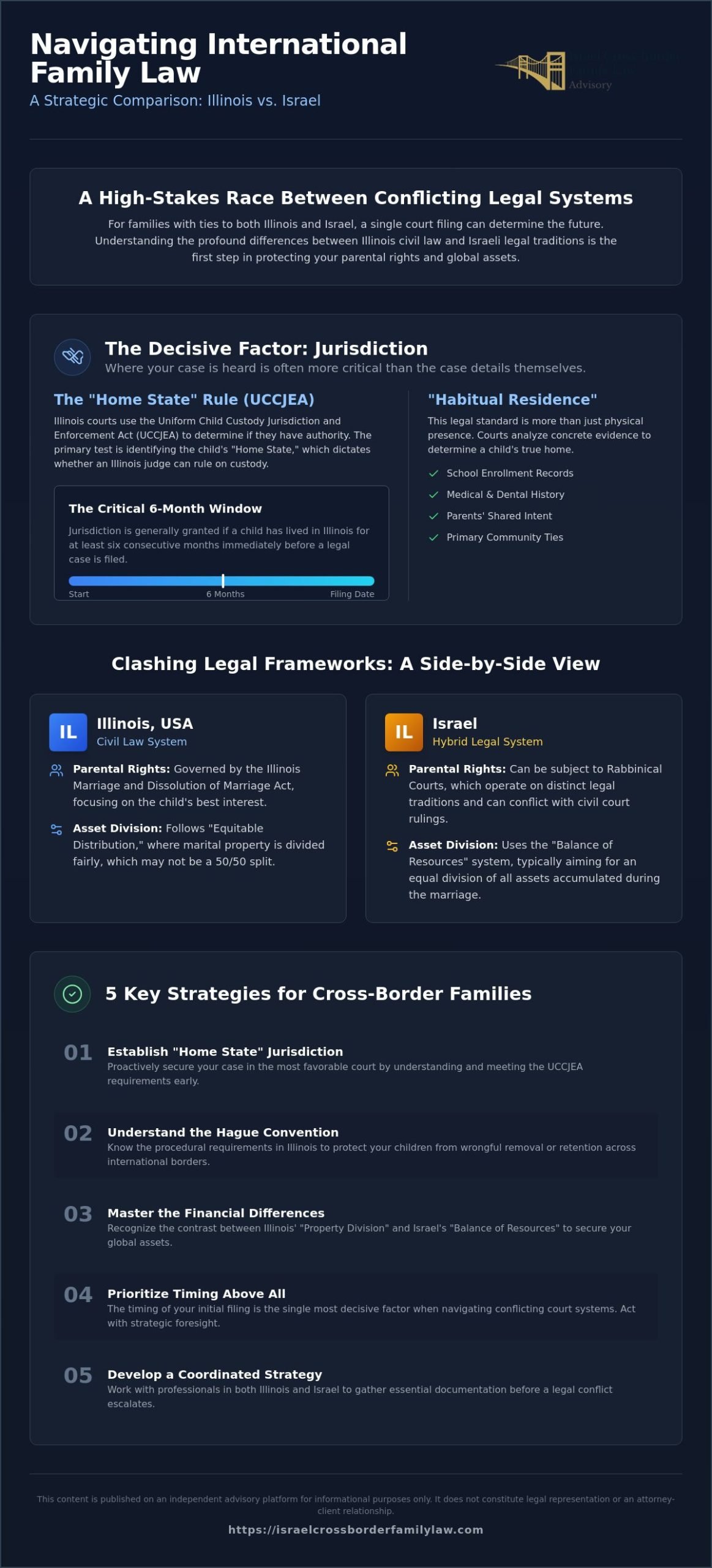
- Establish a clear understanding of “Home State” jurisdiction under the UCCJEA to ensure your case remains in the most favorable court.
- Identify the procedural requirements for the Hague Convention in Illinois to protect your children from wrongful removal across borders.
- Master the differences between Illinois property division and the Israeli “Balance of Resources” system to secure your global assets.
- Learn why the timing of your initial filing is the most decisive factor when navigating international family law illinois and conflicting court systems.
- Develop a coordinated strategy between Illinois and IL professionals to gather essential documentation before a legal conflict escalates.
Understanding International Family Law Jurisdiction in Illinois
International family law manages the legal friction that occurs when a family’s life, children, or property span more than one country. In the context of international family law illinois, this often involves reconciling the Illinois Marriage and Dissolution of Marriage Act with the unique legal traditions of IL. These cases are inherently complex because they require a deep understanding of how local courts interact with foreign jurisdictions. This content is published on an independent advisory platform, not a law firm, and is intended for informational purposes. Strategy and risk guidance provided here do not constitute an attorney-client relationship.
The primary mechanism for determining which court has the authority to make decisions about a child is the Uniform Child Custody Jurisdiction and Enforcement Act (UCCJEA). Illinois courts use this framework to identify the “Home State” of the child. Establishing this status is the most critical step in any cross-border case, as it dictates whether an Illinois judge can even hear the dispute. Without Home State jurisdiction, an Illinois court may be forced to defer to an Israeli court, even if one parent already lives in Chicago or the suburbs. This often intersects with the Hague Convention on the Civil Aspects of International Child Abduction, which focuses on returning children to their place of habitual residence.
To better understand how Illinois handles these sensitive jurisdictional shifts, watch this helpful video:
The UCCJEA and the 6-Month Rule
Under the UCCJEA, Illinois generally claims jurisdiction if a child has lived in the state for at least six consecutive months immediately before the case begins. If the family recently moved from IL, timing becomes everything. Illinois judges may exercise emergency jurisdiction if a child is present in the state and abandoned or threatened with mistreatment. However, if an Israeli court has already issued a valid custody order, Illinois courts are usually required to recognize and enforce it unless specific legal exceptions apply. Understanding international custody and relocation rules is vital before moving a child across borders.
Establishing Habitual Residence for US-Israel Families
Courts distinguish between mere physical presence and legal “habitual residence.” To determine where a child truly lives, Illinois judges look at concrete evidence like school enrollment, medical records, and the parents’ shared intent. For US-Israel families, a summer spent in IL or a year-long religious program can complicate this analysis. Habitual residence is the place where a child has a settled purpose and primary ties. If the stay in IL was intended to be temporary, Illinois may remain the child’s legal home. Decisions made early in a separation, such as where a child attends school, carry immense weight in future jurisdictional battles. Get clarity before you commit. Request a confidential consultation.
Child Custody and the Hague Convention in Illinois Courts
The Hague Convention on the Civil Aspects of International Child Abduction serves as the primary legal framework for families facing the wrongful removal or retention of a child across international borders. In the context of international family law illinois, this treaty provides a mechanism to return a child to their “habitual residence” so that the proper court can decide custody. It’s important to understand that a Hague proceeding does not determine who should have custody. Instead, it focuses on which country has the jurisdiction to make that decision. Both the United States and Israel are active signatories to this treaty, ensuring a level of mutual cooperation between their respective legal systems. This content is published on an independent advisory platform, not a law firm, and provides informational guidance rather than legal representation.
A parent can file a Hague petition in either an Illinois Circuit Court or a U.S. Federal District Court. Speed is the most critical factor in these proceedings. If a petition is filed more than one year after the child was removed, the taking parent may argue that the child is now “well-settled” in their new environment. This defense can significantly complicate the return process. Illinois courts work closely with the U.S. Department of State and the Israeli Ministry of Justice’s Central Authority to track cases and facilitate the safe return of children. In 2025, the U.S. Central Authority handled 908 active abduction cases, highlighting the ongoing necessity of these international protections. Of the 256 abducted children returned to the United States in 2025, the majority came from Hague Convention partner countries.
Preventing International Child Abduction
Proactive measures are often more effective than reactive litigation. Illinois judges can issue “Ne Exeat” orders, which legally prohibit a parent from removing a child from the jurisdiction without court permission. For US-Israel families, it’s also advisable to register Illinois custody orders with the Israeli family court system to ensure they are recognized and enforceable in IL. You can learn more about the Hague Convention and cross-border protection to better understand your options before a conflict arises. Seeking professional clarity early can prevent the weight of irreversible decisions later.
Defenses Against a Hague Return Order
While the goal of the Hague Convention is the prompt return of the child, certain defenses exist. An Illinois court may refuse a return if there is a “grave risk” that returning the child would expose them to physical or psychological harm. Another defense is “acquiescence,” where the petitioning parent is shown to have originally agreed to the child’s relocation. Additionally, if a child has reached an appropriate age and maturity, Illinois judges may consider the child’s own objection to returning to Israel. These determinations are highly fact-specific and require careful strategic planning. If you are concerned about your family’s safety or jurisdictional rights, it may be helpful to request a confidential case review.
Asset Division and Financial Support Across Borders
Financial ties spanning two continents add significant layers of complexity to international family law illinois. While Illinois operates under the principle of “Equitable Distribution,” Israeli courts generally apply the “Balance of Resources” (Izhun Mashabim) system. In Illinois, an equitable division doesn’t strictly mean a 50/50 split. Judges evaluate the length of the marriage, the economic circumstances of each spouse, and their respective contributions to the marital estate. Conversely, IL law typically mandates an equal division of the value of assets accumulated during the marriage. This content is published on an independent advisory platform and is for informational purposes only; it doesn’t constitute legal representation or formal legal advice.
Valuing assets located in IL often presents a challenge for Illinois courts. For example, a spouse’s equity in a Tel Aviv tech startup or complex stock options requires specialized valuation to meet Illinois evidentiary standards. Israeli real estate also requires careful appraisal, as market trends in IL differ greatly from those in the Chicago area. Illinois law generally classifies property acquired before the marriage or through inheritance as “non-marital,” even if those assets are located abroad. If non-marital assets were commingled with marital funds, they may lose their protected status and become subject to division by an Illinois judge.
International Asset Discovery and Transparency
Achieving financial transparency in cross-border cases requires a proactive strategy. Forensic accountants are frequently used to trace funds between U.S. and Israeli accounts or to identify interests in foreign business entities. When a spouse is uncooperative, parties may utilize the Hague Evidence Convention. This treaty allows Illinois courts to request bank records or testimony directly from authorities in IL. Properly managing these financial disclosures is a prerequisite for successful child support cross-border enforcement, as Israeli authorities require specific documentation to recognize and enforce Illinois support orders.
Spousal Maintenance and International Income
When calculating spousal maintenance, Illinois courts apply statutory guidelines to a parent’s global income, including earnings paid in New Shekels. This requires careful attention to currency conversion rates and potential volatility. The US-Israel Tax Treaty significantly impacts how divorce settlements are structured. This treaty helps prevent double taxation on transferred assets and dictates how support payments are treated by both the IRS and Israeli tax authorities. Understanding these tax implications is essential to ensure that a settlement remains financially viable in both jurisdictions. Get clarity before you commit. Request a confidential consultation.
The Conflict of Laws: Illinois Courts vs. Israeli Rabbinical Courts
One of the most complex challenges in international family law illinois is the potential for a “Race to the Court,” known in IL as Merotz Samchuyot. In the Israeli legal system, the first spouse to file for divorce can determine whether the case is heard in a civil Family Court or a religious Rabbinical Court. If a spouse files a “divorce bundle” in the Rabbinical Court, that religious body may claim exclusive jurisdiction over all related matters, including child custody and asset division. Filing first in an Illinois civil court is often a critical strategy to prevent a religious court from taking control of your secular legal rights. This content is published on an independent advisory platform, not a law firm, and provides informational guidance rather than legal representation.
Early decisions in these cases carry immense weight. A preliminary hearing or an initial order in one country can effectively lock out the courts of the other country. For Jewish families, the “Get” or religious divorce document presents an additional hurdle. While an Illinois judge can grant a civil divorce, they don’t have the authority to compel the delivery of a Get. Understanding how these systems intersect is vital to protecting your future. If you are facing a jurisdictional dispute, you should speak with a cross-border advisor to coordinate your strategy.
Parallel Proceedings and Comity
When legal actions are active in both Illinois and IL at the same time, courts look to the principle of “Comity.” This is the practice of one jurisdiction recognizing the legal acts of another. Illinois judges aren’t automatically bound by Israeli rulings. They will typically only respect an Israeli order if it doesn’t violate Illinois public policy and if both parties received fair notice. Strategic forum selection often involves motions to stay or dismiss one case to ensure the most appropriate court handles the dispute. This prevents conflicting orders that neither country can easily enforce.
Prenuptial Agreements in a Cross-Border Context
Illinois courts generally respect prenuptial agreements signed in IL, but only if they meet specific standards. The most important requirement under Illinois law is “full and fair disclosure.” This means both spouses must have had a complete view of each other’s assets and debts before signing. If an Israeli financial agreement was signed without this level of transparency, an Illinois judge may refuse to enforce it. Validating your agreement in both jurisdictions is essential for long-term security. It’s better to address these differences before a conflict arises to avoid the inherent complexity of cross-border litigation.
Strategic Guidance for International Families in Illinois
Managing a household or a separation across continents requires a unified strategy that transcends local borders. In the context of international family law illinois, success often depends on how well your Illinois legal team communicates with experts who understand the nuances of the Israeli system. This content is published on an independent advisory platform and is intended for informational and strategic purposes. It doesn’t constitute legal representation or an attorney-client relationship. Instead, it provides a roadmap for families who need to understand the weight of their decisions before they become irreversible.
Building Your Cross-Border Advisory Team
A common mistake is hiring an Illinois attorney who has no experience with the “Race to the Court” in IL, or vice versa. You need a team that understands the cultural and legal friction between the two systems. While an Illinois attorney handles the filings in the Circuit Court, an independent advisor helps you see the “big picture” of how those filings might trigger a response in an Israeli religious court. Understanding how the advisory process works for international families can help you stay ahead of potential jurisdictional conflicts.
Practical Preparation Checklist
Before any legal conflict escalates, gathering documentation is your most effective defense. Having these items ready allows your team to move quickly if an emergency jurisdictional issue arises. Consider the following steps:
- Secure identifying documents: Ensure you have original passports and birth certificates for all children. If a child has dual citizenship, keep both sets of documents in a secure, accessible location.
- Compile a global asset list: Document all financial interests, including Illinois-based 401(k)s, Israeli pensions (Keren Hishtalmut), and social security entitlements in both countries.
- Verify residency history: Keep records of school enrollment and medical visits to establish “habitual residence” as discussed in previous sections.
For families who prefer a lower-conflict path, international mediation is a viable alternative. This process allows parents to reach a customized agreement that respects the laws of both Illinois and IL without the aggression of a contested trial. This method is particularly useful for families who want to avoid the “all-or-nothing” approach often found in litigation. Regardless of the path you choose, seeking a confidential case review can help you understand your current standing. Get clarity before you commit. Request a confidential consultation.
Securing Your Family’s Future Across Borders
Success in cross-border matters requires looking beyond the immediate conflict to the long-term jurisdictional consequences. You’ve learned that establishing Home State status and understanding the timing of the Israeli “Race to the Court” are the most decisive factors in protecting your parental rights and financial interests. This independent advisory platform provides a specialized focus on US-Israel cross-border strategy, helping the Anglo-expat community navigate the inherent complexity of these two distinct legal systems. Our guidance is informational and doesn’t constitute legal representation; legal services are only provided by licensed attorneys under a separate engagement.
Mastering the intersection of international family law illinois and the legal traditions of IL ensures that your assets are protected and your custody orders remain enforceable. We bring deep experience with the Hague Convention and UCCJEA complexities to help you build a steady, knowledgeable roadmap. Early clarity is your strongest asset when facing a multi-jurisdictional dispute. Get clarity before you commit. Request a confidential consultation.
You don’t have to navigate these challenges alone. Taking the right steps now provides the security and peace of mind your family deserves.
Frequently Asked Questions
Can an Illinois court order my child to be returned from Israel?
Yes, an Illinois court can order a child’s return if it determines that Illinois is the child’s habitual residence and the removal to IL was wrongful. This process typically occurs under the framework of the Hague Convention. However, the physical return of the child requires the cooperation of the Israeli Central Authority and law enforcement to enforce the Illinois order within Israeli borders.
What is the role of the Hague Convention in an Illinois custody case?
The Hague Convention acts as a procedural mechanism to return a child to their home country so that the proper court can decide custody. In an international family law illinois case, the treaty doesn’t settle who is the better parent. Instead, it ensures that children aren’t unilaterally moved to IL to gain a tactical advantage in a foreign court system.
How do I enforce a child support order if the other parent moves to Israel?
You can enforce an Illinois child support order in IL through reciprocal international agreements managed by the Israeli Ministry of Justice. You must submit certified copies of your Illinois order and proof of the debt to the Israeli authorities. Once recognized, the order can be enforced in IL through wage garnishment or other collection methods similar to those used in the United States.
Which country’s laws will govern our asset division?
The laws governing your assets depend on where the divorce is finalized and the nature of the property. Illinois courts apply equitable distribution to marital property, while IL courts use the Balance of Resources system. If you have significant tech equity or real estate in IL, the court that first establishes jurisdiction will likely dictate how those global assets are valued and split.
Do I need a lawyer in both Illinois and Israel?
Yes, maintaining qualified legal counsel in both jurisdictions is almost always necessary for US-Israel families. An Illinois lawyer cannot represent you in an Israeli family court, and an Israeli practitioner cannot file motions in Illinois. A coordinated strategy between both sets of attorneys is essential to prevent conflicting rulings and ensure your rights are protected in both legal systems.
What happens if my spouse files for divorce in an Israeli Rabbinical court first?
If your spouse files a “divorce bundle” in an Israeli Rabbinical court first, that religious body may claim authority over your property and custody rights. This “Race to the Court” can strip an Illinois judge of the power to decide your case. You must act quickly to establish jurisdiction in Illinois to protect your secular legal interests and challenge the religious court’s reach.
Is an Israeli financial agreement enforceable in Illinois?
An Israeli financial agreement is generally enforceable in Illinois if it meets the state’s requirements for transparency and fairness. Illinois judges look for evidence that both parties provided full financial disclosure and signed the document without domestic pressure. If the agreement was signed in IL without these safeguards, an Illinois court might find it invalid under the Illinois Marriage and Dissolution of Marriage Act.
How long does an international custody case typically take in Illinois?
The duration of an international family law illinois case varies significantly based on the level of conflict and the specific legal issues involved. While Hague Convention petitions are intended to be resolved within six weeks, complex cases involving evidence from IL often take six months to two years. Factors such as asset discovery and the need for expert testimony regarding Israeli law can further extend the timeline.

Article by
Gabriel Lior
A Personal Journey That Became a Mission
The advisory was founded by an American father Gabriel Lior, LLB, MBA , global entrepreneur, and cross-border advisor who spent more than a decade navigating the Israeli family court system firsthand and now lives in Singapore with his son.
As a divorced parent in a cross-border family, Gabriel faced nearly every legal challenge a foreign parent can encounter in Israel — including child custody disputes, child support proceedings, property matters in Israel and abroad, false accusations, and complex immigration and relocation proceedings.
Over the years, he learned the hard way how difficult it is for non-Israeli parents to understand the system, identify the right legal strategy, and choose the right legal representation — especially when language, culture, and jurisdictional differences are involved. He also witnessed how foreign parents and new immigrants are often disadvantaged or taken advantage of by service providers and institutions simply because they lack local knowledge or fluency.
From Client to Advisor
To truly understand — and survive — the system, Gabriel pursued formal legal education in Israel, completing two Israeli law degrees, alongside a BA and MBA earned in the United States. This was never about becoming a practicing attorney, but about gaining a deep, structural understanding of how the system works — and where it breaks down for foreign parents.
This rare combination of:
Firsthand client experience
Israeli legal and US business education
International business and negotiation training
Decades of commercial execution
created a unique perspective – one that understands both sides of the table.
After years of litigation, persistence, and at times self-representation, he ultimately succeeded in securing custody of his son and relocating abroad through a rare legal victory in the Israeli Supreme Court — becoming one of the first fathers in Israel to do so under these circumstances.
Disclaimer
Important Disclaimer:
The information provided on this website and in its content is for general informational and educational purposes only and does not constitute legal advice, legal opinion, or legal representation.
Gabriel Lior is not licensed to practice law in Israel (nor is he interested in doing so) and does not provide legal services, despite having completed 2 Law Degrees. The services offered are advisory in nature and are intended to provide general guidance, strategic insight, and information regarding cross-border family law considerations.
No attorney-client relationship is formed by accessing this website, reading its content, or communicating with us.
Any decisions made based on this information are at your own discretion and risk. For legal advice specific to your situation, you should consult a licensed attorney in the relevant jurisdiction.
Where appropriate, we may refer clients to independent, licensed attorneys or professionals. Such referrals do not constitute legal representation and no liability is assumed for services provided by third parties.