For an Israeli parent, the prospect of navigating the complex American legal system to claim what is rightfully owed to your child can feel overwhelming. The distance alone presents a formidable challenge, compounded by concerns over the validity of an Israeli court order, the potential for prohibitive costs, and the fear of a co-parent hiding their location or income. Yet, the process of securing child support from a parent in the US is a well-established, multi-jurisdictional legal pathway designed to protect your child’s rights across international borders.
This comprehensive guide is engineered to demystify this complex process. We provide authoritative guidance on the critical steps required, from validating your Israeli judgment in American courts to leveraging powerful international treaties and state-level enforcement agencies. By reading, you will gain a clear understanding of your legal options, feel confident in the enforceability of your rights, and be equipped to obtain the consistent financial support your child deserves, ensuring their well-being is protected regardless of geography.
Key Takeaways
- Understand the international legal frameworks, such as the Hague Convention, that make cross-border child support enforcement between Israel and the United States possible.
- A legally recognized child support order from an Israeli court is the foundational prerequisite for initiating enforcement actions within the U.S. legal system.
- Learn the specific steps involved in securing child support from a parent in the us, including how your case is transmitted to and managed by a designated state-level agency.
- Navigating common challenges like jurisdictional complexities often requires specialized legal counsel to protect your rights and achieve a successful outcome.
The Legal Foundation: How International Treaties Make Enforcement Possible
When a parent resides in the United States, an Israeli parent may feel that their legal options are limited. However, a sophisticated international legal framework exists specifically to address this multi-jurisdictional challenge. The core principle underpinning this system is that a child’s fundamental right to financial support transcends national borders. The United States and Israel maintain a cooperative agreement, ensuring that parents in Israel have clear and established legal recourse for securing child support from a parent in the us.
For a high-level overview of how these international systems function, the following video provides valuable context:
The Hague Convention on the International Recovery of Child Support
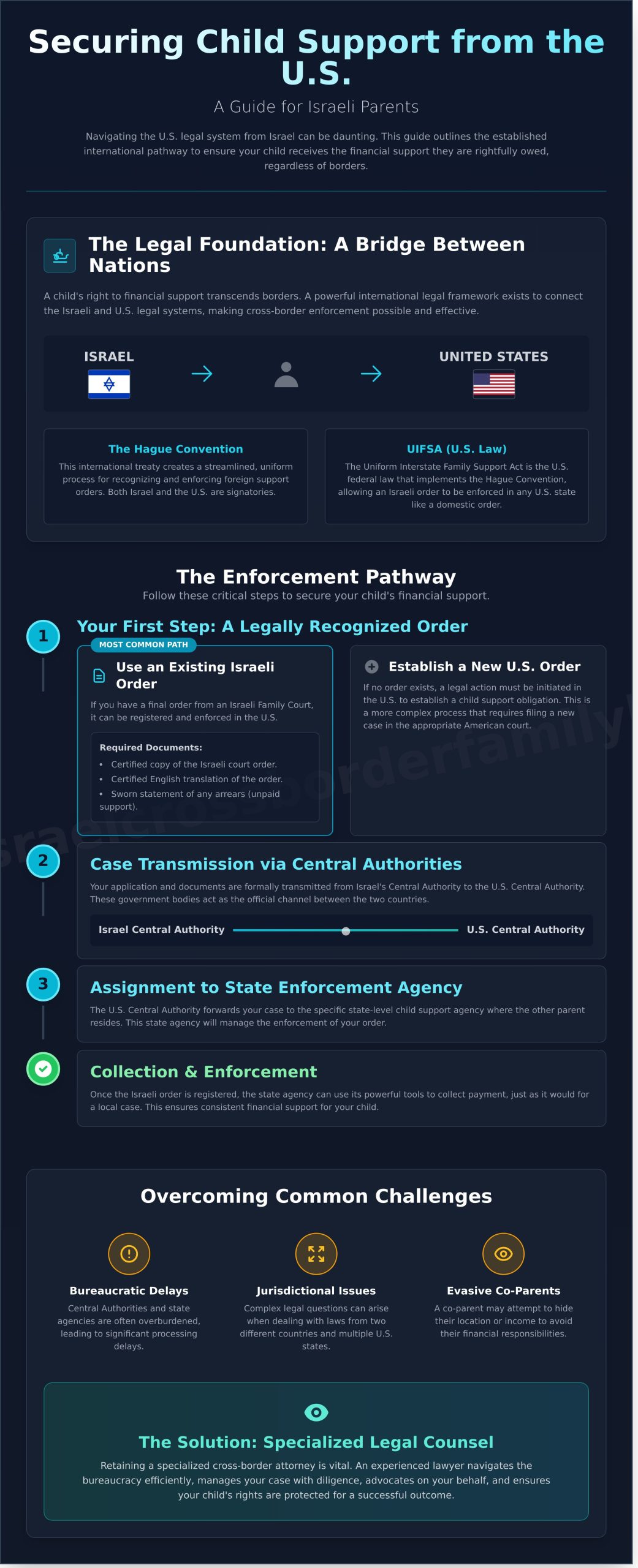
The cornerstone of this global cooperation is the Hague Convention on the International Recovery of Child Support and Other Forms of Family Maintenance. As signatories, both the United States and Israel are bound by its terms. The primary purpose of the Hague Child Support Convention is to establish a streamlined and uniform process for the recognition and enforcement of foreign support orders, significantly simplifying what was once a prohibitively complex legal endeavor.
Understanding UIFSA: The US Domestic Framework
Within the United States, the Uniform Interstate Family Support Act (UIFSA) is the domestic legal mechanism that gives effect to the Hague Convention. This federal law governs how child support orders are handled between US states and, crucially, with other signatory countries like Israel. Under UIFSA, a valid Israeli child support order can be registered and enforced in any US state as if it were a domestic order, providing a powerful and practical tool for collection.
The Role of Central Authorities in Israel and the US
To facilitate this process, both Israel and the United States have designated a “Central Authority”-a specific government agency tasked with managing these international cases. These authorities act as the official channel for transmitting applications, legal documents, and communications between the two countries. While they are an essential part of the framework, these agencies are often overburdened with high caseloads, which can lead to significant delays. Therefore, retaining experienced legal counsel is vital to navigate the bureaucracy efficiently and ensure your case is managed with the necessary diligence and expediency.
Your First Steps: Establishing or Registering a Child Support Order
The foundation for securing child support from a parent in the US is a legally recognized and enforceable court order. Without this official decree, any financial support is merely voluntary and cannot be compelled through state or federal mechanisms. The initial strategy, therefore, depends entirely on whether a valid order already exists from an Israeli court or if one must be established from scratch within the American legal system. In either scenario, the precision and completeness of all documentation are paramount to navigating this complex, cross-border process successfully.
Option 1: Using an Existing Israeli Child Support Order
For individuals who have already been through legal proceedings in Israel, the most direct path is to utilize a final order issued by an Israeli Family Court. This existing order is not automatically enforceable in the United States; it must first be formally ‘registered’ with the appropriate state authority. This process is made possible by international agreements, principally The Hague Convention on Child Support, which streamlines recognition across borders. This is the most common and efficient approach for post-judgment matters arising from divorce and separation cases. Key documents include a certified copy of the order, a certified English translation, and a sworn statement of any arrears.
Option 2: Establishing a New Order in the United States
In circumstances where no Israeli child support order exists-for instance, if the parents were never married or did not litigate the matter in Israel-it is necessary to initiate a new case. A petition must be filed directly in the US state where the non-paying parent resides. This legal action requires not only proving the parent-child relationship, which may involve establishing paternity, but also presenting comprehensive financial information for both parties to determine the appropriate support amount under that state’s specific guidelines. This is an inherently more complex undertaking that demands significant legal guidance to navigate the multi-jurisdictional challenges.
Gathering Essential Documentation
Thorough preparation is critical to the success of securing child support from a parent in the US. Before initiating any legal action, you must compile a comprehensive dossier of evidence. While specific requirements may vary slightly by state, the core documentation universally includes:
- Personal Identification: Certified copies of the child’s birth certificate, your marriage certificate, and any final divorce decrees. Proof of paternity, if applicable, is essential.
- Financial Records: Detailed documentation of your income and expenses, alongside any known information about the other parent’s employment, income, and assets.
- Location Information: The US-based parent’s last known address, employer, and social security number are crucial for locating them and enforcing the order.
- Certified Translations: All documents originally in Hebrew must be accompanied by a certified English translation from a qualified professional.
The US Enforcement Process: What Happens Next?
Once your application is transmitted to the United States, it enters a structured and powerful federal-state enforcement system. This phase moves beyond initial paperwork into active case management within the American legal framework. Understanding this process is paramount for setting realistic expectations and for successfully securing child support from a parent in the us. Your case will be assigned to a dedicated government agency equipped with significant legal authority to compel payment.
The Role of State Child Support Enforcement Agencies
The U.S. operates a cooperative network overseen by the federal Office of Child Support Enforcement (OCSE). Your case will be managed by the specific child support agency in the state where the paying parent resides. These agencies are mandated to locate the non-custodial parent and their assets, utilizing sophisticated national databases like the Federal Parent Locator Service. Their primary objective is to formally establish a U.S.-enforceable support order and ensure its rigorous and ongoing enforcement.
Powerful Enforcement Methods Available in the US
State agencies possess a robust legal arsenal to enforce child support obligations, ensuring compliance through a variety of compelling measures. The most effective and common tool is an income withholding order, also known as wage garnishment, which is sent directly to the parent’s employer for automatic deduction. Other significant enforcement actions include:
- Interception of federal and state income tax refunds to satisfy past-due support.
- Seizure of funds directly from bank accounts or other financial assets.
- Placement of liens on real estate and personal property, such as vehicles.
- Suspension of driver’s licenses, professional licenses (e.g., medical, legal), and recreational licenses.
- Denial, revocation, or restriction of a U.S. passport for significant arrears.
Timelines and Communication
Navigating this multi-jurisdictional process requires patience. Timelines can vary significantly, often ranging from several months to over a year, depending on factors such as the state agency’s caseload, the complexity of the case, and the other parent’s cooperation. Proactive communication is key, but direct contact with busy state caseworkers can be challenging.
Engaging legal counsel with cross-border experience can be instrumental in facilitating communication and expediting the process of securing child support from a parent in the us. An attorney acts as your dedicated advocate, interfacing directly with the U.S. agency to monitor progress, resolve issues, and ensure your case receives the priority it deserves.
Common Challenges in Cross-Border Cases and How to Overcome Them
The multi-jurisdictional complexities of enforcing a child support order in the United States can be formidable. Parents often face anxieties regarding the location of the other parent, their financial transparency, and potential legal disputes. However, these challenges are not insurmountable; they are common obstacles for which the U.S. legal system, in concert with international agreements, has developed sophisticated and effective remedies. Understanding these potential hurdles is the first step toward overcoming them.
Challenge: The Other Parent Cannot Be Located
A common initial hurdle is locating the non-paying parent within the United States. Fortunately, U.S. child support agencies possess powerful investigative tools. The Federal Parent Locator Service (FPLS), for instance, can access data from federal and state agencies to find an individual. To maximize its effectiveness, you should provide all known details, including their Social Security Number, last known address, and former employer. Experienced private counsel can also engage investigative services to supplement these official efforts.
Challenge: The Parent Claims They Have No Income or Hides Assets
Another frequent tactic is the claim of having no income or the deliberate concealment of assets. U.S. courts are well-equipped to address these maneuvers. A judge can “impute” income, setting a support amount based on the parent’s earning capacity, education, and work history, rather than their claimed income. Furthermore, legal counsel can subpoena financial records, tax returns, and bank statements to uncover hidden assets or track the true income of self-employed individuals. These are standard procedures in both domestic and cross-border enforcement.
Challenge: The Parent Disputes Paternity or the Order Itself
Disputes over paternity or the validity of the original Israeli child support order represent another potential challenge. If paternity has not been legally established, U.S. courts can compel DNA testing to resolve the matter conclusively. Crucially, under the Uniform Interstate Family Support Act (UIFSA), a valid foreign order registered in the U.S. cannot be easily challenged on its merits. The grounds for contesting the order are extremely limited, focusing on procedural issues, not the determined amount of support. Learn more about the specifics of cross-border enforcement strategies to understand these protections.
Successfully navigating these obstacles is central to the process of securing child support from a parent in the US. Each case presents a unique set of facts requiring a strategic approach. Engaging with legal professionals who possess deep experience in U.S.-Israel cross-border family law is essential for effectively enforcing your rights and securing your child’s financial future. For a comprehensive evaluation of your case, we invite you to contact our firm.
Why You Need a Specialized Cross-Border Attorney
Understanding the procedural steps is the foundation, but successfully executing them is a far more complex challenge. While government channels exist to facilitate international child support cases, their role is administrative, not adversarial. They process paperwork between countries but do not act as your personal legal advocate. To transition from process to results, and to ensure your child’s rights are fully protected, engaging a specialized cross-border attorney is not a luxury-it is a strategic investment in your child’s future.
Navigating Two Complex Legal Systems
The path to securing child support from a parent in the US requires navigating the distinct legal frameworks of both Israel and the specific US state where the parent resides. An attorney with multi-jurisdictional expertise ensures that your Israeli court orders are correctly domesticated and that all filings comply with US procedural rules. This prevents common and costly mistakes that can lead to significant delays or even outright dismissal of your case. Our structured approach is designed to manage these complexities efficiently. You can see a breakdown of how our advisory process works.
Accelerating the Process and Maximizing Support
A specialized attorney acts as a powerful catalyst. We can advocate directly with US child support enforcement agencies, file motions to compel action if a case stalls, and aggressively pursue all avenues for enforcement. A critical component of our representation is ensuring the support obligation is calculated correctly under applicable US state guidelines, which often differ substantially from Israeli standards. Furthermore, we are skilled in negotiating settlements for arrears (past-due support), working to recover the full amount your child is owed.
Your Advocate and Partner in a Difficult Time
You do not have to face this intricate and often emotional process alone. Retaining legal counsel provides you with a dedicated representative to handle all communications, manage deadlines, and shield you from the stress of direct interaction with the other parent or opposing counsel. We provide strategic advice tailored to the unique facts of your situation, guiding you at every turn. Let us be your partner in securing your child’s financial well-being. Take the first step by requesting a confidential case review.
Your Path Forward in Cross-Border Child Support Enforcement
As we have outlined, the framework established by international treaties provides a clear legal pathway for enforcing child support orders across borders. However, navigating the complexities of the US legal system from Israel presents significant challenges that demand specialized knowledge. Successfully securing child support from a parent in the us requires more than an understanding of statutes; it demands a legal partner with proven, dual-jurisdictional expertise.
Our firm serves as that critical bridge between the Israeli and American legal systems. With a proven track record in complex international enforcement cases and deep expertise in both Israeli and US family law, we provide dedicated guidance for expats and foreign nationals facing these sophisticated matters. To protect your child’s rights and financial future, we invite you to schedule a confidential consultation with our legal team.
With the right strategic counsel, a positive resolution is within reach. Let us help you achieve the stability and security your child deserves.
Frequently Asked Questions
Do I need to travel to the United States to enforce a child support order?
In most circumstances, physical travel to the United States is not a prerequisite for enforcing a valid child support order. International legal frameworks, including the Hague Convention and the US Uniform Interstate Family Support Act (UIFSA), facilitate cross-border enforcement. Experienced legal counsel can represent your interests and navigate the multi-jurisdictional process on your behalf, liaising with US state agencies to ensure the order is properly registered and enforced without requiring your presence.
How long does the international child support enforcement process typically take?
The timeline for international child support enforcement is highly variable and contingent upon numerous factors. These include the specific US state’s processing times, the complexity of the case, and the level of cooperation from the paying parent. While some cases may see progress within six to twelve months, more complex or contested matters can extend beyond this timeframe. Our role is to expedite this process by ensuring all documentation is meticulously prepared and filed correctly from the outset.
What are the estimated costs of hiring a lawyer for a cross-border child support case?
The legal costs for a cross-border child support case are tailored to the specific complexities of each matter. Initial consultation and case evaluation fees may range from ₪1,500 to ₪5,000. For comprehensive representation in a sophisticated international case, legal fees can vary significantly, often starting from ₪20,000 and increasing based on factors such as the need for litigation or extensive asset tracing. We provide a transparent fee structure based on a bespoke strategic plan for your case.
What happens if the other parent moves to a different state within the US?
The United States has a robust legal framework, the Uniform Interstate Family Support Act (UIFSA), designed for precisely this scenario. If the paying parent relocates to a different state, the original child support order can be registered and enforced in the new state of residence. This ensures continuity of payments and prevents evasion of responsibilities. The process of securing child support from a parent in the US continues seamlessly, adapting to their new jurisdiction without needing a new order.
Can I claim child support for past years that were not paid (arrears)?
Absolutely. Unpaid child support from previous years, known as arrears, is legally considered a debt and is fully collectible in the United States. There are strong enforcement mechanisms to recover these past-due amounts. Depending on the state that issued the original order, statutory interest may also be applied to the outstanding balance, significantly increasing the total amount owed. Our legal team can assist in calculating and pursuing these complex retroactive claims on your behalf.
Does it matter if the other parent and I were never married?
No, the parents’ marital status is not a determining factor when securing child support from a parent in the US. The legal obligation is tied to parentage, not marriage. Once legal paternity is established, either voluntarily or through court-ordered testing, both parents have a financial responsibility to the child. This is a fundamental principle of US family law, ensuring the child’s right to support is protected, independent of the parents’ relationship history.
Can a US child support order be modified if my or the other parent’s circumstances change?
Yes, a US child support order can be modified, but it requires a formal legal process. A modification is typically granted only upon demonstrating a “substantial and material change in circumstances” for either parent. This could include a significant increase or involuntary decrease in income, a change in the child’s needs, or a shift in custody arrangements. The request for modification must be filed with and approved by the US court that holds jurisdiction over the original order.

Article by
Gabriel Lior
A Personal Journey That Became a Mission
The advisory was founded by an American father Gabriel Lior, LLB, MBA , global entrepreneur, and cross-border advisor who spent more than a decade navigating the Israeli family court system firsthand and now lives in Singapore with his son.
As a divorced parent in a cross-border family, Gabriel faced nearly every legal challenge a foreign parent can encounter in Israel — including child custody disputes, child support proceedings, property matters in Israel and abroad, false accusations, and complex immigration and relocation proceedings.
Over the years, he learned the hard way how difficult it is for non-Israeli parents to understand the system, identify the right legal strategy, and choose the right legal representation — especially when language, culture, and jurisdictional differences are involved. He also witnessed how foreign parents and new immigrants are often disadvantaged or taken advantage of by service providers and institutions simply because they lack local knowledge or fluency.
From Client to Advisor
To truly understand — and survive — the system, Gabriel pursued formal legal education in Israel, completing two Israeli law degrees, alongside a BA and MBA earned in the United States. This was never about becoming a practicing attorney, but about gaining a deep, structural understanding of how the system works — and where it breaks down for foreign parents.
This rare combination of:
Firsthand client experience
Israeli legal and US business education
International business and negotiation training
Decades of commercial execution
created a unique perspective – one that understands both sides of the table.
After years of litigation, persistence, and at times self-representation, he ultimately succeeded in securing custody of his son and relocating abroad through a rare legal victory in the Israeli Supreme Court — becoming one of the first fathers in Israel to do so under these circumstances.
Disclaimer
Important Disclaimer:
The information provided on this website and in its content is for general informational and educational purposes only and does not constitute legal advice, legal opinion, or legal representation.
Gabriel Lior is not licensed to practice law in Israel (nor is he interested in doing so) and does not provide legal services, despite having completed 2 Law Degrees. The services offered are advisory in nature and are intended to provide general guidance, strategic insight, and information regarding cross-border family law considerations.
No attorney-client relationship is formed by accessing this website, reading its content, or communicating with us.
Any decisions made based on this information are at your own discretion and risk. For legal advice specific to your situation, you should consult a licensed attorney in the relevant jurisdiction.
Where appropriate, we may refer clients to independent, licensed attorneys or professionals. Such referrals do not constitute legal representation and no liability is assumed for services provided by third parties.