This article is published on an independent advisory platform and does not constitute legal representation or legal advice. Legal services are only provided by licensed attorneys under a separate engagement.
The most dangerous mistake in a cross-border dispute isn’t failing to find the law; it’s assuming that a US precedent carries the same weight once it reaches an Israeli courtroom. You’re likely feeling overwhelmed by technical jargon and the conflicting signals from two different legal systems. It’s common to feel a sense of urgency, especially when you’re worried that outdated information might lead to a strategic error. Looking up case law for international family law is a necessary first step, but the real challenge lies in understanding how these rulings interact across borders.
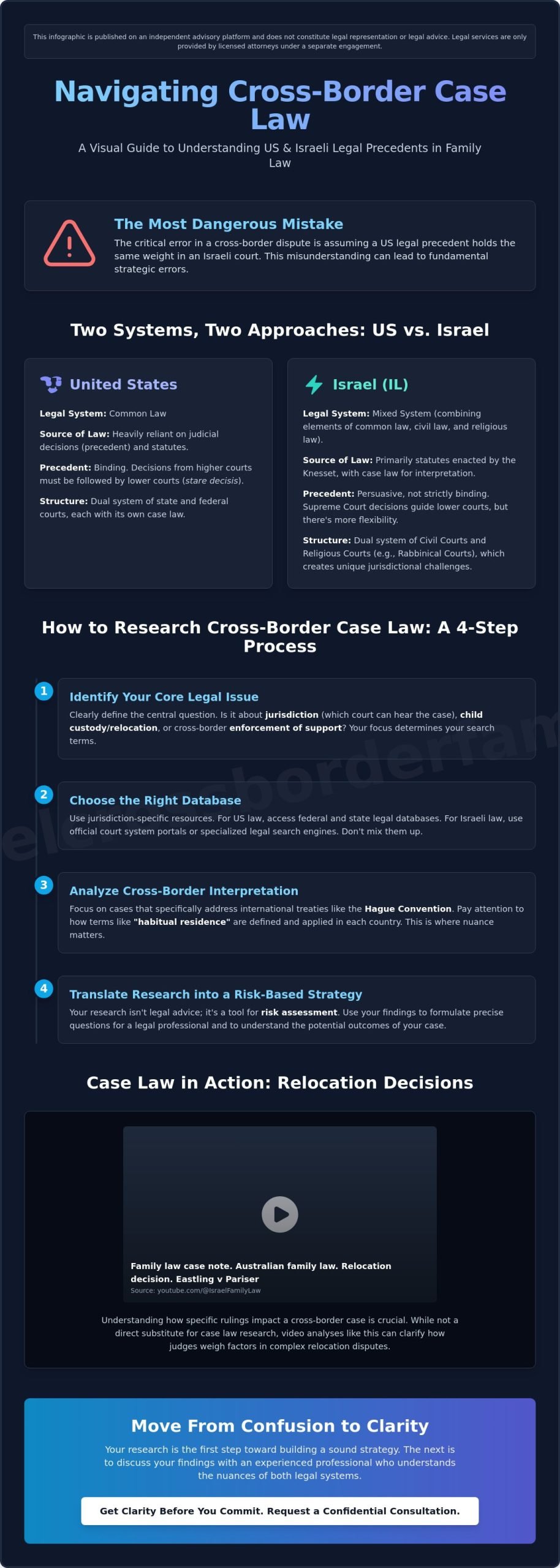
In this guide, you’ll learn how to find and interpret the specific legal precedents that shape family law cases between the United States and Israel. We’ll identify the most reliable databases for your search and explain how different courts value past decisions. By the end, you’ll have the tools to move past the confusion and begin formulating a strategy based on clear, verified risks. Get clarity before you commit. Request a confidential consultation.
Key Takeaways
- Understand how past judicial decisions clarify the application of international treaties like the Hague Convention in cross-border disputes.
- Master a systematic approach to looking up case law for international family law by identifying your specific legal issue and choosing the right database for US or Israeli jurisdictions.
- Recognize the fundamental differences between the US common law system and the mixed legal framework in Israel, which includes civil and religious courts.
- Avoid the common risk of misinterpreting legal precedents, ensuring that domestic state-level rulings aren’t incorrectly applied to international matters.
- Learn how to transform your research into a risk-based strategy that helps you ask the right questions when consulting a legal professional.
This article is published on an independent advisory platform and does not constitute legal representation or legal advice. Legal services are only provided by licensed attorneys under a separate engagement.
Understanding the Role of Case Law in International Family Disputes
Case law is the collection of past judicial decisions that explain how written laws apply to real-life situations. While statutes provide the basic framework, these rulings offer the nuanced interpretation needed for complex disputes. In the context of international families, these precedents help predict how a judge in Tel Aviv or New York might handle a specific conflict. Understanding these past rulings is essential while you’re managing a case that spans two different legal systems. It’s a practical way to identify potential risks before you commit to a specific legal path or sign a binding agreement.
Treaties like the Hague Convention aren’t applied in a vacuum; they’re interpreted through a vast body of International Matrimonial Law. This is why looking up case law for international family law is more than just an academic exercise. It helps you see how courts have historically balanced the rights of parents against the strict requirements of international treaties. By reviewing these decisions, you can better understand the weight of evidence needed to support your position.
To better understand how specific rulings can impact a cross-border case, watch this helpful video analysis of a relocation decision:
Why Precedent Matters for Expats in Israel
Israeli courts often examine how other Western jurisdictions handle international treaties to ensure consistency. This is particularly true when defining “habitual residence,” a term that isn’t always clearly explained in the text of the law itself. Case law fills these gaps, providing a clearer picture of how a family’s daily life might be viewed by the court. For expats in IL, knowing these past outcomes can help you prepare for the specific questions a judge might ask during a hearing. It also clarifies how the interaction between Rabbinical and Civil courts might influence your specific situation, as past rulings often set the boundaries for jurisdiction.
The Difference Between Statutes and Judicial Interpretation
You can think of statutes as the “what” and case law as the “how.” A written law in IL might look similar to one in the US, but the way it’s applied in practice can be quite different. Family law is constantly evolving, especially regarding international relocation and child support standards. Looking up case law for international family law allows you to see the most recent shifts in judicial thinking. This ensures your strategy is based on current trends rather than outdated assumptions. Understanding the “best interests of the child” standard, for example, requires looking at how judges have recently weighed factors like career opportunities against extended family connections.
Get clarity before you commit. Request a confidential consultation.
This article is published on an independent advisory platform and does not constitute legal representation or legal advice. Legal services are only provided by licensed attorneys under a separate engagement.
A Step-by-Step Guide to Looking Up Case Law for International Family Law
To begin your research effectively, you must first isolate the core legal question at the center of your dispute. Are you questioning which court has the authority to hear your case, or are you trying to enforce a support order across borders? Identifying whether the primary issue involves jurisdiction, custody, or the enforcement of financial support will determine your search parameters. Once the issue is clear, you can select the appropriate database for the relevant jurisdiction. For cases involving Hague Convention matters, you will likely need to examine both US Federal rulings and decisions from IL.
Looking up case law for international family law requires a methodical approach to filtering data. You should always prioritize cases from higher courts, as these carry the most weight in future proceedings. It is also vital to filter your results by date. Legal standards change, and a ruling from twenty years ago might no longer be considered “good law” in light of newer regulations or treaty updates. For the most accurate information, consult official court websites for recent or unreported judgments that haven’t yet reached general commercial databases.
Top Databases for US and International Precedents
Google Scholar is an excellent starting point for a broad, free search of US state and federal cases. You can select the “Case law” button to narrow your focus to judicial opinions rather than articles. For treaty-specific disputes, the Hague Conference on Private International Law maintains the INCADAT database. This is a specialized resource for international child abduction cases globally. If you need to understand how Israeli Family Courts handle these matters, official government portals often provide translated summaries of Supreme Court rulings that set the national standard for expats and international families.
Effective Search Terms for Cross-Border Families
Generic terms like “divorce” often produce too many irrelevant results. Instead, use technical phrases that judges use in their written opinions. Searching for “recognition of foreign judgment” is essential if you want to see how a US decree might be treated in IL. In cases where a child is moving between countries, searching for “mirror orders” can reveal how courts ensure rulings are enforceable in both jurisdictions. Other critical terms include “international comity,” “forum non conveniens,” and “habitual residence.” Identifying cases involving dual citizenship can also provide clarity on how courts manage competing jurisdictional claims.
Using these specific terms helps you find the most relevant examples for your situation. While this research is empowering, the interaction between these systems is complex. If you’re feeling stuck, you can request a confidential review to help clarify your next steps. Get clarity before you commit. Request a confidential consultation.
This article is published on an independent advisory platform and does not constitute legal representation or legal advice. Legal services are only provided by licensed attorneys under a separate engagement.
Navigating the Differences Between US and Israeli Precedents
The United States legal system is built on common law. This means that past court decisions, or precedents, are strictly binding on future cases through a principle called stare decisis. If you are looking up case law for international family law in a US context, you are often searching for a specific ruling that a judge must follow. Israel operates differently. It uses a mixed system that combines elements of civil law, common law, and religious law. While the Israeli Supreme Court sets nationwide standards, individual judges have a degree of flexibility that might surprise those accustomed to the American system.
In the US, family law is largely state-specific. A ruling in New York might have little impact on a case in California. In contrast, Israeli family law is national. However, an Israeli judge may choose to ignore a US precedent if it contradicts local “public policy.” This is a critical distinction for families moving between the two countries. If a US order violates fundamental Israeli legal principles, it might not be recognized through the formal process known as “Pesk-Din.” This is the specific legal mechanism required for the recognition and enforcement of foreign judgments in IL.
Common Law vs. The Israeli Mixed System
The weight of a single case differs significantly between a court in New York and one in Tel Aviv. In the US, attorneys rely heavily on “on-point” cases to dictate the outcome. In IL, while the Supreme Court provides essential guidance, the mixed system allows for a broader interpretation of statutes. This is especially true in divorce and separation matters where international elements are involved. Looking up case law for international family law in Israel requires understanding that a judge balances civil statutes with established precedents and, occasionally, religious considerations. This complexity makes it difficult to predict outcomes based solely on a single past ruling.
Civil Courts vs. Rabbinical Courts in Israel
The most unique aspect of the Israeli system is the concurrent jurisdiction of civil family courts and religious Rabbinical courts. This often creates what is known as a “race for jurisdiction,” where the court that receives the filing first may handle the entire case. Understanding the precedents that govern this race is vital for expats and international families. While civil courts strictly follow international treaties, Rabbinical courts may balance these obligations with religious principles. For example, U.S. State Department guidance on international child abduction highlights how the Hague Convention is the primary tool for these disputes. However, how a Rabbinical court interprets “habitual residence” in a Hague case can differ from a civil court’s view. These differences underscore the importance of early strategic planning.
Get clarity before you commit. Request a confidential consultation.
This article is published on an independent advisory platform and does not constitute legal representation or legal advice. Legal services are only provided by licensed attorneys under a separate engagement.
The Risks of Misinterpreting Cross-Border Legal Precedents
Self-research provides a necessary foundation, but it often creates a false sense of security. While looking up case law for international family law can help you understand general patterns, it doesn’t account for the subtle ways a court might distinguish your situation from a previous ruling. A case might look identical on the surface, but a single detail, such as the specific wording of a travel consent form or the timeline of a child’s school registration, can change the entire legal outcome. Relying on an outdated or overturned precedent can lead to strategic errors that are difficult to correct once a case is in motion.
Misapplying domestic US law to a treaty-based dispute is another common pitfall. For example, a state-level custody ruling from a court in New York has no direct authority over a Hague Convention case in IL. These are separate legal frameworks with different standards of proof and evidence. If you base your expectations on a local US case, you might be unprepared for the specific requirements of international child abduction proceedings. The interaction between these systems is complex, and a mistake in interpretation can impact your case’s trajectory for years.
Context is Everything in Family Law
The specific facts of your life determine how the law is applied. In international custody and relocation cases, judges look at the totality of circumstances. A researcher might find a case that seems favorable but miss the “Public Policy” exceptions that allow an Israeli judge to nullify a foreign order. These exceptions are often based on local cultural or religious standards that aren’t always apparent in a simple database search. What worked in one family’s dispute might fail in yours because of a minor difference in how you structured your initial move to IL.
The Need for Dual-Jurisdictional Analysis
A case must be vetted by a professional who understands the hierarchy of courts in both the US and IL. A ruling from a lower family court doesn’t carry the same weight as a Supreme Court decision. There is also a significant translation trap when reading Hebrew court summaries. Automated translations often miss legal nuances, leading to a fundamental misunderstanding of the court’s reasoning. To avoid these risks, you should request a professional review to verify the current status of any precedent you find. Ensuring your information is both current and correctly interpreted is the only way to build a reliable strategy.
Get clarity before you commit. Request a confidential consultation.
This article is published on an independent advisory platform and does not constitute legal representation or legal advice. Legal services are only provided by licensed attorneys under a separate engagement.
Moving from Research to Strategy: Your Next Steps
Researching past rulings is a vital first step, but the data you collect is only as valuable as the strategy it supports. Looking up case law for international family law provides you with the necessary vocabulary and context to engage with legal professionals more effectively. Instead of entering a meeting with general anxieties, you can arrive with specific questions about how recent trends in IL or the US apply to your household. This shift from passive searching to active preparation allows you to move away from the “winning” mindset and toward a more sustainable, risk-based decision-making process.
It is helpful to view case law as a tool for negotiation rather than just a weapon for litigation. When you understand the likely range of outcomes based on similar cross-border disputes, you can set realistic expectations for a settlement. This knowledge often prevents families from pursuing aggressive legal paths that have historically failed in similar circumstances. By aligning your specific custody or asset situation with current judicial trends, you can identify where you have leverage and where you face significant exposure. This clarity is the foundation of any successful international strategy.
Building a Cross-Border Legal Strategy
Integrating your findings into a comprehensive plan for divorce or separation requires a nuanced look at both systems simultaneously. Your research should directly inform your choice of where to file your case first. As discussed in previous sections, the “race for jurisdiction” in Israel means that early decisions often dictate which court system will handle your financial and custodial matters. Furthermore, if your case involves child support enforcement across borders, case law will reveal the practical hurdles you might face when trying to collect payments from a parent living in a different country. Understanding these mechanics early helps you avoid commitments that are legally difficult to enforce.
Seeking Professional Guidance
The role of an independent advisory is to simplify these complex international precedents and translate them into a clear roadmap. While you can conduct significant research on your own, an advisory platform helps you filter out irrelevant data and focus on the rulings that carry the most weight for your specific situation. Early strategy sessions are designed to save you time and emotional energy by highlighting the most efficient path forward. These sessions ground your abstract research in the reality of the Israeli legal environment. Get clarity before you commit. Request a confidential consultation.
This article is published on an independent advisory platform and does not constitute legal representation or legal advice. Legal services are only provided by licensed attorneys under a separate engagement.
Strategic Clarity for Your Cross-Border Future
Managing a legal dispute between the United States and Israel is a significant challenge for any international family. While looking up case law for international family law provides a necessary foundation, the real value lies in how you apply those findings to your specific circumstances. You’ve seen that the weight of a precedent can shift dramatically depending on which court hears your case and how local public policy is interpreted. Early research allows you to identify these risks before they become legal obstacles, ensuring your decisions are based on data rather than assumptions.
Our advisory platform specializes in US-Israel disputes, providing strategic guidance from experienced cross-border practitioners. We focus on delivering plain English explanations so you can understand these complexities without being overwhelmed by technical jargon. By moving from general research to a tailored, risk-based strategy, you protect your family’s interests and your own peace of mind. Get clarity before you commit. Request a confidential consultation today to begin building a path forward that reflects your unique goals.
This article is published on an independent advisory platform and does not constitute legal representation or legal advice. Legal services are only provided by licensed attorneys under a separate engagement.
Frequently Asked Questions
Can I use a US court case as evidence in an Israeli family court?
Israeli judges can consider US rulings as persuasive evidence, particularly in cases involving international treaties or common legal principles. However, a US case is not binding on an Israeli court. It’s often used to demonstrate how other Western jurisdictions handle similar complexities. You’ll need to show why the US reasoning aligns with Israeli public policy to make it effective during a hearing.
Where can I find English translations of Israeli family law cases?
You can find English summaries of landmark Israeli Supreme Court rulings on the official judiciary website and the gov.il portal. These summaries are specifically prepared for the international community and legal scholars. While not every lower court case is translated, major precedents that affect expats and international families are often available in English to ensure legal transparency across borders.
What is the best free database for international family law research?
Google Scholar is the most accessible free database for searching US state and federal rulings. For treaty-specific matters, the INCADAT database managed by the Hague Conference is the gold standard. When you are looking up case law for international family law, these two resources provide a comprehensive starting point for understanding global trends without requiring a paid subscription.
How do I know if a legal precedent is still valid in Israel?
Validity is determined by the court’s hierarchy and the date of the ruling. A decision from the Israeli Supreme Court remains the national standard unless a newer Supreme Court ruling changes that interpretation. You should check if a case has been “distinguished” or “overruled” in more recent years. This is why looking up case law for international family law requires checking the most current filings on official government databases.
Does the Hague Convention provide its own set of case law?
The Hague Convention is a treaty, but its application is clarified by a global body of decisions known as the Hague case law. The INCADAT database acts as a central library for these rulings. It shows how different nations, including IL and the US, interpret terms like “rights of custody” or “grave risk of harm.” This helps create a more consistent international standard for families in crisis.
What happens if US and Israeli case law contradict each other in my divorce?
If case laws contradict, the court where the case is actively being heard will apply its own domestic rules and precedents. An Israeli court isn’t required to follow a US ruling if it conflicts with local statutes or religious principles. This is why the initial “race for jurisdiction” is so critical; the country that hears the case first often decides which legal precedents will ultimately prevail in the dispute.
Is it possible to search for Rabbinical court decisions online?
Yes, the official website of the Rabbinical Courts in IL provides a searchable database of judicial decisions. While many family matters are kept private to protect the parties involved, landmark rulings on jurisdiction and divorce are often published. Most of these records are in Hebrew, so you may need professional assistance to accurately interpret how they apply to your specific situation.
How much weight do international “best practices” have in Israeli custody cases?
International best practices carry significant weight in Israeli family courts, especially when they align with the “best interests of the child” standard. Israeli judges often look to Western psychological and legal trends when deciding on relocation or complex custody arrangements. While they aren’t bound by foreign standards, they use them as a guide to ensure their decisions meet modern international expectations for child welfare.

Article by
Gabriel Lior
A Personal Journey That Became a Mission
The advisory was founded by an American father Gabriel Lior, LLB, MBA , global entrepreneur, and cross-border advisor who spent more than a decade navigating the Israeli family court system firsthand and now lives in Singapore with his son.
As a divorced parent in a cross-border family, Gabriel faced nearly every legal challenge a foreign parent can encounter in Israel — including child custody disputes, child support proceedings, property matters in Israel and abroad, false accusations, and complex immigration and relocation proceedings.
Over the years, he learned the hard way how difficult it is for non-Israeli parents to understand the system, identify the right legal strategy, and choose the right legal representation — especially when language, culture, and jurisdictional differences are involved. He also witnessed how foreign parents and new immigrants are often disadvantaged or taken advantage of by service providers and institutions simply because they lack local knowledge or fluency.
From Client to Advisor
To truly understand — and survive — the system, Gabriel pursued formal legal education in Israel, completing two Israeli law degrees, alongside a BA and MBA earned in the United States. This was never about becoming a practicing attorney, but about gaining a deep, structural understanding of how the system works — and where it breaks down for foreign parents.
This rare combination of:
Firsthand client experience
Israeli legal and US business education
International business and negotiation training
Decades of commercial execution
created a unique perspective – one that understands both sides of the table.
After years of litigation, persistence, and at times self-representation, he ultimately succeeded in securing custody of his son and relocating abroad through a rare legal victory in the Israeli Supreme Court — becoming one of the first fathers in Israel to do so under these circumstances.
Disclaimer
Important Disclaimer:
The information provided on this website and in its content is for general informational and educational purposes only and does not constitute legal advice, legal opinion, or legal representation.
Gabriel Lior is not licensed to practice law in Israel (nor is he interested in doing so) and does not provide legal services, despite having completed 2 Law Degrees. The services offered are advisory in nature and are intended to provide general guidance, strategic insight, and information regarding cross-border family law considerations.
No attorney-client relationship is formed by accessing this website, reading its content, or communicating with us.
Any decisions made based on this information are at your own discretion and risk. For legal advice specific to your situation, you should consult a licensed attorney in the relevant jurisdiction.
Where appropriate, we may refer clients to independent, licensed attorneys or professionals. Such referrals do not constitute legal representation and no liability is assumed for services provided by third parties.