Navigating the multi-jurisdictional complexities of a cross-border partnership in Israel presents unique legal challenges, particularly for unmarried couples. If you are a foreign national or a US citizen cohabiting with a partner in Israel, you may be left uncertain of your legal rights regarding assets, inheritance, and child custody. This ambiguity is central to understanding the legal framework of common law marriage Israel, known locally as Yeduim Betzibur.
This comprehensive guide is designed to provide clarity and strategic guidance. We will meticulously outline the legal definition and evidentiary requirements for establishing your status as Yeduim Betzibur. Furthermore, we will delve into the specific rights and protections this status affords concerning property division, social security benefits, and inheritance, while also addressing the critical cross-border implications for international recognition. Our objective is to equip you with the essential knowledge required to protect your interests and secure your family’s legal standing, both within Israel and abroad.
Key Takeaways
- Understand the distinct legal framework of ‘Yeduim Betzibur’ and why this status is a critical alternative to formal marriage within Israel’s legal system.
- Discover the essential evidence and proactive legal steps required to formally establish and prove your common law status before Israeli courts and administrative bodies.
- Gain a comprehensive understanding of the rights and obligations associated with common law marriage israel, including critical distinctions in areas such as inheritance and property division.
- Navigate the complex cross-border implications of an Israeli common law union, particularly how this status is recognized under U.S. and other international jurisdictions for matters of immigration and taxation.
Understanding ‘Yeduim Betzibur’: Israel’s Unique Approach to Common Law Marriage
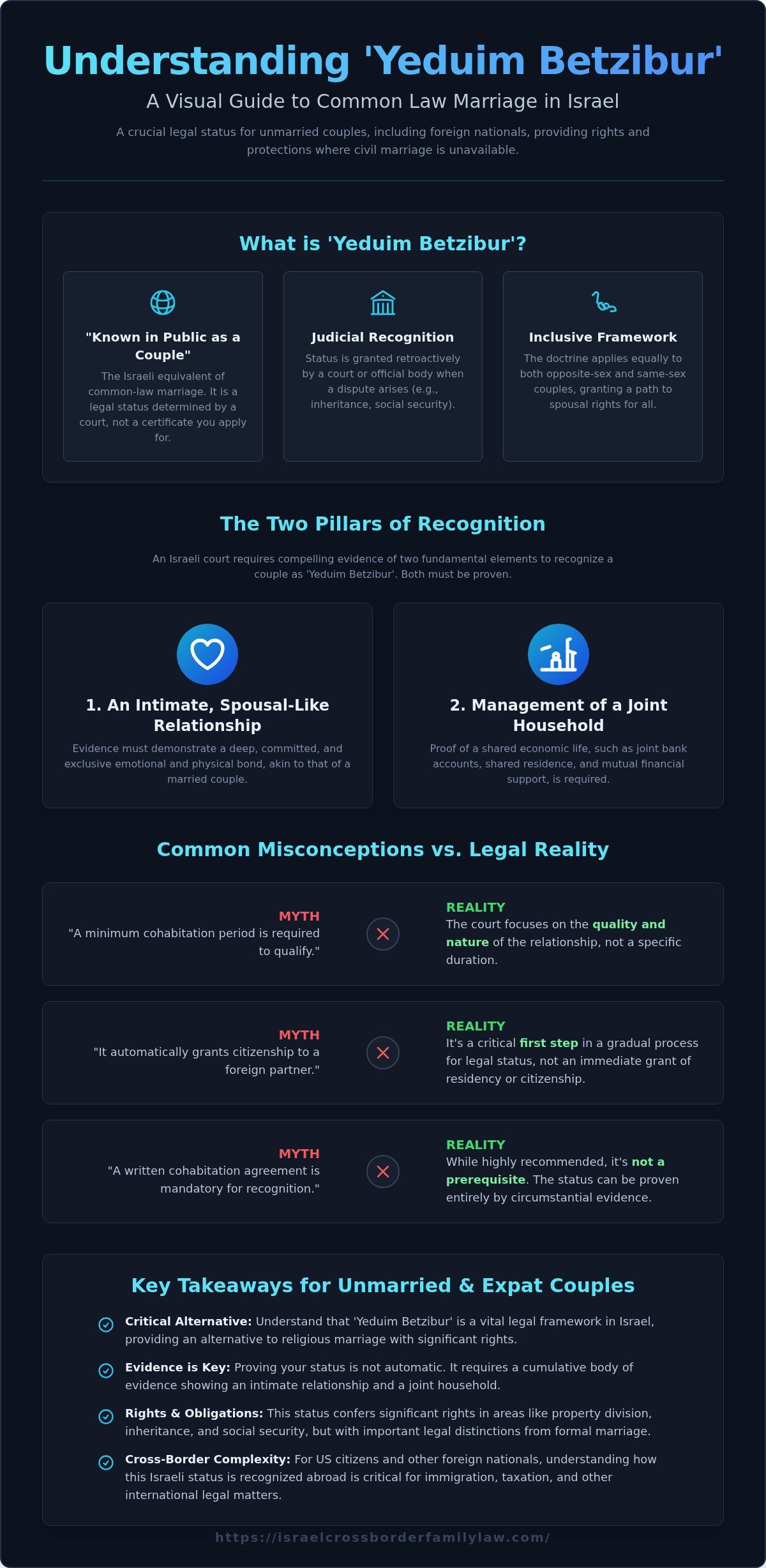
In the complex legal landscape of Israel, where civil marriage is not available within the country’s borders, an alternative framework has gained significant legal weight: Yeduim Betzibur (ידועים בציבור). Literally translating to “known in public as a couple,” this status is the Israeli equivalent of a common-law marriage. It provides a crucial legal pathway for couples, including many expatriates, who are unable or choose not to marry through the official religious channels. Navigating the nuances of common law marriage israel is essential for unmarried partners seeking to establish legal rights and protections.
For a clearer visual explanation of how common-law principles function, the following video provides a helpful overview:
Crucially, Yeduim Betzibur is not a registered certificate or a formal title one applies for. Instead, it is a legal status determined retroactively by a court or another official body when a dispute or a need for recognition arises, such as in matters of inheritance, social security, or partner visas. This judicial recognition stands in contrast to formal religious marriage, which is administered by the Chief Rabbinate for Jews or other recognized religious authorities for other faiths. The doctrine of Unregistered cohabitation in Israel is particularly progressive in that it applies equally to both opposite-sex and same-sex couples, granting them a path to spousal rights that is otherwise unavailable through formal marriage.
The Two Pillars of Recognition
For an Israeli court to recognize a couple as Yeduim Betzibur, the petitioners must provide compelling evidence demonstrating the existence of two fundamental elements. These pillars form the basis of the legal test:
- An Intimate, Spousal-Like Relationship: This involves proving a deep, committed, and exclusive emotional and physical bond, akin to that of a married couple.
- Management of a Joint Household: This requires demonstrating a shared economic life, such as a joint bank account, shared residence, and mutual financial support, which proves the couple operates as a single domestic unit.
Both conditions must be proven to the court’s satisfaction based on the totality of the circumstances presented.
Common Misconceptions vs. Legal Reality
Navigating this status requires distinguishing between common assumptions and the legal facts on the ground. Key misconceptions include:
- Myth: A minimum cohabitation period is required. The court focuses on the quality and nature of the relationship, not a specific duration. A long-term relationship with weak evidence may fail the test, while a shorter but intensely integrated partnership may succeed.
- Myth: It automatically grants citizenship to a foreign partner. Recognition as Yeduim Betzibur is a critical first step in the gradual process for obtaining legal status for a non-Israeli partner, but it does not confer immediate residency or citizenship.
- Myth: A written cohabitation agreement is mandatory. While a formal agreement is highly recommended to define financial and property rights, it is not a prerequisite for recognition. The status can be proven entirely through circumstantial evidence.
Establishing and Proving Your Common Law Status
Unlike a formal marriage, which is established by a single certificate, the status of Yeduim Betzibur (known in public as a couple) is determined by a cumulative body of evidence demonstrating the nature of the relationship. For unmarried expats navigating the requirements for common law marriage israel, taking proactive measures to document and formalize the partnership is a critical strategic step. The Israeli legal system, as detailed in authoritative summaries like the Law Library of Congress’s report on Israel: Recognition of Common Law Marriage, relies on factual proof of a shared life and household, making a robust collection of evidence indispensable.
Building a Body of Evidence
Israeli courts and administrative bodies require tangible proof to substantiate a common-law claim. This evidence should paint a clear picture of a shared life, both financially and socially. Key documents include:
- Financial Interdependence: Joint bank accounts, shared credit cards, rental agreements or property deeds listing both partners, and utility bills addressed to both individuals at a shared residence.
- Social Recognition: Affidavits from friends, family, and colleagues attesting to the couple’s relationship, supplemented by photographs from social events and travel.
- Official Correspondence: Any official mail from government or municipal bodies sent to both partners at the same address serves as strong corroborating evidence.
The Cohabitation Agreement (Financial Agreement)
A cohabitation agreement, often termed a financial agreement, is a legally binding contract that defines the property and financial arrangements between partners. This document is crucial for both Israeli and international couples, as it provides clarity and preempts potential disputes. It can delineate the division of assets acquired during the relationship, spousal support terms, and inheritance rights, simplifying complex matters in the event of separation or the death of a partner. For expats with assets in multiple countries, these agreements can be expertly drafted to be enforceable across different jurisdictions.
Registration with Bituach Leumi and Other Bodies
One of the most significant steps in formalizing your status is registering as a couple with the National Insurance Institute (Bituach Leumi). This process involves submitting a claim form along with comprehensive evidence of your relationship. Once recognized, this registration grants access to a wide range of social security rights and benefits equivalent to those of married couples, including pensions, disability allowances, and survivor’s benefits. Recognition may also be sought from other entities, such as municipalities (arnona discounts) and government ministries, further solidifying your legal standing in Israel.
Legal Rights and Obligations for Common Law Spouses in Israel
For unmarried expats, establishing status as Yeduim Betzibur (publicly known as a couple) is not merely a symbolic act; it confers a comprehensive suite of legal rights and obligations that closely mirrors those of formally married couples. Understanding these tangible benefits is critical for international families navigating life in Israel. The legal framework for common law marriage in Israel is designed to provide protection and stability, acknowledging the reality of committed, long-term relationships outside of formal matrimony. Authoritative bodies like the New Family Organization provide extensive resources on the nuances of this status.
Property and Financial Rights
Under Israeli law, the ‘Presumption of Joint Property’ (Halakat Hashituf) applies to common law spouses. This legal doctrine stipulates that all assets acquired during the relationship through the joint effort of the couple are considered co-owned. Upon separation, these assets are typically divided equally, regardless of whose name they are registered in. Furthermore, a financially dependent partner may be entitled to claim rehabilitative spousal support to ensure their economic stability following the dissolution of the relationship.
Inheritance and Succession Rights
One of the most significant protections afforded to common law spouses is in the area of succession. In the absence of a valid will, Israel’s Succession Law grants a common law spouse the same inheritance rights as a legally married spouse. This means the surviving partner is entitled to inherit the deceased’s estate, either in part or in full, depending on the existence of children. For expats with multi-jurisdictional assets, however, relying on this default provision is ill-advised; a professionally drafted will is essential to prevent complex cross-border probate disputes.
Parental Rights and Child Custody
In Israel, parental rights and responsibilities are fundamentally tied to biology, not marital status. Unmarried parents have the same legal rights and obligations toward their children as married parents. Upon separation, determinations regarding child custody, visitation rights, and child support obligations (which can amount to several thousand shekels per month) are made based on the paramount principle of the child’s best interests. These matters become significantly more complex when one parent is a foreign national, making expert legal counsel crucial for navigating international custody and relocation disputes.
Dissolution and Separation: Ending a Common Law Marriage
While a formal marriage in Israel requires a religious divorce proceeding, ending a common-law relationship does not. There is no requirement for a “get” from the Rabbinical Court or any equivalent religious dissolution. However, this absence of formality does not mean the separation is simple. The legal and financial disentanglement of a long-term partnership is a significant judicial process, often fraught with complexity and disputes over when the relationship truly ended and how assets should be divided.
Navigating the end of a common law marriage israel requires a clear understanding of the legal framework governing separation, property rights, and support obligations. Without the clear start and end dates provided by marriage and divorce certificates, partners often require court intervention to define the parameters of their separation.
The Separation Process
The legal process begins when one partner formally declares the relationship over and files a claim with the Family Court. This claim can seek the division of property, spousal support (alimony), and, if there are children, arrangements for custody and child support. Unlike a formal divorce, the critical point of contention is often establishing the exact date the relationship ceased, as this date significantly impacts the scope of shared assets. The court will examine evidence such as separate living arrangements and financial independence to determine this date. Parties are encouraged to pursue mediation to reach an amicable agreement, but litigation is often necessary to resolve contentious disputes.
Division of Assets and Spousal Support
Upon separation, Israel’s Presumption of Joint Property is applied to common-law couples. This legal doctrine mandates that all assets, savings, real estate, and pension rights accumulated during the relationship are considered joint property and are typically divided equally. This applies regardless of whose name an asset is registered under.
Spousal support is not an automatic right but may be awarded on a “rehabilitative” basis to help a financially dependent partner transition to self-sufficiency. Courts will consider several factors, including:
- The duration of the relationship
- Disparities in earning capacity between the partners
- The contributions each partner made to the household and family
- The standard of living during the relationship
For expatriates and international couples, these matters are amplified. Managing the complex process of separation for international families with assets in multiple jurisdictions requires sophisticated legal expertise. Valuing and dividing international property, cross-border investments, and foreign pensions involves navigating conflicting laws and requires a strategic, multi-jurisdictional approach. Protecting your financial interests during such a complex separation necessitates guidance from legal counsel experienced in Israeli and international family law. Our firm provides the specialized counsel required to navigate these challenges effectively.
Critical Implications for US Citizens and Foreign Nationals
For foreign nationals and U.S. citizens residing in Israel, the recognition of their relationship as a common-law marriage carries profound implications, particularly in the complex arenas of immigration and cross-border legal enforcement. Navigating the intersection of Israeli domestic law and the legal frameworks of other nations demands sophisticated legal guidance to secure one’s status, rights, and assets.
Immigration Status in Israel for a Foreign Partner
Obtaining legal status for a non-Israeli partner based on a relationship involves a rigorous, multi-stage process with the Ministry of Interior (Misrad Hapnim). This “graduated procedure” requires the couple to submit extensive and continuous proof of a genuine, shared life. This evidence typically includes:
- Joint rental agreements and utility bills
- Shared bank accounts and financial records
- Photographs, travel itineraries, and detailed affidavits from friends and family
Applications are frequently scrutinized and can be denied for perceived inconsistencies during interviews or for providing insufficient evidence of a bona fide relationship, underscoring the need for meticulous preparation.
Recognition of Israeli Common Law Status in the United States
A critical distinction must be made: the United States federal government does not recognize a common law marriage israel for immigration purposes, such as sponsoring a partner for a green card. U.S. federal law only acknowledges common-law unions from foreign jurisdictions where they confer the exact same rights and obligations as a formal, ceremonial marriage. As Israel’s framework is a judicial construct rather than a statutory equivalent, it fails to meet this strict standard. Couples seeking U.S. immigration benefits must typically pursue formal marriage elsewhere.
Enforcing Agreements and Orders Across Borders
The cross-border enforcement of cohabitation agreements or Israeli court orders concerning property and support presents significant legal challenges. An agreement drafted solely under Israeli law may not be automatically enforceable in a U.S. court, and vice versa. It is therefore essential to include a robust jurisdiction clause specifying which country’s laws will govern disputes. There are special considerations for expats and foreign nationals when structuring these multi-jurisdictional contracts to ensure their validity and enforceability across international lines. Proactive legal strategy is the most effective tool for protecting your interests in a common law marriage israel. For expert guidance on your cross-border family law matter, contact our firm to schedule a consultation.
Navigating the Complexities of Cross-Border Common Law Marriage in Israel
As this guide has demonstrated, Israel’s unique approach to common law marriage, known as Yeduim Betzibur, provides substantial rights and obligations to unmarried couples, yet establishing this status is a matter of proof, not automatic recognition. For international couples, navigating the legal framework for common law marriage israel is particularly complex. The interplay of multi-jurisdictional laws creates significant challenges impacting critical matters such as property rights, inheritance, immigration status, and child custody, demanding sophisticated legal counsel familiar with the nuances of both Israeli and foreign legal systems.
The personal and financial stakes are high, and a proactive legal strategy is essential to safeguard your interests. Our firm is uniquely positioned to assist, leveraging decades of experience in complex US-Israel cross-border legal matters and a deep understanding of the challenges facing international families. We provide the strategic guidance that expats and foreign nationals require to navigate these sophisticated issues with confidence. To protect your rights and secure your future, we invite you to Schedule a Confidential Case Review to discuss your specific international family law needs.
Let our expertise provide you with the clarity and confidence to move forward.
Frequently Asked Questions
Is there a minimum time you must live together to be considered common law in Israel?
Israeli law does not stipulate a mandatory minimum cohabitation period to establish a common-law relationship. Instead, recognition is based on a holistic assessment of the couple’s life together, focusing on substantive criteria such as maintaining a joint household and managing shared finances. The court evaluates the sincerity and permanence of the relationship, rather than relying on a specific, predetermined timeline, to determine if the partnership functions as a marital unit for legal purposes.
Are same-sex couples recognized as common law partners in Israel?
Indeed, the Israeli legal system provides equal recognition for same-sex couples as common-law partners, granting them rights and obligations equivalent to those of opposite-sex couples. This comprehensive legal parity, established through landmark judicial precedents, extends across various domains, including inheritance rights, social security benefits, and specific immigration considerations. The core legal test remains the nature of the relationship, not the gender of the partners involved in the union.
What happens if one common law partner dies without a will?
In the event of intestacy (death without a will), the surviving common-law partner is afforded rights equivalent to a legal spouse under Israel’s Inheritance Law, 1965. Provided the couple maintained a joint household and were not married to other individuals, the survivor is entitled to inherit a significant portion of the deceased’s estate. This share is determined by the existence of other heirs, such as the deceased’s children or parents, mirroring the statutory inheritance framework for married couples.
Can a tourist on a B/2 visa establish a common law relationship to stay in Israel?
Attempting to transition from a B/2 tourist visa to a residency status based on a common-law relationship is a highly complex and scrutinized process. The Ministry of Interior imposes a significant evidentiary burden on the couple to prove the authenticity and viability of their partnership. Establishing a common law marriage israel for immigration purposes requires navigating a stringent regulatory framework, and success is not guaranteed. Professional legal guidance is essential for managing this multi-jurisdictional challenge.
How does common law status affect my income taxes in Israel?
Recognized common-law partners are generally treated as a single family unit for taxation purposes, similar to married couples. This status can allow the couple to optimize their tax liabilities by utilizing certain tax credits (nekudot zikui) and deductions. To benefit from this treatment, it is critical to properly register the relationship with the National Insurance Institute (Bituach Leumi) and ensure all declarations to the Israel Tax Authority are accurate and compliant with current regulations.
Does a cohabitation agreement need to be approved by a court to be valid?
A cohabitation agreement is legally valid upon being signed by both parties and authenticated by a notary. However, seeking approval from the Family Court elevates its legal standing to that of a court judgment. This additional, highly recommended step provides enhanced enforceability and legal certainty. It is a crucial strategic measure for protecting the complex financial and personal interests of both partners, particularly for expats with multi-jurisdictional assets.

Article by
Gabriel Lior
A Personal Journey That Became a Mission
The advisory was founded by an American father Gabriel Lior, LLB, MBA , global entrepreneur, and cross-border advisor who spent more than a decade navigating the Israeli family court system firsthand and now lives in Singapore with his son.
As a divorced parent in a cross-border family, Gabriel faced nearly every legal challenge a foreign parent can encounter in Israel — including child custody disputes, child support proceedings, property matters in Israel and abroad, false accusations, and complex immigration and relocation proceedings.
Over the years, he learned the hard way how difficult it is for non-Israeli parents to understand the system, identify the right legal strategy, and choose the right legal representation — especially when language, culture, and jurisdictional differences are involved. He also witnessed how foreign parents and new immigrants are often disadvantaged or taken advantage of by service providers and institutions simply because they lack local knowledge or fluency.
From Client to Advisor
To truly understand — and survive — the system, Gabriel pursued formal legal education in Israel, completing two Israeli law degrees, alongside a BA and MBA earned in the United States. This was never about becoming a practicing attorney, but about gaining a deep, structural understanding of how the system works — and where it breaks down for foreign parents.
This rare combination of:
Firsthand client experience
Israeli legal and US business education
International business and negotiation training
Decades of commercial execution
created a unique perspective – one that understands both sides of the table.
After years of litigation, persistence, and at times self-representation, he ultimately succeeded in securing custody of his son and relocating abroad through a rare legal victory in the Israeli Supreme Court — becoming one of the first fathers in Israel to do so under these circumstances.
Disclaimer
Important Disclaimer:
The information provided on this website and in its content is for general informational and educational purposes only and does not constitute legal advice, legal opinion, or legal representation.
Gabriel Lior is not licensed to practice law in Israel (nor is he interested in doing so) and does not provide legal services, despite having completed 2 Law Degrees. The services offered are advisory in nature and are intended to provide general guidance, strategic insight, and information regarding cross-border family law considerations.
No attorney-client relationship is formed by accessing this website, reading its content, or communicating with us.
Any decisions made based on this information are at your own discretion and risk. For legal advice specific to your situation, you should consult a licensed attorney in the relevant jurisdiction.
Where appropriate, we may refer clients to independent, licensed attorneys or professionals. Such referrals do not constitute legal representation and no liability is assumed for services provided by third parties.