What if the standard Western definition of what is a bastard has almost nothing to do with your child’s legal standing in IL? Most parents assume that children born to unmarried couples face the same administrative hurdles in Tel Aviv as they do in New York. In the Israeli legal system, the distinction between a child born out of wedlock and a ‘Mamzer’ is a high-stakes reality that can permanently bar an individual from marriage. This article explains these critical differences, focusing on strategy, risks, and decision-making guidance, so you can navigate the intersection of religious law and civil divorce with confidence.
Understanding how a US divorce decree impacts your status in IL is essential for protecting your children. As of 2023, the Rabbinical courts continue to maintain strict records that can prevent thousands of individuals from marrying within the state. We’ll examine ‘Mamzerut’ risks and provide strategic clarity on divorce timing to ensure your family remains secure. For visual guides on these cross-border topics, visit https://www.youtube.com/@IsraelFamilyLaw.
Get clarity before you commit. Reach out to Israel Cross Border Law Firm via WhatsApp for an advisory call, or request a confidential consultation.
Key Takeaways
Distinguish between the modern pejorative and the high-stakes legal reality of what is a bastard within the specific context of the Israeli legal system.
Identify why the religious status of ‘Mamzerut’-rather than simply being born out of wedlock-is the primary legal concern for international families in IL.
Understand the severe consequences of the Rabbinical Court’s "Blacklist" and how it enforces marriage restrictions on future generations.
Navigate the complexities of cross-border divorce by recognizing why a US civil decree is insufficient to protect your children’s legal status in Israel.
Learn strategic steps to prioritize the religious divorce (Get) to ensure your family’s future is secured across multiple jurisdictions.
Table of Contents
This article is published on an independent advisory platform (not a law firm). Do NOT use language that implies attorney-client relationship, legal representation, or giving legal advice. Focus on strategy, risks, and decision-making guidance. Soft CTA to advisory call / WhatsApp.
The Definition of ‘Bastard’ in Modern and Historical Context
The term "bastard" carries a historical weight that has shifted significantly over the last millennium. Originally derived from Old French, the word served as a technical descriptor for a child born to a nobleman and his mistress. In the 11th century, figures like William the Conqueror were openly referred to as "the Bastard" as a statement of fact rather than a slur. Today, anyone asking what is a bastard will find that the word has transitioned from a neutral legal status into a sharp social pejorative. Most English-speaking jurisdictions have spent the last 50 years scrubbing this language from their statutes to protect children from inherited stigma and ensure equal protection under the law.
To better understand how the usage and meaning of this term has changed over time, watch this helpful video:
Historical Legal Status in English Common Law
Under historical English Common Law, a child born outside of marriage was labeled filius nullius, or the "son of nobody." This status was more than just a social label; it was a legal vacuum. These children could not inherit land, claim a family surname, or access the same protections as "legitimate" offspring. The 1973 Uniform Parentage Act in the United States and the 1987 Family Law Reform Act in the UK effectively ended this era. Modern family law now prioritizes the best interests of the child. This ensures that all children enjoy equal rights to financial support and inheritance regardless of their parents’ marital status. Because of this shift, the term is now considered both legally obsolete and highly offensive in professional and judicial settings.
The legal evolution hasn’t erased all complexities, especially regarding prohibited unions. There’s a common misconception that any child born to unmarried parents faces legal hurdles. In reality, modern law distinguishes between children born out of wedlock and those born from unions that the law forbids, such as incestuous relationships. In the context of Jewish law, which remains highly relevant for many families in IL, the term Mamzer describes a child born from specific prohibited relationships like adultery. This is a much narrower and more legally significant category than the broad Western concept of illegitimacy. It’s a distinction that can have profound impacts on marriage rights within certain jurisdictions.
Why the Question Still Matters Today
Pop culture often romanticizes historical "bastardy," but for international families, the practical implications are what count. When families move between the US and IL, they often encounter two very different approaches to parentage and civil status. While the US focuses almost entirely on civil contracts and biological ties, the system in IL involves a complex interplay between civil law and religious courts. Understanding these differences is vital for securing a child’s future rights and ensuring seamless transition between countries. Expats should consult guides For Expats and Foreign Nationals to see how these definitions might affect their specific cross-border situation. Decisions made early in a child’s life regarding registration and parentage can prevent significant legal friction or inheritance disputes later in life.
Get clarity before you commit. Request a confidential consultation.
This article is published on an independent advisory platform (not a law firm). Do NOT use language that implies attorney-client relationship, legal representation, or giving legal advice. Focus on strategy, risks, and decision-making guidance. Soft CTA to advisory call / WhatsApp.
Mamzerut: The Israeli Legal Equivalent of ‘Illegitimacy’
In the Israeli legal framework, the common understanding of what is a bastard differs sharply from Western secular definitions. While many English speakers use this term to describe any child born outside of marriage, the Hebrew term "Mamzer" carries a far more restrictive and consequential definition. In IL, personal status for Jewish citizens is governed by the Rabbinical Courts. These courts apply Halakhic rules to dictate lineage and marriage eligibility. It is vital to understand that a child born to a single, unmarried woman is not considered a Mamzer under Jewish law. This child holds full rights and faces no religious restrictions on their own future marriage.
The status of Mamzerut is instead reserved for children born from specific "prohibited unions." The most common scenario involves a child born to a woman who is legally married to one man but conceives with another. This distinction creates unique risks for international families who may not realize that their marital status in IL remains active despite changes in their home country. Because the Rabbinical Court maintains exclusive jurisdiction over marriage and divorce for Jews, their definitions override civil labels. The court’s primary goal is to protect the lineage of the Jewish people, yet this often creates modern problems with biblical status for families unaware of the strict criteria.
The ‘Prohibited Union’ Criteria
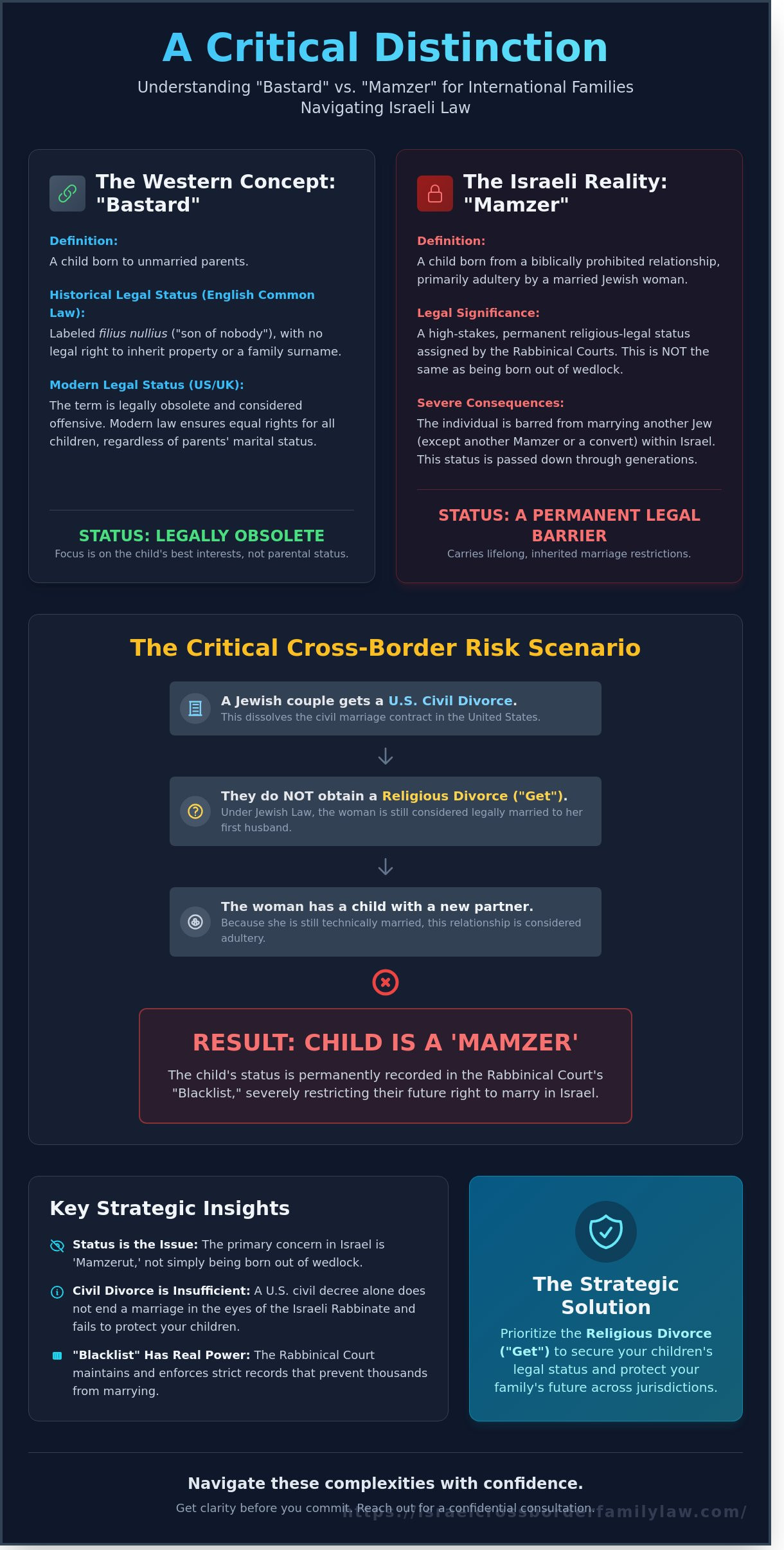
Halakhic rules focus on adultery and incest as the primary drivers of Mamzerut. A significant risk for expats is the "Get" or religious divorce. If a woman obtains a civil divorce in New York or London but fails to secure a religious divorce through the Rabbinical Court, she remains "married" in the eyes of Israeli law. Any child she has with a new partner will be labeled a Mamzer. This status is permanent and hereditary. It prevents the individual from ever marrying another Jew in IL, except for another Mamzer or a convert. Mamzerut is a status arising specifically from prohibited relationships, not mere lack of marriage.
Secular vs. Religious Perspectives in IL
The Israeli Population and Immigration Authority maintains a database often referred to as the "blacklist." This registry includes individuals who are "marriage-restricted." Even completely secular families cannot ignore these definitions. If you plan to have children or marry within IL, the Rabbinical Court will investigate your lineage. For example, if a child is born within 300 days of a mother’s divorce, the state may refuse to register the biological father without a court order. This is done to prevent a finding of Mamzerut. Families often seek strategic guidance on personal status to navigate these overlaps between civil registration and religious law.
The tension between civil rights and religious law is palpable in the Family Court system. While the state aims to ensure every child has a registered father, the law restricts DNA testing if there is a risk the results will prove what is a bastard under religious law. A paternity test in IL generally requires a court order and can cost between ₪1,500 and ₪3,500 depending on the complexity of the case. The court will often appoint a guardian ad litem to protect the child’s future marriageability before allowing such tests to proceed.
Get clarity before you commit. Request a confidential consultation.
This article is published on an independent advisory platform (not a law firm). Do NOT use language that implies attorney-client relationship, legal representation, or giving legal advice. Focus on strategy, risks, and decision-making guidance. Soft CTA to advisory call / WhatsApp.
The Consequences of ‘Illegitimate’ Status in Israel
In Israel, the legal consequences of being classified as a Mamzer differ significantly from Western jurisdictions. While many countries have abolished the legal distinction of birth status, IL maintains a dual system where civil rights and religious personal status coexist. Understanding what is a bastard in the Israeli context requires looking beyond the dictionary definition and into the Rabbinical Court’s strict lineage protocols. From a civil perspective, the 1965 Succession Law ensures that every child has equal inheritance rights. A child born outside of marriage or from an adulterous union still inherits from their parents just like any other sibling. Their rights to state health insurance, education, and social security are fully protected by law.
The primary hardship is not civil but matrimonial. Under the Rabbinical Courts Jurisdiction (Marriage and Divorce) Law of 1953, the Orthodox Rabbinate holds exclusive authority over Jewish marriages in IL. For an individual with this status, the law is absolute; they are prohibited from marrying any other Jew, except for another person with the same status or a convert. This restriction isn’t a temporary penalty. It’s a permanent legal barrier that extends to all future generations. If a Mamzer has children, those children inherit the status automatically, creating a cycle of marital exclusion that the religious legal system cannot easily resolve.
The Rabbinical Court’s Marriage Registry
The Rabbinical Court manages a private, highly sensitive database known as the Reshimat Me’ukavei Nisuin, or the "List of Delayed Marriage." There are currently several thousand individuals listed in this registry for various reasons, including doubts regarding their lineage. When a couple applies for a marriage license in IL, they undergo a "status clarification" process. If a person’s name appears on this list, or if the court discovers a history of unresolved divorce in the maternal line, the wedding is halted. For many adults, this is the moment of a devastating family crisis. They may have lived their entire lives unaware of their parents’ marital history, only to find their personal identity and right to marry challenged by the state’s religious authorities just weeks before their planned ceremony.
Civil Workarounds and Their Limitations
Because the question of what is a bastard remains a religious determination, many Israelis seek civil alternatives to bypass the Rabbinate’s restrictions. The most common solution is Yeduim B’tzibur, or Common Law Marriage. This status provides couples with nearly all the same financial and social benefits as married couples, including joint taxation and pension rights. Another frequent choice is civil marriage abroad, typically in Cyprus. A basic civil wedding package in Cyprus can cost between ₪4,000 and ₪7,000, including travel. Once the couple returns to IL, the Ministry of Interior is legally required to register them as married for civil purposes. However, these workarounds are functional, not transformative. They do not erase the religious status. The individual remains restricted within the Rabbinical system, and the status will still be passed down to any children born from the union, potentially complicating the lives of the next generation.
Deciding how to manage these risks requires a strategic approach to family law and an understanding of how cross-border legal systems interact. Early decisions regarding birth registration and legal documentation can significantly impact a child’s future options within the IL system.
Get clarity before you commit. Request a confidential consultation.
This article is published on an independent advisory platform (not a law firm). Do NOT use language that implies attorney-client relationship, legal representation, or giving legal advice. Focus on strategy, risks, and decision-making guidance. Soft CTA to advisory call / WhatsApp.
Cross-Border Risks for US-Israel Families
Families moving between the US and IL often assume a civil court order from a state like New York or California settles their marital status globally. This is a dangerous misconception. In IL, personal status matters for Jewish citizens are governed by religious law. If a woman hasn’t received a "Get" (a Jewish bill of divorce), she remains legally married in IL regardless of her US civil status. If she has a child with a new partner during this period, the child faces the severe designation of Mamzer. While Westerners might ask what is a bastard in a general sense, the Israeli legal consequences are far more rigid, affecting the child’s ability to marry within the Jewish community for generations.
Timing is the most significant risk factor for international families. A US civil divorce can take months; a religious divorce can sometimes take years if one party is uncooperative. Having a child with a new partner before the religious process is finalized creates an irreversible legal status for the child in IL. US courts generally view "illegitimacy" as a relic of the past with few legal consequences. In contrast, the Israeli system maintains these categories with modern administrative force. This jurisdictional clash can leave families in a state of legal limbo where they’re "divorced" in Los Angeles but "married" in Jerusalem.
The Danger of the ‘Civil-Only’ Divorce
Consider a scenario from 2023. A US citizen completes a civil divorce in Florida and moves to IL shortly after. They assume they’re free to start a new life. However, without a religious termination of the marriage, any child born to the woman from a second relationship is legally classified as a product of adultery. This creates a legal trap that is difficult to escape. To avoid this, it’s vital to ensure a cross-border divorce is recognized by both the civil courts and the Rabbinate. You can find more details on managing these transitions in our guide on Divorce and Separation for International Families.
Paternity and DNA Testing in IL
Paternity claims in IL operate differently than in the US. In many US states, a DNA test is a standard tool to resolve support or custody disputes. In IL, the court often blocks these tests if there’s a suspicion the child was born to a married woman by a man other than her husband. The judges prioritize the "Best Interests of the Child" doctrine to prevent the child from being labeled a Mamzer. If you’re asking what is a bastard under Israeli law, the answer is tied to this specific religious status. Courts will prioritize protecting the child’s social and legal standing over the biological truth of paternity. Filing fees for paternity suits in IL family courts start around ₪550, but the strategic cost of a misstep is much higher.
Navigating these claims requires a strategy that accounts for both civil rights and religious restrictions. You must understand how the IL court system views your family structure before you file any paperwork. Mistakes in the early stages of a cross-border move can lead to decades of legal complications for your children.
Building a secure future for your family requires a sophisticated cross-border strategy that respects both legal systems.
Get clarity before you commit. Request a confidential consultation.
This article is published on an independent advisory platform (not a law firm). Do NOT use language that implies attorney-client relationship, legal representation, or giving legal advice. Focus on strategy, risks, and decision-making guidance. Soft CTA to advisory call / WhatsApp.
Protecting Your Family: Strategic Decision-Making
Managing family status across international borders requires more than just standard paperwork. It demands a deep understanding of how different legal systems overlap. For many Anglo expats, the conflict between US civil law and Israeli religious law creates significant risks. You must obtain absolute clarity regarding your marital status in both jurisdictions before making life-altering choices. A civil divorce decree from a US court doesn’t automatically change your status in Israel (IL). Under the Rabbinical Courts Jurisdiction Law of 1953, the religious authorities maintain exclusive control over the marriage and divorce of Jewish residents. If you’re considered married in IL while living a "divorced" life in the US, the consequences for future children are severe.
Securing a religious divorce, or "Get," must be your top priority if you intend to have children in a new relationship. Without this document, any child born to a woman from a new partner is viewed through a specific religious lens. This is where the technical understanding of what is a bastard becomes critical. In the Israeli legal and religious context, this term refers to a "mamzer," a child born from an adulterous union. This status isn’t just a label; it’s a legal disability that restricts the child’s ability to marry within the Jewish community in Israel. Resolving these issues after a child is conceived is exponentially more difficult than addressing them beforehand.
Legal presumptions of legitimacy are powerful tools when used correctly. Israeli law often relies on the "300-day rule," which presumes a child born within 300 days of a divorce belongs to the former husband. While this can protect a child’s status, it can also create complex paternity disputes if the timing isn’t managed. You should consult with a cross-border advisor before registering a birth in IL. The Ministry of Interior processed approximately 178,000 births in 2023, and each registration involves a verification of the mother’s marital status. Inaccurate or poorly timed registration can trigger an automatic referral to the Rabbinical Court system, potentially exposing the family to status investigations.
The Importance of Early Action
Proactive measures are the only way to ensure your child’s future is unencumbered. Waiting until a child is born is usually too late to fix status issues. By the time a birth certificate is required, the legal "facts on the ground" are already set. You can safeguard the future by finalizing a "Get" or establishing a pre-emptive financial agreement that clarifies separation dates. For a deeper look at how timing affects your legal standing, watch the Israel Family Law YouTube Channel. Early decisions prevent 100% of the most common registration crises.
Seeking a Confidential Advisory Review
Specialized oversight is necessary because general practitioners in the US or IL often miss the nuanced friction between the two systems. A US lawyer might assume a civil decree is sufficient, while an Israeli lawyer might not understand the implications for your US-based assets or citizenship status. A neutral, strategic assessment identifies these "blind spots" before they become litigious. You deserve a clear map of your family’s legal risks. To begin this process, you can Request a Confidential Case Review to evaluate your specific jurisdictional standing.
Get clarity before you commit. Request a confidential consultation.
This article is published on an independent advisory platform (not a law firm). Do NOT use language that implies attorney-client relationship, legal representation, or giving legal advice. Focus on strategy, risks, and decision-making guidance. Soft CTA to advisory call / WhatsApp.
Securing Your Family’s Legal Standing in Israel
Understanding what is a bastard under the 1953 Rabbinical Courts Jurisdiction Law is essential for any international family navigating the intersection of secular and religious systems. The status of mamzerut carries lifelong consequences that restrict a child’s ability to marry within Israel’s legal framework. These risks often catch US-Israel families off guard, especially when cross-border divorces or remarriages aren’t managed with precision. Our team brings expertise in complex jurisdictional conflicts, focusing on risk mitigation to ensure your personal status remains protected. We provide a calm, advisory approach that prioritizes your family’s long-term security. Strategic planning today prevents legal complications that could affect your children for decades. You can find additional guidance on these sensitive topics through our YouTube channel. Taking the right steps now ensures you aren’t navigating the Israeli system alone. You deserve a clear path forward for your family’s future.
Get clarity before you commit. Request a confidential consultation.
This article is published on an independent advisory platform (not a law firm). Do NOT use language that implies attorney-client relationship, legal representation, or giving legal advice. Focus on strategy, risks, and decision-making guidance. Soft CTA to advisory call / WhatsApp.
Frequently Asked Questions
Is a child born out of wedlock considered a bastard in Israel?
No, children born to unmarried parents don’t carry any negative legal status in Israeli civil law. While people often ask what is a bastard in a social context, the term has no standing in Israel’s Ministry of Interior for children of single mothers. These children enjoy full inheritance and support rights under the 1959 Family Law Amendment, provided paternity is legally established through the Family Court.
What is the difference between a bastard and a Mamzer?
The term "bastard" traditionally refers to any child born outside of marriage, but a Mamzer is a specific religious status for a child born from an adulterous relationship involving a married Jewish woman. Understanding what is a bastard in the West won’t help you navigate the Israeli system because Mamzer status only applies to forbidden unions under Halacha. This status creates severe restrictions, specifically a permanent ban on marrying other Jews within the state’s Rabbinical system.
Can a DNA test prove a child is not a Mamzer?
No, because Israeli courts often refuse to authorize DNA tests if the results might "bastardize" the child. Under the Genetic Information Law of 2000, a court won’t order a paternity test if there’s a risk the child will be labeled a Mamzer. The legal system prioritizes the child’s social standing over biological truth, effectively blocking evidence that would prove a child was fathered by someone other than the mother’s husband.
Does the Israeli government keep a list of illegitimate children?
Yes, the Rabbinical Courts maintain a database known as the "Simeurim" list, which includes individuals restricted from marriage. While it’s not a public list of "illegitimate" people, it acts as a blacklist for those whose parentage is legally or religiously compromised. As of 2024, thousands of individuals are on this list, requiring them to undergo a complex "clarification of status" before they can marry in Israel.
What happens if a US citizen has a child in Israel before their US divorce is final?
The child is legally presumed to be the offspring of the current husband, even if he hasn’t lived with the mother for years. If the mother is Jewish and has a child with another man before the civil and religious divorce is finalized, that child faces a high risk of Mamzer status. Navigating this requires a strategic bridge between US civil decrees and Israeli religious requirements to protect the child’s future rights.
Can the ‘Mamzer’ status be removed or fixed later in life?
It’s nearly impossible to remove this status once a Rabbinical Court issues a formal ruling. Most legal strategies focus on prevention, such as utilizing the "rov be’ilot" legal presumption that the husband is the father or finding technical flaws in the parents’ original marriage ceremony. Because the status is hereditary, the stakes are high; it affects not just the individual, but all future generations who’ll also be barred from traditional Jewish marriage in IL.
How does the ‘Best Interests of the Child’ rule apply to illegitimacy in IL?
The "Best Interests" rule is used to suppress biological facts that would harm a child’s legal or religious standing. In many 2024 Family Court cases, judges have blocked paternity claims from biological fathers to ensure the child remains "kosher" in the eyes of the state. This means a child’s right to a clean legal status often overrides a father’s right to be recognized or a child’s right to know their genetic heritage.
Do I need a religious divorce if I was only married in a civil ceremony in the US?
Yes, the Israeli Rabbinate generally requires a "Gett" even for couples who only had a civil wedding abroad. If you’re Jewish and fail to secure a religious divorce, any child you have with a new partner in Israel could be blacklisted. Registering a civil divorce in Israel often costs between ₪500 and ₪1,200 in administrative fees, but the religious component is a separate, vital step for cross-border families.
For more insights on navigating these complex family dynamics, watch our detailed guides on the Israel Family Law YouTube channel: https://www.youtube.com/@IsraelFamilyLaw
Get clarity before you commit. Request a confidential consultation.

Article by
Gabriel Lior
A Personal Journey That Became a Mission
The advisory was founded by an American father Gabriel Lior, LLB, MBA , global entrepreneur, and cross-border advisor who spent more than a decade navigating the Israeli family court system firsthand and now lives in Singapore with his son.
As a divorced parent in a cross-border family, Gabriel faced nearly every legal challenge a foreign parent can encounter in Israel — including child custody disputes, child support proceedings, property matters in Israel and abroad, false accusations, and complex immigration and relocation proceedings.
Over the years, he learned the hard way how difficult it is for non-Israeli parents to understand the system, identify the right legal strategy, and choose the right legal representation — especially when language, culture, and jurisdictional differences are involved. He also witnessed how foreign parents and new immigrants are often disadvantaged or taken advantage of by service providers and institutions simply because they lack local knowledge or fluency.
From Client to Advisor
To truly understand — and survive — the system, Gabriel pursued formal legal education in Israel, completing two Israeli law degrees, alongside a BA and MBA earned in the United States. This was never about becoming a practicing attorney, but about gaining a deep, structural understanding of how the system works — and where it breaks down for foreign parents.
This rare combination of:
Firsthand client experience
Israeli legal and US business education
International business and negotiation training
Decades of commercial execution
created a unique perspective – one that understands both sides of the table.
After years of litigation, persistence, and at times self-representation, he ultimately succeeded in securing custody of his son and relocating abroad through a rare legal victory in the Israeli Supreme Court — becoming one of the first fathers in Israel to do so under these circumstances.
Disclaimer
Important Disclaimer:
The information provided on this website and in its content is for general informational and educational purposes only and does not constitute legal advice, legal opinion, or legal representation.
Gabriel Lior is not licensed to practice law in Israel (nor is he interested in doing so) and does not provide legal services, despite having completed 2 Law Degrees. The services offered are advisory in nature and are intended to provide general guidance, strategic insight, and information regarding cross-border family law considerations.
No attorney-client relationship is formed by accessing this website, reading its content, or communicating with us.
Any decisions made based on this information are at your own discretion and risk. For legal advice specific to your situation, you should consult a licensed attorney in the relevant jurisdiction.
Where appropriate, we may refer clients to independent, licensed attorneys or professionals. Such referrals do not constitute legal representation and no liability is assumed for services provided by third parties.