Navigating a cross-border divorce in Israel presents a uniquely complex set of legal challenges, often accompanied by significant concerns over protracted timelines and escalating costs that can reach hundreds of thousands of shekels. The uncertainty surrounding which country’s laws will apply, the division of multi-national assets, and the potential for strategic delays can feel overwhelming. This naturally leads to the critical question clients ask: exactly how long does an international divorce take in israel? While no two multi-jurisdictional cases are identical, a clear understanding of the procedural roadmap is essential for strategic planning and managing expectations.
This comprehensive guide is designed to provide that definitive clarity. We will deconstruct the sophisticated legal framework governing these matters, offering a realistic timeline by examining the key stages that influence the duration of proceedings. From the initial “race for jurisdiction” between Israeli civil and religious courts to the intricate process of cross-border asset valuation and enforcement, you will gain a strategic understanding of what to expect. Our objective is to empower you with the knowledge needed to anticipate challenges, mitigate unnecessary delays, and confidently prepare for the legal journey ahead.
Key Takeaways
- Understand the vast difference in timelines: an amicable cross-border divorce may conclude in 6-12 months, while complex, contested proceedings frequently extend beyond three years.
- The initial battle over jurisdiction-whether Israeli or foreign courts will preside-and navigating Israel’s unique dual-court system are critical preliminary factors that significantly impact the process.
- The answer to “how long does an international divorce take in israel” is most profoundly influenced by the level of cooperation between spouses; a collaborative approach is the single most effective strategy for expediting proceedings.
- Recognize that multi-jurisdictional asset division and cross-border child custody add inherent layers of complexity that require strategic legal navigation to manage the timeline effectively.
The Realistic Timeline: From 6 Months to Over 3 Years
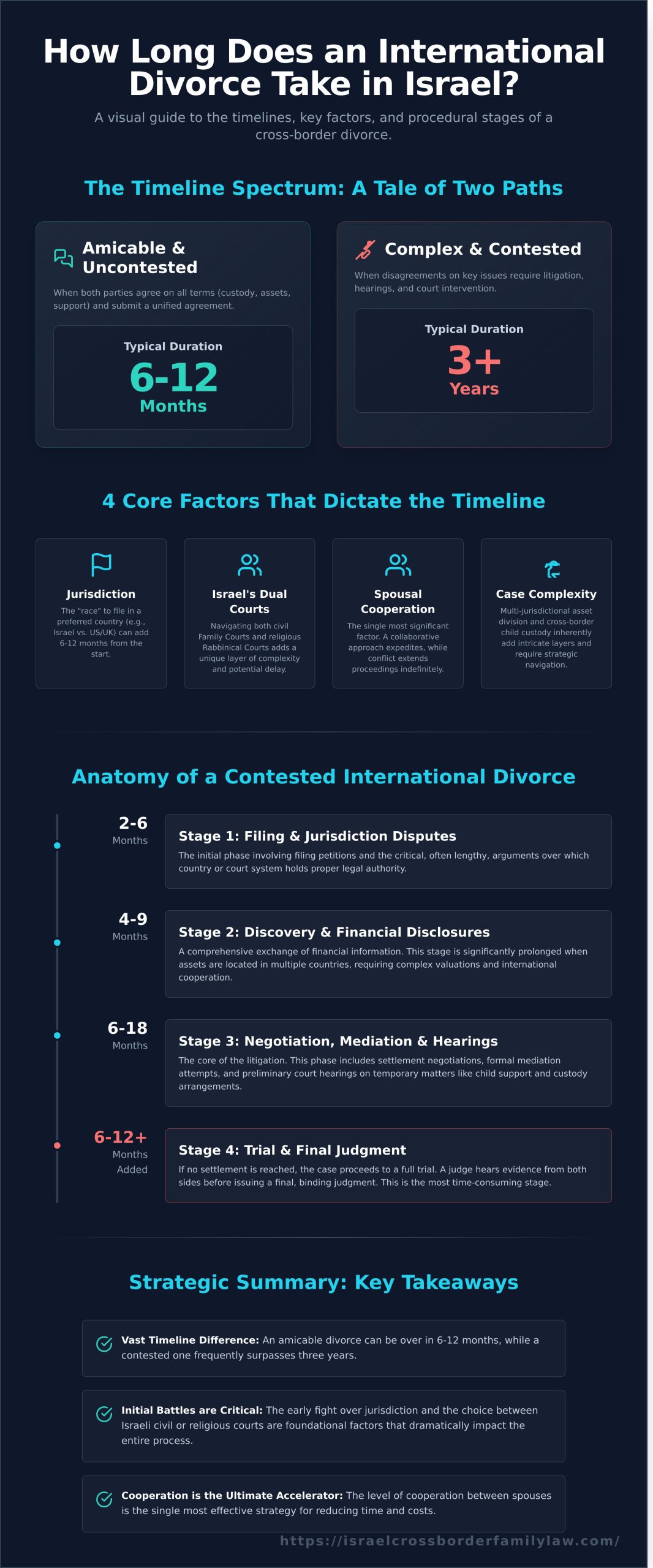
Navigating a cross-border divorce raises a critical question: how long does an international divorce take in israel? The answer is a spectrum. An amicable, uncontested divorce where both parties agree on all terms can be concluded within 6 to 12 months. However, a contested international divorce, involving disputes over assets, custody, or jurisdiction, frequently extends from 18 months to over three years.
This timeline is not arbitrary. It is dictated by four core factors: Jurisdiction, the Court System, Spousal Cooperation, and Case Complexity. This guide will break down each element to provide a clearer understanding of your potential timeline.
For a concise overview of these timeline factors, please watch the following video:
Uncontested vs. Contested Divorce: The Primary Timeline Divide
An uncontested divorce is the fastest route. It occurs when both spouses agree on all major issues-child custody, support, and asset division-and submit a comprehensive divorce agreement to the court for approval. This bypasses lengthy litigation.
A contested divorce, where disagreement exists on one or more key issues, requires litigation. The process of hearings, evidence gathering, and judicial intervention extends the timeline significantly. The dual-system nature of divorce laws in Israel, involving both civil Family Courts and religious Rabbinical Courts, can further complicate these disputes.
A Typical Timeline for a Contested International Divorce
While every case is unique, a contested cross-border divorce generally proceeds through several stages:
- Stage 1: Filing & Jurisdiction Disputes (2-6 months): This initial phase involves filing the petition. In international cases, this is often complicated by arguments over which country or court system holds proper jurisdiction.
- Stage 2: Discovery & Financial Disclosures (4-9 months): Both parties exchange comprehensive financial information. This is a lengthy process when assets are located in multiple countries, requiring complex valuations.
- Stage 3: Negotiation, Mediation & Hearings (6-18 months): The core of the litigation, involving settlement negotiations, mediation, and preliminary hearings on temporary matters like child support.
- Stage 4: Trial & Final Judgment (can add 6-12+ months): If no settlement is reached, the case proceeds to trial, where a court hears evidence before issuing a final judgment. This can add substantial time to the resolution.
Factor 1: The Crucial Battle Over Jurisdiction
In any cross-border family law matter, the first and most consequential question is not “what” but “where.” The concept of jurisdiction-the legal authority of a court in a specific country to hear and decide a case-is the foundational pillar upon which your entire divorce proceeding rests. When spouses have connections to both Israel and another country, such as the United States or the UK, a complex multi-jurisdictional conflict often arises. This can lead to a “race to the courthouse,” a strategic rush where the first spouse to file a claim in their preferred country can secure a significant legal advantage. A protracted dispute over jurisdiction alone can add 6 to 12 months to the process, dramatically influencing how long an international divorce takes in Israel.
Why Jurisdiction Determines the Pace and Outcome
The choice of jurisdiction is far more than a procedural formality; it is a critical strategic decision that shapes the financial and personal outcomes of your divorce. Legal frameworks governing the division of assets, calculation of spousal support (mezonot isha), and child maintenance vary profoundly between countries. For example, one jurisdiction might mandate an equal split of marital assets, while another follows principles of equitable distribution. These substantive legal differences, combined with varying procedural rules that affect the speed of litigation, make the initial filing location a point of intense legal contention.
How Israeli Courts Determine Jurisdiction: ‘Center of Life’ Test
To establish its authority in a cross-border divorce, an Israeli family court will typically apply the ‘center of life’ (merkaz ha’chayim) test. This is a comprehensive, fact-based inquiry to determine where the family’s primary personal, social, and economic connections are located. This is not a simple checklist but a nuanced evaluation of multiple factors, including:
- The length of time the family has resided in Israel.
- The location of the primary family home and other significant assets.
- Where the children are enrolled in school and engaged in community activities.
- The location of the parties’ employment and financial interests.
Resolving this question requires substantial evidence and legal argument, and recent legislation has continued to evolve the standards for international divorce jurisdiction, particularly for Jewish couples where one spouse is not an Israeli citizen. This complexity underscores why determining the proper venue is a time-consuming but essential first step.
The Strategic Impact of Your Filing Location
Securing the appropriate jurisdiction from the outset can streamline your case, reduce unnecessary conflict, and provide a clearer path toward resolution. Conversely, an incorrect or contested filing can lead to a motion to dismiss, resulting in months of wasted time, significant legal fees, and the loss of strategic advantage. Understanding the intricate rules governing jurisdiction is paramount to efficiently navigating the divorce process. You can learn more about the initial steps in our guide to divorce for international families.
Factor 2: Navigating Israel’s Dual Court System
One of the most significant variables determining how long does an international divorce take in israel is the country’s unique dual-jurisdiction legal framework. Unlike many Western nations, Israel operates a parallel system of Rabbinical Courts (religious) and Family Courts (civil). Understanding the division of authority between these two bodies is fundamental to developing an effective legal strategy and managing the timeline of your dissolution.
For Jewish couples, jurisdiction is rigidly defined for the divorce itself: the religious divorce decree, known as a Get, can only be granted by a Rabbinical Court. However, all ancillary matters-such as child custody, spousal support (alimony), and the division of marital assets-can be adjudicated in either the Rabbinical Court or the secular Family Court. This creates a critical “jurisdictional race,” where the first spouse to file a comprehensive claim in their preferred court often secures that venue for the ancillary proceedings, a decision with profound implications for the case’s duration and outcome.
The Rabbinical Court: Religious Law and Timelines
Proceedings in the Rabbinical Court are governed by Halakha (Jewish Law), which introduces a distinct set of procedures and evidentiary standards. Proving the grounds for divorce can become a prolonged and complex process, requiring substantial evidence that may differ significantly from the requirements of a civil court. Furthermore, the procedural steps for arranging and executing the Get ceremony have their own specific timeline, which operates independently of any civil financial or custody rulings.
The Family Court: Civil Law and Procedures
The Family Court operates under Israel’s secular civil laws, presenting a legal environment more recognizable to individuals from North America or Europe. The court applies established civil statutes regarding property division and child welfare. While the procedures are more conventional, it is crucial to recognize that dockets are often heavily congested. This can lead to substantial delays between hearings, potentially extending the overall timeline even when the legal issues are straightforward. Understanding these nuanced Israeli family law procedures is essential for setting realistic expectations.
How Strategic Court Choice Affects Your Timeline
The initial choice of court for ancillary matters represents a pivotal strategic decision that directly impacts the speed and direction of your divorce. One jurisdiction may offer a faster resolution for child custody matters but apply principles of asset division that are less financially advantageous to your position. The question of how long does an international divorce take in israel is therefore not just a matter of process, but of sophisticated legal strategy. Securing expert legal advice is absolutely essential for expats and foreign nationals to navigate this complex choice and pursue the most efficient and favorable path forward.
Factor 3: Cooperation vs. Conflict – The Human Element
Beyond the complexities of jurisdiction and asset location, the single most influential factor determining how long does an international divorce take in israel is the conduct of the spouses themselves. While legal frameworks provide the structure, the human element dictates the pace. A collaborative approach, focused on achieving a fair and pragmatic resolution, will invariably prove more efficient than a high-conflict, adversarial process where every issue becomes a battleground.
The primary objective in an efficient divorce is the creation of a comprehensive Divorce Agreement (Hesekm Gerushin). This sophisticated legal document, once ratified by the Family Court or Rabbinical Court, finalizes all pertinent matters, including child custody, support arrangements, and the division of complex, multi-jurisdictional assets. Spouses who can negotiate the terms of this agreement directly or with the help of counsel are on the fastest track to finality.
Mediation and Negotiation: The Express Lane to Resolution
Mediation offers a structured, confidential forum for spouses to reach a mutually acceptable agreement outside of court. Guided by a neutral mediator, this process empowers the parties to retain control over the outcome. A successful mediation can often conclude a complex international divorce in under a year, saving significant time, reducing substantial legal fees that can amount to tens of thousands of shekels, and mitigating the profound emotional stress associated with protracted litigation.
Common Delay Tactics That Add Years to Your Divorce
Unfortunately, not all parties are committed to an efficient resolution. An uncooperative spouse can employ various tactics designed to prolong the proceedings, increase costs, and exert psychological pressure. Recognizing these strategies is the first step in countering them. Common tactics include:
- Filing frivolous motions: Submitting repeated or baseless requests to the court to exhaust the other party’s financial and emotional resources.
- Withholding financial disclosure: Failing to provide complete and timely documentation of assets, particularly those held in foreign accounts or complex corporate structures.
- Contesting every point: Refusing to agree on even minor procedural matters, turning every step into a protracted and costly legal fight.
While you cannot control your spouse’s actions, engaging experienced legal counsel is critical to neutralize these obstructive maneuvers. An adept attorney can effectively counter these tactics by seeking court intervention and sanctions, thereby keeping the case moving forward. Navigating these human dynamics requires not only legal expertise but strategic foresight. Our firm specializes in guiding clients through complex cross-border divorces, whether through collaborative negotiation or assertive litigation when necessary.
Factor 4: The Inherent Complexity of Your Cross-Border Case
Beyond the level of cooperation between spouses, the single most significant variable influencing how long does an international divorce take in israel is the inherent complexity of the issues involved. Even in an amicable separation, multi-jurisdictional matters require a meticulous and time-intensive process to ensure a fair and legally sound resolution. An international divorce inherently involves more sophisticated legal and financial layers than a domestic one, with each complex issue adding necessary stages of investigation, negotiation, and formalization to the timeline.
International Child Custody and Relocation
Disputes over children are frequently the most contentious and prolonged aspect of a cross-border divorce. These cases often require detailed psychological evaluations and reports from court-appointed experts to determine the child’s best interests. When allegations of parental abduction arise, proceedings under the Hague Convention can become necessary. Resolving complex international custody and relocation disputes can realistically add a year or more to the divorce process.
Valuing and Dividing Assets in Multiple Countries
A global marital estate presents significant logistical challenges. The process demands the proper valuation of diverse assets located in different jurisdictions, including businesses, real estate holdings, investment portfolios, and pensions. This often necessitates retaining a team of specialized professionals, such as forensic accountants and international property appraisers, to provide expert opinions for the court. Tracing hidden or improperly transferred assets across borders is a particularly complex task that can substantially extend the timeline.
Cross-Border Child and Spousal Support
Calculating appropriate support payments is complicated when parents and assets are in different countries. Israeli courts must consider the laws, currencies, and economic standards of another jurisdiction to arrive at a fair calculation. Furthermore, the final support order must be drafted with precision to ensure it is recognized and enforceable abroad. Challenges with cross-border child support enforcement can prolong financial disputes long after the divorce itself is finalized.
Navigating these multi-faceted issues requires experienced legal guidance. If you are facing a complex international divorce, our firm has the expertise to guide you through every stage of the process. Contact our team to discuss the specifics of your case.
Navigating Your International Divorce Timeline with Strategic Counsel
As we have explored, the answer to how long does an international divorce take in israel is not a simple figure but a range dictated by several critical, multi-jurisdictional factors. The initial battle for jurisdiction, the intricate navigation of Israel’s dual court system, and the fundamental level of spousal cooperation are the primary determinants that can shift the timeline from a matter of months to a protracted case lasting several years.
While this complexity can seem daunting, our firm provides the decisive legal support required to manage these challenges effectively. With specialized expertise in US-Israel family law and decades of experience in complex cross-border litigation, we deliver the strategic guidance necessary to protect your interests and pursue a favorable, timely resolution. We are committed to bringing clarity and direction to your case, ensuring you understand every step of the process.
Navigate your cross-border divorce with confidence. We invite you to Request a Confidential Case Review to discuss your unique circumstances and take the first step toward securing your future.
Frequently Asked Questions
Can we get divorced in Israel if we were married in the United States?
Yes, Israeli courts can grant a divorce to couples married abroad, such as in the United States, provided that the court has jurisdiction over the matter. Jurisdiction is typically established if both spouses are Israeli citizens, or if at least one spouse resides in Israel and other specific conditions are met. This cross-border scenario requires careful legal navigation to ensure the foreign marriage certificate is recognized and that the proceedings align with Israeli family law and any relevant international conventions.
Does having a U.S. prenuptial agreement speed up the divorce process in Israel?
A U.S. prenuptial agreement can significantly expedite the financial aspects of a divorce in Israel, but it is not automatically enforceable. The agreement must first be validated by an Israeli Family Court, which will assess its fairness and compliance with Israeli public policy. A properly drafted and validated prenuptial agreement provides a clear framework for asset division, minimizing disputes and potentially shortening the overall timeline for the dissolution of the marriage in a complex, multi-jurisdictional context.
What is a ‘Get’ and why is it a necessary step in an Israeli divorce for Jewish couples?
A ‘Get’ is a religious bill of divorce mandated by Jewish law (Halakha). For Jewish citizens of Israel, the state grants the Rabbinical Courts exclusive jurisdiction over matters of marriage and divorce. Consequently, even after a civil agreement is reached in Family Court, the marriage is not legally dissolved until the husband gives, and the wife accepts, the ‘Get’ in a formal ceremony. This is an indispensable final step for the divorce to be officially recognized by the state.
How can I prevent my spouse from hiding or moving assets to another country during our divorce?
To prevent the dissipation of marital assets across borders, it is critical to act swiftly by petitioning the Israeli Family Court for an injunction or a “freezing order.” This legal instrument, often sought on an ex parte basis to ensure surprise, prohibits the transfer or sale of specified assets, both in Israel and internationally, pending a final court decision. This proactive measure is essential for securing a fair and comprehensive division of the marital estate in a high-stakes, international divorce proceeding.
Is mediation a faster and more affordable option for an international divorce in Israel?
Mediation frequently presents a more efficient and cost-effective alternative to protracted court litigation, particularly in complex international cases. A successful mediation can conclude within months, whereas contested divorces can extend for years, accumulating legal fees that can exceed ₪100,000. By facilitating a mutually agreeable resolution on contentious issues like asset division and child custody, mediation can substantially reduce both the timeline and the financial burden, offering a strategic path to dissolution.
My spouse and I agree on everything. How quickly can we finalize our divorce?
When spouses have reached a comprehensive agreement on all matters, the timeline for how long does an international divorce take in israel is significantly reduced. After drafting and signing a formal divorce agreement, it must be submitted to the Family Court for approval. Following court ratification, the final step for Jewish couples is the ‘Get’ ceremony, which can often be scheduled shortly thereafter. This streamlined process can potentially be concluded in its entirety within just a few months.

Article by
Gabriel Lior
A Personal Journey That Became a Mission
The advisory was founded by an American father Gabriel Lior, LLB, MBA , global entrepreneur, and cross-border advisor who spent more than a decade navigating the Israeli family court system firsthand and now lives in Singapore with his son.
As a divorced parent in a cross-border family, Gabriel faced nearly every legal challenge a foreign parent can encounter in Israel — including child custody disputes, child support proceedings, property matters in Israel and abroad, false accusations, and complex immigration and relocation proceedings.
Over the years, he learned the hard way how difficult it is for non-Israeli parents to understand the system, identify the right legal strategy, and choose the right legal representation — especially when language, culture, and jurisdictional differences are involved. He also witnessed how foreign parents and new immigrants are often disadvantaged or taken advantage of by service providers and institutions simply because they lack local knowledge or fluency.
From Client to Advisor
To truly understand — and survive — the system, Gabriel pursued formal legal education in Israel, completing two Israeli law degrees, alongside a BA and MBA earned in the United States. This was never about becoming a practicing attorney, but about gaining a deep, structural understanding of how the system works — and where it breaks down for foreign parents.
This rare combination of:
Firsthand client experience
Israeli legal and US business education
International business and negotiation training
Decades of commercial execution
created a unique perspective – one that understands both sides of the table.
After years of litigation, persistence, and at times self-representation, he ultimately succeeded in securing custody of his son and relocating abroad through a rare legal victory in the Israeli Supreme Court — becoming one of the first fathers in Israel to do so under these circumstances.
Disclaimer
Important Disclaimer:
The information provided on this website and in its content is for general informational and educational purposes only and does not constitute legal advice, legal opinion, or legal representation.
Gabriel Lior is not licensed to practice law in Israel (nor is he interested in doing so) and does not provide legal services, despite having completed 2 Law Degrees. The services offered are advisory in nature and are intended to provide general guidance, strategic insight, and information regarding cross-border family law considerations.
No attorney-client relationship is formed by accessing this website, reading its content, or communicating with us.
Any decisions made based on this information are at your own discretion and risk. For legal advice specific to your situation, you should consult a licensed attorney in the relevant jurisdiction.
Where appropriate, we may refer clients to independent, licensed attorneys or professionals. Such referrals do not constitute legal representation and no liability is assumed for services provided by third parties.