Navigating the legal landscape of a foreign jurisdiction presents significant challenges, particularly concerning sensitive and stringently enforced personal conduct regulations. The law governing the age of consent in Israel is a prime example of such a complex area, characterized by a multi-tiered structure with distinct age limits that can cause considerable confusion and apprehension for residents and visitors alike. Misunderstanding these nuances is not an option, as the legal consequences can be severe and life-altering. The uncertainty surrounding the key ages of 14, 16, and 18, coupled with specific exceptions related to age gaps, demands absolute clarity.
This comprehensive legal guide is engineered to provide that clarity. We will meticulously dissect the Israeli Penal Law, offering a definitive explanation of each age threshold and the specific circumstances under which they apply. By reading this article, you will gain a robust understanding of the controlling statutes, the critical legal exceptions, and the potential ramifications of a violation. Our objective is to equip you with the authoritative knowledge necessary to ensure full compliance and navigate your personal and professional interactions in Israel with confidence and legal certainty.
Key Takeaways
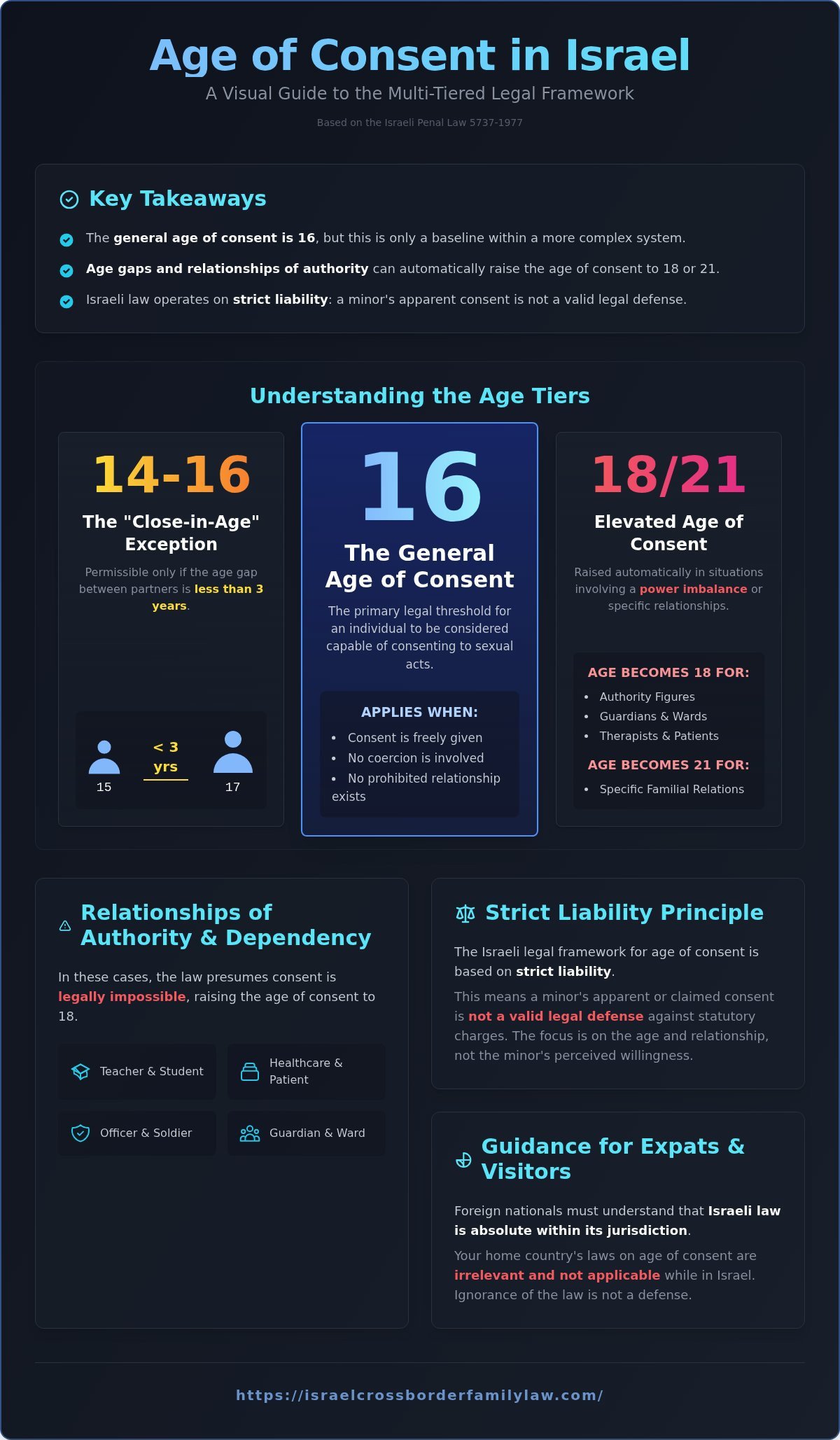
- While the general age of consent in Israel is 16, this figure is the baseline for a far more complex legal framework involving several key age thresholds.
- Learn to identify the critical factors-including significant age differences and relationships of authority-that can legally negate consent and expose individuals to severe criminal liability.
- The legal framework for the age of consent Israel operates on a strict liability basis, meaning a minor’s apparent consent is not a viable defense against statutory charges.
- Expatriates and foreign nationals must understand that Israeli law is absolute within its jurisdiction; this guide clarifies your obligations and the inapplicability of foreign legal standards.
What is the General Age of Consent in Israel?
The State of Israel establishes the baseline age for consensual sexual activity at 16 years old. This threshold, codified within the comprehensive Israeli Penal Law 5737-1977, serves as the primary legal standard for determining an individual’s capacity to consent. While this figure aligns with many international jurisdictions, the general age of consent in Israel is not an absolute figure; it is subject to a sophisticated framework of exceptions and conditions designed to protect vulnerable minors from exploitation.
Navigating this complex legal landscape requires a detailed understanding of the specific circumstances that can alter the applicable age. These nuances are critical for ensuring full regulatory compliance, particularly in situations involving age disparities or relationships of authority.
To provide a broader global context for these regulations, the following video offers a comparative overview.
The Primary Legal Threshold: 16 Years Old
At the age of 16, an individual is legally presumed capable of consenting to sexual acts. This is the most commonly cited figure for the age of consent israel and applies to the majority of scenarios, provided that the consent is given freely and without coercion. The validity of this consent is contingent upon the absence of any prohibited relationships or exploitative circumstances, such as those involving authority or dependency, which are addressed under separate, stringent provisions of the Penal Law.
The Nuance of Ages 14 to 16
The Israeli legal system recognizes a specific, limited exception for minors between the ages of 14 and 16. Under this “close-in-age” provision, sexual relations are not considered a criminal offense if the age difference between the minor and their partner is less than three years. It is imperative to understand that this is a narrow statutory exception designed for relationships between peers and does not grant a general license for adults to engage in sexual activity with minors in this age bracket.
When the Age of Consent is Raised to 18 or 21
The law automatically elevates the age of consent to 18 in circumstances involving a power imbalance or a fiduciary relationship. These situations are strictly defined and include relationships where one party is in a position of authority, dependency, care, or education over the minor. Furthermore, for specific familial relationships, the age of consent is raised even higher to 21 to provide maximum protection. Key examples where the age of consent is raised to 18 include:
- A teacher and their student
- A healthcare provider or therapist and their patient
- A commanding officer and a subordinate soldier
- A legal guardian or social worker and their ward
Key Factors That Modify the Age of Consent
While the general age of consent is established, Israeli law provides a sophisticated framework that recognizes specific circumstances where a minor’s consent is considered legally invalid. These provisions are not arbitrary; they are meticulously designed to protect vulnerable individuals from exploitation by addressing power imbalances and inherent dependencies. Understanding these modifying factors is crucial, as the Penal Law does not recognize ignorance of these statutes as a viable legal defense. The core principle is that in certain relationships, true and free consent is presumed to be impossible, thereby elevating the legal protections afforded to the minor.
The ‘Close-in-Age’ Exception (The Three-Year Rule)
A significant statutory exception exists for consensual relations involving a minor between the ages of 14 and 16. Under this provision, the act is not considered a criminal offense if the age difference between the two individuals is less than three years. For example, a relationship between a 17-year-old and a 15-year-old would typically fall within this exception. However, this rule is strictly limited and does not apply if the older partner has reached the age of 18, at which point the standard age of consent israel regulations apply without exception.
Relationships of Authority and Dependency
The law takes a stringent position on relationships characterized by a significant power imbalance. When an individual is in a position of authority, trust, or dependency over a minor, the age of consent is automatically raised to 18. This includes, but is not limited to, relationships such as:
- Teacher and student
- Doctor or therapist and patient
- Coach and athlete
- Employer and employee
The law presumes that genuine consent cannot be given due to the inherent power dynamic, classifying such an act under the legal principle of Forbidden intercourse despite consent. In cases involving mental health care providers, the protection is even greater, with the age of consent raised to 21.
Prohibited Familial Relationships
In circumstances involving familial relations, consent becomes legally irrelevant due to overarching incest laws. These statutes represent an absolute legal prohibition designed to protect family integrity and prevent exploitation. For a minor’s parent, grandparent, or sibling, the age of consent is 21. For other relatives, such as an uncle or aunt, the age of consent is 18. These regulations are among the strictest in the legal code, reflecting the state’s profound interest in safeguarding minors within the family unit.
Statutory Offenses and Their Legal Consequences
Violations of the age of consent in Israel are classified as serious criminal offenses under the Israeli Penal Law. In this legal framework, any sexual act with a person below the legally defined age of consent constitutes a statutory offense, often referred to as ‘statutory rape’. This is a strict liability crime, meaning the minor’s perceived consent or willingness to participate is legally irrelevant and cannot be used as a defense. The Israeli legal system treats these matters with utmost seriousness, and the complexities are magnified in cross-border legal disputes involving foreign nationals or multi-jurisdictional families.
Penalties for Violations of Consent Laws
The legal consequences for contravening consent laws are severe and primarily involve significant terms of imprisonment. Sentences are not uniform; they are determined based on several factors, including the age of the minor and the specific nature of the act. As detailed in official publications like the Israeli Ministry of Justice Report on Child Protection Laws, the law stipulates the harshest penalties for sexual intercourse with a minor under the age of 14, reflecting the state’s commitment to protecting its most vulnerable.
Implications in International Family Law
An accusation related to the age of consent in Israel can have devastating and immediate consequences in the realm of international family law. Such allegations often become a determining factor in child custody and visitation rights proceedings, potentially leading to a complete loss of parental access. For foreign nationals residing in Israel, a conviction can result in deportation and a permanent ban from re-entering the country. These issues add another layer of complexity when navigating divorce for international families, where legal statuses and parental rights are already under intense scrutiny.
The Importance of a Strong Legal Defense
Facing such a grave accusation necessitates immediate and expert legal counsel. A defense attorney with deep experience in Israeli Penal Law is essential for navigating the intricate procedures of the Israeli court system. A robust defense strategy requires a sophisticated understanding of evidence rules, prosecutorial standards, and the nuances of criminal procedure. Securing skilled representation at the earliest possible stage is paramount to protecting one’s rights and future. If you are facing such a complex legal challenge, it is critical to seek professional legal guidance immediately.
Guidance for Expats and Foreign Nationals in Israel
Navigating the legal framework of a foreign country presents unique and often complex challenges. For expats, international students, and foreign nationals residing in or visiting Israel, understanding your obligations under local law is not merely advisable-it is mandatory. This is particularly critical when dealing with sensitive matters such as consent, where misinterpretations can lead to severe legal consequences. The following guidance is designed to provide clarity and help you avoid potential legal complications.
Jurisdiction: Israeli Law Applies to Everyone
A fundamental principle that all foreign nationals must understand is that Israeli law applies universally to every individual within its territorial borders. Your foreign citizenship does not confer immunity or special status. Whether you are a tourist on a short visit, an international student, or a long-term resident, you are subject to the same legal statutes as Israeli citizens. It is a critical error to assume that the laws of your home country, including those concerning the age of consent israel, are applicable here.
Cultural Norms vs. Legal Statutes
While Israel has a diverse and modern social landscape, it is imperative to distinguish between perceived cultural norms and the explicit letter of the law. Social attitudes can be misleading and offer no defense in a court of law. The only reliable source for your conduct is the Israeli Penal Law itself. When there is any ambiguity or doubt regarding the legality of a relationship or interaction, the most prudent course of action is always to err on the side of caution and strict legal compliance.
When to Seek Professional Legal Advice
Proactive legal counsel is the most effective strategy for mitigating risk. If you have questions about your specific circumstances, particularly if you are in a relationship with a notable age difference, it is highly recommended to seek professional guidance before a legal issue arises. Our firm provides specialized and confidential legal services for expats and foreign nationals facing complex family and criminal law issues in Israel. Understanding the nuances of the law is essential for your protection.
For a comprehensive consultation regarding the age of consent in Israel or other cross-border legal matters, contact our legal team today.
Navigating Israel’s Complex Consent Laws with Confidence
As this guide has demonstrated, the legal landscape surrounding the age of consent israel is far more complex than a single statute. The law establishes a baseline but introduces critical modifications based on factors such as the age gap between individuals, the existence of a relationship of authority or trust, and the context of the relationship. Misunderstanding these nuances can lead to severe legal consequences, creating significant challenges, especially for expatriates and foreign nationals who must navigate an unfamiliar judicial system.
Given the gravity of these matters, securing expert legal counsel is paramount. Our firm possesses extensive experience in representing international clients in sensitive, cross-border family law cases, providing the confidential and strategic legal guidance necessary to protect your rights. We are committed to offering a clear path forward through these intricate legal situations. If you are facing uncertainty or require legal assistance, we invite you to Schedule a Confidential Case Review with Our Legal Team. Taking this decisive step can provide the clarity and protection you need.
Frequently Asked Questions
What is the exact age of consent in Israel for a tourist?
The legal framework governing the age of consent in Israel applies uniformly to all individuals within its jurisdiction, irrespective of their nationality. For tourists, the general age of consent is 16 years old. However, this is subject to specific conditions, particularly concerning age differences and relationships of authority. Foreign nationals are held to the same legal standards as Israeli citizens, and ignorance of local statutes does not constitute a valid legal defense in these complex cross-border matters.
Is there a ‘Romeo and Juliet’ law or close-in-age exception in Israel?
The Israeli Penal Law includes a statutory provision that functions as a close-in-age exception, often analogized to ‘Romeo and Juliet’ laws in other jurisdictions. This exception applies when both individuals are between the ages of 14 and 16. Provided the age difference between the parties does not exceed three years and the relationship is consensual without exploitation or abuse of authority, the act is generally not considered a criminal offense under the prevailing legal framework.
What is the difference between the age of consent and the age of majority in Israel?
In Israeli jurisprudence, the age of consent and the age of majority are distinct legal concepts with different applications. The age of consent pertains specifically to the legal capacity to engage in sexual activity, generally set at 16. Conversely, the age of majority is 18, which is the threshold at which an individual is granted full legal rights and responsibilities, including the right to vote, enter into binding contracts, and act without parental legal supervision.
Are Israel’s age of consent laws gender-neutral and do they apply to same-sex relationships?
Israel’s legal framework regarding sexual offenses is drafted in a comprehensively gender-neutral manner. The statutes do not differentiate based on the gender or sexual orientation of the individuals involved. Consequently, the laws apply with equal force to both heterosexual and same-sex relationships, ensuring that legal protections and prohibitions are uniformly enforced. This reflects a modern and inclusive approach to regulatory compliance in this sensitive area of law.
What should a foreigner do if they are questioned or accused of a crime related to the age of consent?
Should a foreign national be questioned or face accusations related to Israel’s age of consent laws, it is imperative to immediately exercise the right to remain silent. Do not provide any statements to law enforcement authorities without legal representation. The most critical first step is to request a lawyer. Additionally, we advise contacting your country’s embassy or consulate for consular assistance. Navigating these complex legal challenges requires immediate and sophisticated legal guidance to protect your rights.

Article by
Gabriel Lior
A Personal Journey That Became a Mission
The advisory was founded by an American father Gabriel Lior, LLB, MBA , global entrepreneur, and cross-border advisor who spent more than a decade navigating the Israeli family court system firsthand and now lives in Singapore with his son.
As a divorced parent in a cross-border family, Gabriel faced nearly every legal challenge a foreign parent can encounter in Israel — including child custody disputes, child support proceedings, property matters in Israel and abroad, false accusations, and complex immigration and relocation proceedings.
Over the years, he learned the hard way how difficult it is for non-Israeli parents to understand the system, identify the right legal strategy, and choose the right legal representation — especially when language, culture, and jurisdictional differences are involved. He also witnessed how foreign parents and new immigrants are often disadvantaged or taken advantage of by service providers and institutions simply because they lack local knowledge or fluency.
From Client to Advisor
To truly understand — and survive — the system, Gabriel pursued formal legal education in Israel, completing two Israeli law degrees, alongside a BA and MBA earned in the United States. This was never about becoming a practicing attorney, but about gaining a deep, structural understanding of how the system works — and where it breaks down for foreign parents.
This rare combination of:
Firsthand client experience
Israeli legal and US business education
International business and negotiation training
Decades of commercial execution
created a unique perspective – one that understands both sides of the table.
After years of litigation, persistence, and at times self-representation, he ultimately succeeded in securing custody of his son and relocating abroad through a rare legal victory in the Israeli Supreme Court — becoming one of the first fathers in Israel to do so under these circumstances.
Disclaimer
Important Disclaimer:
The information provided on this website and in its content is for general informational and educational purposes only and does not constitute legal advice, legal opinion, or legal representation.
Gabriel Lior is not licensed to practice law in Israel (nor is he interested in doing so) and does not provide legal services, despite having completed 2 Law Degrees. The services offered are advisory in nature and are intended to provide general guidance, strategic insight, and information regarding cross-border family law considerations.
No attorney-client relationship is formed by accessing this website, reading its content, or communicating with us.
Any decisions made based on this information are at your own discretion and risk. For legal advice specific to your situation, you should consult a licensed attorney in the relevant jurisdiction.
Where appropriate, we may refer clients to independent, licensed attorneys or professionals. Such referrals do not constitute legal representation and no liability is assumed for services provided by third parties.