For international families with assets in both the United States and Israel, the process of real estate division in international divorce presents a uniquely complex challenge. The fear of losing a property located thousands of miles away, coupled with profound confusion over which court holds jurisdiction, can be overwhelming. You may be asking: Will an Israeli court recognize a U.S. judgment? How is a property in Herzliya valued for a court in California? These are not just legal questions; they are strategic crossroads that will define your financial future.
This guide is designed to provide clarity amid the complexity. We will break down the critical challenges you will face when dividing property between the U.S. and Israel for 2026. You will gain a clear understanding of the key legal battlegrounds, from determining the correct jurisdiction to the practicalities of enforcing court orders across borders. Our goal is to equip you with a strategic roadmap, empowering you to make calm, informed decisions about your assets, your representation, and your path forward.
Key Takeaways
Understand that a court in one country cannot directly control property in another, making the choice of where to file your divorce a critical first step.
Discover why a divorce decree from one country must be officially recognized by the other before it can be used to divide or sell local property.
Develop a clear strategy for your real estate division in international divorce by learning how to navigate the key challenges of jurisdiction, valuation, and enforcement.
Identify the essential documents you need to gather for both your US and Israeli properties, such as deeds and mortgage records, to build a strong foundation for your case.
Table of Contents
The Core Challenge: Why Dividing Real Estate Across Borders is So Complex
Choosing the Forum: Which Court Will Decide Your Property’s Fate?
Valuation and Division: Establishing What the Property is Worth
Building Your Strategy: How to Approach Real Estate Division with Clarity
The Core Challenge: Why Dividing Real Estate Across Borders is So Complex
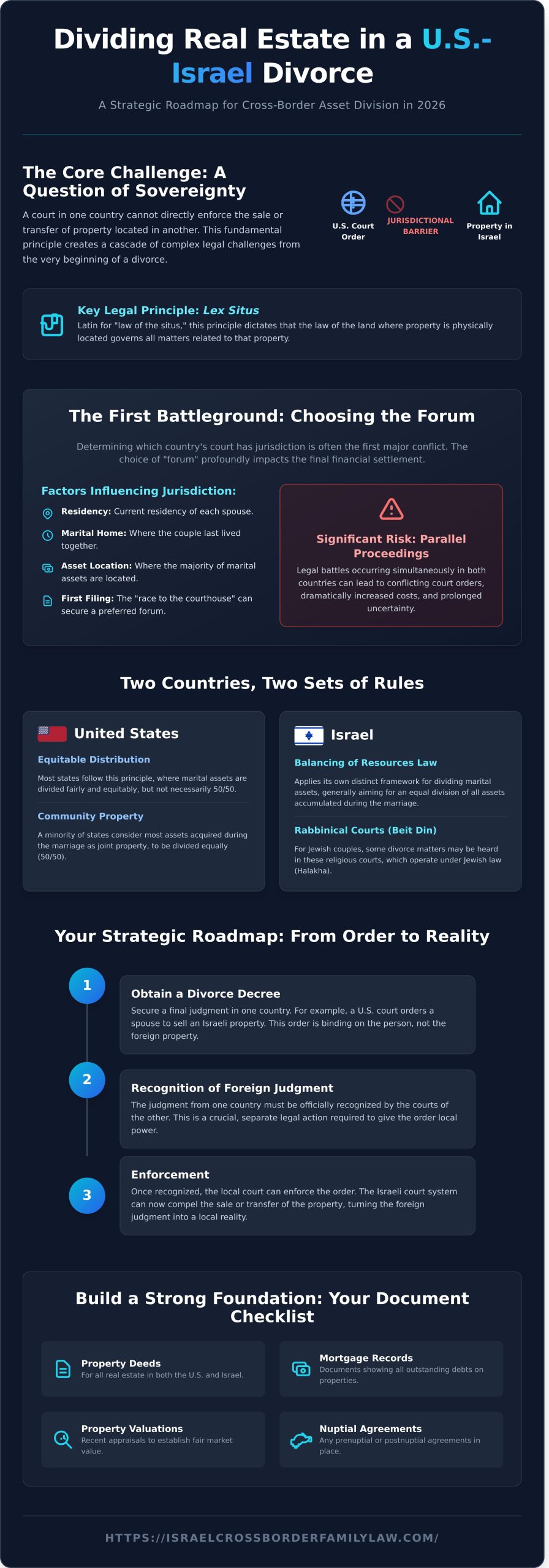
When a marriage ends, dividing assets is a primary task. However, when those assets include real estate in different countries, the process becomes exponentially more complex. The central issue is one of sovereignty: a court in one country, such as the United States, cannot issue an order that directly enforces the sale or transfer of a property located in another country, like Israel. This fundamental limitation creates a cascade of strategic challenges from the very beginning of the divorce proceedings.
To better understand the jurisdictional complexities involved when a spouse is abroad, the following video provides a helpful overview:
This reality is governed by a long-standing legal principle known as Lex Situs, or the "law of the situs," which dictates that the law of the land where the property is physically located governs all matters related to that property. Understanding these foundational international matrimonial law principles is the first step in navigating the intricate process of cross-border asset division. The entire challenge is a common and difficult issue in any divorce for international families.
Jurisdiction: The First and Most Critical Battleground
Jurisdiction is simply the court’s legal power to hear a case and make binding decisions. In an international divorce, determining which country’s court has jurisdiction is often the first major conflict. This decision is influenced by several factors, including where the couple last lived together, the current residency of each spouse, where the divorce was filed, and the location of the property. A significant risk is the initiation of parallel proceedings, where legal battles over the same divorce occur simultaneously in both countries, leading to conflicting orders and increased costs.
Conflicting Legal Systems: US vs. Israel
The outcome of your real estate division in international divorce can vary dramatically depending on which country’s laws are applied. For example, many US states follow either "equitable distribution" or "community property" rules for dividing marital assets. In contrast, Israel applies its "Balancing of Resources Law," which has its own distinct framework. Furthermore, some divorce matters in Israel may be heard in the Rabbinical Courts (Beit Din), which operate under religious law. Choosing the right forum is a critical strategic decision that will profoundly impact the final financial settlement.
Choosing the Forum: Which Court Will Decide Your Property’s Fate?
When a marriage with assets in both the United States and Israel dissolves, one of the first and most critical strategic decisions is determining which country’s courts will have jurisdiction. This choice of "forum" can significantly impact the outcome of your case. There is often a "race to the courthouse," where the first spouse to file a claim can secure jurisdiction in their preferred country. However, this is not an absolute rule; courts will still assess whether they are the appropriate venue to handle the matter.
A well-drafted prenuptial or postnuptial agreement can preempt this conflict by including a "choice of forum" clause, which designates a specific court system to handle any future disputes. In the absence of such an agreement, a court will consider several factors to determine if it has jurisdiction over foreign property, including the residency of each spouse, the location of the majority of the marital assets, and where the couple spent most of their married life. Making an informed decision at this stage is fundamental to the entire process of real estate division in international divorce.
Filing in the United States: What to Expect
A U.S. court can exercise jurisdiction over the individuals involved and order a spouse to sell or transfer title to a property located in Israel. However, that U.S. court order has no direct power within Israel’s sovereign borders. Enforcing the order relies either on the voluntary cooperation of the other spouse or initiating a separate, secondary legal action in Israel to have the U.S. judgment recognized. This complex process highlights the challenges of cross-border enforcement.
Filing in Israel: The Family Court and Rabbinical Court
Israeli courts are well-versed in handling complex cases involving assets held abroad by Israeli citizens or residents. The country offers two parallel systems for family law: the civil Family Court and the religious Rabbinical Court (Beit Din). The choice between them can affect the speed, process, and outcome of the property division. This is a particularly vital consideration for expats and foreign nationals, who must navigate these distinct legal frameworks when addressing their international assets.
Valuation and Division: Establishing What the Property is Worth
Before any property can be divided, its value must be accurately determined. This fundamental step becomes profoundly more complex in a cross-border divorce. The practical challenge is not just getting an appraisal, but getting a credible, defensible valuation for a property located an ocean away, in a different currency, and under a different legal and tax system. Furthermore, currency fluctuations between the Israeli Shekel (ILS) and the US Dollar (USD) can significantly impact the final value of the total asset pool, requiring careful timing and strategic financial planning.
The Cross-Border Appraisal Process
Securing a reliable valuation requires a qualified, often bilingual, appraiser familiar with both the local Israeli market and the evidentiary standards of a foreign court. A crucial early decision is whether to agree on a single, neutral appraiser or to engage in a "battle of the experts," where each side presents a competing report. While a joint appraisal is often more efficient, a separate one may be a strategic necessity. A comprehensive valuation must also factor in local liabilities, including property taxes, transfer fees, and potential capital gains tax (Mas Shevach in Israel). Understanding the nuances of an international appraisal of foreign real estate is critical to ensure the net equity-the true value available for division-is correctly calculated.
Common Division Scenarios for US-Israel Couples
Once fair market values are established, the actual real estate division in international divorce can be structured. For couples with assets in both the United States and Israel, the division typically unfolds in one of three ways:
Asset Swapping: One spouse keeps the US home, while the other retains the Israeli apartment. This is a clean solution when the properties have similar net equity, allowing each party to maintain a home in their respective country of residence.
Sale and Split: The court may order both the US and Israeli properties sold. After settling mortgages and accounting for all cross-border taxes and fees, the net proceeds are pooled and divided between the spouses according to the court’s judgment or the couple’s settlement agreement.
Transactional Buyout: One spouse buys out the other’s interest in a property. This often involves complex international financing, such as securing a mortgage in Israel for ₪2,000,000 to purchase the other spouse’s share of a family home in Ra’anana, a process with different rules and requirements than US lending.
Enforcement: Turning a Court Order into a Reality
Securing a court order for your property settlement is a major milestone, but it is often not the final step in a cross-border case. A divorce decree, including provisions for property, issued in one country is not automatically enforceable in another. To become legally binding, the judgment must first go through a formal process known as ‘recognition’ or ‘domestication’ in the country where the real estate is located. This is a critical consideration for any successful real estate division in international divorce.
This enforcement is a separate and distinct legal proceeding that requires additional time and resources. A foreign court will not simply rubber-stamp the original order; it will scrutinize the judgment to ensure it meets local legal standards. Common grounds for a court to refuse enforcement include:
Public Policy Objections: The judgment contradicts the fundamental legal or moral principles of the enforcing country.
Lack of Due Process: The court finds that one party was not given proper notice of the proceedings or a fair opportunity to present their case.
Fraud or Jurisdictional Issues: The original judgment was obtained by fraud, or the court that issued it did not have proper jurisdiction over the matter.
Enforcing a US Judgment in Israel
To enforce a U.S. judgment concerning Israeli property, you must file a new claim in an Israeli court seeking its recognition and enforcement. The Israeli court’s role is not to re-litigate the divorce but to verify that the U.S. proceedings were fair and procedurally sound. It will examine whether the American court had proper jurisdiction and if both parties had an adequate opportunity to be heard. Enforcement can be denied if the U.S. order fundamentally contradicts Israeli public policy, a complex area requiring careful navigation.
Enforcing an Israeli Judgment in the US
The process for enforcing an Israeli judgment in the United States is governed by individual state law, often based on the Uniform Foreign Money-Judgments Recognition Act. This process is generally straightforward if the Israeli court had clear jurisdiction over the parties and the matter. However, challenges can arise. If one spouse can successfully argue they were not given proper notice or a fair chance to present their case in Israel, a U.S. court may decline to enforce the order related to the real estate division in international divorce.
Building Your Strategy: How to Approach Real Estate Division with Clarity
Navigating the division of property across different countries requires a fundamental shift in mindset. Success is not achieved through reactive litigation but through a proactive, meticulously planned strategy. The key is to develop a single, overarching plan that coordinates your legal teams in Israel and abroad, ensuring all actions are aligned toward a common objective. This approach transforms a potentially chaotic, multi-jurisdictional conflict into a managed process.
The first practical step is gathering all essential property documents, including deeds, mortgage statements, and tax records for every asset. The second is to understand your full range of options-from negotiation to litigation in various jurisdictions-before committing to a specific legal path. This initial phase of information-gathering and strategic planning is critical for maintaining control over the outcome.
The Role of a Cross-Border Advisory
It is essential to distinguish between legal representation and strategic advisory. Legal representation executes specific tasks within a court system. A cross-border advisory, however, provides the high-level strategic framework before you engage lawyers. An advisor helps you understand the complex legal landscape, vet the right attorneys for your specific needs, and make informed decisions based on a clear analysis of risks and potential outcomes. You can learn more about how this advisory process works and its role in building a coherent plan.
Your Action Plan for Clarity
A clear action plan is the foundation for a successful real estate division in international divorce. By following a structured process, you can replace uncertainty with a clear direction forward. We guide clients through three critical steps:
Create a complete inventory of all real estate assets. Document every property, its location, approximate value, and-most importantly-how it is legally titled (e.g., in one spouse’s name, jointly, or held in a trust).
Map out potential jurisdictional scenarios. Consult with an advisor to understand how courts in Israel and the other relevant country would likely handle each property, considering local laws and marital property regimes.
Use this strategic map to hire the right legal teams. Armed with a clear strategy, you can interview and select lawyers who have the precise experience needed for your case and can execute your pre-defined plan effectively.
By defining your strategy first, you ensure that you are not just reacting to events but are actively directing the course of your divorce proceedings. This clarity is the most valuable asset you can have. Get clarity before you commit. Request a confidential consultation.
Navigating Your Path Forward with Strategic Clarity
Dividing property across US and Israeli jurisdictions is one of the most financially significant challenges in a cross-border divorce. As we have outlined, the initial decisions regarding legal forum, property valuation, and the enforcement of court orders are foundational elements that will profoundly shape your future. A successful approach to real estate division in international divorce demands meticulous, forward-thinking strategic planning before any legal action is taken.
For expats and international families facing these complex decisions, gaining a clear understanding of both legal systems is paramount. Our expertise is centered on providing this multi-jurisdictional guidance, helping you build a coherent strategy tailored to the unique circumstances of US-Israel family law. By focusing on informed choices from the outset, you can navigate this process with greater confidence and control.
Get clarity before you commit. Request a confidential consultation.
Making well-considered decisions early is the most powerful step you can take toward securing a stable financial outcome.
Frequently Asked Questions About Real Estate Division in an International Divorce
Can my spouse sell our property in Israel without my consent during a US divorce?
Generally, no. If you are a co-owner, your spouse cannot sell the property without your signature. To prevent an unauthorized sale during complex divorce proceedings, your legal advisor can place a "cautionary note" (He’arat Azhara) on the property’s title in the Israeli Land Registry (Tabu). This action effectively freezes the asset, providing crucial protection by preventing any sale or transfer until a final court order or agreement is in place, securing your interests.
What happens if the property is only in my spouse’s name?
Under Israeli law, assets acquired during a marriage are typically considered joint marital property, regardless of whose name is on the title. This is based on the Spouses’ Property Relations Law. Therefore, even if an Israeli property is registered solely in your spouse’s name, you likely hold a claim to half of its value if it was purchased during the marriage. Proving it is a marital asset is a key step in the legal process.
How are rental properties treated in an international divorce?
Rental properties are viewed as both a marital asset and a source of income, both of which are subject to division. The property’s equity will be valued and divided, and the rental income it generates must also be accounted for and shared. During proceedings, it is common to seek an interim order to have the income deposited into an escrow account, ensuring fair management until a final agreement on the real estate division in international divorce is reached.
Does it matter if we bought the property before or after we were married?
Yes, the timing is a critical factor. Property owned by one spouse before the marriage is generally considered separate property and is not automatically subject to division. However, it can become a marital asset if the other spouse contributed to its mortgage or renovation, or if its value increased due to joint efforts during the marriage. This is a nuanced area that requires a detailed factual analysis of the couple’s financial history.
Can a US court force me to sell my apartment in Tel Aviv?
A US court lacks direct jurisdiction to order the sale of property located in Israel. However, it has jurisdiction over you as a person. The court can order you to cooperate with the sale. If you fail to comply, you could face contempt of court charges in the US. The US judgment can then be submitted to an Israeli court for recognition and enforcement, which would then compel the sale under local Israeli law.
What is the difference between an Israeli Family Court and a Rabbinical Court for property division?
The Israeli Family Court operates under civil law, primarily the Spouses’ Property Relations Law, which presumes an equal 50/50 division of marital assets. The Rabbinical Court (Beit Din) applies Jewish Law (Halacha). While the Rabbinical Court is also required to apply the civil property law, its interpretation and the overall legal atmosphere can differ. The choice of forum is a highly strategic decision that can significantly impact the outcome of your case.
How long does it take to enforce a foreign property order in Israel?
Enforcing a foreign court order in Israel is a formal legal process that is not instantaneous. You must file a petition with the Israeli Family Court to have the foreign judgment recognized as a valid Israeli order. Depending on the court’s caseload and whether your spouse contests the enforcement, this process can take from several months to over a year. This timeline is a vital consideration when planning the strategy for your real estate division in international divorce.
The advisory was founded by an American father Gabriel Lior, LLB, MBA , global entrepreneur, and cross-border advisor who spent more than a decade navigating the Israeli family court system firsthand and now lives in Singapore with his son.
As a divorced parent in a cross-border family, Gabriel faced nearly every legal challenge a foreign parent can encounter in Israel — including child custody disputes, child support proceedings, property matters in Israel and abroad, false accusations, and complex immigration and relocation proceedings.
Over the years, he learned the hard way how difficult it is for non-Israeli parents to understand the system, identify the right legal strategy, and choose the right legal representation — especially when language, culture, and jurisdictional differences are involved. He also witnessed how foreign parents and new immigrants are often disadvantaged or taken advantage of by service providers and institutions simply because they lack local knowledge or fluency.
From Client to Advisor
To truly understand — and survive — the system, Gabriel pursued formal legal education in Israel, completing two Israeli law degrees, alongside a BA and MBA earned in the United States. This was never about becoming a practicing attorney, but about gaining a deep, structural understanding of how the system works — and where it breaks down for foreign parents.
This rare combination of:
Firsthand client experience
Israeli legal and US business education
International business and negotiation training
Decades of commercial execution
created a unique perspective – one that understands both sides of the table.
After years of litigation, persistence, and at times self-representation, he ultimately succeeded in securing custody of his son and relocating abroad through a rare legal victory in the Israeli Supreme Court — becoming one of the first fathers in Israel to do so under these circumstances.

Article by
Gabriel Lior
A Personal Journey That Became a Mission
The advisory was founded by an American father Gabriel Lior, LLB, MBA , global entrepreneur, and cross-border advisor who spent more than a decade navigating the Israeli family court system firsthand and now lives in Singapore with his son.
As a divorced parent in a cross-border family, Gabriel faced nearly every legal challenge a foreign parent can encounter in Israel — including child custody disputes, child support proceedings, property matters in Israel and abroad, false accusations, and complex immigration and relocation proceedings.
Over the years, he learned the hard way how difficult it is for non-Israeli parents to understand the system, identify the right legal strategy, and choose the right legal representation — especially when language, culture, and jurisdictional differences are involved. He also witnessed how foreign parents and new immigrants are often disadvantaged or taken advantage of by service providers and institutions simply because they lack local knowledge or fluency.
From Client to Advisor
To truly understand — and survive — the system, Gabriel pursued formal legal education in Israel, completing two Israeli law degrees, alongside a BA and MBA earned in the United States. This was never about becoming a practicing attorney, but about gaining a deep, structural understanding of how the system works — and where it breaks down for foreign parents.
This rare combination of:
Firsthand client experience
Israeli legal and US business education
International business and negotiation training
Decades of commercial execution
created a unique perspective – one that understands both sides of the table.
After years of litigation, persistence, and at times self-representation, he ultimately succeeded in securing custody of his son and relocating abroad through a rare legal victory in the Israeli Supreme Court — becoming one of the first fathers in Israel to do so under these circumstances.
Disclaimer
Important Disclaimer:
The information provided on this website and in its content is for general informational and educational purposes only and does not constitute legal advice, legal opinion, or legal representation.
Gabriel Lior is not licensed to practice law in Israel (nor is he interested in doing so) and does not provide legal services, despite having completed 2 Law Degrees. The services offered are advisory in nature and are intended to provide general guidance, strategic insight, and information regarding cross-border family law considerations.
No attorney-client relationship is formed by accessing this website, reading its content, or communicating with us.
Any decisions made based on this information are at your own discretion and risk. For legal advice specific to your situation, you should consult a licensed attorney in the relevant jurisdiction.
Where appropriate, we may refer clients to independent, licensed attorneys or professionals. Such referrals do not constitute legal representation and no liability is assumed for services provided by third parties.