This article is published on an independent advisory platform and does not constitute a law firm or an attorney-client relationship.
Your US-based living trust might be essentially invisible to an Israeli bank or land registry. It’s a sobering reality for many families who assume their international legal protections move with them across the ocean. You’ve likely spent years building security for your loved ones, so the fear of mismanaging Israeli bureaucracy or watching dual-jurisdiction requirements complicate your legacy is entirely valid. Effective estate planning for expats in Israel requires more than just translating a document; it demands a strategic alignment of two very different legal systems to prevent future litigation.
This guide provides the clarity you need to protect your assets and family status across borders. We’ll walk through a focused legal roadmap that addresses the unique 2026 landscape, including the mandatory digital filing portals and the vital longevity clauses for joint accounts. You’ll gain a clear priority list of tasks to ensure your cross-border asset management is both compliant and secure. By the end of this guide, you’ll have a strategic framework to navigate the Israeli legal system with confidence and peace of mind.
Key Takeaways
- Identify the specific visa paths and residency statuses that provide the most secure legal foundation for your move to Israel.
- Understand how the “Race to Jurisdiction” affects family law and whether your current prenuptial agreements hold weight in Israeli courts.
- Secure your global legacy through effective estate planning for expats in Israel, focusing on Dual Will strategies to protect assets in both countries.
- Align your financial footprint with international compliance standards while navigating the implications of the US-Israel Tax Treaty.
- Build a proactive roadmap to prioritize urgent legal tasks and assemble a cross-border professional team before you relocate.
Establishing Residency: Legal Foundations and Visa Status
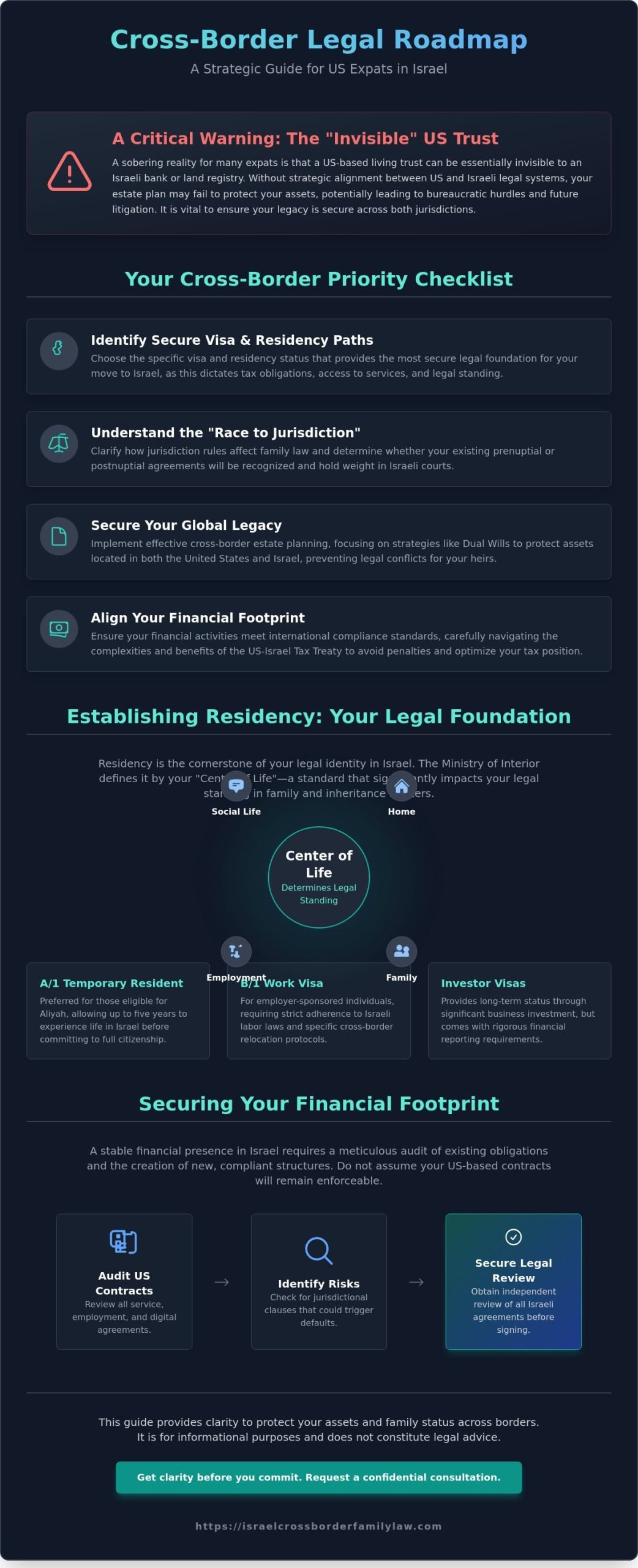
Residency is the cornerstone of your legal identity in IL. It dictates your tax obligations, access to social services, and your standing within Israel’s legal system. For those considering estate planning for expats in Israel, the specific visa you hold can influence how assets are characterized and how local courts view your long-term intentions. Choosing the right category ensures that your legal foundation remains stable as you transition between jurisdictions.
You should document your exact entry dates and maintain a clear record of your status changes from the moment you arrive. These details are vital for future social security claims and tax treaty applications under the US-Israel agreements. Dual citizenship often provides a sense of security, but it also creates a complex layer of dual obligations that require proactive management to avoid conflicting legal demands.
To understand how these residency factors influence your broader financial and legacy strategy, watch this helpful video:
Common Visa Categories for US Expats
- A/1 Temporary Resident: This is often the preferred route for those eligible for Aliyah who wish to experience IL life for up to five years before committing to full citizenship.
- B/1 Work Visa: This category is for employer-sponsored individuals and requires strict adherence to labor laws and specific cross-border relocation protocols.
- Investor Visas: These allow for long-term status through significant business commitments, though they come with rigorous reporting requirements and specific capital thresholds.
The Legal Reality of Residency
The Ministry of Interior defines residency based on an individual’s “center of life”, a standard determined by the physical location of one’s home, family, employment, and social interests within IL territory. This “center of life” test is critical because it can impact your standing in matters concerning international families and family court proceedings. If a court determines your life is centered in IL, local laws may take precedence over foreign ones in matters of guardianship or inheritance.
Your initial procedural steps involve visiting the Misrad HaPnim (Ministry of Interior) shortly after arrival to ensure your residency is correctly recorded. Temporary residency provides a path to stability, but permanent residency offers a more fixed legal status that does not require frequent renewals. Understanding these distinctions is a vital part of estate planning for expats in Israel, as your status determines which jurisdictional rules apply to your global estate.
Securing Your Financial Footprint and Contractual Clarity
Establishing a stable financial presence in IL requires a meticulous audit of your existing obligations and the creation of new, compliant structures. Many expats mistakenly assume that their US-based contracts will remain enforceable or practical after relocation. You should review all current service agreements, employment contracts, and digital subscriptions to identify jurisdictional clauses that may trigger defaults or service interruptions upon your move. Securing an independent legal review of every local agreement is a mandatory safeguard to ensure that Israeli contractual nuances don’t undermine your broader financial stability.
This level of scrutiny is a vital component of estate planning for expats in Israel, as your contractual liabilities directly affect the net value of your global estate. The U.S. Department of State travel information for Israel emphasizes that local laws can differ significantly from those in the US, particularly regarding property and personal status. Consequently, your financial footprint must be built on a foundation of local compliance and international transparency.
Navigating Israeli Real Estate Contracts
Whether you are renting an apartment in Tel Aviv or purchasing a home in Jerusalem, never sign a contract without a dedicated review by a professional familiar with legal protections for foreign nationals. Israeli real estate law includes standard clauses regarding maintenance responsibilities and “force majeure” that often surprise US citizens. Furthermore, your housing contract serves as primary evidence for the Ministry of Interior when determining your “center of life” for residency and tax purposes. Ensure that the names and dates on these documents align perfectly with your official residency filings.
Banking and Cross-Border Financial Flow
Opening an Israeli bank account involves navigating strict international wire compliance and reporting standards. Due to FATCA and FBAR requirements, Israeli banks demand extensive documentation from US citizens to prevent tax evasion. You must also establish clear protocols for receiving US-based income, such as social security, private pensions, or alimony, to ensure these funds aren’t flagged or frozen by compliance departments. It’s also critical to recognize that a US-based Power of Attorney is almost never accepted by Israeli financial institutions; banks typically require their own specific forms or a locally executed Continuous Power of Attorney.
Gaining clarity on your financial obligations before you commit to a major contract can prevent long-term jurisdictional disputes and protect your family’s assets across borders.
Managing Family Law and Cross-Border Protection Strategies
While most relocation guides focus on the logistics of shipping and schooling, the legal framework governing your family is often the most critical factor in long-term stability. Moving to IL introduces your family to a unique legal landscape where civil and religious laws frequently intersect. Just as estate planning for expats in Israel involves protecting financial assets, it must also include a proactive strategy for protecting your family’s legal status across borders. Failing to align your US-based family documents with Israeli standards can lead to significant friction if your personal circumstances change.
One of the most distinct features of the Israeli system is the “Race to Jurisdiction.” This concept refers to the dual-court system where both the Civil Family Court and the Rabbinical Court may have the authority to hear cases involving marriage and divorce. The court where a motion is first filed often secures the right to decide on various aspects of the case, including property division and support. For international families, this “race” can create a strategic disadvantage if they aren’t prepared. Understanding the nuances of divorce and separation for international families is essential before you establish your center of life in IL.
Prenuptial Agreements and Financial Stability
You shouldn’t assume that a prenuptial or postnuptial agreement drafted in the US will be automatically enforceable in an Israeli court. Under the Spouses (Property Relations) Law, a financial agreement (Heskem Mamon) generally requires a specific type of validation by a judge or a notary to be legally binding. Without this local validation, your pre-marital assets could be subject to the Israeli “Balance of Resources” regime, which typically favors an equal split of assets accumulated during the marriage. To prevent the unintended commingling of assets, families should seek a local mirror agreement that reflects their original US intentions while meeting IL procedural requirements.
International Custody and The Hague Convention
Relocating with children involves a complex set of rights regarding international custody and relocation. Both IL and the US are signatories to the Hague Convention on the Civil Aspects of International Child Abduction. This means that moving a child to or from IL without the clear, documented consent of the other parent can be legally classified as “wrongful removal” or “wrongful retention.” Even if you have a US court order, you must ensure it’s recognized locally to avoid complications. Parents should maintain updated travel consent forms and ensure all travel documents are secured. This level of preparation is as vital to your family’s security as any other element of estate planning for expats in Israel.
Finally, you must plan for the continuity of support payments. If you’re receiving or paying alimony or child support in the US, these obligations don’t disappear when you cross the border. You need to establish legal and banking protocols to ensure these payments continue without interruption, avoiding potential claims of default in either jurisdiction. Strategic clarity in these areas ensures that your family remains protected regardless of where you call home.
Estate Planning for Expats in Israel: Protecting Cross-Border Assets
Estate planning for expats in Israel is the strategic alignment of cross-border legal instruments to ensure that a legacy built in one jurisdiction is seamlessly recognized and protected in another. Many international families operate under the misconception that a standard US will is sufficient to cover assets located in IL. However, Israeli law follows the “Situs” rule, meaning local law governs all assets physically located within the country. Relying on a foreign document without a local counterpart often leads to bureaucratic gridlock and significant delays in asset distribution.
A primary objective of your strategy should be the implementation of a Dual Will approach. This involves maintaining a US will for your North American assets and a localized Israeli will for assets such as real estate or bank accounts in IL. While Israel does not have an inheritance or estate tax, you must account for the 25% capital gains tax (Mas Shevach) that applies when an inherited asset is sold. Unlike the US system, Israel does not offer a “step-up in basis,” meaning the tax is calculated from the original purchase price paid by the deceased, which can create a substantial liability for heirs if not planned for correctly.
You must also update beneficiary designations on your US-based retirement and brokerage accounts to reflect your expat status. Simultaneously, you should appoint legal guardians for minor children. These appointments must be documented in a way that satisfies both the US courts and the Israeli Ministry of Justice to ensure continuity of care regardless of where a crisis might occur.
The Israeli Probate Process
The Israeli Registrar of Inheritance Affairs has moved to a mandatory digital-only submission process for all petitions involving foreign residents as of May 2026. For a foreign will to be recognized, you must provide a “Foreign Law Expert Opinion,” which typically costs between ₪3,000 and ₪7,000. The timeline for obtaining a succession or probate order for non-residents is significantly longer than for locals, often taking 8 to 12 months. This process includes a mandatory notice to creditors published in an Israeli newspaper, which costs ₪215 as of current 2026 regulations.
Trusts and Asset Protection
US-style living trusts often present challenges when interacting with Israeli institutions. Israeli land registries and banks frequently struggle to recognize the legal structure of a foreign trust, which can lead to difficulties in transferring property or managing accounts. If you utilize a trust, it must be reviewed to ensure it remains a functional vehicle for beneficiaries residing in IL without triggering unintended tax consequences under the US-Israel Tax Treaty. You can review pricing for advisory services to understand the costs associated with structuring these cross-border protections.
Gaining a clear understanding of these requirements is the first step toward securing your family’s future. To begin your strategy, request a confidential consultation to discuss your specific asset profile.
Executing the Relocation: Strategic Advisory and Final Steps
Relocation to IL is a complex strategic operation that extends far beyond physical logistics. You should assemble a multi-qualified professional team covering law, tax, and finance well before your departure date. This team acts as your navigational guide through the divergent requirements of both the US and Israeli systems. Prioritize your legal tasks based on imminent risk, such as immediate residency and banking compliance, versus long-term maintenance goals like the ongoing management of estate planning for expats in Israel. A final strategic review is essential to identify any remaining jurisdictional gaps that could lead to future friction.
You should maintain a centralized digital vault containing all authenticated cross-border legal documents. This ensures that whether you’re in New York or Jerusalem, you have immediate access to the records necessary to prove your status or manage your assets. To better understand the sequence of these transitions and the strategic milestones involved, you can review how it works to gain process clarity. Success in a cross-border move depends on having a clear roadmap before you commit to permanent changes in your center of life.
Choosing the Right Advisory
There’s a significant difference between a local practitioner and a cross-border specialist. A local lawyer may understand Israeli statutes but might not grasp how those laws interact with your US-based obligations. Using an advisory service helps bridge this gap by providing a high-level strategic overview. It’s vital to understand the distinction between general advisory content and formal legal representation. Advisory services focus on strategy and risk assessment, while legal services are provided by licensed attorneys under a separate, specific engagement.
Final Pre-Flight Checklist
The 30-day window before your departure is the most critical period for document preparation. You must ensure all essential documents, such as birth certificates, marriage licenses, and existing court orders, have received an Apostille. This is a specialized form of international authentication that Israeli government offices require to recognize foreign documents. Without these, you may face significant delays at the Ministry of Interior or within the court system. Remember that your residency status and the way you hold assets are the primary drivers of your legal security. Effective estate planning for expats in Israel isn’t just about a single document; it’s about the comprehensive strategy you build today to prevent cross-border litigation tomorrow.
Get clarity before you commit. Request a confidential consultation.
Securing Your Future Across Borders
A successful relocation to IL depends on more than just logistical coordination; it requires a proactive alignment of your legal and financial interests with the specific requirements of the Israeli system. You’ve seen that establishing a clear residency foundation and securing your contractual footprint are essential first steps in protecting your family’s status. By addressing the “Race to Jurisdiction” and ensuring your foreign documents are properly authenticated with Apostilles, you build a defense against future legal friction and jurisdictional disputes.
Comprehensive estate planning for expats in Israel serves as the final, critical layer of your cross-border strategy. It ensures that your global legacy remains intact and that your heirs aren’t burdened by lengthy probate delays or unrecognized trust structures. Relying on an authoritative guide for Anglo expats helps you navigate these complexities with confidence. Our advisory platform leverages decades of cross-border legal experience with a specialized focus on US-Israel family and estate law to help you make informed decisions before you depart.
Get clarity before you commit. Request a confidential consultation to align your relocation strategy with your long-term goals. Your journey to a secure life in IL begins with the right strategic preparation today.
Frequently Asked Questions
Is my US Will valid in Israel for my local assets?
A US Will is generally recognized in Israel under international treaties, but it isn’t automatically enforceable without a local probate order. To use a foreign document, you must submit a “Foreign Law Expert Opinion” to the Registrar of Inheritance Affairs, which confirms the document’s validity under US law. This process can be lengthy and expensive. Most professionals suggest estate planning for expats in Israel that includes a specific Israeli Will to handle local real estate and bank accounts.
How do I ensure my US prenuptial agreement is recognized by Israeli courts?
You ensure recognition by having the agreement validated as an Israeli Financial Agreement (Heskem Mamon) before a judge or a notary. Israeli courts don’t always accept US prenuptial agreements at face value, especially if they haven’t been notarized according to local standards. Without this validation, your assets could be subject to the “Balance of Resources” regime. It’s best to create a mirror agreement that reflects your US intentions while complying with IL procedural requirements.
What is the most important legal document to have before moving to Israel?
The most critical document is often a local Continuous Power of Attorney (CPOA), which allows a trusted person to manage your affairs if you become incapacitated. US-based Powers of Attorney are rarely accepted by Israeli banks or government offices. Having this document ensures that your medical and financial decisions remain in trusted hands. Without it, your family might face a restrictive and public court-appointed guardianship process that can last for years.
Can I be sued in Israel for US-based legal disputes?
Yes, you can be sued in Israel for foreign disputes if the local court determines it has jurisdiction over the matter or the parties involved. Once you establish a “center of life” in IL, you’re subject to the authority of local courts for many civil and family matters. This is why reviewing all US-based contracts for cross-border compliance is vital before you relocate. Strategic clarity helps you understand where your legal liabilities truly lie in both countries.
Do I need a separate lawyer for my Israeli assets and my US assets?
You generally need legal counsel in both jurisdictions or a multi-qualified practitioner licensed in both the US and IL. Because the legal systems are fundamentally different, a US attorney cannot provide formal representation in an Israeli court, and vice versa. Effective estate planning for expats in Israel relies on a collaborative team that understands how your US trusts and tax obligations interact with Israeli inheritance laws. This prevents conflicting strategies that could jeopardize your assets.
What happens to my US child support order if I move to Israel?
Your US child support order remains legally binding and can be enforced in Israel through international treaties and local court registration. IL and the US cooperate on the cross-border enforcement of support obligations to ensure continuity of care for children. If you’re the payer or recipient, you must establish secure banking protocols to move funds without triggering compliance red flags. Failing to maintain these payments can lead to legal sanctions in both jurisdictions.
How does the Race to Jurisdiction affect expats in Israel?
The Race to Jurisdiction means the court where a family law motion is first filed usually secures the authority to decide the case. In Israel, this involves a choice between the Civil Family Court and the Rabbinical Court. Each system has different rules for property division and alimony. For expats, being the second to file can result in your case being heard in a forum that’s less favorable to your specific international legal needs.
Is an Apostille always required for US legal documents in Israel?
Yes, an Apostille is almost always required for any US government-issued document to be recognized by Israeli authorities. This authentication confirms the signature and seal of the official who issued the document, such as a birth certificate or a divorce decree. Without this stamp, the Ministry of Interior or the Registrar of Inheritance may reject your filings. You should secure these authentications in the US state of issuance before you relocate to avoid delays.

Article by
Gabriel Lior
A Personal Journey That Became a Mission
The advisory was founded by an American father Gabriel Lior, LLB, MBA , global entrepreneur, and cross-border advisor who spent more than a decade navigating the Israeli family court system firsthand and now lives in Singapore with his son.
As a divorced parent in a cross-border family, Gabriel faced nearly every legal challenge a foreign parent can encounter in Israel — including child custody disputes, child support proceedings, property matters in Israel and abroad, false accusations, and complex immigration and relocation proceedings.
Over the years, he learned the hard way how difficult it is for non-Israeli parents to understand the system, identify the right legal strategy, and choose the right legal representation — especially when language, culture, and jurisdictional differences are involved. He also witnessed how foreign parents and new immigrants are often disadvantaged or taken advantage of by service providers and institutions simply because they lack local knowledge or fluency.
From Client to Advisor
To truly understand — and survive — the system, Gabriel pursued formal legal education in Israel, completing two Israeli law degrees, alongside a BA and MBA earned in the United States. This was never about becoming a practicing attorney, but about gaining a deep, structural understanding of how the system works — and where it breaks down for foreign parents.
This rare combination of:
Firsthand client experience
Israeli legal and US business education
International business and negotiation training
Decades of commercial execution
created a unique perspective – one that understands both sides of the table.
After years of litigation, persistence, and at times self-representation, he ultimately succeeded in securing custody of his son and relocating abroad through a rare legal victory in the Israeli Supreme Court — becoming one of the first fathers in Israel to do so under these circumstances.
Disclaimer
Important Disclaimer:
The information provided on this website and in its content is for general informational and educational purposes only and does not constitute legal advice, legal opinion, or legal representation.
Gabriel Lior is not licensed to practice law in Israel (nor is he interested in doing so) and does not provide legal services, despite having completed 2 Law Degrees. The services offered are advisory in nature and are intended to provide general guidance, strategic insight, and information regarding cross-border family law considerations.
No attorney-client relationship is formed by accessing this website, reading its content, or communicating with us.
Any decisions made based on this information are at your own discretion and risk. For legal advice specific to your situation, you should consult a licensed attorney in the relevant jurisdiction.
Where appropriate, we may refer clients to independent, licensed attorneys or professionals. Such referrals do not constitute legal representation and no liability is assumed for services provided by third parties.