What if the first decision you make in a custody dispute-choosing between Israel’s Family Court or a Religious Court-is the most critical one for your children’s future?
For international families, the anxiety of facing a foreign legal system is immense, especially when your relationship with your children is at stake. You’re likely concerned about unfamiliar rules, the unique authority of religious courts, and how a decision made in Tel Aviv could impact your ability to relocate years from now. This fear of a misstep within a complex, dual-jurisdiction system is a significant and valid concern.
This strategic guide is designed to replace that uncertainty with clarity. We provide a comprehensive analysis of Israeli child custody law explained for 2026, focusing on the sophisticated challenges faced by multi-national families. You will learn how Israel defines the "Best Interests of the Child," how to determine the correct court for your situation, and the steps to protect your cross-border parental rights.
Key Takeaways
Learn how Israel’s dual legal system operates and why the first person to file a custody claim often gains a significant strategic advantage.
Grasp how both Civil and Rabbinical courts apply the ‘Best Interests of the Child’ standard, and discover why their interpretations can lead to different outcomes.
Understand the strict legal requirements for relocating a child abroad from IL and the key criteria courts use when deciding whether to grant permission.
With our guide to Israeli Child Custody Law Explained, you can identify key strategic decisions to make early in the process to protect your family’s future.
Table of Contents
Understanding the Dual Legal System in IL: Civil vs. Religious Courts
The ‘Best Interests of the Child’ Standard in Israeli Custody Law
Civil Family Court vs. Rabbinical Court: Key Strategic Differences
International Custody, Relocation, and the Hague Convention in IL
Managing the Custody Process: Strategy and Informed Decisions
Understanding the Dual Legal System in IL: Civil vs. Religious Courts
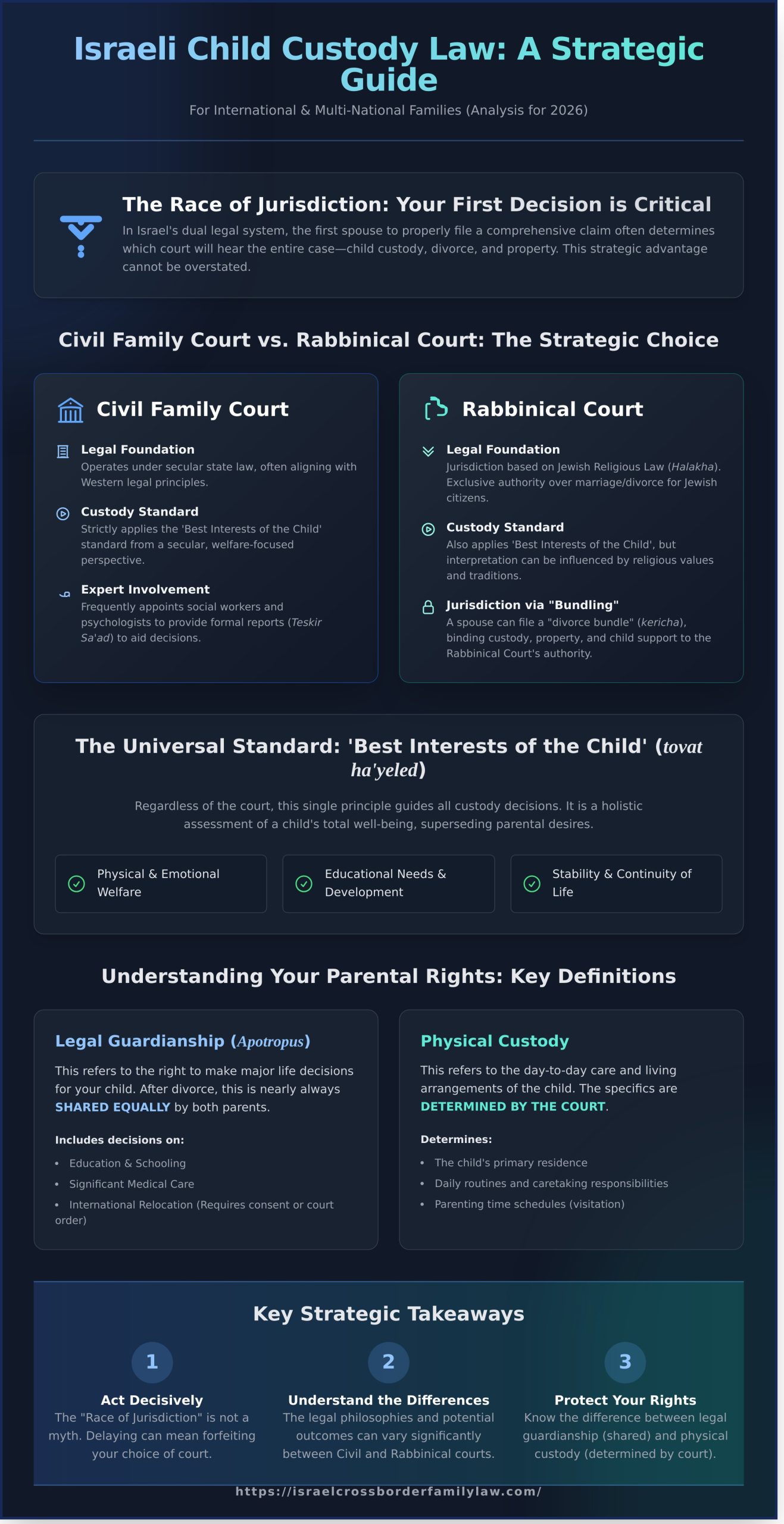
Navigating family law in Israel (IL) presents a unique challenge not found in most Western countries: a dual legal system with overlapping authority. Matters of personal status, including marriage and divorce for Jewish citizens, fall under the "concurrent jurisdiction" of two distinct court systems. This means that both the state’s Civil Family Courts and the religious Rabbinical Courts have the authority to hear your case. The court that first receives a correctly filed claim generally secures jurisdiction over the entire process, creating a high-stakes dynamic that profoundly impacts the outcome of your divorce and child custody arrangements.
This structural complexity is a core component of Israeli Child Custody Law Explained, and it is especially critical for international and cross-border families to comprehend. The legal philosophies, procedures, and even potential outcomes can differ significantly between the two venues. For families with ties to multiple countries, assets abroad, or plans for international relocation, the choice of court is not merely procedural; it is the single most important strategic decision you will make, dictating the legal landscape for years to come.
The Race of Jurisdiction: Why Early Action Matters
The concept of the "Race of Jurisdiction" is exactly what it sounds like: the first spouse to properly file a comprehensive claim often determines where the case will be heard. A spouse can file a "divorce bundle" (known as kericha) in the Rabbinical Court, which binds all related matters, including child custody and property division, to the religious legal framework. This action effectively prevents the other spouse from later opening a case in the Civil Family Court. The implications are significant, as this decision also impacts financial matters, which are governed by distinct child support laws in Israel that each court system may interpret differently. Waiting to act can mean forfeiting your ability to choose the legal system you believe is more favorable to your circumstances.
Legal Guardianship vs. Physical Custody
A crucial distinction in Israeli law is the difference between legal guardianship and physical custody. Even after a divorce, both parents almost always retain shared legal guardianship, or Apotropus. This means you both maintain equal rights and responsibilities for major decisions in your child’s life, such as those concerning education, significant medical care, and living abroad. This principle ensures that one parent cannot unilaterally alter the core aspects of a child’s upbringing. Physical custody, on the other hand, refers to the day-to-day care and living arrangements of the child. Understanding this separation is fundamental to grasping how parental rights are preserved post-divorce and is a key part of how the advisory works to build a stable co-parenting plan.
Gaining a clear understanding of this dual system is the first step toward protecting your parental rights. The initial decisions made in a cross-border divorce case carry immense weight, making informed, early action essential.
Get clarity before you commit. Request a confidential consultation.
The ‘Best Interests of the Child’ Standard in Israeli Custody Law
In any custody dispute, Israeli Family Courts operate under a single, guiding principle: the ‘best interests of the child’ (טובת הילד, tovat ha’yeled). This legal standard supersedes parental desires or perceived rights, focusing exclusively on the child’s physical, emotional, and educational welfare. It’s a holistic assessment designed to foster stability and ensure the child’s needs are met in the most supportive environment possible. The court’s entire decision-making process is filtered through this lens, making it the most critical concept in any custody proceeding.
To determine what serves a child’s best interests, the court doesn’t rely solely on parental testimony. It frequently appoints independent professionals, such as social workers or child psychologists, to conduct a comprehensive evaluation and submit a formal report (Teskir Sa’ad). This expert assesses parental capability, observes parent-child interactions, and may interview teachers, counselors, and the children themselves if they are of sufficient age and maturity. This report carries significant weight in the court’s final ruling.
For international and cross-border families, the court places significant weight on maintaining the "continuity of care." This involves a detailed analysis of the child’s established routine, educational framework, social connections, and primary language. A court will be hesitant to approve a move that disrupts a stable life without a compelling reason. The jurisdiction of Israeli courts in these family matters is well-established, a point affirmed by sources like the U.S. State Department on Israeli family law, which notes that religious courts often handle such cases. As of 2026, Israeli courts increasingly prioritize joint parental responsibility over traditional sole custody models, reflecting a modern understanding of child development.
The Evolution of the Tender Years Presumption
Historically, Israeli child custody law demonstrated a clear preference for maternal custody through the "Tender Years Presumption." This doctrine automatically presumed that mothers were the primary custodians for children under the age of six. However, this legal standard is now largely obsolete. The 2026 legal reality reflects a judiciary that has significantly weakened this presumption, recognizing that active involvement from both parents is typically in the child’s best interest. This evolution has created a more equitable legal landscape for fathers seeking equal custody rights and responsibilities.
Shared Parental Responsibility: The New Default
The modern legal framework in IL favors shared parental responsibility, but a successful arrangement requires more than just a court order. The court will assess several key factors before approving a joint custody plan, including:
Parental Communication: The ability of the parents to cooperate and communicate effectively regarding the child’s needs is non-negotiable.
Geographic Proximity: For a true 50/50 physical custody split to be practical, parents must live reasonably close to one another to facilitate school and social routines without undue disruption for the child.
Parental Fitness: The court must be satisfied that both parents can provide a safe and stable home environment.
The financial implications are also profound. Shared custody often modifies traditional child support obligations. Instead of one parent paying a fixed monthly sum (mezonot), costs are frequently calculated based on the parents’ respective incomes and the precise division of time. This can include direct sharing of major expenses like education and healthcare. Properly structuring these financial details from the outset is critical, and understanding your specific cross-border custody options can prevent significant future conflict and financial uncertainty.
Civil Family Court vs. Rabbinical Court: Key Strategic Differences
In Israel, family law matters, including child custody, are handled by a unique dual-jurisdiction system. Parents may find their case before either the secular Civil Family Court or the religious Rabbinical Court (Beit Din). The choice of venue is one of the most critical strategic decisions you will make, as it can significantly influence the procedure, atmosphere, and outcome of your case. While both courts are legally bound to apply the "Best Interests of the Child" standard, their interpretation of that principle can diverge based on their foundational philosophies.
The Civil Family Court operates under Israeli civil law and tends to align with Western legal traditions. Proceedings often rely heavily on professional evaluations, such as psychological assessments and reports from social workers. The Rabbinical Court, conversely, operates under Halakha (Jewish Law). A common misconception, particularly among international families, is that these courts are automatically biased against women or foreigners. While their framework is rooted in tradition, they are still governed by the laws of the state. The primary difference lies in emphasis; a Rabbinical court might place greater weight on factors like a child’s religious education and upbringing when determining their best interests.
The Role of Social Workers (Pkidot Sa’ad)
Regardless of the court, social workers appointed by the Ministry of Welfare, known as Pkidot Sa’ad, act as the court’s investigative arm. They are tasked with preparing a comprehensive report (taskir) that includes recommendations on custody and visitation. For cross-border families, preparing for home visits and interviews is critical. Be prepared to articulate your long-term plans, your connection to Israel, your local support network, and how you will facilitate the child’s relationship with the other parent. Navigating cultural differences is key; parenting norms from your country of origin may not align with Israeli expectations, so clarity and cooperation are essential.
Enforcement and Temporary Orders
At the outset of a dispute, temporary orders establish an immediate parenting schedule. The Civil Family Court is generally structured to issue these orders quickly and efficiently based on initial filings. The Rabbinical Court can also act decisively, though its procedures may feel less formal. A critical tool in international cases is the "Stay of Exit" order, which prevents either parent from removing a child from Israel. Both courts can grant these orders swiftly, often without the other party’s initial involvement. Should an international abduction occur, the Israeli Ministry of Justice oversees the state’s response under the Hague Convention. This is a core part of how Israeli Child Custody Law Explained works in practice to protect children.
Ultimately, selecting the appropriate court requires a careful evaluation of your personal and strategic objectives. This decision is deeply intertwined with the broader legal strategy for your separation. For a detailed overview of these related challenges, please see our guide on Divorce for International Families.
Get clarity before you commit. Request a confidential consultation.
International Custody, Relocation, and the Hague Convention in IL
Cross-border family life introduces sophisticated legal challenges, particularly when one parent wishes to move a child to another country. In the context of Israeli law, this is not a simple matter of logistics; it is a formal legal process known as “Relocation.” A parent cannot unilaterally decide to move a child abroad. Relocation requires either the explicit, written consent of the other parent or a formal court order from the Israeli Family Court. The court’s primary and overriding consideration in these multi-jurisdictional cases is always the child’s best interests.
These situations are governed by a robust international legal framework. Israel is a signatory to the Hague Convention, ensuring a legal framework for the prompt return of children wrongfully removed from their habitual residence. This treaty provides a civil mechanism to locate and return children who have been abducted by a parent and taken to another member country, reinforcing that custody disputes must be resolved in the child’s home jurisdiction.
Preventing International Child Abduction
To proactively prevent a child from being removed from Israel without permission, a parent can petition the court for a "Stay of Exit" order (Tzav Ikkul Yetzia Me’HaAretz). Once granted, this order is registered with the Israeli border police, effectively blocking the child’s departure from any port or airport. For cases where an abduction has already occurred, Israel’s Central Authority, operating within the Ministry of Justice, manages incoming and outgoing applications under the Hague Convention and Child Abduction protocols, coordinating with its international counterparts to facilitate the child’s return.
Relocation Disputes: Winning the Argument
When a parent seeks legal permission to relocate, they must present a comprehensive and convincing plan to the court. Judges scrutinize these proposals to determine if the move genuinely serves the child’s welfare. A successful argument requires a detailed analysis of the child’s future life, as this provides a complete picture for anyone seeking to have Israeli Child Custody Law Explained in a practical setting. Key factors include:
The Relocation Plan: Evidence of suitable schooling, stable housing, employment for the parent, and access to a family or community support network.
Quality of Life: A comparison of the child’s current life in Israel versus the proposed life abroad, covering educational, social, and cultural opportunities.
The Non-Relocating Parent’s Rights: A concrete and financially viable plan for maintaining the child’s relationship with the other parent, detailing visitation schedules, travel costs, and consistent video communication.
Crucially, Israeli courts often require "Mirror Orders." This means the parent seeking to move must first obtain an order from a court in the destination country that recognizes and agrees to enforce the Israeli court’s custody and visitation rulings. This provides assurance that the non-relocating parent’s rights will be protected after the child leaves Israel. Navigating the complexities of International Custody and Relocation demands meticulous preparation and a clear understanding of the court’s expectations. For anyone facing such a situation, it’s vital to understand your strategic options before taking any formal steps.
Managing the Custody Process: Strategy and Informed Decisions
Successfully navigating a child custody matter in Israel requires more than an emotional response; it demands a clear strategy built on informed decisions. The goal should always be to secure the child’s best interests while minimizing conflict and expense. Proactive measures like mediation and comprehensive financial agreements are powerful tools to bypass the uncertainty and high costs of litigation, which can often exceed ₪100,000 per parent in complex cases.
Mediation offers a structured, confidential forum to negotiate parenting plans, while a formal "Financial Agreement" (Heskem Mammon) can pre-emptively resolve disputes over assets and support. For international families, the choice of representative is paramount. Firms like Israel Cross Border Law Firm specialize in this complex area. Your advisor or attorney must possess deep, specific expertise in cross-border family law. A professional who understands only the domestic side of Israeli Child Custody Law Explained may not anticipate the critical implications of international treaties, dual citizenship, or jurisdictional conflicts.
Before initiating any formal process, parents should compile a foundational file. This preparation empowers you to make strategic choices from a position of strength. For visual guides on these topics, visit Israel Cross Border Law Firm on YouTube.
Checklist for Parents Starting the Custody Process:
Gather Essential Documents: Collect passports (yours and your children’s), birth certificates, marriage certificates, and any existing visa or residency permits.
Document Your Parental Role: Keep records of your involvement in your child’s daily life, including school communications, medical appointment logs, and photos of activities.
Outline Financials: Prepare a clear summary of your income,
Securing Your Family’s Future Across Borders
Navigating child custody in Israel isn’t just a legal process; it’s a strategic one, especially for international families. The initial choice between the Civil Family Court and the Rabbinical Court-the "Race of Jurisdiction"-can fundamentally shape your case’s outcome. For families considering a move, understanding how Israel applies the Hague Convention on international relocation is equally critical. Having the framework of Israeli Child Custody Law Explained is your essential starting point for sound decision-making.
Our advisory is built on specialized expertise in US-Israel cross-border family law. We provide a calm, objective perspective, helping you understand the complex dual-court dynamics and make informed decisions without pressure. We empower you with strategic information tailored to the unique challenges faced by expats and international families.
The most important decisions are often made at the very beginning. Get clarity before you commit. Request a confidential consultation to understand your options. Armed with the right knowledge, you can move forward with confidence.
Frequently Asked Questions About Israeli Child Custody Law
How is custody determined in Israel for non-citizens?
Custody is determined based on the child’s "habitual residence," not the parents’ citizenship status. If a child has been living in Israel for a significant period, typically six months or more, Israeli Family Courts will generally assume jurisdiction. The court’s primary and overriding principle in all decisions is the "best interest of the child" (tovat ha’yeled), regardless of whether the parents are Israeli citizens, foreign nationals, or hold dual citizenship.
Does the mother always get custody of young children in IL?
No, it isn’t automatic, though Israeli law contains a principle called the "Tender Years Presumption." This legal presumption favors granting the mother custody of children under the age of six. However, this is a rebuttable presumption, and fathers can, and often do, gain custody if it’s proven to be in the child’s best interest. Courts are increasingly ordering joint custody arrangements, reflecting a modern approach to co-parenting.
Can I move back to the US with my child without the other parent’s consent?
No. Relocating a child internationally from Israel without the other parent’s explicit, written consent or a specific court order is considered international child abduction under the Hague Convention. To legally relocate, you must either obtain a notarized agreement from the other parent or petition the Israeli Family Court for a relocation judgment. Unilateral relocation can lead to severe legal consequences, including a court order for the child’s immediate return.
What is a "Stay of Exit" order and how do I get one?
A "Stay of Exit" order is a court injunction that prevents a child, and often a parent, from leaving the country. To obtain one, a parent must file an urgent application with the Family Court or Rabbinical Court, providing evidence of a credible flight risk. These orders are often granted quickly on a temporary (ex-parte) basis to prevent potential abduction while the court fully examines the case.
How do Rabbinical courts handle custody compared to Family courts?
Family Courts have jurisdiction over all citizens, while Rabbinical Courts’ authority over custody for Jewish couples requires the consent of both parties. Both court systems are legally bound to prioritize the child’s best interest. However, Family Courts tend to rely heavily on secular, psychological evaluations from social workers. Rabbinical Courts, while also using these reports, may incorporate principles of Jewish Law (Halakha) into their decision-making framework.
What happens if a parent kidnaps a child to or from Israel?
Israel is a signatory to the Hague Convention on the Civil Aspects of International Child Abduction. If a child is wrongfully removed to Israel, the left-behind parent can file a Hague Convention application for the child’s prompt return to their country of habitual residence. Similarly, if a child is abducted from Israel to another member country, the Israeli parent can use the Convention’s framework to seek the child’s return. It’s a serious criminal offense.
How long does a typical custody battle take in the Israeli system?
The timeline depends entirely on the level of conflict. Cases where parents reach an agreement through mediation can be resolved in 2-4 months. Contested cases requiring court-appointed experts and multiple hearings often take between 12 and 24 months to reach a final judgment. A timeline this long highlights the system’s complexity when Israeli child custody law explained in practice involves high-conflict or international elements.
Are US custody orders enforceable in Israel?
Yes, but the process isn’t automatic. A US custody order must be formally recognized and enforced by an Israeli Family Court. This requires filing a specific legal action under the Foreign Judgments Enforcement Law of 1958. The Israeli court will review the US order to ensure the original court had proper jurisdiction and that enforcing the judgment does not contradict Israeli public policy or the child’s welfare.

Article by
Gabriel Lior
A Personal Journey That Became a Mission
The advisory was founded by an American father Gabriel Lior, LLB, MBA , global entrepreneur, and cross-border advisor who spent more than a decade navigating the Israeli family court system firsthand and now lives in Singapore with his son.
As a divorced parent in a cross-border family, Gabriel faced nearly every legal challenge a foreign parent can encounter in Israel — including child custody disputes, child support proceedings, property matters in Israel and abroad, false accusations, and complex immigration and relocation proceedings.
Over the years, he learned the hard way how difficult it is for non-Israeli parents to understand the system, identify the right legal strategy, and choose the right legal representation — especially when language, culture, and jurisdictional differences are involved. He also witnessed how foreign parents and new immigrants are often disadvantaged or taken advantage of by service providers and institutions simply because they lack local knowledge or fluency.
From Client to Advisor
To truly understand — and survive — the system, Gabriel pursued formal legal education in Israel, completing two Israeli law degrees, alongside a BA and MBA earned in the United States. This was never about becoming a practicing attorney, but about gaining a deep, structural understanding of how the system works — and where it breaks down for foreign parents.
This rare combination of:
Firsthand client experience
Israeli legal and US business education
International business and negotiation training
Decades of commercial execution
created a unique perspective – one that understands both sides of the table.
After years of litigation, persistence, and at times self-representation, he ultimately succeeded in securing custody of his son and relocating abroad through a rare legal victory in the Israeli Supreme Court — becoming one of the first fathers in Israel to do so under these circumstances.
Disclaimer
Important Disclaimer:
The information provided on this website and in its content is for general informational and educational purposes only and does not constitute legal advice, legal opinion, or legal representation.
Gabriel Lior is not licensed to practice law in Israel (nor is he interested in doing so) and does not provide legal services, despite having completed 2 Law Degrees. The services offered are advisory in nature and are intended to provide general guidance, strategic insight, and information regarding cross-border family law considerations.
No attorney-client relationship is formed by accessing this website, reading its content, or communicating with us.
Any decisions made based on this information are at your own discretion and risk. For legal advice specific to your situation, you should consult a licensed attorney in the relevant jurisdiction.
Where appropriate, we may refer clients to independent, licensed attorneys or professionals. Such referrals do not constitute legal representation and no liability is assumed for services provided by third parties.