The discovery that your child has been taken across international borders without your consent is a uniquely terrifying experience, leaving you feeling powerless against a foreign legal system. This fear becomes a complex legal reality when you are forced to ask, what happens if my ex takes my child to Israel? While the situation is daunting, it is critical to understand that you are not without recourse. Established international treaties, specifically the Hague Convention on the Civil Aspects of International Child Abduction, provide a powerful legal framework designed to protect your parental rights and secure the prompt return of your child. This comprehensive guide is engineered to provide immediate clarity and an actionable strategy. We will navigate you through the sophisticated legal landscape, outlining the step-by-step process for initiating a Hague Convention case in Israel. You will gain a deep understanding of your rights, the critical first actions you must take, and how to engage legal counsel with the multi-jurisdictional expertise required to effectively represent your interests in both U.S. and Israeli courts. Your fight for your child begins now, with knowledge and a clear path forward.
Immediate Steps to Take: Your First 72 Hours
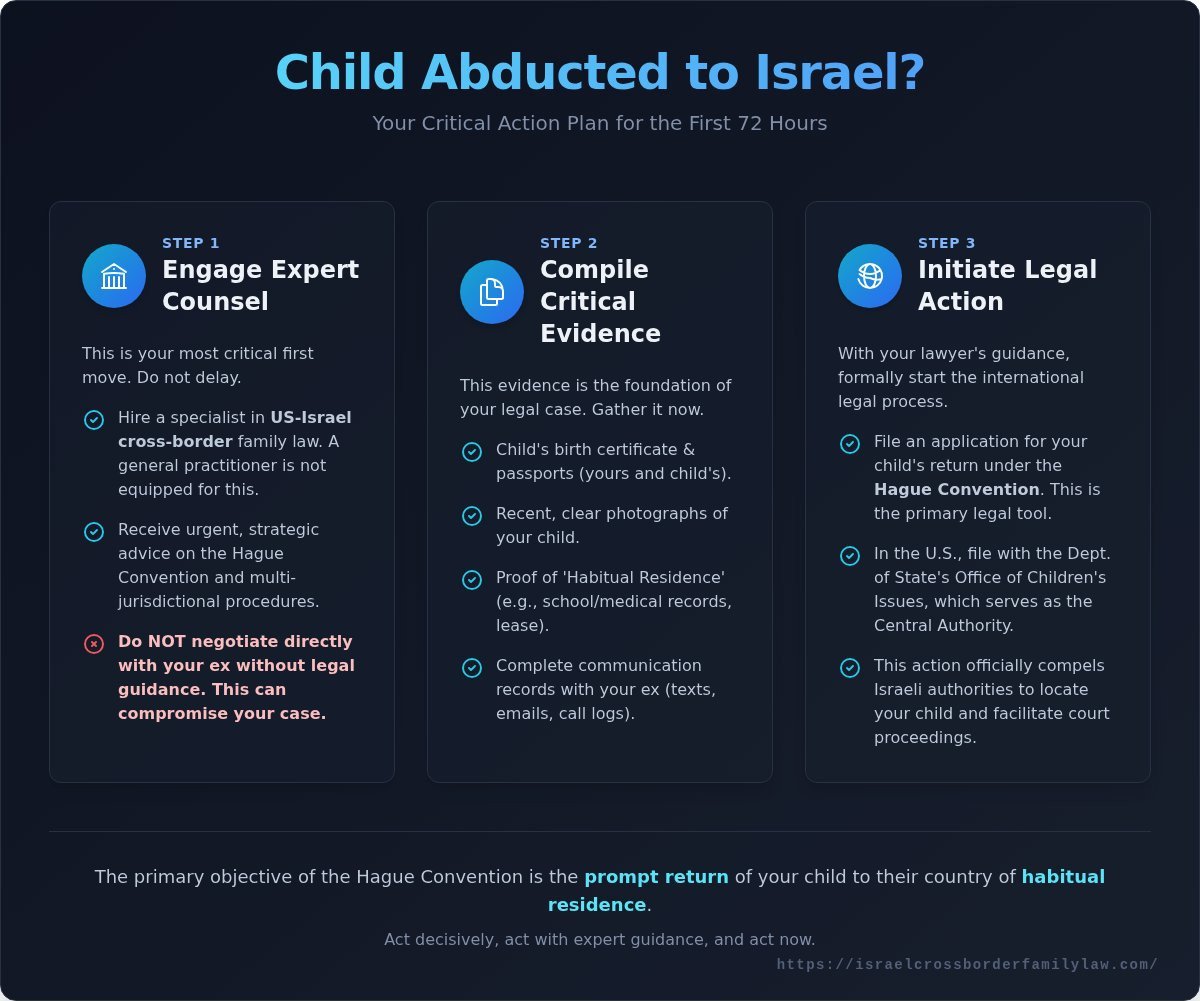
The discovery that your child has been taken to another country without your consent is a profound crisis. When confronting the question of what happens if my ex takes my child to Israel, it is imperative to understand that this is a time-sensitive legal emergency. The actions you take within the first 72 hours are critical and can substantially influence the successful return of your child. This section provides a strategic checklist designed to help you officially document the abduction and initiate formal legal proceedings. It is crucial that you do not attempt to negotiate directly with your ex-partner during this period without the guidance of experienced legal counsel, as such actions can inadvertently compromise your legal position. To better understand the immediate legal framework, please review the following expert guidance:
Step 1: Contact a Specialized International Family Lawyer
Your first and most critical action is to retain legal representation with specific, demonstrable experience in complex US-Israel cross-border family law. This is not a matter for a general practitioner. You require a firm with a deep understanding of the international treaties governing child abduction, particularly the Hague Convention. An experienced attorney will provide urgent, strategic advice, act as your official representative, and immediately begin navigating the multi-jurisdictional legal systems to protect your parental rights and secure your child’s prompt return.
Step 2: Gather Essential Documentation
While your legal counsel initiates contact with relevant authorities, you must immediately compile a comprehensive file of essential documents. This evidence is foundational to your legal case and will be required for official applications. Your file should include:
- Your child’s original birth certificate and copies of both your and your child’s passports.
- Recent, clear photographs of your child.
- Substantial evidence proving your child’s ‘habitual residence’ was in your home country (e.g., school records, medical records, lease agreements).
- A complete record of all recent communication with your ex-partner, including text messages, emails, and call logs.
Step 3: File a Hague Convention Application
With the guidance of your lawyer, the next step is to formally file an application for the return of your child under the Hague Convention on the Civil Aspects of International Child Abduction. This treaty is the primary international legal instrument for resolving such cases between signatory countries like the United States and Israel. In the U.S., this application is submitted to the Department of State’s Office of Children’s Issues, which serves as the Central Authority. This filing officially initiates the international legal process, compelling the Israeli authorities to locate your child and facilitate court proceedings for their return.
Understanding the Hague Convention on Child Abduction
When a child is wrongfully removed across international borders, the primary legal instrument governing their return is the 1980 Hague Convention on the Civil Aspects of International Child Abduction. Critically, both the United States and Israel are signatories to this treaty, providing a structured, multi-jurisdictional framework for these complex cases. The central objective of the Convention is not to adjudicate the merits of a custody dispute, but to secure the prompt return of the child to their country of habitual residence. This crucial distinction means the Convention determines which country’s courts have the proper jurisdiction to make long-term custody decisions, preventing the abducting parent from gaining an unfair advantage by moving the child to a new legal venue.
What Constitutes ‘Wrongful Removal’ or ‘Retention’?
For the Hague Convention to apply, the removal or retention of a child must be deemed “wrongful.” This has a specific legal definition under the treaty. The action must be in breach of custody rights that were being actively exercised by the parent left behind under the laws of the state where the child was habitually resident immediately before the removal. Furthermore, the Convention applies only to children under the age of 16. Successfully arguing these points is the foundational step to initiating a return order.
The Concept of ‘Habitual Residence’
The cornerstone of any Hague Convention application is establishing the child’s “habitual residence.” This is the country where the child’s life was primarily centered before the abduction, a place that reflects a degree of settled purpose from the child’s perspective. Israeli courts, like those in other signatory nations, will analyze a range of factors to determine this, including the child’s schooling, social and family environment, and the shared intention of the parents regarding the child’s home prior to the dispute. Proving that the child’s habitual residence was outside of Israel is a critical element of your case.
The Role of the Central Authorities
Each signatory country designates a Central Authority to manage and process Hague Convention applications. These government bodies act as the primary channel for international cooperation, assisting in locating the child and facilitating the necessary legal proceedings. When you are confronting the question of what happens if my ex takes my child to Israel, our legal team prepares and submits the application on your behalf, working directly with these authorities. We navigate the intricate procedures and maintain professional communication with Israel’s Central Authority for the Hague Convention to ensure your case is advanced efficiently and effectively.
The Legal Process in Israel for a Child’s Return
When you are faced with the question of what happens if my ex takes my child to Israel, understanding the subsequent legal framework is critical. Once your Hague Convention application is formally transmitted to the Israeli authorities, a structured and predictable legal process is initiated. The Israeli judicial system is specifically designed to handle these sensitive international child abduction cases expeditiously, prioritizing the child’s welfare. Comprehending the key stages of this process can demystify the situation and provide a clear roadmap for what lies ahead, navigated on your behalf by your legal team.
Filing with the Israeli Family Court
Upon receipt of the Hague application, Israel’s Central Authority for the Convention promptly forwards the case to the Family Court with the appropriate jurisdiction. Reflecting the urgency of these matters, the court schedules an initial hearing, typically within a few weeks. It is crucial to understand that the court’s focus in these proceedings is exceptionally narrow; its sole function is to determine whether to order the child’s immediate return to their country of habitual residence, not to litigate broader custody disputes.
Evidence and Hearings
The court proceedings are adversarial, with both parents presenting their case through their respective legal counsel. The primary evidentiary focus is to establish two key elements: the child’s “habitual residence” before the abduction and the “wrongful” nature of the removal or retention under the Convention’s terms. The abducting parent may attempt to counter this by raising specific, narrowly interpreted defenses, such as alleging a grave risk of physical or psychological harm to the child upon return.
The Return Order and Enforcement
If the court finds that a wrongful removal has occurred and rejects any defenses raised, it will issue a formal return order. This judicial decree is not a suggestion; it is a legally binding command that is fully enforceable by Israeli authorities. The system includes robust mechanisms to ensure compliance and facilitate the child’s safe and prompt return, backed by the full force of Israeli law. This powerful legal mandate for repatriation is the definitive outcome of a successful Hague petition. Navigating this multi-jurisdictional legal framework requires sophisticated counsel with proven experience in cross-border family law. The process is complex. Get expert guidance for your case. [ Download ](https://getautoseo.com/screenshots/getautoseocom_1769307186_ehvaS7Hq.jpg) Feedback & Recreate Delete 
Potential Defenses and Exceptions to a Hague Return
In a Hague Convention proceeding, the abducting parent is not without recourse and may present specific legal arguments, or “defenses,” against the child’s return. The Convention provides for a very limited number of exceptions to the rule of immediate return. It is of paramount importance for the left-behind parent to anticipate these potential arguments. The Israeli family courts, known for their strong support of the Convention’s objectives, interpret these exceptions narrowly and apply a rigorous standard of proof. Successfully navigating these complex defenses is central to the question of what happens if my ex takes my child to Israel. A proactive and well-prepared legal strategy is essential for countering these claims and securing your child’s prompt return.
Defense 1: Grave Risk of Physical or Psychological Harm
The most frequently raised defense under Article 13(b) is that returning the child would expose them to a grave risk of physical or psychological harm or otherwise place them in an intolerable situation. The burden of proof on the abducting parent is exceedingly high. This defense requires clear and convincing evidence of serious, imminent danger, not merely the general emotional upset or adjustment difficulties associated with a return. Israeli courts can, and often do, neutralize this defense by securing “undertakings” (enforceable promises) or issuing protective orders to mitigate potential risks upon the child’s return to their country of habitual residence.
Defense 2: The Child’s Objection
If a child has attained an age and degree of maturity at which it is appropriate to take account of their views, the court may refuse to order their return if the child objects. There is no specific age threshold in Israel; the court assesses each child’s maturity on a case-by-case basis. The judge will carefully examine whether the objection is genuinely the child’s own, not the result of influence from the abducting parent. It is critical to understand that a child’s objection is not an absolute veto but one of several factors the court will weigh in its final decision.
Defense 3: Consent or Acquiescence
An abducting parent may argue that you either consented to the child’s removal or relocation before it happened, or that you acquiesced to it afterward. Proving this defense requires substantial evidence, such as written communication or clear patterns of behavior demonstrating your agreement. Any ambiguity can be exploited, which is why taking decisive and immediate legal action is vital. Delay can be misinterpreted as acquiescence, potentially complicating what should be a straightforward return order. Engaging experienced counsel to formally document your non-consent is a critical first step. Understanding and refuting these defenses requires sophisticated legal expertise in cross-border family law. For guidance on your specific situation, contact our legal team for a confidential consultation.
Preventing International Child Abduction to Israel
In complex cross-border family disputes, a proactive legal strategy is paramount. While understanding your options after an abduction is crucial, implementing preventative measures is a far more effective approach to safeguarding your parental rights. Instead of waiting to confront the devastating question of what happens if my ex takes my child to Israel, you can establish robust legal barriers that deter such actions. A well-drafted custody order with specific international travel restrictions is your most powerful defense, providing legal clarity and enforceability across jurisdictions.
Warning Signs of Potential Abduction
Recognizing the indicators of a potential abduction is the first step toward prevention. A parent contemplating such a drastic action often leaves a trail of logistical and behavioral clues. Be vigilant for sudden, unexplained changes, including:
- The liquidation of assets, such as selling a home or car, closing bank accounts, or abruptly quitting a long-term job.
- Direct or veiled threats to take the child “home” to Israel, or statements suggesting you will never see your child again.
- Attempts to procure an Israeli passport for the child without your knowledge or express written consent.
Legal Safeguards and Prevention Orders
Should you harbor credible fears of abduction, immediate legal consultation is critical. Several powerful legal tools can be deployed. The cornerstone of prevention is a clear, unambiguous court order that explicitly delineates custody rights and international travel protocols. We advise clients to pursue orders that include specific provisions such as requiring your notarized, written consent for any international travel and demanding that the child’s passports be held by a neutral third party or the court itself. For U.S. citizens, enrolling your child in the State Department’s Children’s Passport Issuance Alert Program (CPIAP) provides an additional layer of security.
The Importance of Mirror Orders
In a multi-jurisdictional context, a “mirror order” is an indispensable strategic asset. This involves having an Israeli court formally recognize and register your home country’s custody order, making it directly enforceable within Israel. This preemptive step transforms a foreign decree into a local one, significantly simplifying enforcement and demonstrating to the other parent that the Israeli legal system will uphold your rights. Navigating this process requires sophisticated legal guidance familiar with both legal systems. Secure your parental rights with a cross-border legal strategy.
Navigating the Path Forward: Securing Your Child’s Return
The wrongful removal of a child is an overwhelming experience, but swift, informed action is your most powerful tool. This guide has underscored the critical importance of the initial 72 hours, the central role of the Hague Convention, and the complexities of the Israeli legal system. Understanding what happens if my ex takes my child to Israel is the first step, but navigating this multi-jurisdictional challenge requires specialized legal counsel. The process demands a sophisticated approach, bridging the legal and cultural nuances between two distinct nations. Our firm is uniquely positioned to manage these intricate cases. With specialized expertise in US-Israel cross-border family law and extensive experience handling Hague Convention child abduction cases, we provide decisive representation. Our legal teams, located in both the United States and Israel, ensure seamless, on-the-ground advocacy, eliminating the critical delays that can jeopardize a successful return. We are prepared to act with the urgency your situation demands. If your child has been taken to Israel, contact us immediately for an urgent consultation. Taking this decisive step is the beginning of the path to bringing your child home.
Frequently Asked Questions
How long does a Hague Convention case take in Israel?
The Hague Convention mandates an expeditious process for the return of wrongfully removed children. In Israel, family courts are directed to handle these cases urgently, often aiming to deliver an initial judgment within six to eight weeks from the date of filing. However, this timeline is not guaranteed. The process can be extended significantly if either party files an appeal to a higher court, which can add several more months to the legal proceedings before a final resolution is reached.
Do I need to travel to Israel for the court hearings?
While a parent’s physical presence in court can be impactful, it is not always a mandatory requirement for every hearing in a Hague Convention case. Israeli courts may permit testimony to be given via video conference, and a substantial portion of the case can be presented through sworn affidavits and evidence submitted by your legal counsel. Having an experienced legal team on the ground in Israel is paramount to representing your interests effectively, regardless of your ability to travel for each appearance.
Can I file criminal charges for parental kidnapping in the U.S.?
Yes, you can pursue criminal charges in the United States under federal laws like the International Parental Kidnapping Crime Act (IPKCA). This criminal action is a separate and distinct process from the civil Hague Convention application, which is focused solely on the prompt return of the child. While a U.S. federal arrest warrant can create significant legal pressure on the abducting parent, it does not, by itself, compel the Israeli courts to order the child’s immediate return.
What happens if my child was taken from a non-Hague Convention country to Israel?
When a child is taken from a non-signatory country, the streamlined procedures of the Hague Convention are unavailable. In this scenario, what happens if my ex takes my child to Israel is that you must initiate a standard custody or return action directly within the Israeli family court system. The court’s decision will not be based on the wrongful removal, but on a comprehensive “best interests of the child” analysis under Israeli law, which is a more complex and lengthy legal undertaking.
How much does it cost to file a Hague Convention case for my child’s return?
The initial application filed through the Israeli Central Authority typically involves minimal to no government fees. However, the primary cost is associated with securing sophisticated private legal representation, which is critical for navigating the complexities of the Israeli court system. Legal fees vary based on case complexity, but clients should anticipate costs ranging from ₪50,000 to over ₪150,000 for a contested case, which encompasses legal strategy, court filings, evidence preparation, and representation at all required hearings.
Will the Israeli court decide on our custody arrangement?
No. The scope of a Hague Convention proceeding in Israel is intentionally and strictly limited. The Israeli court’s sole function is to determine whether the child was wrongfully removed from their country of habitual residence and if they should be promptly returned. The court will not make any determinations regarding the underlying, substantive custody dispute or future parenting arrangements. Such decisions are deferred to the jurisdiction of the courts in the child’s home country once the child has been returned.
What if my ex-partner is an Israeli citizen and I am not?
Within the legal framework of the Hague Convention, the citizenship of the parents is not the determining factor. The central legal question is the child’s country of “habitual residence” prior to the wrongful removal or retention. Israeli courts are obligated by international treaty to apply the principles of the Convention impartially, regardless of parental nationality. However, navigating a case where the other parent has strong local ties makes engaging experienced, multi-jurisdictional legal counsel even more critical to protect your rights.

Article by
Gabriel Lior
A Personal Journey That Became a Mission The advisory was founded by an American father Gabriel Lior, LLB, MBA , global entrepreneur, and cross-border advisor who spent more than a decade navigating the Israeli family court system firsthand and now lives in Singapore with his son.
As a divorced parent in a cross-border family, Gabriel faced nearly every legal challenge a foreign parent can encounter in Israel — including child custody disputes, child support proceedings, property matters in Israel and abroad, false accusations, and complex immigration and relocation proceedings. Over the years, he learned the hard way how difficult it is for non-Israeli parents to understand the system, identify the right legal strategy, and choose the right legal representation — especially when language, culture, and jurisdictional differences are involved. He also witnessed how foreign parents and new immigrants are often disadvantaged or taken advantage of by service providers and institutions simply because they lack local knowledge or fluency. From Client to Advisor To truly understand — and survive — the system, Gabriel pursued formal legal education in Israel, completing two Israeli law degrees, alongside a BA and MBA earned in the United States. This was never about becoming a practicing attorney, but about gaining a deep, structural understanding of how the system works — and where it breaks down for foreign parents. This rare combination of: Firsthand client experience Israeli legal and US business education International business and negotiation training Decades of commercial execution created a unique perspective – one that understands both sides of the table. After years of litigation, persistence, and at times self-representation, he ultimately succeeded in securing custody of his son and relocating abroad through a rare legal victory in the Israeli Supreme Court — becoming one of the first fathers in Israel to do so under these circumstances.
Disclaimer
Important Disclaimer: The information provided on this website and in its content is for general informational and educational purposes only and does not constitute legal advice, legal opinion, or legal representation. Gabriel Lior is not licensed to practice law in Israel (nor is he interested in doing so) and does not provide legal services, despite having completed 2 Law Degrees. The services offered are advisory in nature and are intended to provide general guidance, strategic insight, and information regarding cross-border family law considerations. No attorney-client relationship is formed by accessing this website, reading its content, or communicating with us. Any decisions made based on this information are at your own discretion and risk. For legal advice specific to your situation, you should consult a licensed attorney in the relevant jurisdiction. Where appropriate, we may refer clients to independent, licensed attorneys or professionals. Such referrals do not constitute legal representation and no liability is assumed for services provided by third parties.