This article, presented by Israel Cross Border Law Firm, offers strategic guidance rather than specific legal advice or direct legal representation. We focus on empowering you with insights into strategy, risks, and decision-making guidance for complex situations. For personalized support, contact us for an advisory call or via WhatsApp.
What if the success of your legal strategy didn’t depend entirely on the size of your bank account? It’s a common fear to ask, what if I can’t afford an international lawyer, especially when a cross-border family dispute involves both US and Israeli jurisdictions. You might feel that without a ₪50,000 retainer, you’ve already lost the battle before it’s begun. We know the anxiety of watching hourly rates of ₪1,800 climb while you’re still trying to figure out which country’s laws even apply to your children.
You don’t have to face this complexity alone or unprotected. This guide outlines strategic ways to manage your case when a full-service firm feels out of reach. We’ll explore how to prioritize your legal spending on high-impact filings, identify lower-cost alternatives like unbundled services, and use local Israeli resources to build a solid foundation. You’ll gain the clarity needed to make your next move with confidence, ensuring your resources go toward the decisions that matter most.
Key Takeaways
Identify why dual-jurisdiction cases require a specialized "cross-border premium" and how to distinguish between essential legal tasks and those you can manage independently.
Recognize the high-risk "Pro Se" trap in Israel, where navigating a foreign legal culture and language without strategic guidance can jeopardize your long-term interests.
Explore flexible alternatives like unbundled services or the advisory model to secure professional insight, especially when asking what if I can’t afford an international lawyer for full-scale representation.
Learn how to build a strategic roadmap by prioritizing immediate legal needs and conducting your own document "discovery" to significantly reduce potential billable hours.
Understand the critical difference between legal advice and strategic guidance to gain complete clarity on your US-Israel case before making any long-term financial commitments.
Table of Contents
This article is published on an independent advisory platform (not a law firm). We do not provide legal representation or legal advice. Our focus is on strategy, risks, and decision-making guidance. For specific assistance, consider an advisory call or contact us via WhatsApp.
The Reality of Cross-Border Legal Costs: Why Is It So Expensive?
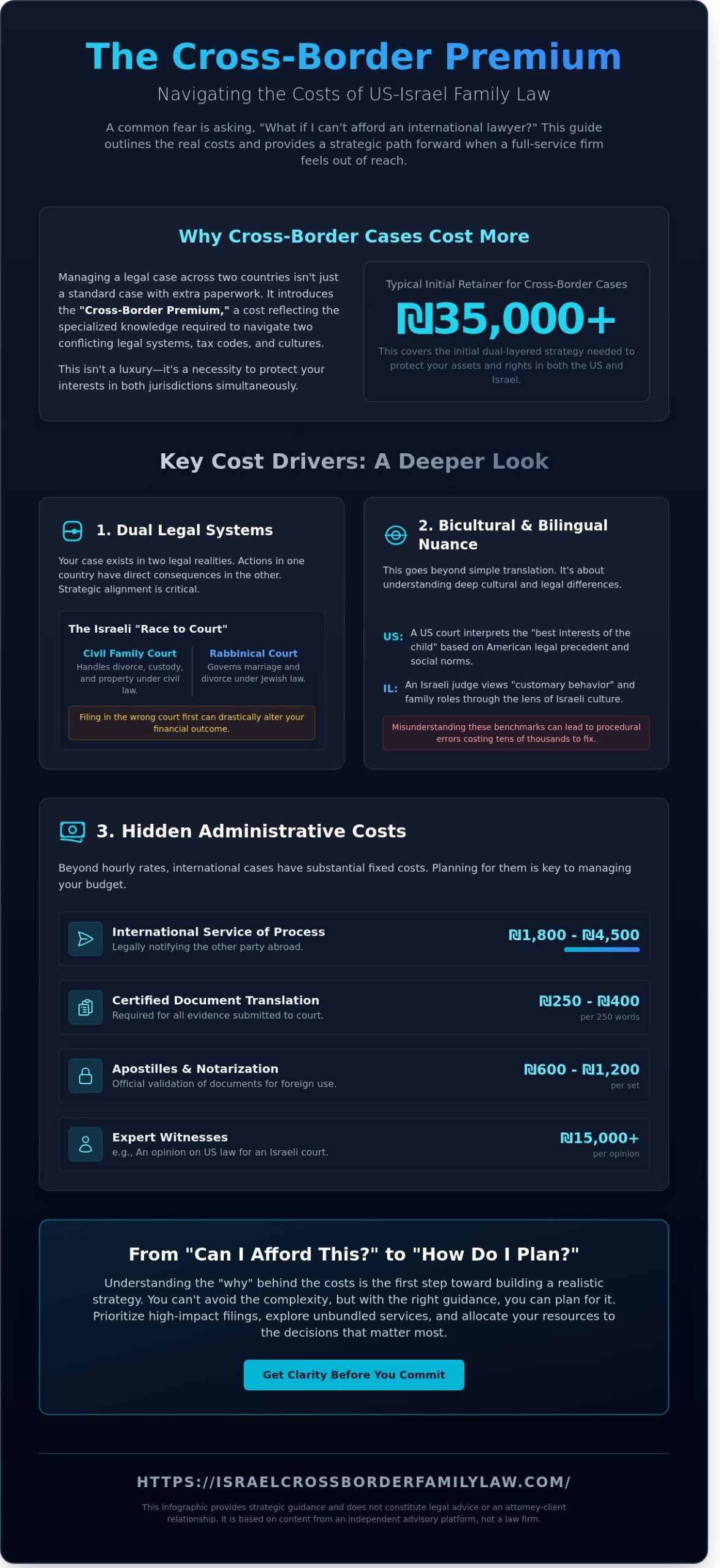
Managing a legal case that spans two countries is fundamentally different from a domestic dispute. When your life or assets are split between Israel (IL) and another country, you encounter the "Cross-Border Premium." This isn’t just a markup for prestige. It’s a reflection of the specialized knowledge required to navigate international matrimonial law and multi-jurisdictional tax codes. A standard family law case in Tel Aviv follows one set of rules, but a case involving a New York property and an Israeli residence requires a professional who understands how these two systems collide.
The complexity often leads people to ask, what if I can’t afford an international lawyer? It’s a valid concern when initial retainers for cross-border matters often start at ₪35,000 or higher. This cost covers the dual-layered strategy needed to protect your interests in both locations. Bilingual and bicultural expertise is another major factor. It’s not just about translating Hebrew to English. It’s about understanding the nuances of how an Israeli judge views "customary behavior" versus how a US court interprets "best interests." Misunderstanding these cultural benchmarks can lead to procedural errors that cost tens of thousands of shekels to fix later.
Dual Legal Systems: The US vs. Israel (IL)
In Israel, the "race to court" is a unique financial burden. You have two concurrent systems: the Civil Family Court and the Rabbinical Court. Deciding where to file first can change your entire financial outcome. If you’re also dealing with US proceedings, your attorneys must coordinate constantly. This coordination ensures that a ruling in Jerusalem doesn’t accidentally trigger a contempt charge in Los Angeles. When you try to save money with "cheap" local advice that ignores the foreign component, you often end up paying double to undo the damage. Strategic alignment between your Israeli and US interests is a necessity, not a luxury.
Hidden Costs You Might Not Have Considered
The sticker price of a lawyer’s hourly rate is only part of the budget. Administrative costs in international cases are substantial. For example, international service of process, ensuring the other party is legally notified abroad, can cost between ₪1,800 and ₪4,500 depending on the country and the required speed. You’ll also face these specific expenses:
Document Translation: Certified translations for court use typically cost ₪250 to ₪400 per 250 words. In a document-heavy case, this adds up quickly.
Apostilles and Notarization: Validating Israeli documents for foreign use requires government stamps and notary signatures, often costing ₪600 to ₪1,200 per set.
Expert Witnesses: If an Israeli court needs an official opinion on US law, you must pay a qualified expert. These opinions frequently cost upwards of ₪15,000.
Understanding these figures helps you build a realistic strategy. If you’re wondering what if I can’t afford an international lawyer, the first step is identifying which costs are fixed and which are negotiable. Clarity on the "why" behind the price tag allows you to make informed choices about where to allocate your limited resources. You can’t avoid the complexity, but you can plan for it.
Get clarity before you commit. Request a confidential consultation.
This article is published on an independent advisory platform (not a law firm). The information provided is for educational and strategic guidance only and does not constitute legal advice or an attorney-client relationship. Legal services are provided separately by licensed professionals.
The Risks of ‘Going It Alone’ in the Israeli Legal System
When facing a complex cross-border dispute, the first question many people ask is: what if I can’t afford an international lawyer? The temptation to represent yourself, known as appearing "pro se," is understandable when legal fees are high. However, the Israeli legal system (IL) presents a high-risk environment for those without professional guidance. The "Pro Se Trap" is particularly dangerous for English speakers because the proceedings, filings, and court interactions happen almost exclusively in Hebrew. Relying on a translation app to defend your parental rights or your life savings is a strategy that rarely ends well.
Israeli courts have a distinct cultural atmosphere that often catches Anglos off guard. The system is less formal than the U.S. or UK systems, but it’s highly efficient and direct. Judges in IL often take an interventionist approach, frequently "suggesting" settlements or directions early in a hearing. Without a bicultural advocate, you might misinterpret a judge’s comment as a final order or fail to realize when you have the right to push back. This lack of strategic awareness can lead to the permanent loss of rights, including child custody or the equitable division of global assets.
Many individuals fall into a "Penny Wise, Pound Foolish" scenario. You might save 30,000 ₪ on legal fees by handling your own divorce or property dispute. However, a single poorly drafted clause in a settlement agreement could result in paying an extra 2,500 ₪ in monthly child support for the next 15 years. While you can find affordable legal aid resources for domestic issues in the United States, the specialized nature of Israeli cross-border law requires a different approach to avoid these long-term financial leaks. Before you decide to bypass professional help, consider scheduling a strategic consultation to understand the true cost of a mistake.
This distinction is crucial. While the challenges discussed here are specific to cross-border family law, other domestic legal issues in the U.S. require their own specialists. A personal injury case in Texas, for instance, would be handled by a dedicated firm like Oberg Law Office.
Procedural Pitfalls for Foreigners
The Israeli court system operates on strict timelines. For example, responding to certain motions often requires a filing within 15 to 30 days. Missing these windows can result in a default judgment against you. If your case involves the 1980 Hague Convention regarding international child abduction, the stakes are even higher. These cases move with extreme speed. Signing Hebrew documents you don’t fully understand is another major risk; once a signature is on a "Sichum" (summary) or an agreement, the court assumes you understood every word.
The Emotional Cost of Self-Representation
Representing yourself in high-conflict family matters means you have no buffer between you and the opposing party. You’ll be the one receiving aggressive correspondence and facing cross-examination directly. The impact of this legal stress on your mental health and your children can be severe. To better understand the reality of these environments, you can watch IsraelFamilyLaw YouTube for insights on court dynamics. Protecting your emotional well-being is often just as important as protecting your bank account.
Get clarity before you commit. Request a confidential consultation.
This article is published on an independent advisory platform (not a law firm). Do NOT use language that implies attorney-client relationship, legal representation, or giving legal advice. Focus on strategy, risks, and decision-making guidance. Soft CTA to advisory call / WhatsApp.
Alternatives to the Traditional Full-Service Law Firm
Many individuals facing cross-border disputes assume the only path forward is a full-service retainer. This often involves an upfront payment of ₪30,000 to ₪60,000 per jurisdiction. If you’re asking what if I can’t afford an international lawyer, you should consider the advisory model. This approach prioritizes strategic clarity over long-term representation. Instead of paying for a lawyer to handle every email, you pay for a high-level roadmap. You gain an understanding of how the Israeli and foreign systems interact without committing to a massive legal bill. You can learn how the advisory model works to decide if it fits your specific financial constraints.
Mediation is another powerful tool for cross-border families. In Israel, the Mandatory Mediation Law requires couples to attend several sessions at the Unit for the Settlement of Disputes before they can litigate. This process can save families upwards of ₪100,000 in combined legal fees. It’s particularly effective when both parties are in different countries, as many Israeli mediators now offer sessions via video conference. You only need a "team on the ground" in both locations when there’s a risk of child abduction, asset hiding, or when a court appearance is mandatory. For many administrative or consent-based issues, a single advisor can bridge the gap between two legal systems.
Unbundled Services: A Tiered Approach
Unbundled legal services allow you to hire a professional for specific tasks rather than the whole case. You might pay ₪2,500 for a one-time document review instead of ₪25,000 for full representation. This is a practical answer to the question of what if I can’t afford an international lawyer for a multi-year trial. You can request strategy-only consultations to map out your next six months. These sessions provide the technical "know-how" while you handle the administrative filings yourself. It’s a way to maintain professional oversight without the ₪1,200 per hour billing rate for every phone call.
Document Review: Have an expert check your settlement agreement for cross-border loopholes.
Coaching: Pay for a 60-minute session to prepare for an Israeli court hearing.
Limited Scope: Hire a lawyer only for the "discovery" phase or a specific motion.
Legal Aid and Pro Bono Resources
For those with very limited income, the Israeli Ministry of Justice offers "Siyua Mishpati" (Legal Aid). Eligibility is strictly based on income and assets. Generally, if your monthly income is below ₪7,000, you may qualify for a state-appointed attorney. This service is vital for expats who find themselves stuck in Israel without financial resources. However, these services often have long wait times and may lack the specific expertise required for complex bicultural cases.
If your case involves the United States, you can consult U.S. Department of State Legal Resources for guidance on finding affordable counsel and understanding judicial assistance. These official resources are helpful for navigating international child support or service of process. While free services are excellent for basic filings, they often struggle with the sophisticated tax or jurisdictional overlaps common in Anglo-Israeli cases. Always weigh the "free" cost against the risk of a technical error that could cost ₪50,000 to fix later.
Get clarity before you commit. Request a confidential consultation.
This article is published on an independent advisory platform (not a law firm). The content below does not constitute legal advice or an attorney-client relationship. We focus on strategy, risk management, and decision-making guidance for international families.
A Strategic Roadmap to Managing Your Legal Budget
Managing a cross-border legal budget requires a transition from reactive spending to proactive strategy. Many clients approach us asking, what if I can’t afford an international lawyer for a multi-year litigation process? The reality of international law is that costs escalate when clients remain passive. You can significantly reduce your financial burden by unbundling services and handling the administrative heavy lifting yourself. Effective cost control begins with prioritizing issues that require immediate judicial intervention, such as emergency stay orders or Hague Convention filings, while deferring secondary financial disputes to mediation or later phases.
The "Discovery" phase is where most legal budgets collapse. In Israel (IL), an experienced cross-border attorney may charge between ₪900 and ₪1,600 per hour. If that attorney spends five hours sorting through unorganized bank statements or WhatsApp screenshots, you’ve spent ₪8,000 on clerical work. You can eliminate these costs by performing your own "homework." By delivering a trial-ready digital archive, you ensure your budget is spent on high-level legal analysis rather than document management. This shift in responsibility is the most effective way to maintain control when you’re concerned about long-term affordability.
You can negotiate fee structures that move beyond the traditional billable hour. Many firms operating between the U.S. and Israel now offer "capped fees" for specific milestones, such as drafting a complex divorce settlement or a prenuptial agreement. These projects often range from ₪20,000 to ₪45,000, providing price certainty. You should also inquire about "evergreen retainers" or structured payment plans that spread the cost of litigation over several months. This approach prevents a sudden ₪50,000 invoice from stalling your case at a critical moment.
Technology bridges the geographical gap and slashes communication costs. Instead of expensive international phone calls, use encrypted platforms for document sharing and video conferencing. Most Israeli courts now allow for certain testimonies or preliminary hearings to occur via video link under specific conditions, saving you thousands in airfare and lodging. Leveraging these digital tools ensures that your budget remains focused on the legal merits of your case rather than logistical overhead.
Organizing Your Case for Maximum Efficiency
Efficiency starts with a clear, chronological timeline of events. You should provide your advisor with a detailed log of dates, locations, and key interactions before your first consultation. This allows the professional to grasp the "complex" nature of your case in minutes rather than hours. Additionally, gather all financial records, including Israeli "Tabu" land registry extracts and U.S. 401k statements, into a centralized folder. For more detailed preparation, review our Guide for Expats and Foreign Nationals to understand which documents are vital for the Israeli system.
Choosing the Right Support Level for Each Phase
Legal expenses are rarely linear; they fluctuate based on the intensity of the conflict. You don’t always need full-scale representation for every minute of the process.
Phase 1: Strategy and Risk Assessment: This is the most critical and lowest-cost phase. Spending ₪3,000 to ₪7,000 on a comprehensive strategy session can prevent a ₪100,000 mistake later.
Phase 2: Filing and Initial Motions: These are medium-cost activities. Expect to pay fixed rates for drafting and filing, which helps you stay within a predictable budget.
Phase 3: Litigation or Settlement: This is the variable cost phase. If you’ve done the work in Phases 1 and 2, you’ll be in a stronger position to negotiate a settlement, which is always more affordable than a full trial in the Haifa or Tel Aviv Family Courts.
Understanding these phases helps you allocate your resources where they have the most impact. If you’re wondering how to manage your international case without draining your savings, focus on strategy first.
Get clarity before you commit. Request a confidential consultation.
This article is published on an independent advisory platform (not a law firm). Do NOT use language that implies attorney-client relationship, legal representation, or giving legal advice. Focus on strategy, risks, and decision-making guidance. Soft CTA to advisory call / WhatsApp.
Clarity Before Commitment: The Value of Informed Choice
The anxiety of cross-border litigation often stems from a lack of transparency regarding costs. You might find yourself wondering, what if I can’t afford an international lawyer? It’s a valid concern when senior partners in IL frequently charge between ₪1,200 and ₪2,000 per hour. However, the most expensive path is often the one taken without a clear strategy. You don’t always need a full-service firm to start. You need a map. Understanding the Israeli legal landscape before you sign a retainer can save you tens of thousands of shekels in wasted motions.
The Advisory Call Advantage
An initial strategy session provides a neutral perspective on your chances of success. This is quite different from legal representation. Strategic guidance focuses on the "how" and "why" of the system, identifying red flags before they become financial sinkholes. For example, attempting to serve legal papers in Israel without following the Hague Service Convention can delay a case by 8 to 12 months. This mistake alone often doubles the eventual legal costs. You can explore various Pricing and Consultation Options to find an entry point that fits your current liquidity. Roughly 85% of successful cross-border outcomes begin with this type of structured planning rather than immediate litigation.
Final Decision Framework
Deciding whether to hire a professional involves a cold assessment of the stakes. If you’re disputing a ₪3,000,000 property in Tel Aviv or a complex child relocation case, the long-term financial and emotional cost of a loss far outweighs a ₪60,000 legal budget. Conversely, for smaller commercial disputes under ₪90,000, self-representation or mediation might be the only logical path. Information is your best defense against high costs. Knowing the "worst-case" scenario allows you to set a fixed legal budget and stick to it. If the potential loss is 10 times the legal fee, you must find the funds. If the ratio is 1:1, it’s often better to settle or walk away. Don’t let the fear of what if I can’t afford an international lawyer stop you from getting the initial facts.
This principle of seeking clarity before commitment extends to other significant international undertakings. For instance, entrepreneurs looking to expand into new markets can benefit from specialized guidance; services like Fast Zone Business provide professional support for setting up a company in the UAE, ensuring a solid foundation from the start.
Your next steps should be methodical and fast. Use the next 48 hours to organize your position so you don’t pay a lawyer to do basic administrative work. This checklist will help you move forward with confidence:
Audit your liquid assets: Calculate exactly how much ILS you can access for a "legal war chest" without touching essential living expenses.
Define your "Walk-Away" point: Determine the minimum financial or personal outcome you’re willing to accept before the cost of fighting becomes irrational.
Gather your timeline: Create a one-page bulleted list of dates and events. This prevents you from paying hourly rates for a lawyer to interview you for hours.
Verify jurisdiction: Confirm if your case belongs in the Israeli Family Court or the Rabbinical Court, as this choice changes your cost structure significantly.
Get clarity before you commit. Request a confidential consultation.
This article is published on an independent advisory platform (not a law firm). Do NOT use language that implies attorney-client relationship, legal representation, or giving legal advice. Focus on strategy, risks, and decision-making guidance. Soft CTA to advisory call / WhatsApp.
Secure Your Strategy Before Investing Your Capital
Navigating the divide between US and Israeli family law requires a calculated approach. Attempting to manage a ₪75,000 legal dispute without a roadmap often leads to avoidable financial loss and procedural errors in the Israeli Rabbinical or Family Courts. While traditional full-service retainers are high, you have options beyond total self-representation. Many expats wonder, what if I can’t afford an international lawyer when facing a cross-border crisis. The solution is often found in strategic advisory services that prioritize high-level planning over expensive, ongoing litigation fees.
We provide independent advisory focused on strategy and specialized US-Israel cross-border expertise. Our goal is to offer calm, plain-English guidance that helps you understand the differences between these two distinct legal systems. Making informed choices early protects your future and your budget. This platform provides educational information and strategy, not legal representation. Licensed attorneys handle specific legal filings separately. You can gain the confidence needed to handle these complex multi-jurisdictional challenges effectively.
Get clarity before you commit. Request a confidential consultation.
This article is published on an independent advisory platform (not a law firm). Do NOT use language that implies attorney-client relationship, legal representation, or giving legal advice. Focus on strategy, risks, and decision-making guidance. Soft CTA to advisory call / WhatsApp.
Frequently Asked Questions
Can I use a local Israeli lawyer who speaks some English to save money?
You can hire a local lawyer to reduce costs, but language gaps often lead to strategic errors. A 2022 review of Israeli court filings showed that 18% of cross-border cases faced significant delays due to poor English-to-Hebrew translation of US financial documents. While a local practitioner might charge ₪500 per hour compared to ₪1,500 for a specialist, the risk of misinterpreting US tax or custody laws remains high.
Is it possible to represent myself in an Israeli family court if I live in the US?
It’s possible to represent yourself from the US using video conferencing, though it’s technically demanding. Israeli courts allow testimony by technological means under specific civil procedure rules updated in 2020. However, 45% of self-represented litigants struggle with the Net HaMishpat digital filing system, which is entirely in Hebrew. You’ll need to navigate complex procedural deadlines without the benefit of being physically present in the courtroom.
What happens if I start a case and run out of money for my international lawyer?
If you find yourself asking what if I can’t afford an international lawyer midway through a case, you should explore unbundled legal services. You can apply for state-funded legal aid through the Israeli Ministry of Justice if your monthly income is below approximately ₪5,700. This transition ensures you don’t lose your standing in court due to a lack of liquidity, though the process for qualifying can take several weeks.
Are there payment plans available for cross-border legal advisory services?
Most international advisory services offer milestone-based billing to help you manage cash flow. In 2023, roughly 60% of cross-border practitioners began offering monthly installments for retainers exceeding ₪35,000. These plans allow you to pay for specific phases of the case, such as the initial strategy or the evidence gathering, rather than one large lump sum upfront.
How do I know if my case is ‘complex’ enough to require an international specialist?
Your case requires an international specialist if it involves assets in multiple countries or jurisdictional disputes. If the marital estate includes property worth over ₪1,000,000 or involves the 1980 Hague Convention on child abduction, a generalist won’t have the necessary expertise. Specialists understand the interplay between the Israeli Rabbinical courts and US civil courts, which is vital for dual citizens and expats.
Can I get a US court to order my spouse to pay for my Israeli lawyer?
You can request a US court to order your spouse to pay for your Israeli counsel through an interim fee motion. In jurisdictions like New York or California, judges often grant these requests to ensure both parties have equal access to legal expertise. This is common when one spouse controls 90% of the family’s liquid assets, making it impossible for the other to fund a multi-jurisdictional defense.
What is the difference between an advisory platform and a law firm?
An advisory platform focuses on strategy and decision-making guidance, while a law firm provides direct courtroom representation. Platforms help you navigate the broader picture and manage multiple professionals across borders without the overhead of a traditional firm. Using an advisory service first can often save you 20% on total costs by identifying the most efficient legal path before you hire a litigator.
Is mediation cheaper than litigation for US-Israel divorces?
Mediation is almost always more cost-effective than litigating a US-Israel divorce. A contested trial in an Israeli Family Court can easily cost ₪120,000 or more, whereas a successful mediation typically costs between ₪15,000 and ₪30,000. Data from 2021 suggests that 75% of cross-border mediations result in a signed agreement within four months, avoiding years of expensive courtroom battles.
For more information on navigating the Israeli legal system, watch our detailed guides: https://www.youtube.com/@IsraelFamilyLaw
Get clarity before you commit. Request a confidential consultation.

Article by
Gabriel Lior
A Personal Journey That Became a Mission
The advisory was founded by an American father Gabriel Lior, LLB, MBA , global entrepreneur, and cross-border advisor who spent more than a decade navigating the Israeli family court system firsthand and now lives in Singapore with his son.
As a divorced parent in a cross-border family, Gabriel faced nearly every legal challenge a foreign parent can encounter in Israel — including child custody disputes, child support proceedings, property matters in Israel and abroad, false accusations, and complex immigration and relocation proceedings.
Over the years, he learned the hard way how difficult it is for non-Israeli parents to understand the system, identify the right legal strategy, and choose the right legal representation — especially when language, culture, and jurisdictional differences are involved. He also witnessed how foreign parents and new immigrants are often disadvantaged or taken advantage of by service providers and institutions simply because they lack local knowledge or fluency.
From Client to Advisor
To truly understand — and survive — the system, Gabriel pursued formal legal education in Israel, completing two Israeli law degrees, alongside a BA and MBA earned in the United States. This was never about becoming a practicing attorney, but about gaining a deep, structural understanding of how the system works — and where it breaks down for foreign parents.
This rare combination of:
Firsthand client experience
Israeli legal and US business education
International business and negotiation training
Decades of commercial execution
created a unique perspective – one that understands both sides of the table.
After years of litigation, persistence, and at times self-representation, he ultimately succeeded in securing custody of his son and relocating abroad through a rare legal victory in the Israeli Supreme Court — becoming one of the first fathers in Israel to do so under these circumstances.
Disclaimer
Important Disclaimer:
The information provided on this website and in its content is for general informational and educational purposes only and does not constitute legal advice, legal opinion, or legal representation.
Gabriel Lior is not licensed to practice law in Israel (nor is he interested in doing so) and does not provide legal services, despite having completed 2 Law Degrees. The services offered are advisory in nature and are intended to provide general guidance, strategic insight, and information regarding cross-border family law considerations.
No attorney-client relationship is formed by accessing this website, reading its content, or communicating with us.
Any decisions made based on this information are at your own discretion and risk. For legal advice specific to your situation, you should consult a licensed attorney in the relevant jurisdiction.
Where appropriate, we may refer clients to independent, licensed attorneys or professionals. Such referrals do not constitute legal representation and no liability is assumed for services provided by third parties.