
This article is published on an independent advisory platform and is not a law firm. The information provided is for educational purposes and does not constitute legal representation or an attorney-client relationship. Legal services are only provided by licensed attorneys under a separate engagement.
A foreign birth certificate does not provide the absolute legal shield many expats expect when moving to Israel. While the state has made historic strides in equality, legal parentage remains a strategic status that you must actively secure rather than assume. You might feel uncertain about how your family structure will be viewed by local authorities, or perhaps you worry about the influence of religious courts. It’s common to feel a sense of urgency to protect your children’s future while managing a life that spans multiple countries.
This guide provides a clear framework for understanding custody rights for LGBTQ parents in israel as of 2026. You’ll learn how to navigate the Civil Family Court system, which handles these matters instead of the Rabbinical Court, and how to obtain essential Parental Orders for non-biological parents. We also discuss how to safeguard your family against international relocation risks and ensure both parents have full legal recognition. For more visual insights, you can view our resources at https://www.youtube.com/@IsraelFamilyLaw. Get clarity before you commit. Request a confidential consultation.
This article is published on an independent advisory platform and is not a law firm. The information provided is for educational purposes and does not constitute legal representation or an attorney-client relationship. Legal services are only provided by licensed attorneys under a separate engagement.
Key Takeaways
- Recognize that foreign birth certificates are often insufficient for local authorities and learn how to secure formal recognition through a Parenthood Order.
- Navigate the dual court system by understanding why the Civil Family Court serves as the primary secular forum for international family matters.
- Gain insight into how Israeli courts apply the “Best Interests of the Child” standard to determine custody rights for LGBTQ parents in israel.
- Implement strategic cross-border safeguards, such as mirror orders, to mitigate the legal risks associated with international relocation.
- Understand the importance of proactive legal planning to reconcile foreign documentation with the specific requirements of the Israeli legal system.
Understanding the Legal Landscape for LGBTQ Parents in Israel (2026)
The distinction between social recognition and legal parentage in IL is a critical concept for international families to grasp. While Israeli society generally offers a warm and inclusive environment for diverse family structures, the legal system requires specific procedural steps to translate that social acceptance into enforceable rights. For many expats, the assumption that a foreign birth certificate or a stable domestic life is enough to secure custody rights for LGBTQ parents in israel can lead to significant complications during times of transition or dispute.
The Israeli Supreme Court has played a foundational role in shaping the 2026 legal environment. Because the legislature often moves slowly on family law reforms, the judiciary has stepped in to mandate equality in areas like adoption and surrogacy. To understand the broader context of these milestones, it is helpful to review the Legal Landscape for LGBTQ Parents in Israel. This judicial activism has created a secular path for parental recognition that bypasses religious restrictions; however, it remains a system built on specific court rulings rather than a single comprehensive civil code.
To better understand the current climate regarding surrogacy and parental rights, watch this helpful video:
International families face unique evidentiary hurdles when establishing their status in IL. Documents issued in the United States, Europe, or elsewhere may not be automatically accepted by the Ministry of Interior without specific apostilles or local court validations. This multi-jurisdictional complexity is why proactive legal planning is essential. Waiting for a crisis to define your parental standing is a high-risk strategy. Establishing a clear legal foundation early on ensures that your status is recognized by hospitals, schools, and border control authorities.
The Evolution of LGBTQ Family Law in IL
Recent landmark rulings have significantly expanded the rights of same-sex couples. In December 2023, the High Court ended discriminatory adoption policies, and a 2021 ruling opened surrogacy to all citizens. Many couples also rely on “Public Celebrity” status, known as Yaduim BeZibur. While this status grants common-law rights, it does not replace the need for a formal Parenthood Order to secure full custody rights for LGBTQ parents in israel. For visual context on how these dynamics play out in court, you can explore the Israel Family Law YouTube channel. This is particularly relevant for expats and foreign nationals who must reconcile their home country’s laws with Israeli standards.
Advisory Platform Disclaimer
This article is published on an independent advisory platform and is not a law firm. The information provided here is for educational and informational purposes only; it does not constitute an attorney-client relationship. Cross-border family law is inherently complex and carries significant risks. We strongly recommend that you seek counsel from a licensed attorney for specific litigation or legal strategy. Legal services are only provided by licensed practitioners under a separate, formal engagement. Get clarity before you commit. Request a confidential consultation.
This article is published on an independent advisory platform and is not a law firm. The information provided is for educational purposes and does not constitute legal representation or an attorney-client relationship. Legal services are only provided by licensed attorneys under a separate engagement.
Establishing Legal Parentage: The Critical First Step for Custody
For international families, the most common misconception is that a foreign birth certificate serves as an absolute proof of parentage in Israel. While these documents are valid in their country of origin, the Israeli Ministry of Interior often views them as administrative records rather than final judicial determinations. To secure comprehensive custody rights for LGBTQ parents in israel, the non-biological or non-gestational parent must typically obtain a formal Israeli court order. Without this, you may find yourself unable to make medical decisions or register your child for local services during an emergency.
The concept of “Intent to Parent” is the legal foundation for many of these cases. Research into Establishing Legal Parentage highlights how Israeli courts have moved toward recognizing the psychological and intentional bond between a parent and child, regardless of biological ties. This shift is crucial for expats who have built families through surrogacy or assisted reproduction abroad. It’s better to address these documentation gaps early through a confidential case review to avoid complications during a later relocation or dispute.
The Parenthood Order (Tzav Horut) Process
The “Tzav Horut” is the primary mechanism for establishing legal parentage in the Civil Family Court. This process involves filing a petition that demonstrates the shared intent of both partners to raise the child. In 2026, the court typically requires a suite of documents, including the original surrogacy agreement, foreign birth certificates, and, in some cases, DNA results to confirm the biological link of one parent. While the process has become more streamlined following a 2021 Supreme Court ruling, families should expect a timeline of several months. Filing within the first 90 days of the child’s birth is highly recommended to ensure continuous legal coverage and immediate standing.
Adoption and Surrogacy Recognition
Navigating the recognition of foreign adoptions requires a strategic approach. If you adopted a child in the US or another jurisdiction, Israel does not always grant automatic reciprocity without a local validation process. This is particularly relevant for gay fathers who used surrogacy abroad. The state requires clear evidence that the surrogacy was conducted according to the laws of the host country and that all parental rights were legally transferred. You can find more detailed guidance on these requirements in our information for expats and foreign nationals. Establishing this legal baseline is the only way to ensure your custody rights remain protected under both Israeli and international law.
This article is published on an independent advisory platform and is not a law firm. The information provided is for educational purposes and does not constitute legal representation or an attorney-client relationship. Legal services are only provided by licensed attorneys under a separate engagement.
Navigating Jurisdiction: Civil Family Courts vs. Rabbinical Courts
Israel maintains a unique dual judicial structure. This system consists of secular Civil Family Courts (Beit Mishpat Le’inyanei Mishpacha) and religious Rabbinical Courts, each possessing different philosophical approaches to domestic life. For international families, understanding which court will hear your case is the most critical strategic decision you’ll make. While the Civil Family Court is the standard forum for custody rights for LGBTQ parents in israel, the complexities of the Israeli legal system mean that jurisdiction is not always automatic. The Civil system operates under secular law, prioritizing modern parental equality and the best interests of the child.
The Rabbinical Court system generally does not recognize same sex marriage or partnerships. This lack of recognition usually means these courts lack authority over LGBTQ family matters, providing a more predictable and secular environment in the Civil courts. However, jurisdictional overlaps can still occur, especially in complex cross-border situations where one party might attempt to challenge the venue. It’s vital to ensure your case remains within the Civil system, where judicial training specifically addresses the nuances of diverse family units and international legal standards. Get clarity before you commit. Request a confidential consultation.
The Race to the Court (Merotz HaSamchuyot)
In Israeli law, a phenomenon known as the “Race to the Court” or Merotz HaSamchuyot can significantly impact the outcome of a case. This rule dictates that the court where a claim is first filed generally retains jurisdiction over the matter. For international families facing a potential separation, acting decisively is essential. The first party to file determines whether the case is heard in a secular or religious forum, which directly influences how custody, visitation, and child support are calculated. Delaying this step can leave your parental standing vulnerable to jurisdictional challenges that are difficult to reverse once a court has seized the case.
Civil Family Court Protections
The Civil Family Court offers robust protections for LGBTQ parents that are simply unavailable in the religious system. Judges in these courts are trained to apply secular laws that recognize the evolving nature of parenthood in 2026. They focus on psychological bonds and the “Intent to Parent” rather than strictly biological or traditional definitions. This secular approach is particularly important when managing divorce and separation for international families, where foreign legal concepts must be translated into the Israeli context. By securing your case in the Civil forum, you ensure that custody rights for LGBTQ parents in israel are evaluated based on child welfare standards rather than religious doctrine.
This article is published on an independent advisory platform and is not a law firm. The information provided is for educational purposes and does not constitute legal representation or an attorney-client relationship. Legal services are only provided by licensed attorneys under a separate engagement.
How Israeli Courts Determine Custody: The Best Interests Standard
The paramount consideration in any Israeli custody proceeding is the “Best Interests of the Child,” known in Hebrew as Tovat HaYeled. This standard is not a rigid formula but a flexible assessment of a child’s emotional, physical, and developmental needs. When determining custody rights for LGBTQ parents in israel, the Civil Family Court prioritizes the continuity of care and the strength of existing parental bonds. The court’s focus remains on who has been the primary caregiver and which environment provides the most stability, regardless of biological ties or gender roles.
Recent trends in 2026 show a significant shift toward joint parental responsibility. Following a landmark 2017 Supreme Court ruling, the legal system has moved away from traditional presumptions that favored one parent over the other. Instead, judges increasingly favor egalitarian models where both parents share the rights and obligations of upbringing. For international families, this means the court will look closely at how the child has integrated into Israeli life while balancing the importance of maintaining connections to their country of origin.
The Role of the Child Welfare Officer (Pkidat Saad)
The court often appoints a specialized social worker, known as a Pkidat Saad, to serve as its eyes and ears. This officer conducts home visits, interviews both parents, and may speak with school teachers or pediatricians. They evaluate the relationship with non-biological parents with the same scrutiny as biological ones, focusing on the “psychological parenthood” established over time. Expats often find this process intrusive. It’s helpful to remember that the goal is to provide the judge with a neutral, professional recommendation. Avoiding conflict during these evaluations is essential, as the officer’s report carries significant weight in the final judicial decision.
Drafting Binding Parenting Agreements
While many couples prefer to settle matters privately, a parenting agreement in Israel is only legally binding once it has been validated by a court order. A signed contract between partners is not enough to protect your rights during a crisis. These agreements must be comprehensive, specifically addressing international custody and relocation risks. You should include clear clauses regarding international travel, the renewal of foreign passports, and how disputes will be resolved if one parent decides to move back to their home country. Ensuring the agreement is structured to be enforceable in both IL and your home jurisdiction is a vital strategic step. Request a confidential consultation to discuss your parenting agreement.
This article is published on an independent advisory platform and is not a law firm. The information provided is for educational purposes and does not constitute legal representation or an attorney-client relationship. Legal services are only provided by licensed attorneys under a separate engagement.
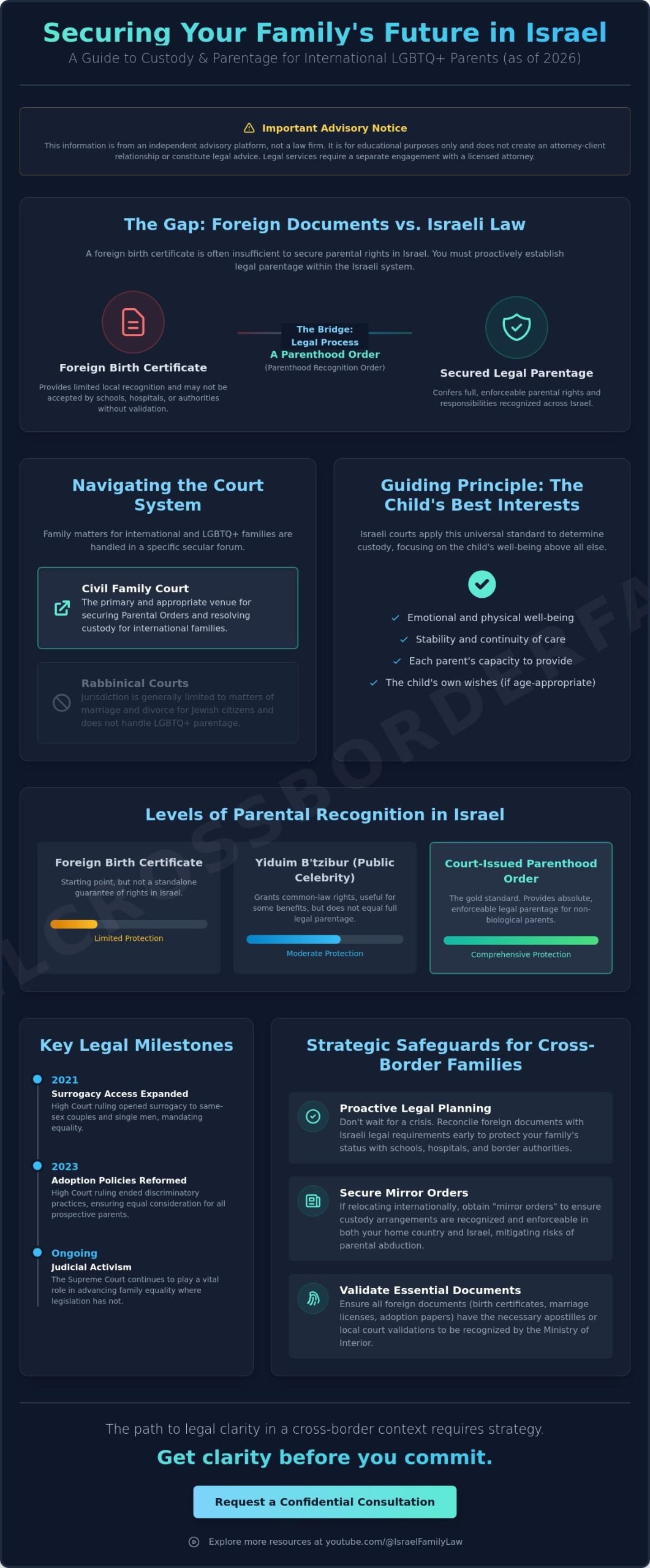
Strategic Safeguards for Cross-Border LGBTQ Families
Living between two legal systems creates a unique set of vulnerabilities for international families. When you manage custody rights for LGBTQ parents in israel, you aren’t just dealing with local statutes; you’re managing the intersection of two different cultures and legal frameworks. One of the most significant risks is the “Status Quo” trap. In Israeli law, the courts often favor the existing living arrangement of a child. If you delay seeking legal clarity, you might inadvertently establish a permanent residence that makes it difficult to relocate in the future. Proactive planning is the only way to ensure that your family’s mobility isn’t restricted by a lack of documentation.
Cross-border child support is another area where early strategy pays off. Israel has specific models for calculating support based on parental income and time spent with the child. However, enforcing these orders in a foreign country requires specific legal structures. If one parent moves abroad, you need to ensure that the Israeli order is recognized and enforceable in that jurisdiction. This prevents a state of limbo where one parent is left without financial support while the other is beyond the reach of local authorities. Addressing these obligations early is a critical component of a stable cross-border parenting plan.
Relocation and Abduction Prevention
Israel is a signatory to the Hague Convention on the Civil Aspects of International Child Abduction. This treaty applies to all families, including those with same-sex parents. If a child is removed from IL without the consent of both legal parents, the convention provides a mechanism for their immediate return. However, this protection only works effectively if both parents are legally recognized in IL. You should also consider an “Exit Stay Order,” known locally as a Tsav Ikur Yetzia Min HaAretz, if there’s a risk of a child being taken abroad without permission. For more detailed strategies, review our international custody and relocation guidance or learn about the Hague Convention and child abduction.
Final Advisory Steps
A “Mirror Order” is perhaps the most powerful tool for an international family. This is a court order obtained in a foreign jurisdiction, such as a US state, that mirrors the terms of your Israeli custody agreement. It ensures that custody rights for LGBTQ parents in israel are respected even if the family moves across borders. Dual citizenship adds another layer of complexity, as it can impact which country has the “most significant connection” to the child during a dispute. Before making any major life changes or commitments, it’s essential to understand how these factors interact. Get clarity before you commit. Request a confidential consultation.
This article is published on an independent advisory platform and is not a law firm. The information provided is for educational purposes and does not constitute legal representation or an attorney-client relationship. Legal services are only provided by licensed attorneys under a separate engagement.
Securing Your Family’s Cross-Border Future
Securing your children’s legal standing in Israel requires more than just administrative filing; it demands a strategic, cross-border approach. By prioritizing an early Parenthood Order and ensuring your case remains within the secular Civil Family Court, you build a foundation of certainty. These steps, combined with mirror orders and relocation safeguards, protect your family from the inherent complexities of living between two different legal systems. Understanding custody rights for LGBTQ parents in israel is about making informed choices before a crisis occurs.
Our advisory platform specializes in the nuances of US-Israel family law. We provide a neutral, strategy-based perspective on international custody and Hague Convention matters to help you manage multi-jurisdictional risks effectively. Whether you’re planning a move or documenting your parental status, seeking clarity early is the most effective way to safeguard your future. Get clarity before you commit. Request a confidential consultation. You have the tools to build a secure and recognized life for your family in IL.
This article is published on an independent advisory platform and is not a law firm. The information provided is for educational purposes and does not constitute legal representation or an attorney-client relationship. Legal services are only provided by licensed attorneys under a separate engagement.
Frequently Asked Questions
Can a non-biological LGBTQ parent get custody in Israel?
Yes, non-biological parents can obtain full legal custody through a Parenthood Order or adoption. Israeli courts recognize the concept of “psychological parenthood” and the shared intent of both partners to raise a child together. You must typically secure a formal order from the Civil Family Court to establish these rights. This ensures your parental status is protected regardless of a biological connection or the gender of the parents.
Is a foreign birth certificate enough to establish parental rights in IL?
A foreign birth certificate is generally insufficient for full legal recognition by the Israeli Ministry of Interior. While the document is valid in its country of origin, IL authorities usually require an Israeli court order to register a non-biological parent. Without this local judicial validation, you may encounter significant hurdles when trying to access your child’s medical records or making critical educational decisions during an emergency.
Can the Rabbinical Court handle my LGBTQ custody case?
The Rabbinical Court generally does not handle LGBTQ custody matters because it operates under religious law that doesn’t recognize same-sex unions. Instead, these cases are heard in the secular Civil Family Court system. This provides a more predictable and rights-based environment for international families. It’s essential to ensure your case is filed in the correct forum to benefit from modern legal standards and secular parental equality.
What is the “Best Interests of the Child” standard in Israel?
The “Best Interests of the Child” is the primary legal standard used by Israeli judges to determine custody and visitation. This standard prioritizes the child’s emotional stability, physical safety, and the continuity of their care over the parents’ preferences. The court evaluates who has served as the primary caregiver and the strength of the child’s existing bonds to ensure their developmental needs are met in a stable environment.
How does a Parenthood Order (Tzav Horut) protect my rights?
A Parenthood Order grants you the same legal status as a biological parent and is a binding judicial decree. It is the most effective way to secure custody rights for LGBTQ parents in israel because it is recognized by all government agencies. This order is particularly vital for international families who need their parental status to be enforceable across borders and in foreign jurisdictions like the United States.
What happens if my partner tries to move our child out of Israel?
If a partner removes a child from IL without your consent, the Hague Convention on international child abduction provides a legal framework for their return. You can petition the court for an immediate mandate to bring the child back to their habitual residence. To prevent this risk, you may also file for an Exit Stay Order, which stops the child from leaving the country while a dispute is pending.
Are same-sex custody agreements from the US enforceable in Israel?
US custody agreements aren’t automatically enforceable in IL and must be validated by an Israeli court. To ensure your rights are protected, you should seek a “mirror order” that translates the terms of your US agreement into the Israeli legal context. This process makes the agreement enforceable by local police and authorities, which is a critical safeguard for custody rights for LGBTQ parents in israel during a relocation.
How does surrogacy abroad affect my custody standing in IL?
Surrogacy abroad requires a specific legal process to establish recognized custody in IL. You must provide evidence that the surrogacy was legal in the host country and then petition the Israeli Civil Family Court for a Parenthood Order. This judicial step is necessary to ensure the non-biological parent has full legal standing and can be registered as a parent with the Ministry of Interior upon returning to Israel.

Article by
Gabriel Lior
A Personal Journey That Became a Mission
The advisory was founded by an American father Gabriel Lior, LLB, MBA , global entrepreneur, and cross-border advisor who spent more than a decade navigating the Israeli family court system firsthand and now lives in Singapore with his son.
As a divorced parent in a cross-border family, Gabriel faced nearly every legal challenge a foreign parent can encounter in Israel — including child custody disputes, child support proceedings, property matters in Israel and abroad, false accusations, and complex immigration and relocation proceedings.
Over the years, he learned the hard way how difficult it is for non-Israeli parents to understand the system, identify the right legal strategy, and choose the right legal representation — especially when language, culture, and jurisdictional differences are involved. He also witnessed how foreign parents and new immigrants are often disadvantaged or taken advantage of by service providers and institutions simply because they lack local knowledge or fluency.
From Client to Advisor
To truly understand — and survive — the system, Gabriel pursued formal legal education in Israel, completing two Israeli law degrees, alongside a BA and MBA earned in the United States. This was never about becoming a practicing attorney, but about gaining a deep, structural understanding of how the system works — and where it breaks down for foreign parents.
This rare combination of:
Firsthand client experience
Israeli legal and US business education
International business and negotiation training
Decades of commercial execution
created a unique perspective – one that understands both sides of the table.
After years of litigation, persistence, and at times self-representation, he ultimately succeeded in securing custody of his son and relocating abroad through a rare legal victory in the Israeli Supreme Court — becoming one of the first fathers in Israel to do so under these circumstances.
Disclaimer
Important Disclaimer:
The information provided on this website and in its content is for general informational and educational purposes only and does not constitute legal advice, legal opinion, or legal representation.
Gabriel Lior is not licensed to practice law in Israel (nor is he interested in doing so) and does not provide legal services, despite having completed 2 Law Degrees. The services offered are advisory in nature and are intended to provide general guidance, strategic insight, and information regarding cross-border family law considerations.
No attorney-client relationship is formed by accessing this website, reading its content, or communicating with us.
Any decisions made based on this information are at your own discretion and risk. For legal advice specific to your situation, you should consult a licensed attorney in the relevant jurisdiction.
Where appropriate, we may refer clients to independent, licensed attorneys or professionals. Such referrals do not constitute legal representation and no liability is assumed for services provided by third parties.
Related Insights & Resources

Divorce Issues for Olim Hadashim: A Strategic Cross-Border Guide (2026)
Filing for divorce in Israel is not just a local event; it is a complex...Read More →
Divorce in Israel for US Citizens: Legal Guide (2026)
In a US-Israel divorce, the first 48 hours of strategic planning often determine the next...Read More →
Jay Hait Law: Navigating US-Israel Cross-Border Legal Challenges
This article is published on an independent advisory platform and does not constitute an attorney-client...Read More →