The "Race to Court" in Israel is often won or lost in the first 24 hours of a filing. Many Anglos realize too late that assuming the legal rules here work like they do in the US or UK can lead to a total loss of jurisdictional control. You likely feel the weight of this complexity, especially when trying to protect assets across two different continents. This guide explains how to navigate these strategic hurdles and why engaging an experienced Israeli family lawyer, such as those at Israel Cross Border Law Firm, is critical for protecting your interests in both IL and abroad.
You’ll gain a clear understanding of how to shield your ₪250,000 plus in local assets from jurisdictional errors and how to establish a custody strategy that respects international borders. We’ll examine the specific differences between the Rabbinical and Civil systems so you can make informed choices before the clock runs out. For more visual insights on these topics, visit the IsraelFamilyLaw YouTube channel. Get clarity before you commit. Request a confidential consultation with Israel Cross Border Law Firm.
Key Takeaways
Navigate the concurrent jurisdiction of Rabbinical and Family Courts to understand how filing first can dictate the strategic direction of your case.
Evaluate how the "Center of Life" principle determines whether Israeli courts will accept your case and the impact of filing in Israel versus a US state.
Compare the Israeli "needs-based" child support model and rare spousal support standards against US models to better project potential financial outcomes.
Understand the legal definition of relocation and the severe implications of the Hague Convention when moving children across international borders without consent.
Learn why partnering with a bicultural israeli family lawyer who bridges the gap between two legal cultures is vital for protecting your interests in complex cross-border matters.
Table of Contents
Understanding the Israeli Family Law System: The Rabbinical vs. Civil Court Dynamic
Jurisdiction and the Anglo Expat: Why Where You File First Matters
Strategic Planning for International Families: Relocation and the Hague Convention
Choosing the Right Israeli Family Lawyer for Your Cross-Border Case
This article is published on an independent advisory platform (not a law firm). Do NOT use language that implies attorney-client relationship, legal representation, or giving legal advice. Focus on strategy, risks, and decision-making guidance. Soft CTA to advisory call / WhatsApp.
Understanding the Israeli Family Law System: The Rabbinical vs. Civil Court Dynamic
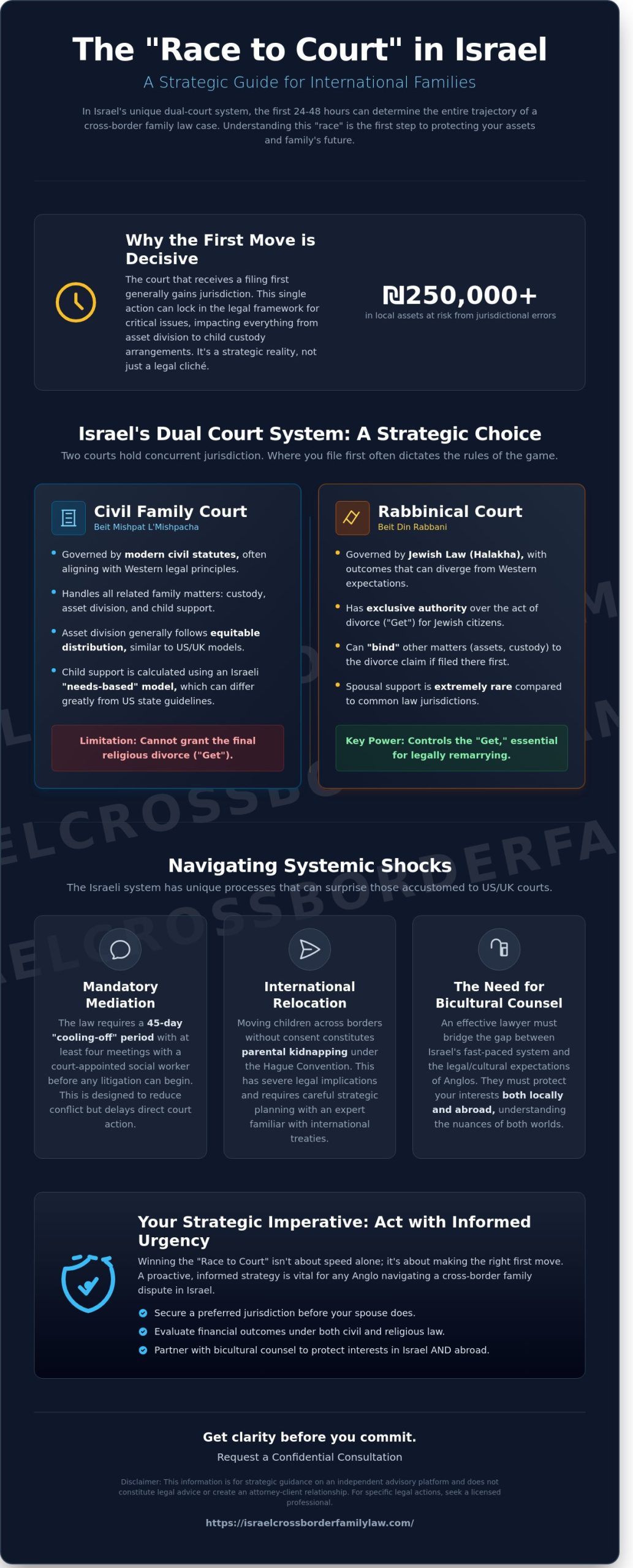
Israel’s legal landscape for domestic relations is built on a dual-court structure that often surprises those from common law jurisdictions. For any Anglo or international resident, Understanding the Israeli Family Law System is the first step in recognizing that marriage and divorce are governed by religious affiliation. This means that two separate systems, the civil Family Court and the religious Rabbinical Court, hold concurrent jurisdiction. Decisions made in the first 48 hours of a dispute often dictate the financial and personal trajectory of a case for years.
The "Race to Court" is not just a legal cliché in Israel; it’s a structural reality. Under the 1953 Rabbinical Courts Jurisdiction Law, the court that receives a filing first generally gains the authority to hear the case. For an international family, this creates an urgent need for strategic clarity. Choosing the wrong venue can lead to outcomes that don’t align with Western expectations regarding property division or alimony. It’s why many seek an israeli family lawyer who understands both the local statutes and the cultural nuances of the Anglo community.
Even for secular couples, the "Get" (the religious writ of divorce) remains a critical factor. In Israel, the Rabbinical Court maintains an exclusive monopoly over the act of divorce itself for Jewish citizens and residents. This means even if you resolve your financial assets in a civil court, you must still pass through the religious system to be legally single. This intersection of ancient tradition and modern civil law requires a sophisticated approach to ensure that religious requirements don’t become leverage in civil negotiations.
The Concurrent Jurisdiction Explained
Both court systems can theoretically handle the same issues, including child custody and asset distribution. The key is the "binding" process. When a party files for divorce in the Rabbinical Court, they can "bind" related matters to that claim. If the filing is done correctly and is deemed sincere, the civil court may lose its ability to intervene in those specific areas. For international families with assets outside Israel, this creates significant jurisdictional risks that must be managed with precision. Acting quickly to secure a preferred jurisdiction is often the most important tactical move a person can make.
Cultural and Systemic Shocks for Anglos
Expats often find the Israeli system’s focus on mandatory mediation a major shift from the adversarial nature of US or UK courts. The 2016 Law for the Settlement of Family Disputes requires couples to attend at least four meeting sessions with a court-appointed social worker before they can even set foot in front of a judge. This 45-day "cooling off" period is designed to reduce litigation, yet it can feel frustrating for those used to immediate judicial intervention.
The system also reflects Israel’s "Start-up Nation" mindset; it’s fast, digital, and often less formal than Western counterparts. However, this speed can be a double-edged sword. Without bicultural guidance, an israeli family lawyer might navigate the Hebrew-language bureaucracy effectively but miss the specific concerns of a client whose primary financial interests remain abroad. Having a team on the ground that bridges these two worlds is essential for maintaining control over the process.
Get clarity before you commit. Request a confidential consultation.
This article is published on an independent advisory platform (not a law firm). It does not constitute legal representation or legal advice. The focus is on strategy, risks, and decision-making guidance. For specific legal actions, contact us for a referral to a licensed professional or a soft CTA to an advisory call via WhatsApp.
Jurisdiction and the Anglo Expat: Why Where You File First Matters
For international families living in Israel, the decision of where to initiate legal proceedings is the most critical choice you’ll make. Israel operates under a unique dual-court system where both Family Courts and Rabbinical Courts have jurisdiction. The "Race to Court" is a well-known phenomenon here; the party that files first often dictates which court system handles specific aspects of the case, such as alimony or property division. When you add a US state jurisdiction into the mix, the complexity doubles. Choosing the right israeli family lawyer to help navigate these early filing decisions can prevent years of jurisdictional battles.
The concept of "Center of Life" (Merkaz Chaim) is the primary yardstick Israeli courts use to determine jurisdiction. It isn’t just about your physical presence. The court examines your economic ties, where your children attend school, and your long-term intentions. If you’ve lived in Israel for more than 183 days in a tax year, or if your primary residence and social ties are in Jerusalem or Tel Aviv, the court will likely claim jurisdiction. This remains true even if you still maintain a home or bank accounts in New York or California.
Protecting US-based assets while litigating in Israel requires a multi-layered strategy. Israeli courts may issue orders regarding your 401k, IRA, or US real estate, but these orders aren’t always recognized by US financial institutions without a local "mirror order." You must account for the fact that an Israeli court might value assets in Israeli Shekels (₪), which can lead to significant discrepancies due to currency fluctuations. If you’re managing cross-border interests, you can find more detailed guidance on divorce and separation for international families to understand how these systems overlap.
Strategic Considerations for US Citizens in IL
Parallel proceedings occur when one spouse files in an Israeli court while the other files in a US state court. This creates a high-stakes environment where two different legal systems might issue conflicting orders. While Israel has signed several international treaties, US orders are not automatically enforceable. They must undergo a process called "Lidshur" to be recognized. Additionally, your citizenship status impacts Rabbinical proceedings. Even if you aren’t an Israeli citizen, the Rabbinical court may claim jurisdiction over your divorce if you are Jewish and present in the country, which can lead to complications regarding the "Get" (religious divorce decree).
The "Race to Court" Checklist
Child Support vs. Property: Israeli child support calculations often differ significantly from US state guidelines. It’s vital to understand the Key Differences Between US and Israeli Family Law before deciding where to file, as Israel may offer higher support amounts but different property division rules.
Asset Locking: Filing in a court that doesn’t understand complex cross-border assets can "lock" you into a disadvantageous position. For example, an Israeli judge might not understand the tax implications of a US-based Roth IRA.
Pre-Communication Strategy: Don’t speak to your spouse about separation until you’ve consulted an advisor. The moment they know your intent, they may file first in a jurisdiction that favors them, potentially costing you hundreds of thousands of Shekels in the long run.
Before making a move that could affect your global assets and family dynamic, it’s wise to get a strategic overview of your specific situation. Every international case has unique variables that a standard domestic filing won’t cover.
Get clarity before you commit. Request a confidential consultation.
This article is published on an independent advisory platform (not a law firm). Do NOT use language that implies attorney-client relationship, legal representation, or giving legal advice. Focus on strategy, risks, and decision-making guidance. Soft CTA to advisory call / WhatsApp.
Key Differences Between US and Israeli Family Law Standards
Understanding the jurisdictional gap between the United States and Israel is the first step in protecting your financial future. While the US often relies on state-specific "income-shares" models that use rigid formulas to determine support, Israel traditionally utilized a "needs-based" system rooted in religious law. This distinction creates significant friction for expats. An israeli family lawyer must often reconcile these two worlds when a divorce involves assets or parties in both countries. In Israel, the financial burden was historically placed almost exclusively on the father, but a landmark 2017 Supreme Court ruling (919/15) transformed the landscape for children aged six to 15. Now, support obligations are shared between parents based on their relative income and the actual time spent with the children.
Spousal support, or alimony, presents another sharp contrast. In many US states, long-term or permanent alimony is a standard component of divorce settlements. In Israel, "Mezonot Isha" (wife support) generally terminates the moment the divorce is finalized. Rehabilitative alimony exists in the civil court system but is granted far less frequently and for shorter durations than in the US. This makes the initial strategy regarding where to file for divorce a critical decision that impacts long-term liquidity.
Property division also requires a nuanced approach. Israel follows the "Equitable Distribution" principle, which mirrors many US states, yet the execution differs when dealing with foreign retirement accounts. A US-based 401k or IRA cannot be easily split by an Israeli court order alone. These instruments require specific US legal tools like a Qualified Domestic Relations Order (QDRO), which an Israeli court cannot issue. Without a coordinated strategy, you may find yourself with an Israeli judgment that is unenforceable against your US-based wealth.
Child Support and Financial Obligations
The Israeli "Executive Office" (Hotsaa LaPoal) serves as the primary mechanism for enforcing support orders. If you hold a US child support order, it isn’t automatically active in Israel; it must be domesticated through a formal legal process. You must also account for currency volatility. A fixed payment of ₪3,500 may have been affordable when the Shekel was weak, but a strengthening currency can effectively increase your costs by 10% or 15% overnight. For those dealing with relocation disputes, the Hague Convention on International Child Abduction provides the framework for returning children to their habitual residence, a process that is often intertwined with child-support-cross-border-enforcement strategies.
Asset Protection and Prenuptial Agreements
A common misconception among expats is that a US-signed prenuptial agreement is automatically binding in Israel. Under Article 2 of the Israeli Financial Relations Law, a financial agreement must be approved by a judge to be valid. If you move to Israel with a US prenup, an israeli family lawyer should help you "validate" that agreement in an Israeli Family Court to ensure it holds up during a crisis. This is especially vital when managing real estate. Israeli law treats a primary residence in Tel Aviv differently than a vacation home in Florida, and failing to synchronize your international holdings can lead to double taxation or conflicting court orders.
Get clarity before you commit. Request a confidential consultation.
This article is published on an independent advisory platform (not a law firm). The following information is provided for strategic planning and decision-making guidance only. It does not constitute legal advice or establish an attorney-client relationship. For specific legal representation, you should consult with a licensed professional.
Strategic Planning for International Families: Relocation and the Hague Convention
Moving a child across international borders is the most complex challenge a family can face in the Israeli legal system. Under the Capacity and Guardianship Law of 1962, both parents are recognized as natural guardians. This means neither parent has the unilateral right to change a child’s country of residence without the express written consent of the other or a formal order from an Israeli court. If you move a child to or from Israel without this authorization, you risk being accused of "wrongful removal," which triggers severe international legal consequences.
The Hague Convention on the Civil Aspects of International Child Abduction, which Israel joined in 1991, provides the framework for these disputes. Its primary objective is not to determine who is the "better" parent. Instead, the convention seeks to restore the status quo by returning the child to their "habitual residence." An israeli family lawyer can help you understand that the court’s role in a Hague case is jurisdictional. They focus on where the child lived before the removal, rather than the long-term merits of a custody claim. If a child is taken from the US to Israel, or vice versa, the court in the receiving country is generally obligated to order the child’s return unless very specific, narrow exceptions apply.
Navigating International Relocation Requests
When a parent wishes to move abroad legally, the Israeli family court applies the "Best Interests of the Child" standard. This isn’t a vague concept; it involves a rigorous evaluation of the child’s emotional, social, and educational needs. In approximately 75% of contested relocation cases, the court appoints a court-certified expert to provide a recommendation. You must present a meticulous "Parenting Plan" that bridges two continents. This plan should detail how the child will maintain a deep connection with the left-behind parent, including specific flight schedules and digital communication routines.
To protect against unauthorized travel during a dispute, parents often secure an Exit Stay Order, known in Hebrew as Tsav Ikur Yetzia Min HaAretz. These orders are filed electronically and flag the child’s passport at Ben Gurion Airport immediately. Filing fees for these motions typically start at ₪500, but the security they provide is invaluable for parents concerned about a potential flight risk. Understanding the nuances of international custody and relocation is the first step in protecting your parental rights.
Hague Convention Risks and Realities
Speed is the defining characteristic of Hague Convention proceedings. While a standard family law case in Israel might last 12 to 18 months, Article 11 of the Convention sets a target of just six weeks for a decision. This rapid pace means there’s no room for tactical errors. The "Habitual Residence" test is the most critical factor. The court looks at the child’s "degree of integration" into their Israeli or foreign environment. This includes school attendance, social ties, and even the language spoken at home.
For expats living in Israel, the risk is often a misunderstanding of how quickly a temporary stay can transform into a legal "habitual residence." If you’ve lived in Tel Aviv for more than a year, the court may view Israel as the child’s home, making it difficult to leave without consent. You can find practical insights on these timelines and jurisdictional traps on the @IsraelFamilyLaw YouTube channel. Engaging with an israeli family lawyer early allows you to build a strategic planning foundation before a crisis occurs.
Get clarity before you commit. Request a confidential consultation.
This article is published on an independent advisory platform (not a law firm). This content is for informational and advisory purposes only, not legal representation or legal advice. Legal services are provided separately by licensed attorneys. Focus on strategy, risks, and decision-making guidance. Soft CTA to advisory call / WhatsApp.
Choosing the Right Israeli Family Lawyer for Your Cross-Border Case
Selecting a legal representative in Israel involves more than checking a directory. For an international Anglo client, a standard local lawyer often lacks the specific toolkit required for a multi-jurisdictional dispute. While a domestic practitioner might understand the inner workings of the Haifa or Tel Aviv family courts, they may not grasp the implications of a QDRO in the United States or how an Israeli divorce decree affects tax filings with the IRS. You need a professional who acts as a bicultural bridge. This ensures that your strategy in Israel doesn’t inadvertently trigger a 20% capital gains tax hit or a contempt of court charge in your home country.
True expertise in this field requires bilingual fluency. It isn’t just about speaking English; it’s about understanding the conceptual differences between Common Law and the Israeli civil/religious hybrid system. Misunderstandings in terminology can lead to errors in drafting agreements that are meant to be enforceable in both jurisdictions. Before you sign a retainer, you must determine if the professional can navigate the 7 hour time difference with the US East Coast or the 10 hour gap with the West Coast without delaying your case. Understanding how it works when managing two legal systems simultaneously is the first step toward a successful outcome.
Questions to Ask Your Potential Legal Team
When interviewing a potential israeli family lawyer, vague answers are a red flag. You need concrete data to assess their suitability for a cross-border matter. Start with these three specific questions:
"How many US-IL cross-border cases have you handled in the last 24 months?" Look for a professional who manages at least 5 to 10 such cases annually. General practitioners might only see one every few years.
"Do you have experience with the specific US state laws relevant to my assets?" Laws in California (community property) differ vastly from New York (equitable distribution). Your lawyer must know how these interact with Israeli law.
"How do you handle communication with clients across different time zones?" Ask if they use secure portals or scheduled WhatsApp windows to ensure you aren’t left waiting 48 hours for an urgent update.
The Value of an Advisory Approach
Jumping straight into litigation is often a ₪50,000 mistake. Using an advisory platform allows you to screen for the right litigation attorney while maintaining a high-level strategic view. This stage helps you understand the realistic costs. In the Israeli market, fee structures vary significantly. Some firms charge a flat fee for specific stages, such as ₪20,000 for a divorce agreement. Others use hourly rates, which for a senior israeli family lawyer in 2024, typically range from ₪800 to ₪1,500 per hour.
An advisory session provides the clarity needed to choose between these structures. It prevents you from being locked into a high-conflict litigation path when mediation might save you 40% in legal costs. By analyzing your risks before committing to a specific firm, you protect your assets and your emotional well-being.
Get clarity before you commit. Request a confidential consultation.
This article is published on an independent advisory platform (not a law firm). Do NOT use language that implies attorney-client relationship, legal representation, or giving legal advice. Focus on strategy, risks, and decision-making guidance. Soft CTA to advisory call / WhatsApp.
Secure Your Global Family Strategy
Navigating the intersection of two legal systems requires more than just basic paperwork. Success in IL often depends on understanding the 2 distinct court tracks, the Rabbinical and Civil systems. Because jurisdiction is frequently determined by who files first, early strategic decisions are vital. If your case involves international relocation, the 1980 Hague Convention standards will apply, making risk mitigation a top priority. You don’t have to manage these multi-jurisdictional complexities alone. A qualified israeli family lawyer with bilingual and bicultural expertise provides the necessary bridge between US and IL standards. For more insights on protecting your interests, visit our YouTube channel. Choosing a path based on clear data and strategic planning ensures you stay in control of your family’s future. We’re here to help you navigate these transitions with confidence and precision. Get clarity before you commit. Request a confidential consultation.
This article is published on an independent advisory platform (not a law firm). The content below is for informational and advisory purposes only, not legal representation or legal advice. Focus on strategy, risks, and decision-making guidance. For specific legal assistance, contact us via WhatsApp or schedule an advisory call.
Frequently Asked Questions
Do I need a separate Israeli family lawyer if I already have one in the US?
You definitely need a local expert because a US attorney lacks the license to appear in Israeli courts or file motions in the Hebrew legal system. An israeli family lawyer provides the necessary team on the ground to manage local filings while coordinating with your US counsel to ensure your global strategy remains consistent. This collaboration prevents conflicting rulings in different jurisdictions that could jeopardize your assets or custody rights.
Can a US citizen be forced to go to a Rabbinical Court in Israel?
Yes, the Rabbinical Court can exercise jurisdiction over Jewish US citizens if the marriage or divorce has sufficient ties to Israel. Under the Rabbinical Courts Jurisdiction Law of 1953, these courts hold exclusive authority over the act of divorce itself for Jewish residents. This remains true even if you don’t hold Israeli citizenship but are physically present or maintain a residence within the country.
What happens if my spouse files for divorce in Israel before I file in the US?
If your spouse files in Israel first, it triggers a jurisdictional race that could lock the case into the Israeli court system. Israeli courts often apply the principle of prior pendency, meaning the first court to receive the valid file usually handles the proceedings. This choice can significantly impact asset division and alimony, as Israeli law differs from US state laws regarding marital property and support obligations.
How is child support calculated for expats living in Israel?
Child support in Israel follows the 2017 Supreme Court ruling 919/15, which balances payments based on the income of both parents and the percentage of time spent with the children. For children over age six, the court calculates a needs-based amount, often starting around ₪2,150 per month for basic necessities plus housing costs. Expats should know that their global income, including US stocks or rental income, is factored into this calculation.
Are US prenuptial agreements enforceable in Israeli courts?
US prenuptial agreements are generally enforceable, but they must be validated to meet the standards of the Israeli Spousal Property Relations Law of 1973. If the agreement wasn’t approved by a judge or a notary at the time of signing, an Israeli court might scrutinize its fairness. It’s vital to have an israeli family lawyer review the document to ensure it aligns with local public policy and will be recognized during a local dispute.
How can I prevent my spouse from taking our children out of Israel without my consent?
You can file for an emergency Stay of Exit order, known as Tzav Ikur Yetzia Min Ha’aretz, to prevent a child from being removed from the country. This order is registered with the border police and stops the child at Ben Gurion Airport immediately. Since Israel is a signatory to the 1980 Hague Convention, there are international protocols to return children, but a local prevention order is the most effective first step.
Is it possible to mediate a cross-border divorce remotely?
Remote mediation is a standard practice for international families and is highly effective for resolving cross-border disputes without expensive travel. Modern Israeli courts and mediators regularly use platforms like Zoom to conduct sessions between parties in different time zones. This approach reduces costs and allows for a calmer environment during sensitive negotiations regarding property and visitation schedules.
How long does a typical international divorce take in the Israeli system?
A typical international divorce in the Israeli system lasts between 12 and 24 months if there are contested assets or custody issues. If the parties agree on all terms, a Divorce by Mutual Consent can be finalized in as little as 90 to 180 days. However, cases involving multi-jurisdictional property or complex business valuations often require multiple hearings over a two year period.
For more information on navigating these complex legal waters, visit our YouTube channel: https://www.youtube.com/@IsraelFamilyLaw
Get clarity before you commit. Request a confidential consultation.

Article by
Gabriel Lior
A Personal Journey That Became a Mission
The advisory was founded by an American father Gabriel Lior, LLB, MBA , global entrepreneur, and cross-border advisor who spent more than a decade navigating the Israeli family court system firsthand and now lives in Singapore with his son.
As a divorced parent in a cross-border family, Gabriel faced nearly every legal challenge a foreign parent can encounter in Israel — including child custody disputes, child support proceedings, property matters in Israel and abroad, false accusations, and complex immigration and relocation proceedings.
Over the years, he learned the hard way how difficult it is for non-Israeli parents to understand the system, identify the right legal strategy, and choose the right legal representation — especially when language, culture, and jurisdictional differences are involved. He also witnessed how foreign parents and new immigrants are often disadvantaged or taken advantage of by service providers and institutions simply because they lack local knowledge or fluency.
From Client to Advisor
To truly understand — and survive — the system, Gabriel pursued formal legal education in Israel, completing two Israeli law degrees, alongside a BA and MBA earned in the United States. This was never about becoming a practicing attorney, but about gaining a deep, structural understanding of how the system works — and where it breaks down for foreign parents.
This rare combination of:
Firsthand client experience
Israeli legal and US business education
International business and negotiation training
Decades of commercial execution
created a unique perspective – one that understands both sides of the table.
After years of litigation, persistence, and at times self-representation, he ultimately succeeded in securing custody of his son and relocating abroad through a rare legal victory in the Israeli Supreme Court — becoming one of the first fathers in Israel to do so under these circumstances.
Disclaimer
Important Disclaimer:
The information provided on this website and in its content is for general informational and educational purposes only and does not constitute legal advice, legal opinion, or legal representation.
Gabriel Lior is not licensed to practice law in Israel (nor is he interested in doing so) and does not provide legal services, despite having completed 2 Law Degrees. The services offered are advisory in nature and are intended to provide general guidance, strategic insight, and information regarding cross-border family law considerations.
No attorney-client relationship is formed by accessing this website, reading its content, or communicating with us.
Any decisions made based on this information are at your own discretion and risk. For legal advice specific to your situation, you should consult a licensed attorney in the relevant jurisdiction.
Where appropriate, we may refer clients to independent, licensed attorneys or professionals. Such referrals do not constitute legal representation and no liability is assumed for services provided by third parties.