This article is published on an independent advisory platform, not a law firm, and does not imply an attorney-client relationship. Legal services are only provided by licensed attorneys under a separate engagement.
Imagine sitting in a high-stakes meeting regarding your family’s future, hearing every word in English, yet feeling completely lost in translation. For many of the 3,500 Americans who immigrated to Israel in 2025, the gap between US expectations and Israeli legal reality is a source of constant anxiety. You might worry that an aggressive local style will escalate a delicate matter or that your specific US-based assets will be misinterpreted. Ensuring my lawyer understands my cultural background isn’t just about comfort; it’s a strategic necessity to protect your interests in complex cross-border cases.
It’s natural to feel overwhelmed when US and Israeli legal norms intersect, especially with significant changes like the January 1, 2026, tax reporting requirements for foreign income. We understand that you need more than just a representative; you need a bridge between two distinct systems. This guide provides the tools to vet a legal professional for cultural competency, ensuring your voice is heard throughout the process. We’ll explore how a bicultural approach reduces conflict and helps you make informed decisions based on strategy rather than fear.
Key Takeaways
- Understand how a lawyer’s failure to grasp your cultural context can create strategic risks in complex cross-border family or estate matters.
- Identify the core differences between Western expectations of legal formality and the direct, results-oriented nature of the Israeli system.
- Learn the essential questions for ensuring my lawyer understands my cultural background, including their track record with international families from your specific country.
- Recognize critical red flags, such as a professional dismissing the US tax consequences or the personal religious values that shape your legal goals.
- Discover the benefits of a “strategy first” approach to clarify your options before you commit to a specific path in the Israeli legal system.
This article is published on an independent advisory platform, not a law firm, and does not imply an attorney-client relationship. Legal services are only provided by licensed attorneys under a separate engagement.
Why Cultural Background Matters in US-Israel Legal Matters
Cultural background is often a misunderstood term in legal circles. It’s not merely a reference to your place of birth or the language you speak at home. In a legal context, your background encompasses your communication style, your religious values, and your fundamental expectations of how a justice system should operate. When dealing with international family law, these factors become the invisible foundation of every decision. Failing to account for them creates a “hidden risk” where a lawyer might apply the correct law but pursue a strategy that contradicts your personal or professional goals.
Many expats believe that finding a lawyer who speaks fluent English is enough to bridge the gap. However, language fluency is not the same as cultural competency. A lawyer can translate words without translating the nuances of Cross-cultural communication. For example, an American client might expect a high degree of formal “discovery” and written procedure, while the Israeli system often moves with a different pace and level of directness. Ensuring my lawyer understands my cultural background is a vital step in preventing these misalignments from turning into costly legal errors.
To better understand how these dynamics play out in a professional setting, watch this helpful video:
The Role of Cultural Competency in Legal Strategy
Cultural awareness is a practical tool for preventing unnecessary escalation. In sensitive family disputes, the “direct” Israeli style can often feel aggressive or dismissive to Western clients. If your lawyer doesn’t recognize this friction, they might inadvertently push a strategy that causes you more stress or defensiveness. A bicultural attorney acts as a strategic bridge. They translate “legal intent” across cultures, ensuring that the assertive nature of Israeli litigation doesn’t alienate you or damage the chances of a settled resolution.
Cross-Border Nuances: More Than Just Translation
The “Anglo” mindset often prioritizes a specific type of privacy and structured disclosure. In Israel, family law is deeply intertwined with religious identity, whether Jewish, Christian, or Muslim. This intersection influences everything from inheritance to custody. If a lawyer is “system-blind” to your specific cultural or religious needs, they may miss how these factors influence a judge’s perspective. Ensuring my lawyer understands my cultural background means finding someone who recognizes that your identity isn’t a side issue; it’s a core component of your legal strategy in IL.
Get clarity before you commit. Request a confidential consultation.
This article is published on an independent advisory platform, not a law firm, and does not imply an attorney-client relationship. Legal services are only provided by licensed attorneys under a separate engagement.
The Anglo-Israeli Gap: Contrasting Legal Cultures
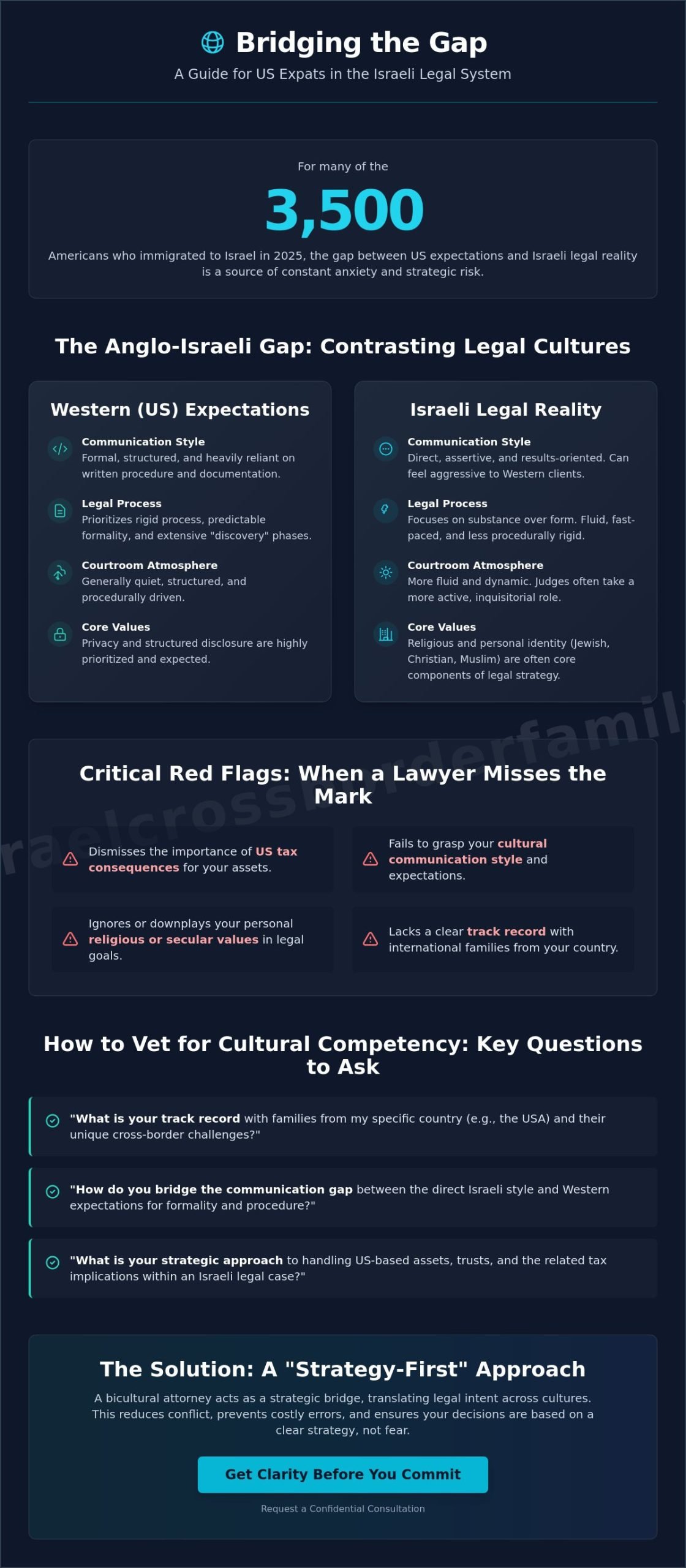
Relocating to Israel involves more than just a physical move; it requires a psychological shift in how you view authority and the law. According to data from early 2026, immigration from North America increased by 12% in 2025, bringing thousands of professionals into a legal environment that often feels foreign. Western legal systems, particularly in the US, prioritize rigid process and predictable formality. In contrast, the Israeli system focuses heavily on results and directness. This transition often triggers “legal culture shock” for expats who expect a quiet, structured courtroom experience but find a more fluid and assertive atmosphere instead.
In the Israeli legal system, you will encounter “Dugri,” a cultural value of unapologetic directness. While Westerners often view the courtroom as a place of quiet deliberation, the Israeli reality is frequently louder and more confrontational. This isn’t a sign of chaos; it’s a different way of reaching a resolution. This is why ensuring my lawyer understands my cultural background is so important. Without that bridge, a lawyer’s directness might feel like a lack of empathy or a disregard for your privacy, when it’s actually a standard part of the local legal machinery.
Negotiation Styles: Polite vs. Persistent
An Israeli lawyer’s persistent, even loud, stance in court isn’t necessarily a sign of anger. In IL, “politeness” in a negotiation is often misinterpreted as weakness or a lack of confidence in one’s position. Western clients who value professional distance may feel uncomfortable when their representative pushes back hard against a judge or opposing counsel. A bicultural lawyer understands both worlds. They can maintain the persistence required to win in Israel while communicating with you in a way that respects your need for calm and clarity. If you’re facing a complex divorce or separation, this balance is essential.
The Secular-Religious Intersection in Israel
Unlike the US, where civil and religious law are strictly separated, Israeli family law exists at a unique intersection. Your cultural background dictates how comfortable you feel navigating Rabbinical versus Civil courts. The Israeli system often prioritizes collective community values, which can clash with the individualistic expectations common in the West. Cultural competency in the context of the Israeli Rabbinical Court system means possessing the nuanced knowledge required to respect religious protocols while strategically safeguarding a client’s civil interests. It’s often helpful to discuss your specific concerns with an advisor who understands these dual pressures.
Get clarity before you commit. Request a confidential consultation.
This article is published on an independent advisory platform, not a law firm, and does not imply an attorney-client relationship. Legal services are only provided by licensed attorneys under a separate engagement.
Red Flags: When a Lawyer Misses the Cultural Context
Identifying potential issues early is critical when managing cross-border legal matters. While many lawyers are technically proficient in Israeli law, they may lack the specific awareness required to protect an expat’s interests. Ensuring my lawyer understands my cultural background involves watching for warning signs that indicate a professional is “system-blind” to your unique situation. If a representative treats your case as a standard local matter, they may miss the nuances that define your legal and financial security.
- Dismissing US-side implications: If a lawyer suggests that your US assets, tax obligations, or custody rights are irrelevant to the Israeli proceeding, take it as a serious warning. For example, as of January 1, 2026, new immigrants must report foreign-sourced income to the Israel Tax Authority. A professional who ignores these cross-border complexities can inadvertently create significant liability.
- Pushing for excessive aggression: While the Israeli system is results-oriented, it shouldn’t come at the cost of your personal values. If a representative ignores your preference for a mediated resolution or pushes for a style that escalates conflict, they’re missing the cultural context of your request.
- Inexperience with international cases: Successfully managing a divorce for international families requires more than a standard legal template. It demands an understanding of how two different legal systems will eventually clash or align over time.
- Over-promising results: The Israeli legal system is highly discretionary. Any professional who guarantees a specific outcome without explaining the risks is likely oversimplifying the inherent complexity of your background.
Communication Failures to Watch For
Effective communication is about more than just a shared language. You should be wary if a professional ignores the emotional subtext of your concerns or fails to explain Israeli legal jargon in plain English. A dismissive attitude toward complex cross-border asset structures is another sign of trouble. If your lawyer doesn’t take the time to understand the specifics of your US-based retirement accounts or trusts, they aren’t truly advocating for your entire financial picture. Clear communication is the only way to avoid the “lost in translation” feeling that plagues many expats.
Strategic Blind Spots
A “system-centric” lawyer often focuses only on the immediate Israeli ruling. They might neglect how a specific custody or financial decision in IL will impact your legal status in the US years later. Anglo family dynamics often involve different expectations regarding privacy and long-term planning. If your representative treats your case like a standard local matter, they risk creating strategic damage that is difficult to undo. Protecting your interests requires a lawyer who looks beyond the local courtroom to the global impact of every decision.
Get clarity before you commit. Request a confidential consultation.
This article is published on an independent advisory platform, not a law firm, and does not imply an attorney-client relationship. Legal services are only provided by licensed attorneys under a separate engagement.
How to Vet Your Lawyer for Cultural Competency
Vetting a professional in a foreign country requires a different set of criteria than you might use in your home jurisdiction. While years of experience are important, they don’t always translate to cultural awareness or an understanding of your specific needs as an expat. Ensuring my lawyer understands my cultural background starts with a structured interview process that tests their ability to bridge the gap between your expectations and the local system. By taking an active role in the selection process, you reduce the risk of future misunderstandings that could jeopardize your interests.
- Step 1: Ask about country-specific experience. A lawyer who has worked with dozens of North American or British expats will already be familiar with the common hurdles these groups face, such as US tax filing requirements or the nuances of Anglo estate planning.
- Step 2: Discuss the advisory model. Inquire about their familiarity with how the advisory works for international families. This helps determine if they are willing to work within a collaborative, strategy-first framework that prioritizes clarity over conflict.
- Step 3: Test their ability to simplify concepts. Ask them to explain Israeli legal terms like “Gett” (a religious divorce decree) or “Mezonot” (financial support) in plain English. If they rely on jargon, they may struggle to keep you informed during complex proceedings.
- Step 4: Check for technical cross-border knowledge. Inquire about their understanding of the US-Israel tax treaty or Hague Convention protocols. This is vital for cases involving international assets or relocation.
- Step 5: Observe their listening skills. A culturally competent lawyer listens more than they lecture. They should seek to understand your specific values rather than assuming a standard Israeli approach is the only option.
Questions to Ask During Your Initial Consultation
Your first meeting is an opportunity to gauge the professional’s strategic depth. Ask how many US-Israel cross-border cases they’ve handled in the last 12 months. This provides a clear metric of their current engagement with the international community. You should also ask how your US assets might be viewed by an Israeli court and what their approach is to resolving conflicts outside of a courtroom. These questions help you identify if the lawyer’s style aligns with your goals for a low-conflict resolution.
Evaluating ‘Bicultural’ Qualifications
A true “bridge” lawyer often possesses bicultural qualifications that go beyond simple language skills. Look for a professional who is part of a “team on the ground” in IL but maintains a deep connection to Western legal norms. You can often evaluate this by reviewing their published content for cultural insight. For example, watching videos on the Israel Family Law YouTube channel can reveal if their approach resonates with your background. If you’re ready to find a representative who truly understands your perspective, reach out to our team today.
Get clarity before you commit. Request a confidential consultation.
This article is published on an independent advisory platform, not a law firm, and does not imply an attorney-client relationship. Legal services are only provided by licensed attorneys under a separate engagement.
The Cross-Border Advisory Approach: Strategy Before Commitment
Independent advisory platforms serve as a necessary buffer for expats who feel pressured by the fast-paced nature of the Israeli legal system. By providing a neutral starting point, these platforms allow you to survey the landscape without the immediate obligation of hiring a litigator. This “strategy first” mindset is essential for international families who must reconcile Western expectations of privacy and process with the direct, results-oriented reality of IL courts. Ensuring my lawyer understands my cultural background is more than a preference; it’s the foundation of a strategy that accounts for both your personal values and your global legal obligations.
Navigating the intersection of two systems requires a high degree of sophistication. For instance, the January 1, 2026, change in tax laws means that new immigrants are now mandatory reporters of foreign-sourced income. A lawyer who lacks this cross-border awareness might focus solely on a local custody dispute while ignoring the financial reporting risks that could follow you back to the US. Our approach emphasizes how the advisory works to build a bridge between these two worlds, helping you achieve early-stage clarity before you make significant legal commitments.
Why We Focus on Risk-Based Decision Making
Moving beyond the trope of the “aggressive Israeli lawyer” allows you to find a more sustainable path through sensitive family matters. A strategy rooted in cultural competency often leads to better mediation outcomes because it respects the communication styles of both parties. By identifying potential points of friction early, you can avoid unnecessary escalations that often stem from cultural misunderstandings rather than legal disagreements. This risk-based approach ensures that your decisions are driven by long-term objectives rather than immediate emotional reactions.
Next Steps for International Families in Israel
Before engaging a litigator, it’s vital to identify your core goals and understand how they align with the Israeli system. Bicultural support plays a critical role in reducing the anxiety that naturally arises during high-stakes cross-border cases. When you work with professionals who understand your history and your language, the legal process feels less like a battle and more like a structured transition. A culturally competent legal strategy ensures that your Western values are protected while you successfully navigate the unique complexities of the Israeli justice system.
Get clarity before you commit. Request a confidential consultation.
This article is published on an independent advisory platform, not a law firm, and does not imply an attorney-client relationship. Legal services are only provided by licensed attorneys under a separate engagement.
Securing Your Future Through Strategic Cultural Alignment
Navigating the Israeli legal system as an expat requires more than just following the law; it requires a specialized advisory approach that respects your unique origins. With immigration from North America rising by 12% in 2025 according to data from The Jerusalem Post, the need for bicultural legal strategy has never been more pressing. Ensuring my lawyer understands my cultural background is the most effective way to avoid the “hidden risks” of cross-border litigation, particularly regarding US-side tax obligations and asset reporting rules that went into effect on January 1, 2026.
By prioritizing strategy and risk-based decision making, you can bridge the gap between Israeli legal results and your own personal values. Our specialized advisory for international families focuses on these complex US-Israel dynamics to provide you with the stability you need during a high-stakes transition. You don’t have to feel lost in translation or pressured into an aggressive style that doesn’t fit your goals. Get clarity before you commit. Request a confidential consultation.
Taking this first step allows you to move forward with confidence, knowing your interests are protected by a strategy that truly speaks your language.
This article is published on an independent advisory platform, not a law firm, and does not imply an attorney-client relationship. Legal services are only provided by licensed attorneys under a separate engagement.
Frequently Asked Questions
Is it necessary for my lawyer to speak my native language if I speak Hebrew?
Even if you are fluent in Hebrew, having a lawyer who shares your native language ensures that the nuances of your cultural intent are not lost. Legal concepts often involve emotional subtext that is difficult to convey in a second language. Ensuring my lawyer understands my cultural background is easier when you can communicate in the language you use for your most personal and complex life decisions.
Can an Israeli lawyer handle my US-based assets?
An Israeli lawyer can advise on how local law views your US assets, but they generally cannot execute legal actions within the US unless they are also licensed there. For complex portfolios, you need a professional who understands the interaction between both jurisdictions. This prevents situations where an Israeli court order inadvertently triggers negative tax consequences or legal barriers in the United States or other foreign territories.
What should I do if I feel my lawyer isn’t listening to my cultural concerns?
If you feel your cultural concerns are being dismissed, you should request a formal strategy meeting to address the disconnect. Clearly explain how your background influences your goals, such as a preference for low-conflict resolution or specific religious values. If the dismissal continues, it may indicate a fundamental mismatch that could jeopardize your case’s long-term success and your personal peace of mind during a high-stakes process.
How much more does a ‘cross-border’ lawyer cost compared to a local one?
Cross-border legal services often involve higher fees than standard local representation due to the specialized knowledge and dual-jurisdiction coordination required. While local matters like simple contracts have lower market rates, complex family law involving international assets requires more billable hours for research and strategy. You are paying for a “bridge” expertise that prevents the much higher costs of legal errors in two different systems.
Are US prenuptial agreements culturally understood in Israeli courts?
US prenuptial agreements are not automatically enforceable in Israel and must be reviewed by an Israeli court for validation. The court examines if the agreement contradicts Israeli public policy or if it was signed under fair conditions. A culturally aware lawyer will help you present the “Anglo” context of the agreement to ensure the Israeli judge understands the original intent and the Western legal norms behind the document.
What is the difference between a ‘litigator’ and a ‘cross-border strategist’?
A litigator focuses on winning specific battles in a courtroom, while a strategist looks at the global impact of every decision. In cross-border cases, a strategist ensures that a victory in an Israeli court doesn’t create a legal or tax disaster in the US. They prioritize risk-based decision-making to protect your long-term interests across multiple jurisdictions rather than just focusing on the immediate local results of a trial.
How does my religious background affect my divorce proceedings in Israel?
In Israel, family matters like divorce are often under the jurisdiction of religious courts, which apply laws based on your specific faith. Whether you are Jewish, Christian, or Muslim, your religious identity dictates which court system handles your case and what rules apply to marriage. Ensuring my lawyer understands my cultural background and religious affiliation is critical for navigating these distinct and often complex legal environments successfully.
Can I change lawyers if I realize there is a cultural mismatch mid-case?
You have the legal right to change representation at any point if you realize there is a cultural mismatch. While switching mid-case can cause temporary delays, continuing with a lawyer who doesn’t understand your perspective can lead to a strategy that doesn’t reflect your actual goals. It’s better to seek clarity early and transition to a professional who acts as a true bicultural bridge for you and your family.

Article by
Gabriel Lior
A Personal Journey That Became a Mission
The advisory was founded by an American father Gabriel Lior, LLB, MBA , global entrepreneur, and cross-border advisor who spent more than a decade navigating the Israeli family court system firsthand and now lives in Singapore with his son.
As a divorced parent in a cross-border family, Gabriel faced nearly every legal challenge a foreign parent can encounter in Israel — including child custody disputes, child support proceedings, property matters in Israel and abroad, false accusations, and complex immigration and relocation proceedings.
Over the years, he learned the hard way how difficult it is for non-Israeli parents to understand the system, identify the right legal strategy, and choose the right legal representation — especially when language, culture, and jurisdictional differences are involved. He also witnessed how foreign parents and new immigrants are often disadvantaged or taken advantage of by service providers and institutions simply because they lack local knowledge or fluency.
From Client to Advisor
To truly understand — and survive — the system, Gabriel pursued formal legal education in Israel, completing two Israeli law degrees, alongside a BA and MBA earned in the United States. This was never about becoming a practicing attorney, but about gaining a deep, structural understanding of how the system works — and where it breaks down for foreign parents.
This rare combination of:
Firsthand client experience
Israeli legal and US business education
International business and negotiation training
Decades of commercial execution
created a unique perspective – one that understands both sides of the table.
After years of litigation, persistence, and at times self-representation, he ultimately succeeded in securing custody of his son and relocating abroad through a rare legal victory in the Israeli Supreme Court — becoming one of the first fathers in Israel to do so under these circumstances.
Disclaimer
Important Disclaimer:
The information provided on this website and in its content is for general informational and educational purposes only and does not constitute legal advice, legal opinion, or legal representation.
Gabriel Lior is not licensed to practice law in Israel (nor is he interested in doing so) and does not provide legal services, despite having completed 2 Law Degrees. The services offered are advisory in nature and are intended to provide general guidance, strategic insight, and information regarding cross-border family law considerations.
No attorney-client relationship is formed by accessing this website, reading its content, or communicating with us.
Any decisions made based on this information are at your own discretion and risk. For legal advice specific to your situation, you should consult a licensed attorney in the relevant jurisdiction.
Where appropriate, we may refer clients to independent, licensed attorneys or professionals. Such referrals do not constitute legal representation and no liability is assumed for services provided by third parties.