This article is published on an independent advisory platform (not a law firm). Do NOT use language that implies attorney-client relationship, legal representation, or giving legal advice. Focus on strategy, risks, and decision-making guidance. Soft CTA to advisory call / WhatsApp.
What if the social stigma you fear is actually the least of your legal concerns when moving between the US and Israel? Many international families assume that "illegitimacy" is a relic of the past, but the modern bastard child meaning carries heavy legal weight in 2026. This is especially true when civil laws collide with religious definitions like Mamzerut. You likely feel the weight of uncertainty regarding how these labels affect your child’s future marriage or inheritance rights across borders. We’ll help you understand the precise legal definitions so you can move forward with confidence. This guide clarifies the distinction between social labels and legal status while outlining how to protect family rights in IL. We’ll explore the specific cross-border implications that impact your estate and your child’s standing in the Israeli system. For more insights, visit our YouTube channel at https://www.youtube.com/@IsraelFamilyLaw. Get clarity before you commit. Request a confidential consultation.
Key Takeaways
Learn how the historical bastard child meaning has evolved into a social term in the West while remaining a complex legal and religious challenge in IL.
Understand the critical distinction between children born out of wedlock and the Israeli concept of ‘Mamzer’ to avoid life-altering status errors.
Identify how the timing of a US divorce can inadvertently create marriage and inheritance obstacles for children relocating to the Israeli system.
Discover why obtaining strategic clarity on your family status is essential before committing to legal or religious proceedings in IL.
Table of Contents
The Legal Evolution: From ‘Illegitimacy’ to Equal Rights in the West
The Critical Distinction: ‘Bastard’ vs. the Israeli Concept of ‘Mamzer’
Practical Legal Consequences in Cross-Border US-Israel Situations
This article is published on an independent advisory platform (not a law firm). Do NOT use language that implies attorney-client relationship, legal representation, or giving legal advice. Focus on strategy, risks, and decision-making guidance. Soft CTA to advisory call / WhatsApp.
Defining ‘Bastard Child’ in Modern and Historical Contexts
The term "bastard" was once a precise legal designation. It identified a child born to parents who lacked a valid marriage contract at the moment of birth, a status that triggered severe restrictions on the child’s future. Understanding the bastard child meaning requires looking at both ancient statutes and modern family codes. In historical English Common Law, such a child was categorized as a "stranger in blood" to their own family. By the late 20th century, specifically between 1960 and 1980, Western legal systems shifted away from this terminology. They moved toward "non-marital child" or "child born out of wedlock" to reduce social stigma and align with human rights standards.
While the word is largely obsolete in US civil law and modern Israeli statutes, it remains a functional term in specific international contexts. Some jurisdictions still use traditional definitions to determine citizenship or tribal belonging. Citing Legitimacy in family law helps clarify how these definitions once formed the backbone of social hierarchy. Today, the distinction is less about morality and more about procedural rights, such as establishing paternity for support or inheritance purposes.
To better understand the cultural and legal weight behind these concepts, watch this helpful video:
The Social vs. Legal Weight of the Term
In 2026, the phrase "child born out of wedlock" is the standard for legal documents in the US and Europe. The social stigma that once defined the 20th century has largely faded in secular societies. However, cultural background still dictates how the term is perceived. For many Anglo expats in Israel, the bastard child meaning is often confused with the religious concept of "mamzer," though the two are legally distinct. In secular civil law, being born to unmarried parents doesn’t limit your rights. In religious frameworks, the status of the parents’ marriage can still impact marriage eligibility for the child later in life.
Historical Legal Consequences of Illegitimacy
The "filius nullius" doctrine, or "son of nobody," was the standard in English Common Law for centuries. This meant a child born outside of marriage had no legal right to inherit property from their father or bear his family name. These old laws weren’t just about social standing; they were about protecting the wealth of landed estates. Even today, these historical precedents can influence modern estate disputes. We see this when a person dies without a will in a jurisdiction that still recognizes older common law principles. A claimant might need to spend upwards of ₪25,000 in legal fees just to prove paternity and secure a portion of an estate that would have been theirs automatically if their parents were married.
Inheritance: Historically, non-marital children were excluded from intestate succession.
Naming Rights: The right to use a paternal surname was often restricted or required a formal court petition.
Support: Fathers often had no legal obligation to provide financial maintenance unless paternity was specifically "adjudicated."
Navigating these differences requires a clear strategy, especially for international families with assets in multiple countries. You can find more detailed breakdowns of cross-border family issues on our YouTube channel at https://www.youtube.com/@IsraelFamilyLaw. Decisions made early in a child’s life regarding legal recognition can prevent ₪100,000 disputes decades later.
Get clarity before you commit. Request a confidential consultation.
This article is published on an independent advisory platform (not a law firm). Do NOT use language that implies attorney-client relationship, legal representation, or giving legal advice. Focus on strategy, risks, and decision-making guidance. Soft CTA to advisory call / WhatsApp.
The Legal Evolution: From ‘Illegitimacy’ to Equal Rights in the West
Historically, the bastard child meaning was rooted in the common law doctrine of "filius nullius," which literally translated to "the child of nobody." Under this rigid framework, children born outside of a legal marriage possessed almost no legal standing, inheritance rights, or claims to paternal support. This started to change significantly in the mid-20th century as Western legal systems moved toward a more equitable approach. Between 1968 and 1973, the US Supreme Court issued several landmark rulings, including Gomez v. Perez, which determined that the Equal Protection Clause of the Fourteenth Amendment prohibits states from discriminating against children based on the marital status of their parents. These decisions effectively dismantled the legal barriers that previously penalized children for circumstances beyond their control.
Modern family law has replaced the focus on parental morality with a focus on the "best interests of the child." This universal standard ensures that every child has a right to financial support and legal recognition from both parents. The process of "legitimation" still exists in various forms across US states, but it functions differently than it did in the past. Today, legitimation is often a administrative or judicial process where a father legally recognizes his biological child. If the parents marry after the birth, most jurisdictions automatically grant the child "legitimate" status. This transition is essential for ensuring the child’s identity and rights are fully protected under civil law, especially when dealing with complex family dynamics.
Modern Parental Rights and Obligations
Paternity establishment is the essential gateway to legal rights for children born out of wedlock. Without a formal legal declaration of paternity, a child may lack access to a father’s medical history, social security benefits, or health insurance. Financial responsibility is another critical area where marital status is irrelevant. In IL, as in the US, child support is a mandatory obligation based on biological parentage. Marital status does not excuse a parent from providing for their child’s needs. Furthermore, fathers who establish paternity gain the right to seek custody and visitation. These rights are not granted automatically to unmarried fathers; they require a proactive legal step to ensure the father has a say in the child’s upbringing and welfare.
Inheritance and Estate Rights in the US
State laws in the US have evolved to protect the inheritance rights of all biological children, regardless of the parents’ marital history. Most modern probate codes treat all children equally if paternity has been legally established before or after the parent’s death. However, the bastard child meaning can still surface as a point of contention in poorly drafted estate plans. Clear and specific language in a will is necessary to prevent "bastardy" challenges from other heirs who might seek to exclude a non-marital child from a share of the estate.
In cross-border situations, these issues become even more technical. The U.S. Code on children born out of wedlock sets specific requirements for children born abroad to acquire US citizenship through a US citizen father. These requirements often include a written agreement to provide financial support until the child reaches age 18. For families navigating these multi-jurisdictional rules, understanding estate planning for international families is a critical step in avoiding future litigation and ensuring all heirs are treated fairly. Proper strategy can prevent the high costs of paternity disputes, which in IL often involve court-ordered genetic testing costing between ₪1,500 and ₪3,000.
Get clarity before you commit. Request a confidential consultation.
This article is published on an independent advisory platform (not a law firm). Do NOT use language that implies attorney-client relationship, legal representation, or giving legal advice. Focus on strategy, risks, and decision-making guidance. Soft CTA to advisory call / WhatsApp.
The Critical Distinction: ‘Bastard’ vs. the Israeli Concept of ‘Mamzer’
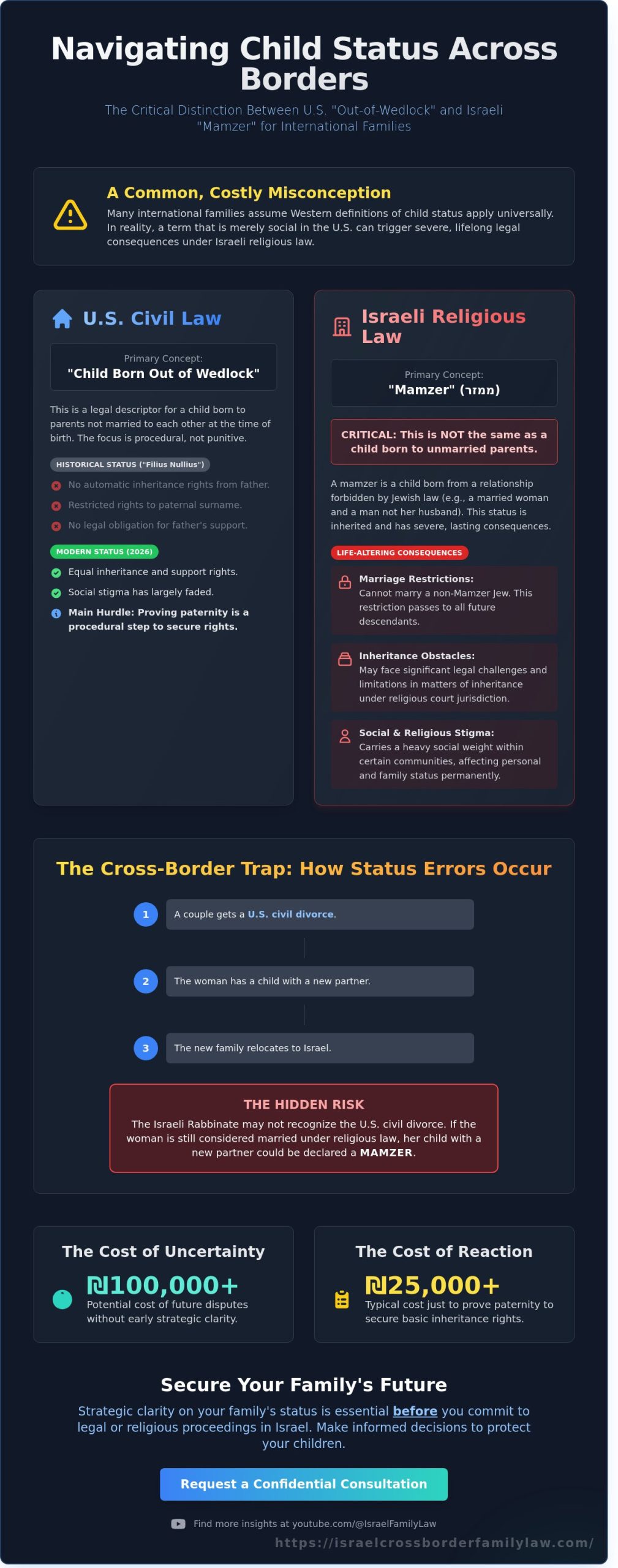
Expats and international families moving to Israel often encounter significant confusion regarding the bastard child meaning in a local context. In Western common law, the term historically described any child born outside of a legal marriage. However, Israeli law, which delegates matters of personal status to religious courts, operates under the Halakhic definition of a "Mamzer." This distinction is not merely linguistic; it carries profound legal consequences that can echo through generations. A Mamzer is specifically a child born from an adulterous union involving a married woman and a man who isn’t her husband, or from an incestuous relationship. It’s vital to understand that a child born to an unmarried couple is not a Mamzer under Jewish law. These children face no religious or civil impediments regarding their status or future marriage prospects in Israel.
The Israeli Rabbinical Courts apply these definitions strictly because the status of Mamzerut is considered a permanent legal "stain" that lasts for ten generations. While the Western legal evolution of illegitimacy has largely moved toward equalizing the rights of all children regardless of their parents’ marital status, the Israeli religious system maintains these ancient categories. For families navigating cross-border lives, failing to distinguish between a "child born out of wedlock" and a "Mamzer" can lead to unnecessary panic or, conversely, a failure to prepare for genuine legal hurdles within the Rabbinical system.
Marriage Restrictions in Israel
The primary consequence of being declared a Mamzer involves severe restrictions on the right to marry. The Rabbinical Courts maintain a centralized database, colloquially known as the "Blacklist" or Reshimat Me’ukavei Nissuin, which contains roughly 5,000 to 7,000 individuals who are prohibited from marrying under religious law. A person with this status can only marry another Mamzer or a convert. Because Israel does not offer a domestic civil marriage option, individuals on this list are effectively barred from legal marriage within the country’s borders. Most couples in this situation are forced to seek civil ceremonies in jurisdictions like Cyprus or Georgia, subsequently registering their marriage with the Ministry of Interior upon their return.
Proving Status: The Role of DNA and Testimony
The Israeli legal system employs a unique strategy of "judicial blindness" to protect children from being labeled as Mamzers. Rabbinical judges, or Dayanim, are historically reluctant to investigate a child’s lineage unless absolutely necessary. Under the 1953 Rabbinical Courts Jurisdiction Law, the court often prioritizes the legal principle of Rov Beilot Achar HaBa’al, which assumes the husband is the father of any child born during a marriage. This legal fiction serves as a shield for the child. Furthermore, Israeli family courts frequently block requests for DNA paternity testing if the results might "bastardize" the child. The court values the child’s social and legal standing over biological accuracy, ensuring they don’t lose their right to marry within the Jewish community. This protective stance is a cornerstone of Israeli family law strategy, aimed at preventing the devastating social consequences of a Mamzerut ruling.
Get clarity before you commit. Request a confidential consultation.
This article is published on an independent advisory platform (not a law firm). Do not use this content as legal representation or legal advice. This section focuses on strategy, risks, and decision-making guidance for families moving between jurisdictions. For specific legal services, contact a licensed attorney.
Practical Legal Consequences in Cross-Border US-Israel Situations
Moving between the US and IL creates immediate legal friction because the two systems categorize family status differently. While the historical bastard child meaning in the US has shifted toward ensuring financial support, the Israeli system maintains a dual track of civil and religious laws. This creates a high risk of status challenges when families relocate. A child’s legal standing in New York or California doesn’t always translate seamlessly to the Ministry of Interior or the Rabbinical Courts in Jerusalem.
A primary risk involves the timing of a US divorce. If a Jewish woman conceives a child with a new partner before her religious divorce, known as a Get, is finalized, the child may face ‘Mamzerut’ issues in IL. This status is irreversible and prevents the individual from marrying most other Jews in IL. Even if a US civil court has issued a final decree of divorce, the Rabbinical Courts only recognize the date the Get was delivered. It’s vital to synchronize these two processes before a new pregnancy occurs to avoid lifelong religious sanctions for the child.
Enforcing US support orders in IL for non-marital children presents another hurdle. Israel is a signatory to the 2007 Hague Convention on the International Recovery of Child Support. However, if paternity wasn’t established via a formal court judgment in the US, the Israeli family court may require a fresh paternity suit. Filing fees for these proceedings often start around ₪500, but the emotional and time costs are much higher. You should always check your status and documentation before initiating any Rabbinical Court proceedings, as these courts have broad jurisdiction over personal status matters that can impact your residency rights.
Explore cross-border legal strategies
Citizenship and Residency Issues
Establishing paternity for Aliyah purposes is a rigorous process for children born out of wedlock. The Law of Return (1950) requires clear proof of Jewish lineage or relationship to a Jewish parent. For US-born children of Israeli citizens, registration at the consulate must happen within 30 days of birth. If this window is missed, the Ministry of Interior often demands a DNA test authorized by an Israeli Family Court. These tests, including legal and lab fees, typically cost between ₪3,500 and ₪5,000. You can find more detail on international custody and relocation requirements here.
International Inheritance Disputes
When an IL estate is claimed by a US child born out of wedlock, conflicts often arise between the IL Succession Law (1965) and US probate findings. Under Israeli law, all biological children have equal inheritance rights regardless of the parents’ marital status. However, if a US father dies without a specific Israeli will, the US child must prove paternity to the Israeli Registrar of Inheritance Affairs. This process is complex if the father’s name isn’t on the birth certificate. Proactive estate planning is the only way to ensure US-based heirs are protected from lengthy litigation in Israeli courts. Strategic planning prevents the bastard child meaning from affecting a child’s rightful share of an estate.
Get clarity before you commit. Request a confidential consultation.
This article is published on an independent advisory platform (not a law firm). Do NOT use language that implies attorney-client relationship, legal representation, or giving legal advice. Focus on strategy, risks, and decision-making guidance. Soft CTA to advisory call / WhatsApp.
Navigating Status Challenges: Strategy and Decision-Making
Managing personal status in Israel requires a proactive approach. You shouldn’t wait until a conflict arises to understand how religious laws intersect with civil rights. When people ask about the bastard child meaning in a modern context, they’re often surprised to find it isn’t just an archaic term. It’s a legal classification with real consequences for marriage eligibility. In the Israeli system, clarity must come before you commit to any legal path. Understanding the bastard child meaning in the context of mamzerut helps you see why the Rabbinical Court’s involvement is so significant for Jewish families.
Delays in obtaining a religious divorce (Get) are not just emotional burdens. They’re strategic risks. If a woman has a child with a new partner before the religious divorce is finalized, that child may face permanent restrictions. These restrictions effectively bar them from marrying within the Jewish community in Israel. Strategic use of financial agreements, often costing between ₪3,500 and ₪10,000 to draft correctly, can create leverage to ensure a timely Get. This protects the status of future children from legal ambiguity.
Early Decisions and Risk Mitigation
Waiting to address status issues often leads to permanent legal traps. If you’re an Anglo expat, don’t assume your foreign civil divorce protects you in Israel. The Rabbinical Courts maintain a "blacklist" of individuals whose marriage or divorce status is in question. If paternity is challenged within this system, the court’s priority is religious law, not civil preference. You should consult with cross-border advisors early to map out potential complications. Handling sensitive paternity issues without a roadmap can trigger an investigation by the religious authorities. Once an investigation starts, you lose control over the timeline and the outcome. Informed choice means knowing when to use civil jurisdictions and when you must engage with the religious courts to secure your family’s future.
The Importance of Specialized Advisory
A standard family lawyer in the United States or the UK likely lacks the training to spot Israeli religious law risks. They may finalize a settlement that leaves you vulnerable to status challenges years later. Effective coordination between international legal frameworks is the only way to ensure your status is recognized in both countries. Families moving between jurisdictions should review our divorce and separation guide for international families to understand these overlaps. We’ve seen cases where a simple oversight in a US divorce decree led to a decade of litigation in Israel, costing upwards of ₪150,000 in legal fees. Specialized advisory helps you navigate these complexities before they become crises. You need a team that understands both the "start-up nation" culture and the rigid requirements of the religious courts.
Get clarity before you commit. Request a confidential consultation.
Securing Your Family’s Legal Status Across Borders
Navigating the intersection of US and IL legal systems requires a deep understanding of how personal status impacts inheritance and civil rights. While the historical bastard child meaning has shifted toward legal equality in Western courts, the Israeli religious framework maintains the distinct category of Mamzer. This status carries significant consequences for marriage and lineage within IL. You’ll need to account for these differences when managing assets or family transitions between jurisdictions in 2026. Our advisory focus centers on risk mitigation and sophisticated strategy to protect your interests in both systems.
We’ve seen how early decisions prevent costly litigation in IL family courts, where religious law often intersects with civil statutes. Proactive planning ensures that your family’s status remains secure despite the complexities of multi-jurisdictional regulations. Specialized knowledge of both civil and religious legal systems is essential for anyone managing a cross-border life. Don’t wait until a conflict arises to understand your standing. It’s vital to address these status challenges with a clear strategy before they escalate into high-stakes legal hurdles. Taking the right steps today provides the certainty your family deserves for the future.
Get clarity before you commit. Request a confidential consultation.
This article is published on an independent advisory platform (not a law firm). Do NOT use language that implies attorney-client relationship, legal representation, or giving legal advice. Focus on strategy, risks, and decision-making guidance. Reach out for an advisory call or via WhatsApp for strategic support.
Frequently Asked Questions
Is a child born to an unmarried couple considered a bastard in 2026?
No, the legal term is largely obsolete in modern secular jurisdictions, including Israel. Under the Status of Children Law of 1976, every child in Israel has equal rights and obligations toward their parents, regardless of whether the parents were married at the time of birth. This ensures that children receive the same protections in terms of child support and social benefits.
What is the difference between a bastard and a mamzer in Israeli law?
Understanding the bastard child meaning requires distinguishing between secular and religious definitions. While a bastard traditionally refers to any child born out of wedlock, a mamzer is a specific religious status under Halakha (Jewish Law) referring to a child born from an adulterous or incestuous relationship. This distinction is vital because a child born to an unmarried single woman is not a mamzer, but a child born to a married woman from a man who isn’t her husband carries this severe religious label.
Can a child born out of wedlock in the US inherit property in Israel?
Yes, children born out of wedlock have full inheritance rights under the Israeli Succession Law of 1965. If an American citizen dies with assets in Israel, their biological children are entitled to their legal share of the estate. The family must typically apply for a Succession Order through the Inheritance Registrar, which involves a filing fee of approximately ₪500 to ₪650 and proof of the biological connection.
Does getting married after a child’s birth change their legal status?
It doesn’t change the child’s fundamental rights to support or inheritance, as these are already protected by civil law. However, marriage can simplify administrative tasks, such as registering the child with the Population and Immigration Authority or applying for Israeli citizenship. In 2023, the Ministry of Interior handled thousands of such status updates for international families looking to streamline their civil documentation.
Can the Israeli Rabbinical Court prevent a US citizen from marrying?
Yes, the Rabbinical Court has jurisdiction over the marriage of all Jews in Israel, including foreign nationals. If a US citizen is listed on a "marriage delay" list due to questions about their lineage or a potential mamzer status, the court can refuse to authorize a wedding ceremony. This often occurs when the court suspects the individual was born from a relationship that violates religious law, impacting about 1% of applicants annually.
What happens if a child is labeled a mamzer in Israel?
The primary consequence is a restriction on the right to marry within the Jewish faith in Israel. A person with this status can only marry another mamzer or a convert in a ceremony recognized by the Chief Rabbinate. This status is hereditary for 10 generations. It’s important to note that this doesn’t affect civil rights like healthcare, education, or employment, which remain guaranteed for all residents.
Is DNA testing used to prove illegitimacy in cross-border cases?
Israeli courts are extremely hesitant to order DNA testing if it might result in a child being labeled a mamzer. Under the Genetic Information Law of 2000, judges prioritize the "best interests of the child" over biological truth to prevent social and religious stigmatization. In cross-border inheritance disputes, however, a court may authorize a test to prove paternity for a fee of ₪2,000 to ₪4,000, provided it doesn’t create a religious conflict.
For more insights on navigating these complex family dynamics, watch our detailed guides on the Israel Family Law YouTube channel.
Get clarity before you commit. Request a confidential consultation.

Article by
Gabriel Lior
A Personal Journey That Became a Mission
The advisory was founded by an American father Gabriel Lior, LLB, MBA , global entrepreneur, and cross-border advisor who spent more than a decade navigating the Israeli family court system firsthand and now lives in Singapore with his son.
As a divorced parent in a cross-border family, Gabriel faced nearly every legal challenge a foreign parent can encounter in Israel — including child custody disputes, child support proceedings, property matters in Israel and abroad, false accusations, and complex immigration and relocation proceedings.
Over the years, he learned the hard way how difficult it is for non-Israeli parents to understand the system, identify the right legal strategy, and choose the right legal representation — especially when language, culture, and jurisdictional differences are involved. He also witnessed how foreign parents and new immigrants are often disadvantaged or taken advantage of by service providers and institutions simply because they lack local knowledge or fluency.
From Client to Advisor
To truly understand — and survive — the system, Gabriel pursued formal legal education in Israel, completing two Israeli law degrees, alongside a BA and MBA earned in the United States. This was never about becoming a practicing attorney, but about gaining a deep, structural understanding of how the system works — and where it breaks down for foreign parents.
This rare combination of:
Firsthand client experience
Israeli legal and US business education
International business and negotiation training
Decades of commercial execution
created a unique perspective – one that understands both sides of the table.
After years of litigation, persistence, and at times self-representation, he ultimately succeeded in securing custody of his son and relocating abroad through a rare legal victory in the Israeli Supreme Court — becoming one of the first fathers in Israel to do so under these circumstances.
Disclaimer
Important Disclaimer:
The information provided on this website and in its content is for general informational and educational purposes only and does not constitute legal advice, legal opinion, or legal representation.
Gabriel Lior is not licensed to practice law in Israel (nor is he interested in doing so) and does not provide legal services, despite having completed 2 Law Degrees. The services offered are advisory in nature and are intended to provide general guidance, strategic insight, and information regarding cross-border family law considerations.
No attorney-client relationship is formed by accessing this website, reading its content, or communicating with us.
Any decisions made based on this information are at your own discretion and risk. For legal advice specific to your situation, you should consult a licensed attorney in the relevant jurisdiction.
Where appropriate, we may refer clients to independent, licensed attorneys or professionals. Such referrals do not constitute legal representation and no liability is assumed for services provided by third parties.