Receiving a court summons from Israel can be a daunting experience, particularly when faced with a complex, cross-border legal matter. The immediate instinct for many is one of uncertainty, followed by a critical question that can define the entire outcome of the case: what happens if I ignore an Israeli court summons? This is not a query to be taken lightly. The Israeli legal system has stringent protocols, and inaction can trigger severe and often irreversible consequences, transforming a manageable legal issue into a significant crisis.
Choosing to disregard a summons can lead to a default judgment against you, potentially resulting in significant financial liabilities, the freezing of assets, and even travel restrictions that could prevent you from entering or leaving the country. This comprehensive guide is designed to provide clarity and control. We will meticulously navigate the legal process, detailing the precise timeline and the specific ramifications of non-compliance, empowering you with the knowledge to protect your rights and defend your interests effectively within the Israeli judicial framework.
Key Takeaways
- Disregarding an Israeli court summons almost invariably results in an immediate default judgment (Psak Din Be’Heder Haganah), where the court rules entirely in the plaintiff’s favor without hearing your defense.
- Understanding what happens if you ignore an Israeli court summons is critical; the consequences escalate beyond the initial ruling to include bank account freezes, property liens, and potential restrictions on entering or leaving Israel.
- A default judgment is a severe outcome, yet the Israeli legal system provides specific, time-sensitive procedures for filing a motion to have it canceled and your case heard on its merits.
- Foreign nationals and expatriates are not immune; international legal treaties facilitate the cross-border enforcement of Israeli judgments, making a timely response essential regardless of your location.
Understanding the Israeli Court Summons: What It Is and Why It Matters
Receiving a court summons in Israel is a formal, non-negotiable directive from the judiciary. It is not a suggestion but a legal order compelling your appearance or response in a specific legal matter. To disregard this document is not a passive act; it is a direct refusal to engage with the court’s authority, a decision that carries significant legal repercussions. Understanding what happens if I ignore Israeli court summons begins with recognizing the gravity of the document itself. It signifies that a legal process has been initiated, and your participation is now legally mandated.
To better understand the serious implications of ignoring a court summons, the following video provides a helpful overview:
A summons is a comprehensive document containing critical information that dictates your next steps. It will specify the court handling the case, a unique case number for reference, the identities of all parties involved (plaintiff and defendant), and, most importantly, the strict deadlines for your response or appearance. The moment you are legally served, a countdown begins, and failing to act within the prescribed timeframe can result in a default judgment against you.
Types of Legal Summons in Israel
The nature of the summons depends entirely on the legal context of your case. While formats may vary, they generally fall into several distinct categories, each demanding a specific action:
- Summons to a Hearing (Hazmana Le’Diyun): This is an order requiring your physical or, in some cases, virtual presence before a judge on a specified date and time to provide testimony or participate in proceedings.
- Summons to Submit a Defense (Ktav Hagana): Typically issued in civil lawsuits, this document commands you to file a formal written defense statement with the court within a set period.
- Summons for Family Court Matters: These address sensitive and complex issues such as divorce proceedings, child custody, and support payments, often with expedited and strictly enforced timelines.
Methods of Service (Masa’a): How a Summons Legally Reaches You
For a summons to be legally binding, it must be delivered according to specific procedural rules known as Masa’a (service). The Israeli court system authorizes several methods to ensure proper notification, even in complex cross-border situations. Service can be completed via personal delivery by a court messenger or private courier, by registered mail to your last known address, or through your appointed legal counsel. For individuals residing abroad, service is often executed under the multi-jurisdictional framework of the Hague Service Convention, ensuring that international recipients cannot evade their legal obligations.
The Immediate Consequence: The Default Judgment (Psak Din Be’Heder Haganah)
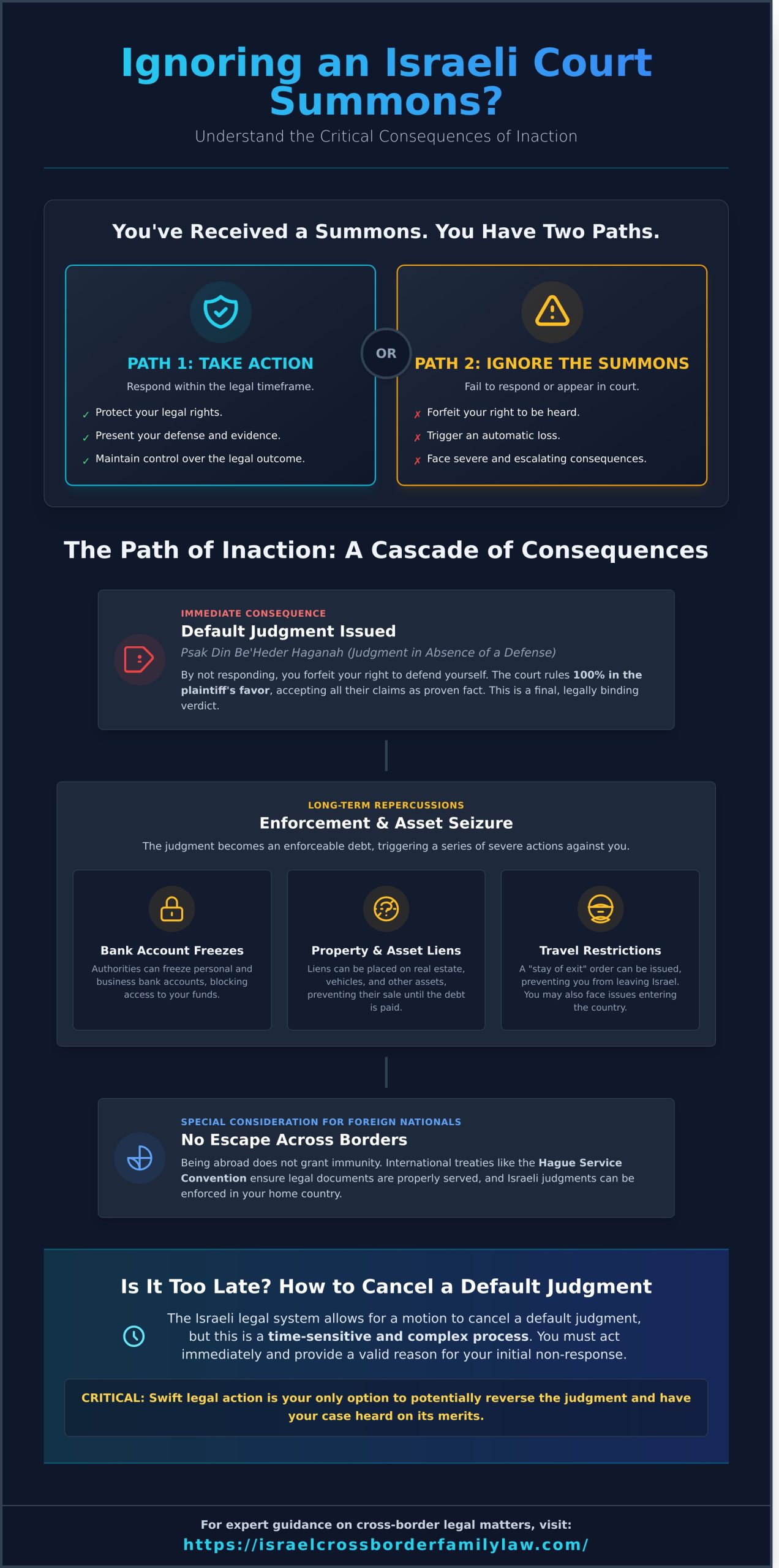
For individuals and entities contemplating the question, “what happens if i ignore israeli court summons,” the answer is unequivocal and severe: the court will likely issue a default judgment against you. Known in Hebrew as a Psak Din Be’Heder Haganah (judgment in the absence of a defense), this is not a temporary penalty but a final and legally binding verdict. By failing to respond, you forfeit your right to present evidence, contest the allegations, or offer any defense. The Israeli court operates on the assumption that your silence is an admission, effectively allowing the plaintiff’s claims to proceed unchallenged and be accepted as fact.
What is a Default Judgment?
A default judgment is a conclusive ruling issued by a judge when a defendant fails to respond to a lawsuit within the prescribed time limit. It is a powerful legal instrument that grants the plaintiff precisely what they requested in their initial statement of claim. This judgment carries the full weight and authority of a verdict reached after a comprehensive trial, making it fully enforceable under Israeli law. Its application is broad, covering complex commercial litigation, financial claims, real estate disputes, and sensitive family law matters, including divorce petitions and child custody arrangements.
The Power a Default Judgment Grants the Other Party
Once a default judgment is secured, the plaintiff is armed with significant legal authority to enforce the court’s decision. They are no longer required to prove their case; the judgment itself is the proof. This empowers them to immediately initiate a range of potent collection and enforcement actions, including:
- Commencing Collection Proceedings: The plaintiff can open a file with the Israeli Execution Office (Hotzaa LaPoal) to begin compulsory collection.
- Seizing Assets: They gain the legal right to place liens on property you own in Israel, freeze your Israeli bank accounts, and seize other valuable assets.
- Garnishing Wages: The judgment holder can obtain an order to garnish wages directly from an employer in Israel.
- Finalizing Legal Status: In family law, a default judgment can finalize a divorce or establish permanent child custody and support terms based solely on the petitioner’s assertions.
How Quickly Can a Default Judgment Be Issued?
The timeline for a default judgment in Israel is swift and unforgiving. A plaintiff can petition the court for a default judgment the very day after the defendant’s deadline to file a statement of defense has passed. These deadlines are strictly enforced, typically 30 days for civil claims, though this can vary. These timelines apply even to defendants residing abroad, provided the summons was served correctly under international law. As outlined in the U.S. Department of State guidance on the matter, proper service under treaties like the Hague Convention starts the clock. Once the plaintiff files their request, the court can issue the judgment rapidly, often within weeks, cementing the severe consequences of what happens if I ignore Israeli court summons.
Long-Term Repercussions of an Unanswered Summons and Judgment
The decision to disregard a court summons from Israel initiates a cascade of severe and enduring consequences that extend far beyond the immediate legal dispute. Once a summons has been properly served, often in accordance with complex international agreements like the Hague Convention on the Service of Process, the Israeli legal system considers you officially notified. The critical question of what happens if I ignore Israeli court summons is answered not by the problem disappearing, but by its escalation into a default judgment against you. This judgment grants the other party significant power to begin enforcement actions, often without any further notice, impacting your finances, freedom of movement, and family life for years to come.
Severe Financial Consequences
A default judgment transforms a legal claim into an enforceable debt, providing the opposing party with powerful tools to collect. The Israeli Execution Office (Hotza’a La’Poal) can be instructed to implement a range of measures designed to seize assets and compel payment, including:
- Freezing of Israeli Bank Accounts: Your access to any funds held in Israeli financial institutions can be immediately blocked.
- Garnishment of Wages: If you are employed in Israel, a portion of your salary can be legally redirected to the creditor.
- Property Liens: Liens can be placed on any real estate you own in Israel, preventing its sale or transfer until the debt is satisfied.
- Seizure of Personal Property: Movable assets, including vehicles and other valuable personal property, can be confiscated and liquidated.
Travel and Immigration Restrictions
The repercussions directly impact your ability to travel internationally and maintain your status in Israel. A default judgment can lead to immediate and restrictive orders that severely limit your freedom of movement. These multi-jurisdictional complications can include:
- Stay of Exit Order (Tzav Ikur Yetzia): This is a common and highly effective tool that prevents you from leaving Israel for any reason until the judgment is addressed.
- Future Entry Complications: An outstanding judgment can flag your name at border control, potentially leading to detention or refusal of entry upon arrival in Israel.
- Visa and Residency Issues: The judgment can create significant obstacles when attempting to renew or obtain Israeli visas, work permits, or residency status.
Impact on Custody, Support, and Other Family Matters
In family law cases, the consequences of a default judgment are particularly devastating. By failing to appear, you forfeit your right to present evidence or argue your position. The court is then compelled to rule based solely on the claims and evidence provided by the other party. This can result in permanent, unfavorable orders that are exceptionally difficult to modify in the future, establishing high child support or alimony payments and setting disadvantageous custody terms. Navigating these issues is notoriously complex, especially when dealing with cross-border child support enforcement and international parental rights.
Your Legal Options: How to Cancel a Default Judgment
Receiving a default judgment is one of the most severe answers to the question, what happens if I ignore Israeli court summons? It signifies that the court has ruled against you without hearing your defense. While this is a serious legal development, it is not always irreversible. The Israeli legal system provides a specific mechanism to challenge such a ruling, but this recourse is time-sensitive and requires a compelling legal argument. Navigating this process successfully is nearly impossible without experienced legal counsel guiding your strategy.
The Motion to Cancel a Default Judgment (Bakasha Le’Bitul Psak Din)
To challenge the ruling, you must file a formal legal request known as a Bakasha Le’Bitul Psak Din with the same court that issued the judgment. This motion must be filed within a strict timeframe, typically 30 days from the date you were officially notified or became aware of the judgment. The motion must persuasively argue two key points: the reason for your failure to respond to the original summons and the merits of your legal defense, demonstrating a reasonable chance of success if the case were reopened.
What Does the Court Consider When Reviewing the Motion?
The court exercises judicial discretion when evaluating a motion to cancel. It meticulously balances the right of the defendant to be heard against the right of the plaintiff to a final resolution. Key factors include:
- The Reason for Non-Appearance: The court will assess whether your failure to respond was due to a justifiable mistake, an administrative error, or a deliberate attempt to evade the legal process.
- The Merits of Your Defense: You must present a plausible defense. The court will not reopen a case if it appears your defense has no chance of succeeding.
- The Speed of Your Action: Filing the motion immediately upon learning of the judgment demonstrates diligence and respect for the court. Unreasonable delays will significantly weaken your position.
Often, the court will seek a fair outcome by balancing the interests of both parties, which may include cancelling the judgment while ordering you to pay the other party’s legal costs for the inconvenience.
Why Time is of the Essence
Delay is your greatest adversary when facing a default judgment. The longer you wait, the more difficult it becomes to convince the court to grant your motion. During this time, the opposing party is legally entitled to pursue enforcement actions, which can include freezing bank accounts, placing liens on property, or imposing travel restrictions. Taking immediate action is critical to protecting your rights and assets. The first step in this complex cross-border process is a professional evaluation of your case. Request a confidential case review today to understand your strategic options.
Special Considerations for Foreign Nationals and Expats
A common misconception among foreign nationals and expatriates is that physical distance from Israel provides a shield from its legal system. This assumption is incorrect and can lead to severe, multi-jurisdictional consequences. The global legal landscape is highly interconnected, and Israeli courts are adept at extending their reach across borders through established international treaties and agreements. The absence of a local Israeli address may complicate the service of process, but it does not prevent it.
Service of Process Under the Hague Convention
Israel, the United States, and most European nations are signatories to the Hague Convention on the Service Abroad of Judicial and Extrajudicial Documents. This international treaty creates a formal, recognized channel for serving legal documents, including court summons, between member countries. Consequently, claiming you were unaware of a lawsuit because you reside abroad is not a viable defense. A summons properly served under the Convention carries the same legal weight as one delivered within Israel.
Enforcement of Israeli Judgments in Your Home Country
Ignoring a summons often results in a default judgment against you in an Israeli court. Due to bilateral treaties and the principle of international comity, this judgment is not confined to Israel’s borders. An Israeli judgment can be taken to a court in your country of residence-be it in North America or Europe-and be converted into a local, legally enforceable judgment. This empowers the opposing party to pursue collection actions against your local assets, such as bank accounts, real estate, and wages.
Why You Need a Cross-Border Legal Expert
Navigating the complexities of an international legal dispute requires sophisticated, multi-jurisdictional expertise. Understanding what happens if I ignore Israeli court summons as an expat is critical, but acting on that knowledge requires specialized counsel. A cross-border legal expert can:
- Manage the intricate requirements of international service and enforcement treaties.
- Appear in Israeli court on your behalf, often negating the need for international travel.
- Develop a robust legal strategy that accounts for the laws and potential ramifications in both Israel and your home country.
Attempting to manage such a complex matter without proper guidance is a significant risk. Our firm specializes in providing dedicated legal services for expats and foreign nationals, offering the strategic counsel necessary to protect your interests across borders. If you have received a summons or are concerned about a potential legal action in Israel, we encourage you to contact our legal team for a consultation.
Your Strategic Response to an Israeli Court Summons
In conclusion, an Israeli court summons is a critical legal directive that demands an immediate and strategic response. Ignoring it is not a viable option; it leads directly to a default judgment (Psak Din Be’Heder Haganah), which carries the full force of law and can result in severe financial penalties, asset seizure, and even travel restrictions. Ultimately, the answer to what happens if I ignore an Israeli court summons is clear: it initiates a cascade of complex legal consequences that can have a lasting impact, particularly for foreign nationals and expatriates.
Navigating these multi-jurisdictional challenges requires sophisticated legal guidance. Our firm offers dedicated expertise in Israeli family law for international clients, backed by extensive experience in complex cross-border litigation. As a bilingual team fluent in both Hebrew and English, we provide the nuanced counsel necessary to protect your rights and assets. Do not let inaction dictate your future. Don’t risk a default judgment. Contact our cross-border legal team for a confidential consultation. Taking decisive action is the first step toward securing a positive resolution.
Frequently Asked Questions
How long do I have to respond to an Israeli court summons?
The timeframe for responding to a court summons in Israel is stipulated by the Rules of Civil Procedure and is typically 30 days from the date of service. However, this period can be shorter for specific motions or expedited proceedings. It is imperative to examine the summons itself for the precise deadline, as failing to file a statement of defense within the mandated period grants the plaintiff the right to request a default judgment against you, a complex situation that requires immediate legal intervention.
What if I never actually received the summons or it was sent to an old address?
Under Israeli law, a plaintiff must demonstrate proper ‘service of process.’ If a summons was delivered to a verifiably incorrect or outdated address, and you can substantiate that you never received it, you may have strong grounds to file a motion to cancel the subsequent default judgment. Successfully arguing improper service requires presenting compelling evidence to the court, a sophisticated legal maneuver best handled by experienced counsel familiar with Israeli procedural rules and precedents in these cross-border matters.
Can I be arrested if I ignore a court summons in Israel?
For civil matters, such as contractual or commercial disputes, the immediate consequence is not arrest but a default judgment, leading to financial enforcement actions like bank account liens or property seizures. However, in certain contexts, what happens if i ignore israeli court summons can be more severe. Ignoring a subpoena to testify or a summons in a criminal proceeding can absolutely result in the court issuing a warrant for your arrest to compel your appearance before the court.
Will ignoring a summons from a Rabbinical Court have the same consequences?
A summons from a Rabbinical Court (Beit Din) carries the full force of Israeli state law in matters of personal status, such as divorce. Ignoring such a summons can lead to uniquely severe sanctions that are enforced by the civil authorities. These may include the freezing of bank accounts, suspension of your driver’s license, the issuance of a travel ban preventing you from leaving Israel, and in cases of extreme recalcitrance (e.g., refusing to grant a ‘get’), even imprisonment.
How much does it cost to hire a lawyer to cancel a default judgment?
The legal fees for filing a motion to cancel a default judgment in Israel are not fixed and depend on the complexity of the case. Factors include the reasons for the delay, the amount of the claim, and the evidence required to support your motion. Generally, professional fees for such a service can range from ₪7,000 to over ₪20,000, in addition to court filing fees. This investment is critical for protecting your assets from enforcement and restoring your legal standing.
Can I represent myself from abroad to save money?
While technically permissible, attempting to represent yourself from abroad is fraught with procedural peril and is strongly discouraged. The Israeli court system operates in Hebrew, involves complex e-filing requirements, and adheres to strict procedural deadlines that are nearly impossible to manage without a ‘team on the ground.’ The question of what happens if i ignore israeli court summons is often a direct result of individuals underestimating these complexities. Engaging local counsel is the only strategically sound approach for navigating this multi-jurisdictional challenge effectively.

Article by
Gabriel Lior
A Personal Journey That Became a Mission
The advisory was founded by an American father Gabriel Lior, LLB, MBA , global entrepreneur, and cross-border advisor who spent more than a decade navigating the Israeli family court system firsthand and now lives in Singapore with his son.
As a divorced parent in a cross-border family, Gabriel faced nearly every legal challenge a foreign parent can encounter in Israel — including child custody disputes, child support proceedings, property matters in Israel and abroad, false accusations, and complex immigration and relocation proceedings.
Over the years, he learned the hard way how difficult it is for non-Israeli parents to understand the system, identify the right legal strategy, and choose the right legal representation — especially when language, culture, and jurisdictional differences are involved. He also witnessed how foreign parents and new immigrants are often disadvantaged or taken advantage of by service providers and institutions simply because they lack local knowledge or fluency.
From Client to Advisor
To truly understand — and survive — the system, Gabriel pursued formal legal education in Israel, completing two Israeli law degrees, alongside a BA and MBA earned in the United States. This was never about becoming a practicing attorney, but about gaining a deep, structural understanding of how the system works — and where it breaks down for foreign parents.
This rare combination of:
Firsthand client experience
Israeli legal and US business education
International business and negotiation training
Decades of commercial execution
created a unique perspective – one that understands both sides of the table.
After years of litigation, persistence, and at times self-representation, he ultimately succeeded in securing custody of his son and relocating abroad through a rare legal victory in the Israeli Supreme Court — becoming one of the first fathers in Israel to do so under these circumstances.
Disclaimer
Important Disclaimer:
The information provided on this website and in its content is for general informational and educational purposes only and does not constitute legal advice, legal opinion, or legal representation.
Gabriel Lior is not licensed to practice law in Israel (nor is he interested in doing so) and does not provide legal services, despite having completed 2 Law Degrees. The services offered are advisory in nature and are intended to provide general guidance, strategic insight, and information regarding cross-border family law considerations.
No attorney-client relationship is formed by accessing this website, reading its content, or communicating with us.
Any decisions made based on this information are at your own discretion and risk. For legal advice specific to your situation, you should consult a licensed attorney in the relevant jurisdiction.
Where appropriate, we may refer clients to independent, licensed attorneys or professionals. Such referrals do not constitute legal representation and no liability is assumed for services provided by third parties.