This article is provided for informational purposes by Israel Cross Border Law Firm and does not establish an attorney-client relationship. Legal services are exclusively provided by our licensed attorneys through a formal engagement.
What if the physical distance between your home and an Israeli courtroom is actually the smallest hurdle you face when challenging an inheritance? Many families living outside Israel believe that time zones and travel are their biggest enemies. It’s a common concern, especially when you’re unfamiliar with how the Israeli Succession Law of 1965 operates. You might feel a sense of powerlessness while watching a family estate be distributed in a way that feels unjust or legally unsound.
This guide offers the strategic clarity you need for contesting a will in Israel from abroad without the confusion. We’ll outline the specific legal grounds for an objection, from undue influence to formal defects in the document. You’ll gain a clear roadmap of the process, an honest look at the potential risks, and an understanding of the procedural costs involved, such as the standard filing fees that often start around ₪1,000. By the end, you’ll have a framework to decide if a legal challenge is the right move for your family’s future. Get clarity before you commit. Request a confidential consultation.
Key Takeaways
- Understand how the Israeli Succession Law (1965) governs assets within IL and the procedural roles of the Registrar of Inheritance Affairs versus the Family Court.
- Identify the primary legal grounds for a challenge, such as demonstrating a lack of testamentary capacity or proving undue influence exerted upon the deceased.
- Navigate the critical timelines and authentication requirements, including the necessary Apostille, for contesting a will in israel from abroad effectively.
- Assess the financial risks involved, including Israeli court fees and potential “costs orders” issued in ILS (₪) should the legal objection fail to meet the court’s standards.
- Learn how to strategically gather evidence and conduct a preliminary case review from overseas to make an informed decision before committing to formal litigation.
This article is published on an independent advisory platform (not a law firm) and does not imply an attorney-client relationship. Legal services are only provided by licensed attorneys under a separate engagement.
Understanding the Framework for Will Contests in Israel
The process of contesting a will in israel from abroad begins with a clear understanding of the Succession Law, 5725-1965. This statute dictates how assets are distributed and how disputes are resolved within the Israeli legal system. When a person passes away leaving property, bank accounts, or high-value items in Israel, the local authorities maintain jurisdiction over those specific assets, even if the deceased was a foreign citizen. This legal framework draws some of its foundational principles from historical Jewish inheritance laws, which have been integrated into a modern, secular statutory system.
To better understand the basics of how assets are distributed when legal documentation is or isn’t in place, watch this helpful video:
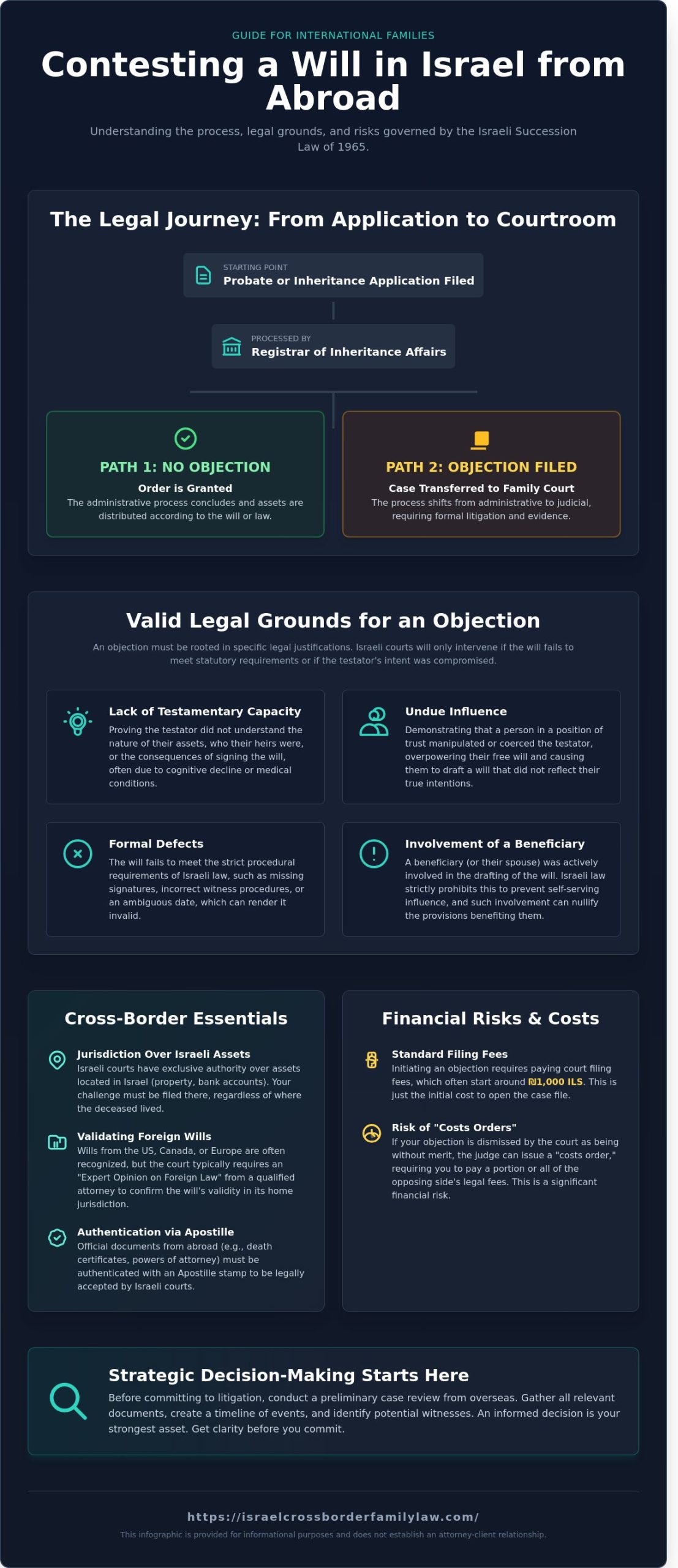
Most estate matters start at the Registrar of Inheritance Affairs. This administrative body processes standard applications for a Probate Order, which validates a will, or an Inheritance Order, which is used when no will exists. However, the moment a formal objection is filed, the Registrar loses its authority to settle the matter. The file is then transferred to the Family Court, where a judge oversees the litigation. International families often struggle with this transition because it requires a shift from simple paperwork to complex legal strategy involving Israeli evidentiary rules.
The Legal Authority of the Israeli Court
The Succession Law is the governing body for all estate disputes in Israel. For non-residents, the court determines its jurisdiction based on two primary factors: the deceased’s last place of residence or the physical location of the assets. If a family member is contesting a will in israel from abroad, they must prove the court has the right to hear the case. For example, if the deceased held a portfolio worth ₪2,500,000 in a Tel Aviv bank, the Israeli court remains the only venue capable of issuing a binding order to release those specific funds.
Foreign Wills vs. Israeli Wills
Israeli courts generally recognize wills drafted in the US, Canada, or Europe, provided they meet the formal requirements of the place they were signed. However, it’s common for the court to demand an “expert opinion on foreign law.” This is a formal document written by a qualified attorney in the foreign jurisdiction explaining why the will is valid under their local statutes. Without this expert testimony, the Israeli court may struggle to authenticate the document. For more detailed information on how these rules apply to your specific situation, see this guide for expats and foreign nationals.
Get clarity before you commit. Request a confidential consultation.
This article is published on an independent advisory platform (not a law firm) and does not imply an attorney-client relationship. Legal services are only provided by licensed attorneys under a separate engagement.
Legal Grounds for Objecting to an Israeli Will
The Israeli Inheritance Law of 1965 provides the rigid framework for all succession matters in the country. When you’re contesting a will in israel from abroad, your objection must be rooted in specific legal justifications rather than general feelings of unfairness. Israeli courts prioritize the “will of the deceased,” but they’ll intervene if the document fails to meet statutory requirements or if the testator’s intent was compromised by outside forces.
Common grounds for objection include:
- Lack of Testamentary Capacity: Proving the testator didn’t understand the nature or consequences of the document at the time of signing.
- Undue Influence: Demonstrating that a beneficiary used unfair pressure, threats, or deceit to dictate the terms of the will.
- Technical Defects: Errors in witnessing, signing, or the formal structure of the document under Sections 19 through 25 of the Law.
- Forgery or Fraud: Disputing the authenticity of the signature or the document itself through forensic analysis.
- Section 35 Involvement: Israeli law strictly prohibits a beneficiary from taking any part in the preparation, drafting, or witnessing of the will.
Success in these cases often depends on a deep understanding of the Grounds for Objecting to an Israeli Will, as the evidentiary standards are high and the court’s starting position favors the existing document.
Proving Undue Influence from Abroad
Proving undue influence is particularly challenging for family members living outside of Israel. You’re often at a disadvantage because you weren’t present to witness the daily interactions between the deceased and the primary beneficiary. Israeli courts look for specific “red flags” such as the sudden isolation of the testator from their overseas family or the unexpected replacement of a long-standing legal advisor. Evidence typically includes phone logs, email records, and testimony from local neighbors or caregivers who observed the beneficiary’s control over the deceased’s environment. The court applies a four-part test involving the testator’s dependence, the beneficiary’s level of involvement, and the degree of isolation.
Capacity and Medical Evidence
Israeli law operates on a “presumption of validity.” This means the court assumes the will is valid unless you prove otherwise. The burden of proof rests entirely on the person filing the objection. When contesting a will in israel from abroad, medical records from the specific date of signing are often the deciding factor. If the testator suffered from cognitive decline, contemporaneous evaluations are vital. In cases of suspected forgery, you’ll likely need to hire a forensic handwriting expert. In Israel, these experts typically charge between ₪3,500 and ₪8,000 for a professional opinion. It’s vital to understand how the process works before committing to expensive litigation.
Get clarity before you commit. Request a confidential consultation.
The Procedural Reality: How Cross-Border Challenges Work
Speed is your most valuable asset when you’re contesting a will in israel from abroad. Once a probate application reaches the Registrar of Inheritance, a public notice is issued. This notice appears in Israeli newspapers and the official government gazette. It serves as the formal starting gun for any legal challenge. If you aren’t actively monitoring these publications, the window for action can close before you’ve even secured legal counsel.
You usually have exactly 14 days from the publication date to submit an initial objection. If you miss this window, the Registrar may grant the probate order. Reversing a distributed estate is significantly harder and more expensive than stopping the process at the start. Administrative fees for late filings or motions to set aside an order often begin at ₪500, but the true cost lies in the increased legal complexity of undoing a closed file.
Navigating the Registrar of Inheritance
The Registrar acts as an administrative clearinghouse. Their primary role is to ensure the public knows a will is being probated. Monitoring these notices from 5,000 miles away is difficult without a local team. If you file a valid objection, the file moves from the Registrar’s office to the Family Court. This shift changes the nature of the case from administrative to litigious. Understanding this transition is vital. You can learn more about how our advisory process works to help manage these transitions effectively.
Remote Litigation Logistics
You don’t always need to fly to Tel Aviv or Jerusalem to testify when contesting a will in israel from abroad. Israeli courts increasingly use video conferencing for foreign witnesses under specific civil procedure rules. You must coordinate this through a formal request, proving that your presence in Israel would cause undue hardship. The court will then set strict technical requirements for the video link to ensure the integrity of the testimony.
Documentation is a frequent stumbling block for international clients. Every foreign document, including death certificates and affidavits, requires an Apostille under the 1961 Hague Convention to be recognized in IL. Informal translations are never accepted in court. The Israeli legal system requires “notarial translations” by a licensed Israeli notary who certifies the accuracy of the Hebrew text. You’ll also need a specific Power of Attorney (POA) that grants your representative authority to act in Israeli courts. Managing these requirements across time zones requires a strategy that accounts for the Sunday to Thursday Israeli work week. Getting these logistics right early prevents costly delays in your case.
Risks and Considerations for Beneficiaries Residing Abroad
Contesting a will in israel from abroad involves more than just legal arguments. It’s a high-stakes financial and emotional commitment that requires a strategic approach. In Israel, the court system operates on a “loser pays” principle. If a challenge is dismissed, the plaintiff is often ordered to pay the legal fees of the winning side. These costs can range from ₪30,000 to well over ₪120,000 based on the complexity of the estate and the duration of the trial. This financial risk is a primary factor that international beneficiaries must weigh before filing a formal objection.
The process of contesting a will in israel from abroad also impacts assets held in other jurisdictions. If you initiate a challenge in IL, it can freeze probate proceedings in the US or other countries for years. This delay prevents the distribution of assets that aren’t even part of the dispute, potentially causing tax complications or liquidity issues for the family. Reacting quickly without a clear strategy often leads to procedural errors that are expensive to fix. Decisions made in the first 30 days of learning about a will often dictate the outcome of the next three years of litigation.
Cost-Benefit Analysis of a Will Contest
You must evaluate if the potential inheritance justifies the risk of litigation. Legal fees, expert witness costs, and international document authentication quickly accumulate. Because Israeli courts prioritize efficiency, a failed contest results in a “costs order” against you. This means you pay your own lawyer and a significant portion of the opponent’s legal fees. It’s vital to seek transparency in pricing and costs before committing to a multi-year legal battle.
Alternative Dispute Resolution
Israeli family law often mandates a “Meeting for Information, Coordination and Coordination” to encourage settlement. Mediation allows international families to reach agreements without a full trial, which protects global assets and preserves family relationships. This route is often more predictable than a court ruling. For visual guides on these strategies and how they apply to international cases, visit the Israel Family Law YouTube channel. Settlement strategies can often be tailored to protect your interests in both Israel and your home country.
Get clarity before you commit. Request a confidential consultation.
Strategic Decision-Making and Next Steps
Successfully contesting a will in Israel from abroad requires a shift from emotional reaction to calculated strategy. The Israeli legal system, governed primarily by the Inheritance Law of 1965, operates on specific procedural timelines that don’t always align with Western expectations. Before you commit to a formal objection, a preliminary case review is essential. This stage identifies whether your claim has a “triable issue” or if it risks being dismissed, saving you from wasting thousands of shekels (₪) in court fees and security deposits often required from foreign plaintiffs.
Israeli courts prioritize the “testator’s will” above almost all else. If you’re living in New York, Los Angeles, or Chicago, you face the challenge of proving undue influence or lack of capacity from thousands of miles away. You don’t need to be physically present in Israel to initiate this process, but you do need a structured approach to bridge the geographical gap. Preparing for the long-term nature of these proceedings is vital; many contested estate cases in the Family Court take 18 to 36 months to reach a final judgment.
Building Your Evidence File
Gathering documentation from abroad is a logistical hurdle that requires early intervention. You should secure a “chronology of influence” that includes:
- Previous versions of the Israeli will to show radical changes in beneficiaries.
- Medical records from Israeli clinics or hospitals dated near the time of the will’s signing.
- Records of financial transfers or changes to Israeli bank accounts.
- Correspondence, such as emails or WhatsApp messages, that indicate the deceased’s true intentions.
Finding local witnesses in Israel is often more impactful than fly-in testimony. Neighbors, caregivers, or even the local grocery delivery person in Tel Aviv or Jerusalem can provide neutral observations about the deceased’s mental state. An advisor helps streamline communication between US probate standards and Israeli evidentiary rules, ensuring your file meets local court requirements.
Seeking Professional Clarity
There’s a significant difference between a “legal battle” and a “strategic resolution.” A legal battle focuses on the conflict, while a strategic resolution focuses on the outcome and the preservation of the estate’s value. Independent advisory provides a neutral risk assessment that isn’t clouded by the desire to litigate. By analyzing the costs of contesting a will in israel from abroad against the likelihood of success, you can make a decision based on data rather than grief.
Cross-border expertise is vital because dual-jurisdiction estates often involve conflicting tax laws and treaty obligations. Understanding how an Israeli court ruling affects your tax liability in your home country is a step many overlook until it’s too late. Get clarity before you commit. Request a confidential case review to understand your options and the potential risks involved in your specific situation.
Secure Your Family Legacy Through Strategic Planning
Protecting your rights requires more than just a basic understanding of the law. Under the Israeli 1965 Inheritance Law, the window to file an objection is often as short as 14 to 30 days after a probate notice is published. Successfully contesting a will in israel from abroad involves managing procedural hurdles, such as court-ordered deposits for legal costs that often exceed ₪30,000 for non-residents. You must balance these financial risks against the strength of your legal grounds, such as lack of testamentary capacity or undue influence.
As an independent advisory platform, we focus on cross-border strategy and provide authoritative guidance for the international Anglo community. Our expertise in US-Israel dual-jurisdiction family law ensures you don’t make critical errors in the early stages of a dispute. For visual guides on navigating these multi-jurisdictional challenges, visit our YouTube channel. Taking the right steps now prevents costly complications later.
Get clarity before you commit. Request a confidential consultation. You deserve a clear path forward in protecting your family’s interests.
This article is published on an independent advisory platform and does not constitute a law firm or an attorney-client relationship. The information provided is for educational purposes only. Legal services are only provided by licensed attorneys under a separate, formal engagement.
Frequently Asked Questions
Can I contest an Israeli will if I live in the United States?
You can certainly contest a will in the Israeli legal system while residing in the United States or any other country. Jurisdiction is determined by the deceased’s assets or residency in Israel rather than your physical location. Successfully contesting a will in israel from abroad requires coordinating with a professional team that understands how to manage cross-border evidence and procedural requirements remotely.
What is the deadline for objecting to a will in Israel?
The standard window for filing an objection is 14 days from the date the application for a Probate Order is published in the Israeli press. While you can request an extension, the court rarely grants more than 30 additional days without a compelling reason. Missing this short window often leads to the distribution of assets, which makes recovering your rightful inheritance significantly more difficult and expensive.
How much does it cost to challenge a will in the Israeli Family Court?
Filing a formal objection carries a mandatory court fee of ₪544 as of the 2024 fee schedule. Beyond this administrative cost, total legal expenses for a contested case often range from ₪35,000 to ₪120,000 depending on the volume of evidence required. You should also budget for expert witnesses, such as medical professionals or handwriting analysts, who typically charge per report.
Do I need to travel to Israel to testify in a will contest?
You don’t necessarily have to travel to Israel to provide testimony in a will dispute. Israeli courts frequently permit international witnesses to testify via video conference from an Israeli consulate or a certified notary’s office in their home country. This approach reduces travel expenses and allows members of the international community to participate in the process without disrupting their lives abroad.
What happens if a will was signed in a foreign language?
A will written in English or another language is legally valid in Israel but must be accompanied by a certified Hebrew translation. The translator is required to submit an affidavit confirming the translation’s accuracy to the Registrar of Inheritance Affairs. Since roughly 40 percent of Israeli estate cases involve international documents, the courts have established clear protocols for handling foreign-language testaments.
Is it possible to settle an inheritance dispute without going to court?
Mediation is a highly recommended path for resolving disputes and is often encouraged by Israeli judges to save time. Data suggests that approximately 70 percent of inheritance conflicts are settled through mediation rather than a final court judgment. This strategy often preserves family dynamics and can reduce your overall legal costs by 50 percent compared to a full trial. You can learn more about these dynamics at https://www.youtube.com/@IsraelFamilyLaw.
Can I challenge a will if I was not mentioned in it at all?
You have the legal standing to challenge a will even if the deceased completely excluded you from the document. Common grounds for contesting a will in israel from abroad include proving “undue influence” or demonstrating that the deceased lacked the mental capacity to understand the document they signed. If the court finds the will invalid, the estate is typically distributed according to Israeli intestacy laws, which favor biological heirs.
What is an Apostille and why do I need it for my inheritance case?
An Apostille is an international certification that verifies the authenticity of a public document under the 1961 Hague Convention. You’ll need this stamp for any foreign birth certificates, death certificates, or powers of attorney you submit to the Israeli court. Without an Apostille, the Israeli Registrar cannot verify the document’s origin, which will cause your case to be stalled or dismissed.
Get clarity before you commit. Request a confidential consultation.

Article by
Gabriel Lior
A Personal Journey That Became a Mission
The advisory was founded by an American father Gabriel Lior, LLB, MBA , global entrepreneur, and cross-border advisor who spent more than a decade navigating the Israeli family court system firsthand and now lives in Singapore with his son.
As a divorced parent in a cross-border family, Gabriel faced nearly every legal challenge a foreign parent can encounter in Israel — including child custody disputes, child support proceedings, property matters in Israel and abroad, false accusations, and complex immigration and relocation proceedings.
Over the years, he learned the hard way how difficult it is for non-Israeli parents to understand the system, identify the right legal strategy, and choose the right legal representation — especially when language, culture, and jurisdictional differences are involved. He also witnessed how foreign parents and new immigrants are often disadvantaged or taken advantage of by service providers and institutions simply because they lack local knowledge or fluency.
From Client to Advisor
To truly understand — and survive — the system, Gabriel pursued formal legal education in Israel, completing two Israeli law degrees, alongside a BA and MBA earned in the United States. This was never about becoming a practicing attorney, but about gaining a deep, structural understanding of how the system works — and where it breaks down for foreign parents.
This rare combination of:
Firsthand client experience
Israeli legal and US business education
International business and negotiation training
Decades of commercial execution
created a unique perspective – one that understands both sides of the table.
After years of litigation, persistence, and at times self-representation, he ultimately succeeded in securing custody of his son and relocating abroad through a rare legal victory in the Israeli Supreme Court — becoming one of the first fathers in Israel to do so under these circumstances.
Disclaimer
Important Disclaimer:
The information provided on this website and in its content is for general informational and educational purposes only and does not constitute legal advice, legal opinion, or legal representation.
Gabriel Lior is not licensed to practice law in Israel (nor is he interested in doing so) and does not provide legal services, despite having completed 2 Law Degrees. The services offered are advisory in nature and are intended to provide general guidance, strategic insight, and information regarding cross-border family law considerations.
No attorney-client relationship is formed by accessing this website, reading its content, or communicating with us.
Any decisions made based on this information are at your own discretion and risk. For legal advice specific to your situation, you should consult a licensed attorney in the relevant jurisdiction.
Where appropriate, we may refer clients to independent, licensed attorneys or professionals. Such referrals do not constitute legal representation and no liability is assumed for services provided by third parties.