Could a single legal filing in Jerusalem prevent you from boarding your flight home to New York or London? For many expats, the reality of a “Stay of Exit” order is a constant source of anxiety that makes managing israeli child support feel like a high-stakes gamble. It’s understandable to feel overwhelmed when you’re caught between modern civil laws and ancient religious traditions, especially when your financial stability and freedom of movement are on the line.
This article serves as an educational resource on the Israel Cross Border Law Firm advisory platform. We’ll help you find the clarity you need to navigate these legal waters with confidence. You’ll learn how the 2017 legal revolution changed payment obligations for children over six and how the 2025 temporary law impacts court jurisdiction. We’ll also provide a strategic overview of cross-border enforcement and how to manage the risk of travel bans. This guide previews how shared custody affects your payments and how Israeli courts treat foreign income. Our goal is to help you understand the weight of early decisions before you make any formal commitments.
Key Takeaways
- Understand the dual-court system and how the “race to the court” determines if your case follows religious or civil law under recent legislative changes.
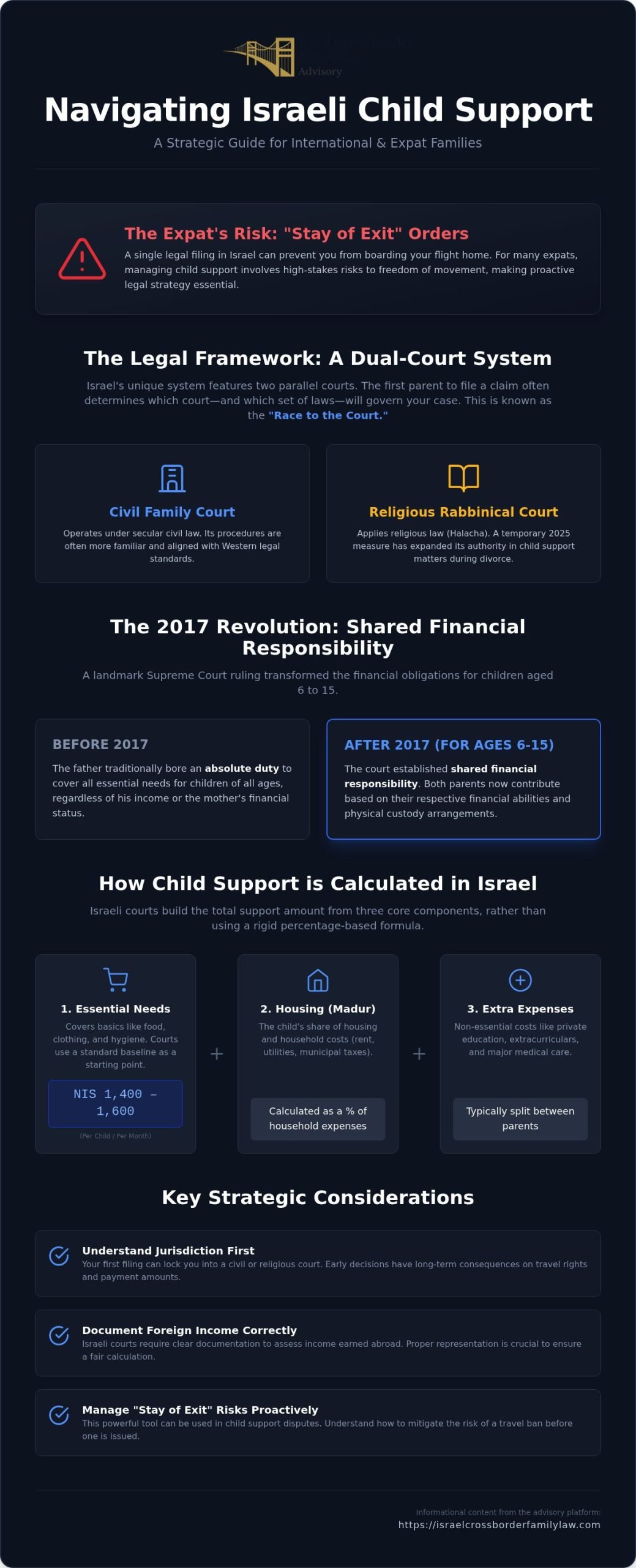
- Learn how israeli child support is calculated using essential needs and housing shares rather than a fixed table or formula.
- Explore the impact of the 2017 Supreme Court revolution, which established shared financial responsibility for children between the ages of 6 and 15.
- Identify the risks of “Stay of Exit” orders and discover how to manage cross-border enforcement for families with international interests.
- Gain clarity on the documentation required to represent US income and the strategic weight of decisions made early in the legal process.
The Framework of Israeli Child Support: Religious vs. Civil Jurisdiction
Understanding the landscape of israeli child support requires a firm grasp of the country’s dual-court system. Unlike many Western nations, Israel maintains a parallel structure where Family Courts and Rabbinical Courts share authority over domestic matters. For international families, this intersection of civil and religious law often creates significant confusion. Child support laws in Israel are fundamentally based on the “personal law” of the parents, which usually means their religious affiliation dictates the underlying legal principles.
A defining feature of this system is the “race to the court.” This means the first parent to file a claim typically determines which court system will govern the proceedings. On November 17, 2025, the Knesset passed a temporary measure that expanded the authority of rabbinical courts to rule on child support during divorce proceedings for a two-year period. This legislation reversed earlier restrictions, making it even more critical for parents to act with a clear strategy. For expats and non-citizens, Israeli courts may still claim jurisdiction if the child is physically present in the country, even if the parents aren’t permanent residents.
To better understand the nuances of modifying these obligations, watch this helpful video:
The Role of Personal Law (Halacha)
In Israel, Jewish law (Halacha) serves as the foundational framework for support obligations, even within the secular Family Court system. The law distinguishes between “Essential Needs” and “Charity” (Din Tzedaka). For children under the age of six, the father traditionally bears an absolute duty to cover all essential needs regardless of his income. For older children, the court treats support as a form of charity, where both parents contribute based on their financial ability. Non-Jewish citizens navigate a similar religious framework, with Sharia or Christian courts applying their own respective personal laws to determine parental obligations.
Choosing the Right Forum
Selecting between a Rabbinical and Family court is a strategic decision that carries long-term consequences. Many international families prefer the Family Court system because its procedures often feel more familiar to those accustomed to Western legal standards. It’s also vital to consider the Dispute Resolution Law, which mandates a stay of proceedings while parents attempt mediation. This period is a critical window for those managing child support cross-border enforcement. Decisions made during these first 30 days can determine whether your case is heard by a civil judge or a religious panel, impacting everything from travel rights to final payment amounts.
This content is published on an independent advisory platform and is intended for informational purposes only. It does not constitute legal representation or formal legal advice.
How Support is Calculated: Essential Needs, Housing, and Extra Expenses
Determining the financial scope of israeli child support involves a precise categorization of expenses rather than a simple percentage of income. Courts typically begin with a baseline for “Essential Needs,” which covers fundamental requirements such as nutrition, clothing, and basic hygiene. While Israeli law does not utilize a rigid formula, judicial practice often establishes a standard yardstick between NIS 1,400 and NIS 1,600 per child as a starting point. This figure represents the minimum threshold for basic subsistence and does not include housing or extraordinary costs.
The ‘Madur’ (Housing) Component
Beyond basic needs, the “Madur” component accounts for the child’s share of housing and household maintenance. This includes not only rent or mortgage payments but also municipal taxes (Arnona), water, electricity, and gas. Courts calculate this as a specific percentage of the custodial parent’s actual housing costs. The standard application is 33% for one child, 40% for two children, and 50% for three or more children. In high-demand regions like Jerusalem or Herzliya, where rental prices are significantly elevated, the Madur payment often becomes the most substantial portion of the monthly obligation.
Income Assessment in Cross-Border Cases
For international families, the court’s evaluation of income requires a sophisticated understanding of transnational financial structures. When a parent earns income in US dollars or holds foreign assets, the court does not merely apply a currency conversion. It assesses the parent’s global economic capacity and the standard of living the children enjoyed before the separation. Judges also consider the significant cost of living differences between the US and Israel when determining fair payment amounts. If a parent appears to be intentionally underemployed, the court may “impute” income based on their professional qualifications and past earning history. This complex process is often subject to International child support enforcement protocols, which facilitate cooperation between US and Israeli authorities.
Extraordinary expenses are typically handled outside the monthly base payment and are generally split equally between parents. These costs include:
- Medical costs not covered by basic insurance, such as orthodontics, glasses, or therapy.
- Educational requirements, including textbooks, school trips, and specialized supplies.
- Extracurricular activities, summer camps (kaytana), and after-school programs.
Strategic planning is essential when documenting these costs to ensure a fair distribution of the financial burden. If you are managing these complexities from abroad, it’s helpful to understand how child support cross-border enforcement mechanisms might apply to your specific situation. You can gain more clarity by requesting a confidential case review to discuss your circumstances.
This content is published on an independent advisory platform and is intended for informational purposes only. It does not constitute legal representation or formal legal advice.
The 2017 Supreme Court Revolution: Shared Responsibility for Ages 6–15
The 2017 Supreme Court ruling represents a fundamental departure from the traditional model where fathers bore the nearly exclusive financial burden of child maintenance. Supreme Court Case 919/15 serves as the definitive pivot point for equity in Israeli child support, establishing that both parents share financial responsibility for children aged six to 15. This landmark decision introduced a formulaic approach that considers the actual income of both parents alongside the time each spends with the children. It moved the system toward gender neutrality, reflecting the modern reality of shared parenting in many international households.
Central to this modern framework is the “Relative Wealth” test. Instead of looking solely at a father’s earnings, the court examines the disposable income of both parties. This assessment includes salaries, business profits, and investment returns. By comparing these figures, the court determines a proportional contribution for each parent. For international families, this process often involves reviewing foreign tax returns and bank statements to establish a clear picture of global financial standing. It’s essential to present this data accurately to ensure the court’s calculation reflects the true economic capacity of both parents.
Age-Based Obligations
The child’s age remains a critical factor in determining how these principles apply under israeli child support law. Obligations are categorized into three distinct stages:
- 0–6 Years: The father maintains a nearly absolute obligation to cover “essential needs,” regardless of the mother’s income or the custody arrangement.
- 6–15 Years: This is the primary window for shared responsibility, where obligations are balanced based on financial means and parenting time.
- 15–18 Years: Support is based primarily on “Din Tzedaka,” a charitable obligation under Jewish law. This typically results in a lower payment baseline as the child nears adulthood and mandatory military service.
The Impact of Parenting Time
The specific “stay-over” schedule is a primary driver of the final NIS amount. In cases of 50/50 shared custody, where the child spends equal time in both homes, the support payment may be significantly reduced if the parents have similar incomes. However, this creates unique challenges for long-distance parents. If one parent resides in the United States while the children are in Israel, the lack of regular stay-overs usually means the local parent retains a higher support claim. Calculating israeli child support in these scenarios requires a careful balance of international travel costs and the financial realities of maintaining households in two different countries.
This content is published on an independent advisory platform and is intended for informational purposes only. It does not constitute legal representation or formal legal advice. Legal services are only provided by licensed attorneys under a separate engagement.
Cross-Border Challenges: Stay of Exit Orders and International Enforcement
For many parents living outside the country, the most daunting aspect of israeli child support is the potential for a “Stay of Exit” order. This legal mechanism, known as a Tzav Ikul, can effectively bar a parent from leaving Israel until their debt is settled or future payments are secured. It’s a common tool used by the courts to ensure that parents with international ties don’t evade their financial responsibilities. The National Insurance Institute (Bituach Leumi) also plays a central role; they may pay the custodial parent directly and then use aggressive collection tactics against the obligor, including wage garnishment and asset seizure.
Navigating ‘Stay of Exit’ Orders
A Stay of Exit order is a significant risk because it can be issued even if you don’t have current arrears. Even with the new ETA-IL travel authorization requirement for 2025, a court ordered exit ban will still prevent departure. If the court believes there’s a risk you won’t return to fulfill future obligations, they may grant the order as a preventative measure. To lift this restriction, the court usually requires the appointment of one or two Israeli residents to act as guarantors. These individuals must be solvent and willing to assume the financial liability if you fail to make payments. This process requires careful strategic planning, particularly when managing International Custody and Relocation issues.
Enforcement of US Orders in Israel
The enforcement of US state court orders in Israel is governed by the Family Law Amendment (Legal Aid to Foreign States). This reciprocal agreement allows for a foreign support order to be “recognized” and enforced by the Israeli Family Court as if it were a local judgment. However, the transition isn’t always seamless. Conflicts often arise regarding currency fluctuations between the US dollar and the Israeli Shekel. Additionally, the court may need to reconcile the significant differences in the cost of living between a US city and an Israeli municipality. These complexities highlight why Child Support Cross-Border Enforcement requires a nuanced approach.
Disputes over support can occasionally overlap with the Hague Convention if one parent attempts to relocate the child without consent during a financial disagreement. Achieving a resolution requires a clear understanding of both legal systems and the risks involved. If you are concerned about travel restrictions or the enforcement of a foreign order, you should request a confidential consultation to discuss your strategy.
This content is published on an independent advisory platform and is intended for informational purposes only. It does not constitute legal representation or formal legal advice. Legal services are only provided by licensed attorneys under a separate engagement.
Strategic Guidance: Achieving Clarity Before You Commit
The initial 30 days of a dispute often dictate the trajectory of your entire case. Because the “race to the court” determines whether your matter is heard in a Rabbinical or Family court, the strategy you employ during this window is paramount. Decisions made in haste can lead to long-term financial obligations or restrictive travel bans that are difficult to reverse. Achieving clarity on israeli child support requirements before you sign any documents or make formal statements is the most effective way to protect your interests and your relationship with your children.
Israeli judges require comprehensive documentation to apply the “Relative Wealth” test accurately. For expats, this means preparing several years of US tax returns, including all schedules and W-2s, alongside recent Israeli bank statements. If you hold assets in multiple countries, the court will look at your global economic capacity. Providing a transparent and well-organized financial profile prevents the court from “imputing” an income that may not reflect your actual disposable earnings. It also helps in negotiating “Global” settlements that satisfy both US state requirements and Israeli legal standards.
A “Financial Agreement” (Heskem Mamon) is a powerful and binding contract that must be approved by a court to be valid. You should seek a professional advisory review before committing to such an agreement. These documents often include clauses regarding future housing costs and extraordinary expenses that can fluctuate significantly over time. Understanding the weight of these commitments is essential for maintaining financial stability in a cross-border context.
The Advisory Approach
Mediation provides a private, controlled forum that is often safer for international families than high-conflict litigation. It allows for nuanced discussions about currency exchange rates, international travel costs, and holiday schedules that a standard court ruling might overlook. When reviewing proposed support agreements, look for “Red Flags” such as vague definitions of extraordinary expenses or the absence of a mechanism to adjust payments if a parent relocates. You can learn more about How the Advisory Process Works to see how this strategic framework applies to your situation.
Next Steps for Expats
Managing israeli child support from abroad requires a specialist who understands the interplay between two distinct legal systems. We recommend utilizing educational resources, such as the @IsraelFamilyLaw YouTube channel, to understand the court’s perspective on shared custody and financial equity. Taking the time to gather facts and build a strategy is the best way to avoid the “Stay of Exit” orders discussed in previous sections. To begin your strategy, you may request a Confidential Case Review to discuss the specifics of your cross-border circumstances.
This content is published on an independent advisory platform and is intended for informational purposes only. It does not constitute legal representation or formal legal advice. Legal services are only provided by licensed attorneys under a separate engagement.
Securing Your Family’s Future Across Borders
Managing israeli child support requires more than just a local understanding of the law; it demands a strategic perspective that bridges two distinct legal cultures. You now understand how the dual-court system operates and why the 2017 Supreme Court ruling significantly changed the financial landscape for children over six. We’ve also highlighted the critical importance of addressing “Stay of Exit” orders and international enforcement mechanisms early in the process to protect your freedom of movement.
This content is published on an independent advisory platform and is intended for informational purposes only. It doesn’t constitute legal representation or formal legal advice. Our platform provides specialized cross-border expertise focused on the unique needs of expats and the Anglo community. We offer authoritative guidance without an aggressive sales pitch, ensuring you have the knowledge to make informed decisions for your family’s long-term stability.
Get clarity before you commit. Request a confidential consultation. Taking proactive steps today can prevent complex legal hurdles tomorrow, providing you with the steady guidance needed for this transition. You don’t have to navigate these challenges alone.
Frequently Asked Questions
What is the average child support payment per child in Israel?
Israeli law doesn’t have a set table or rigid formula for calculating payments. Amounts are determined case-by-case, considering the child’s specific needs and each parent’s income. While there’s no official average, courts often use a baseline of NIS 1,400 to 1,600 for essential needs. This doesn’t include housing or extra expenses, which can significantly increase the total monthly obligation depending on the family’s previous standard of living.
Can an Israeli court issue a Stay of Exit order if I live in the US?
Yes, an Israeli court can issue a Stay of Exit order against a parent living in the US if they are physically present in Israel. These orders are often used as a preventative measure to ensure future payments are secured. To lift the ban, you’ll likely need to provide solvent Israeli guarantors. It’s a significant risk for visiting parents, as orders can sometimes be issued even without existing arrears.
Does child support in Israel continue after the age of 18?
The obligation to pay israeli child support generally continues until the child reaches age 18. However, it’s standard practice for support to extend at a reduced rate, typically one-third of the original amount, while the child completes mandatory military or national service. This extension recognizes that the child remains financially dependent on their parents during their service period, which usually lasts until age 21 or 22.
How does shared physical custody affect child support payments?
For children between the ages of 6 and 15, shared physical custody has a direct impact on support amounts under the 2017 Supreme Court ruling. The court calculates obligations by comparing the disposable income of both parents and the time the child spends in each home. If you have a 50/50 schedule and similar earnings to the other parent, your monthly payment may be reduced significantly compared to traditional custody arrangements.
Can I enforce a California or New York child support order in Tel Aviv?
You can enforce a child support order from California, New York, or other US states in Israel through the Family Law Amendment. This reciprocal agreement allows the Israeli Family Court to recognize foreign judgments. The court will treat the US order as if it were issued locally, though challenges often arise regarding currency conversion and reconciling the cost of living differences between US cities and Israeli municipalities like Tel Aviv.
What happens if I cannot afford to pay the court-ordered amount?
If you can no longer afford your payments, you must proactively file a motion to modify the support order based on a “material change in circumstances.” Simply stopping payments will lead to aggressive enforcement by the official Enforcement Office. They have the power to garnish wages, seize bank accounts, and even revoke your driver’s license or passport. It’s vital to seek a strategic adjustment before arrears begin to accumulate.
Does the mother ever pay child support to the father in Israel?
Yes, it’s possible for a mother to pay child support to a father in Israel, particularly for children aged 6 to 15. Since the 2017 legal shift toward gender neutrality, the court focuses on the “Relative Wealth” of both parents. If the father is the primary caregiver or shares custody 50/50 and the mother has a significantly higher disposable income, she may be required to contribute to the child’s expenses.
How do Israeli courts treat income from US-based stocks or RSUs?
Israeli courts consider income from US-based stocks, RSUs, and other investment vehicles when assessing a parent’s “global economic capacity.” They don’t just look at a base salary; they examine all available financial resources. When calculating israeli child support, the court will review vesting schedules and historical data from your US tax returns to determine your actual disposable income. This ensures that the support amount reflects your true financial ability to provide.

Article by
Gabriel Lior
A Personal Journey That Became a Mission
The advisory was founded by an American father Gabriel Lior, LLB, MBA , global entrepreneur, and cross-border advisor who spent more than a decade navigating the Israeli family court system firsthand and now lives in Singapore with his son.
As a divorced parent in a cross-border family, Gabriel faced nearly every legal challenge a foreign parent can encounter in Israel — including child custody disputes, child support proceedings, property matters in Israel and abroad, false accusations, and complex immigration and relocation proceedings.
Over the years, he learned the hard way how difficult it is for non-Israeli parents to understand the system, identify the right legal strategy, and choose the right legal representation — especially when language, culture, and jurisdictional differences are involved. He also witnessed how foreign parents and new immigrants are often disadvantaged or taken advantage of by service providers and institutions simply because they lack local knowledge or fluency.
From Client to Advisor
To truly understand — and survive — the system, Gabriel pursued formal legal education in Israel, completing two Israeli law degrees, alongside a BA and MBA earned in the United States. This was never about becoming a practicing attorney, but about gaining a deep, structural understanding of how the system works — and where it breaks down for foreign parents.
This rare combination of:
Firsthand client experience
Israeli legal and US business education
International business and negotiation training
Decades of commercial execution
created a unique perspective – one that understands both sides of the table.
After years of litigation, persistence, and at times self-representation, he ultimately succeeded in securing custody of his son and relocating abroad through a rare legal victory in the Israeli Supreme Court — becoming one of the first fathers in Israel to do so under these circumstances.
Disclaimer
Important Disclaimer:
The information provided on this website and in its content is for general informational and educational purposes only and does not constitute legal advice, legal opinion, or legal representation.
Gabriel Lior is not licensed to practice law in Israel (nor is he interested in doing so) and does not provide legal services, despite having completed 2 Law Degrees. The services offered are advisory in nature and are intended to provide general guidance, strategic insight, and information regarding cross-border family law considerations.
No attorney-client relationship is formed by accessing this website, reading its content, or communicating with us.
Any decisions made based on this information are at your own discretion and risk. For legal advice specific to your situation, you should consult a licensed attorney in the relevant jurisdiction.
Where appropriate, we may refer clients to independent, licensed attorneys or professionals. Such referrals do not constitute legal representation and no liability is assumed for services provided by third parties.