This article is published on an independent advisory platform and does not constitute legal representation or legal advice. An attorney-client relationship is only formed through a separate engagement with a licensed attorney.
What if the most critical decision in your divorce occurs before you ever step into a courtroom? For international families, the “race for jurisdiction” between Rabbinical and Family courts creates an immediate layer of complexity that many are not prepared to handle. You’ve built a life across borders, and now you’re facing a legal system that feels unfamiliar. Securing a divorce lawyer tel aviv families can rely on is about more than just filing paperwork; it’s about finding a strategic partner who understands the high stakes of cross-border litigation.
It’s understandable to feel concerned about how your ₪1,500,000 pension or your children’s residency will be treated in a local court. We believe you deserve a fair division of international assets and a process that protects your children from unnecessary conflict. This guide offers a clear roadmap for 2026, providing the expert clarity you need to move forward with confidence. You’ll learn how to manage jurisdictional overlaps, protect foreign-held property, and develop a strategy that prioritizes long-term stability.
Get clarity before you commit. Request a confidential consultation.
Key Takeaways
- Understand how “habitual residence” determines court jurisdiction and why the “race of jurisdiction” between civil and rabbinical courts is a critical factor for expats.
- Learn why engaging a specialized divorce lawyer in tel aviv is essential for navigating the complex interplay between Israeli family law and international legal standards.
- Discover the financial implications of dividing cross-border assets, such as Israeli pensions and US 401ks, while ensuring compliance with the US-Israel Tax Treaty.
- Identify the essential documentation and strategic goals required to protect your interests before entering the legal arena.
- Explore how an advisory-first strategy can help international families minimize litigation costs and the emotional toll of a cross-border divorce.
This article is published on an independent advisory platform and is for informational purposes only. It does not constitute legal representation or an attorney-client relationship. Legal services are only provided by licensed attorneys under a separate engagement.
Navigating Divorce in Tel Aviv: What International Families Need to Know
Expats and foreign nationals often find the Israeli legal system surprisingly complex. If you are a resident living in Tel Aviv, your case follows specific jurisdictional rules that differ significantly from those in Europe or North America. This guide provides independent guidance to help you understand the strategic landscape of family law in Israel. Most international families require a specialized approach because their assets, children, and legal status often span multiple borders. A standard local approach rarely accounts for the long-term implications of cross-border enforcement or international relocation.
Jurisdiction in Israel usually depends on the concept of “habitual residence.” If your center of life is currently in Israel, the local courts likely have the authority to hear your case. Understanding Marriage and divorce laws in Israel is vital because the system combines civil family courts with religious oversight. This dual system creates a unique environment for international families who are often used to purely secular proceedings in their home countries. Decisions made in Tel Aviv can have a permanent impact on your standing in your country of origin.
To better understand the importance of timing in this process, watch this helpful video:
The Legal Landscape for Expats in Tel Aviv
Many “Anglos” or English-speaking residents assume their foreign citizenship protects them from local statutes. This isn’t the case. If you are from the US, your legal strategy must account for how Israeli rulings might be viewed by American courts later, especially regarding pension funds or property. A divorce lawyer tel aviv must be bicultural to bridge these gaps effectively. Since Hebrew is the language of the court, having a team that can translate the nuances of your international life into the local legal dialect is a practical necessity. You can learn more about how this advisory process works for expats and foreign nationals before you take formal action.
Initial Risks and Common Misconceptions
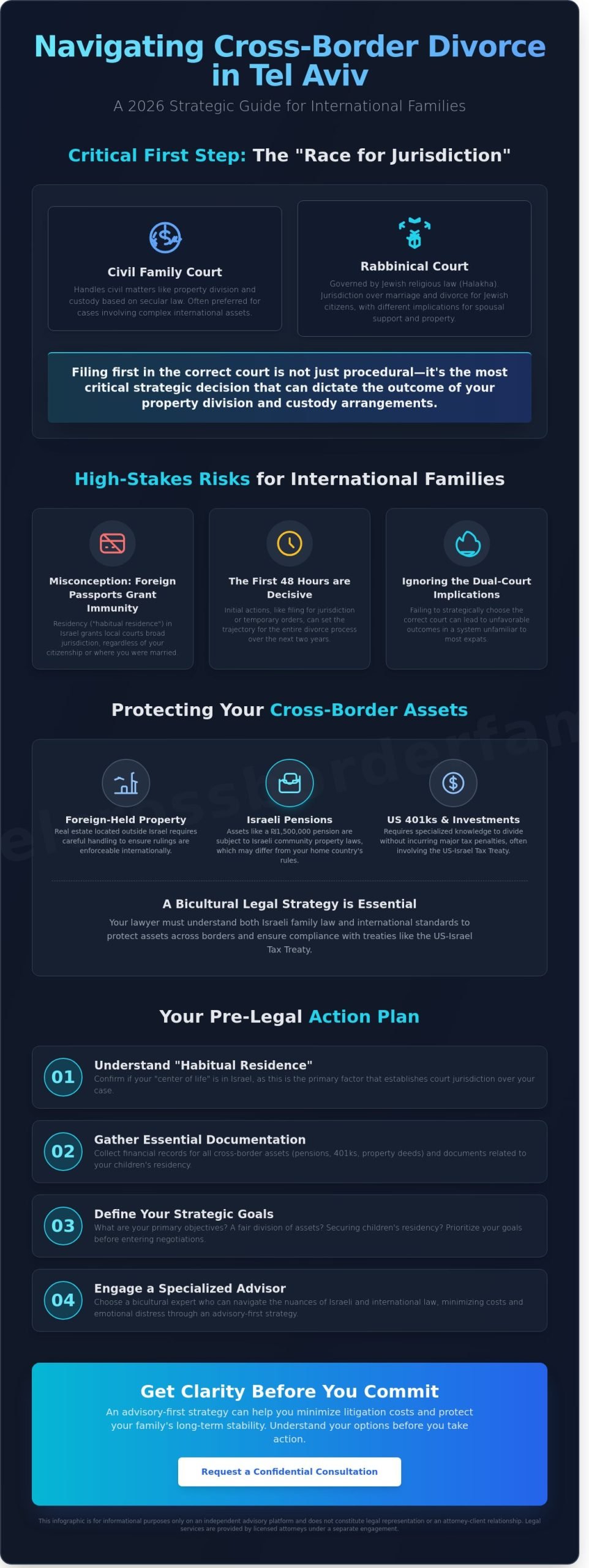
One major mistake is believing that a foreign passport allows you to bypass the Israeli Family Court or Rabbinical Court. These institutions have broad reach over anyone residing within the borders, regardless of where the marriage took place. Decisions made in the first 48 hours often dictate the direction of the next two years. The “Race of Jurisdiction” is the most critical early-stage risk in IL divorce. Filing first in the correct venue can determine which laws apply to your property and custody arrangements. Without a clear strategy, you might find yourself litigating in a court that doesn’t favor your specific circumstances. Get clarity before you commit. Request a confidential consultation.
This article is published on an independent advisory platform, not a law firm, and does not imply an attorney-client relationship. Legal services are only provided by licensed attorneys under a separate engagement.
The “Race of Jurisdiction”: Understanding Israeli Family vs. Rabbinical Courts
Israel maintains a unique dual-jurisdiction system that often catches international families by surprise. Divorce proceedings can take place in two parallel tracks: the Civil Family Court (Beit Mishpacha) or the Rabbinical Court (Beth Din). The “Race of Jurisdiction” refers to the legal reality where the court that first receives a valid petition generally gains the authority to rule on all ancillary matters, such as asset distribution and spousal support. This isn’t just a matter of administrative preference; the choice of venue can lead to vastly different outcomes based on the legal principles each court prioritizes.
Under the 2016 Law for the Settlement of Family Disputes, couples must first file an application for the “Settlement of Dispute” before a formal lawsuit can be submitted. This triggers a mandatory 45-day stay of proceedings, during which the parties attend meetings with the court’s Unit for the Settlement of Disputes. Once this period ends, the party who filed the initial application has a 15-day window to choose where to file their claims. A divorce lawyer tel aviv will tell you that missing this window or failing to understand the strategic implications of each court can fundamentally change the trajectory of your case.
The Role of the Family Court
The Civil Family Court operates under secular Israeli law. Its primary focus remains on civil rights, modern property division standards, and the “best interests of the child.” For expats, this court is often the preferred venue for complex custody disputes or when navigating Divorce & Separation for International Families. The court is accustomed to dealing with multi-jurisdictional issues and international treaties. For those managing obligations across borders, International Child Support Enforcement with Israel provides essential context on how these systems interact with U.S. authorities. The Family Court typically applies the principle of equitable distribution for assets acquired during the marriage, regardless of whose name is on the title.
The Rabbinical Court (Beth Din) and Expats
In Israel, the Rabbinical Court has exclusive jurisdiction over the act of marriage and divorce itself for Jewish citizens and residents, even those who identify as completely secular. While the Family Court handles civil matters, the Rabbinical Court is the only body that can grant the Gett, the religious divorce decree. If a spouse “attaches” matters like alimony or property to a divorce petition in the Beth Din before a claim is filed in the Family Court, the Rabbinical Court may take jurisdiction over those issues. This can be significant because the Rabbinical Court may interpret certain financial obligations or “fault” in a manner different from secular law. Understanding these nuances is vital before any documents are signed. It’s common for filing fees to start around ₪554, but the long-term financial impact of the venue choice is much higher.
The complexity of these parallel systems makes early strategy essential. Don’t wait until a petition is served to understand your rights. Get clarity before you commit. Request a confidential consultation.
This article is published on an independent advisory platform and does not constitute a law firm relationship or legal advice. Legal services are only provided by licensed attorneys under a separate engagement.
Managing Cross-Border Assets and International Child Custody
International families often face a jurisdictional split where their daily lives are centered in Tel Aviv, yet their financial footprint remains global. When a marriage dissolves, the complexity of managing assets across two legal systems requires a strategic approach. A divorce lawyer tel aviv must account for the interplay between the Israeli “Balance of Resources” law and foreign property statutes to ensure a fair distribution. This process involves more than just identifying accounts; it requires a deep understanding of how different jurisdictions characterize marital property.
The 1975 US-Israel Tax Treaty plays a critical role in these negotiations. It influences how alimony payments are taxed and how the transfer of high-value assets, such as real estate or corporate stock, is handled. Without careful planning, a settlement that looks equitable on paper can result in significant tax liabilities in one country. Strategic decision-making early in the process helps mitigate these risks and protects the long-term liquidity of both parties.
Division of International Property and Pensions
Israeli law typically follows the “Balance of Resources” principle, which aims for an equal distribution of assets acquired during the marriage. This includes Israeli pensions and “Keren Hishtalmut” funds, as well as foreign-held 401ks, IRAs, and real estate. Because these assets are governed by different sets of rules, forensic accounting is often necessary to determine the present value of future benefits. Israeli courts can issue orders regarding foreign assets, but enforcement requires specific cross-border expertise to ensure the foreign institution recognizes the Israeli ruling.
Custody, Relocation, and the Hague Convention
Child custody is perhaps the most sensitive aspect of international divorce. Israeli courts prioritize the “best interests of the child,” but for expats, this often intersects with the desire to return to their home country. Moving a child out of Israel without formal consent or a court order can be classified as international child abduction. Legal barriers to relocation are high, and the court often requires a detailed “parenting plan” that addresses how the child will maintain a meaningful relationship with the parent remaining in Israel.
The 1980 Hague Convention on the Civil Aspects of International Child Abduction provides the legal framework for returning children who have been wrongfully removed or retained. It’s a vital tool for parents who fear their spouse might leave the country without authorization. You can find detailed guidance on these protections through resources on International Custody & Relocation and the Hague Convention Child Abduction protocols.
Ensuring that child support orders are enforceable is equally vital. While Israel is a signatory to international conventions that facilitate the recovery of maintenance abroad, the practical application involves navigating the “Bureau of Enforcement” (Hotsaa LaPoal) and foreign agencies. A divorce lawyer tel aviv should ensure that any support agreement is drafted with specific language that meets the requirements of both the Israeli court and the relevant foreign jurisdiction.
Get clarity before you commit. Request a confidential consultation.
This article is published on an independent advisory platform, not by a law firm. The information provided is for educational purposes and does not constitute legal advice or an attorney-client relationship.
Essential Steps Before Consulting a Divorce Lawyer in Tel Aviv
The preliminary phase of a cross-border separation is often the most critical period for protecting your long-term interests. In Israel, the legal system operates under a unique “race to the court” dynamic, where the first party to file can often dictate the jurisdiction and the procedural rules of the case. Before you search for a divorce lawyer in Tel Aviv, you must shift from an emotional mindset to a strategic one. This involves a cold assessment of your “habits of life,” which includes a detailed record of your family’s standard of living, private school tuitions, and recurring monthly expenses. These figures form the baseline for future maintenance and child support claims.
Maintaining a calm demeanor is vital during this stage. Emotional escalations often lead to “legal traps” where one spouse provokes the other to document an outburst for use in custody proceedings. You should focus on identifying your non-negotiables, such as international relocation rights or specific asset divisions, before entering the legal arena. Having a clear roadmap helps you avoid reactive decisions that could haunt your financial future for years.
Preparation and Documentation Checklist
Securing data is your primary defense in a multi-jurisdictional dispute. It’s much harder to obtain financial transparency once a formal case is opened and accounts are potentially shielded. You should compile a comprehensive file that includes:
- Financial Records: At least three years of US or foreign tax returns, local Israeli bank statements, and pension fund reports.
- Property Proof: Israeli “Tabu” records for real estate holdings and any foreign mortgage statements.
- Legal Agreements: Original copies of prenuptial or postnuptial agreements and your marriage certificate.
- Digital Evidence: Backups of relevant communications and evidence of shared “habits of life” that prove your family’s economic status.
A Confidential Case Review is a sophisticated tool for mapping these risks. It allows you to evaluate your standing before any public filings occur, ensuring your strategy is based on data rather than impulse.
Strategic Communication and Risk Assessment
How you handle discussions with your spouse when divorce is imminent can change the trajectory of your case. In the Israeli context, a major concern for expats is the “stay of exit” order, known as Tsav Ikur. This order can be placed on you or your children, preventing any travel outside of Israel for the duration of the proceedings, which sometimes lasts years. Assessing the risk of such an order is a priority for international families who may need to travel for work or family support.
Selecting a divorce lawyer in Tel Aviv is a secondary step to securing your immediate safety and jurisdictional advantage. You should review resources like the “First Steps in Israeli Divorce” video from the IsraelFamilyLaw YouTube channel to understand how the local courts view international residency. This knowledge helps you communicate with your spouse in a way that doesn’t trigger a pre-emptive filing before you’re prepared. Strategy and risk management are the only ways to navigate this complex transition successfully.
Get clarity before you commit. Request a confidential consultation.
Building a Strategy for Your International Family Law Case
A standard divorce lawyer in Tel Aviv often focuses exclusively on the local Family Court or Rabbinical Court system. While this expertise is necessary, it’s rarely sufficient for an international family. If your assets include U.S. brokerage accounts, Social Security benefits, or property in both countries, a local-only perspective can create a financial disaster. For instance, an Israeli court order that divides a U.S. retirement account without a proper Qualified Domestic Relations Order (QDRO) won’t be recognized by U.S. plan administrators. This results in significant delays and unnecessary legal fees that can exceed ₪20,000 just to rectify the error.
Selecting a strategic advisor over a pure litigator changes the trajectory of your case. Litigation is reactive; strategy is proactive. By analyzing the multi-jurisdictional risks before filing a single document, families can often avoid the high-conflict “race to the court” that exhausts emotional and financial resources. An advisory-first approach identifies the most favorable jurisdiction for child support or asset division based on current 2026 legal precedents in both Israel and the relevant U.S. state.
Choosing the Right Representation
When interviewing a potential divorce lawyer in Tel Aviv, you must look beyond their local reputation. Ask specific questions to gauge their bicultural competence. Do they understand the tax reporting requirements for U.S. citizens living in Israel? How do they coordinate with counsel in other jurisdictions? You need to know if they are prepared to handle the complex interplay between the Israeli “race to the court” and U.S. jurisdictional rules. For more detailed guidance, see our resources For Expats & Foreign Nationals.
- The Litigator: Focuses on winning the immediate motion or court hearing.
- The Strategic Advisor: Focuses on the global outcome, including tax efficiency and long-term stability.
- The Cross-Border Specialist: Understands how an Israeli ruling will be enforced, or challenged, in a U.S. court.
Next Steps: Moving Toward Clarity
The transition from a state of anxiety to a state of informed decision-making begins with a clear roadmap. Most expats feel overwhelmed by the differences between the Israeli legal culture and what they expect from their home country. Moving forward requires a professional assessment of your specific risks. It’s vital to remember that a divorce lawyer in Tel Aviv can only provide legal representation through a separate, formal engagement. Initial strategy sessions are designed to provide the clarity you need to decide which path is right for your family.
By prioritizing strategy over reaction, you protect your children and your financial future from the volatility of cross-border litigation. Get clarity before you commit. Request a confidential consultation.
Navigating Your Path with Strategic Clarity
Managing a cross-border separation involves more than just local paperwork. It requires a deep understanding of how the “Race of Jurisdiction” between Israeli Family and Rabbinical Courts impacts your specific rights. For international families, the decisions you make in the first few days can influence your financial security and custody arrangements for years to come. Our bicultural and bilingual advisory team focuses on risk-based decision making to help you protect assets and maintain stability during this transition. Whether you’re dealing with property in the United States or complex custody matters within Israel, having a specialized strategy is essential.
Before you take any formal legal steps, it’s vital to consult with a qualified divorce lawyer tel aviv who understands the nuances of international law. We provide the expert guidance needed to bridge the gap between different legal cultures and systems. You don’t have to face these complexities without a clear roadmap. By focusing on US-Israel cross-border strategy, we ensure your interests are protected on both sides of the map.
Get clarity before you commit. Request a confidential consultation.
This article is published on an independent advisory platform and does not constitute legal advice or an attorney-client relationship. Legal services are only provided by licensed attorneys under a separate engagement.
Frequently Asked Questions
Do I need an Israeli divorce lawyer if I was married in the United States?
Yes, you need local representation because the Israeli legal system maintains jurisdiction over residents living in the country, regardless of where the wedding ceremony occurred. A specialized divorce lawyer in Tel Aviv will navigate the dual-track system involving both Family Courts and Rabbinical Courts. While your US marriage certificate remains a valid legal document, the dissolution process must comply with Israeli statutes to ensure the final decree is recognized both locally and by US authorities.
Can an Israeli court decide on my property or bank accounts located in the US?
Israeli Family Courts have the authority to rule on global assets under the principle of equitable distribution if they have personal jurisdiction over the parties. This power extends to real estate, investment portfolios, and retirement accounts situated anywhere in the United States. Successfully managing these cases requires a sophisticated strategy to ensure Israeli judgments are enforceable in US state courts, often involving coordinated efforts with a team on the ground in both jurisdictions.
What is the “Race of Jurisdiction” and how does it affect my divorce in Tel Aviv?
The “Race of Jurisdiction” refers to the legal competition between the secular Family Court and the religious Rabbinical Court. In Israel, the court where the first valid claim is filed typically gains the authority to decide related matters like property division and spousal support. For expats, a delay in filing can fundamentally change the legal framework of their case. This makes early strategic planning vital to ensure your case is heard in the forum most favorable to your specific objectives.
How is child support calculated in Israel for international families?
Child support is calculated based on the specific needs of the child, the relative income of both parents, and the time-sharing arrangement. Following the 2017 Supreme Court ruling 9148/16, parents in joint custody arrangements for children over age six generally share financial burdens based on their economic capacity. For international families, the court also accounts for the high cost of living in Tel Aviv and the unique expenses associated with maintaining cross-border family connections.
Will my US prenuptial agreement be honored by a Tel Aviv Family Court?
Israeli courts generally respect foreign prenuptial agreements, provided they were entered into fairly and don’t violate local public policy. To ensure full enforceability, the agreement must often be validated by an Israeli court under the Financial Relationships Act of 1973. A bilingual attorney can bridge the gap between US contract law and Israeli family statutes to ensure your original intentions are upheld. This prevents the unintended application of Israeli default property laws to your global assets.
What happens if my spouse tries to take our children out of Israel without my consent?
Israel is a signatory to the 1980 Hague Convention, which provides a legal framework for the return of children taken across borders without parental consent. If you suspect an abduction risk, you can request an immediate “Stay of Exit” order, known as a Tsav Ikuv Yetzia Min HaAretz, from the court. This order alerts border control at all ports of entry, including Ben Gurion Airport, to prevent the children from leaving the country until the legal matter is resolved.
How long does the divorce process typically take in Israel for expats?
A contested divorce involving complex cross-border assets and custody disputes typically takes 18 to 24 months to reach a final judgment. If the parties reach a comprehensive settlement through mediation, the process can be finalized in as little as 3 to 6 months. The duration depends heavily on the complexity of international financial discovery and the level of cooperation between spouses. Early intervention and clear strategy are the most effective ways to reduce these timelines.
Can I get a divorce in Israel if I am not a religious Jew?
Yes, non-religious Jews, members of other faiths, and couples with no religious affiliation can divorce through the secular Family Court system. Under the Matter of Dissolution of Marriage (Special Cases) Law of 1969, the Family Court has the authority to dissolve marriages for civil or interfaith couples. This ensures that all residents have access to a legal path for ending their marriage, regardless of their religious observance or the nature of their original ceremony.
Get clarity before you commit. Request a confidential consultation. For more insights on navigating these complex transitions, visit our resource library at https://www.youtube.com/@IsraelFamilyLaw.

Article by
Gabriel Lior
A Personal Journey That Became a Mission
The advisory was founded by an American father Gabriel Lior, LLB, MBA , global entrepreneur, and cross-border advisor who spent more than a decade navigating the Israeli family court system firsthand and now lives in Singapore with his son.
As a divorced parent in a cross-border family, Gabriel faced nearly every legal challenge a foreign parent can encounter in Israel — including child custody disputes, child support proceedings, property matters in Israel and abroad, false accusations, and complex immigration and relocation proceedings.
Over the years, he learned the hard way how difficult it is for non-Israeli parents to understand the system, identify the right legal strategy, and choose the right legal representation — especially when language, culture, and jurisdictional differences are involved. He also witnessed how foreign parents and new immigrants are often disadvantaged or taken advantage of by service providers and institutions simply because they lack local knowledge or fluency.
From Client to Advisor
To truly understand — and survive — the system, Gabriel pursued formal legal education in Israel, completing two Israeli law degrees, alongside a BA and MBA earned in the United States. This was never about becoming a practicing attorney, but about gaining a deep, structural understanding of how the system works — and where it breaks down for foreign parents.
This rare combination of:
Firsthand client experience
Israeli legal and US business education
International business and negotiation training
Decades of commercial execution
created a unique perspective – one that understands both sides of the table.
After years of litigation, persistence, and at times self-representation, he ultimately succeeded in securing custody of his son and relocating abroad through a rare legal victory in the Israeli Supreme Court — becoming one of the first fathers in Israel to do so under these circumstances.
Disclaimer
Important Disclaimer:
The information provided on this website and in its content is for general informational and educational purposes only and does not constitute legal advice, legal opinion, or legal representation.
Gabriel Lior is not licensed to practice law in Israel (nor is he interested in doing so) and does not provide legal services, despite having completed 2 Law Degrees. The services offered are advisory in nature and are intended to provide general guidance, strategic insight, and information regarding cross-border family law considerations.
No attorney-client relationship is formed by accessing this website, reading its content, or communicating with us.
Any decisions made based on this information are at your own discretion and risk. For legal advice specific to your situation, you should consult a licensed attorney in the relevant jurisdiction.
Where appropriate, we may refer clients to independent, licensed attorneys or professionals. Such referrals do not constitute legal representation and no liability is assumed for services provided by third parties.