What if the court that decides your divorce is determined not by where you live, but by which door you walk through first? For many individuals, Divorce for Expats Living in Israel feels like a high-stakes jurisdictional race where the first filing dictates the rules for global assets and child custody. It’s natural to feel anxious about the choice between Rabbinical and Family Courts, particularly when you’re worried about international property or the implications of the Hague Convention.
We recognize that these cross-border challenges require a steady, knowledgeable hand to navigate. This comprehensive guide provides the clarity you need to manage these complexities, offering a strategic roadmap to protect your interests in both the US and Israel. You’ll learn how the Israeli legal system functions, how to secure assets across borders, and what steps are necessary to ensure the security of your children. This content is published on an independent advisory platform and is intended for informational purposes only; it doesn’t constitute legal representation or formal legal advice.
Key Takeaways
- Understand why the parallel authority of Civil Family and Rabbinical courts makes the timing of your initial filing the most critical factor in your case.
- Navigate the unique complexities of Divorce for Expats Living in Israel by learning how to strategically manage the “race for jurisdiction” to protect your financial interests.
- Gain clarity on how the Israeli legal system treats assets located in the United States and other foreign jurisdictions during property division.
- Identify the risks associated with international child relocation and how the Hague Convention defines a child’s “habitual residence” across borders.
- Learn why prioritizing strategic decision-making over immediate action is essential through the guidance provided on this independent advisory platform.
Understanding the Dual Jurisdiction System for Expats in Israel
Israel utilizes a unique legal framework where civil and religious authorities share power over family matters. This dual system often confuses foreigners who are accustomed to a single secular court. While civil courts handle many aspects of family life, religious courts have the final word on the divorce decree itself. Gaining a foundational Understanding Israel’s Religious Marriage and Divorce Laws is the first step for any foreign national seeking clarity. This content is published on an independent advisory platform and is intended for informational and advisory purposes only; it does not constitute legal representation or formal legal advice.
Divorce for Expats Living in Israel involves navigating “Inherent Jurisdiction” and “Jurisdiction by Consent.” Religious courts have inherent authority over the act of divorce for members of their faith. However, for civil matters like property division or spousal support, these courts only gain authority if both parties agree or if one party “bundles” these issues into a divorce petition first. Your path is dictated by your recognized religious status. Jewish, Christian, and Muslim expats follow different tracks, while those with “No Religion” status typically use the civil system.
To better understand this concept, watch this helpful video:
The Family Court vs. The Rabbinical Court
The Family Court operates under civil law and usually handles child custody, support, and property division. It’s often seen as more predictable for secular expats or those from Western legal backgrounds. In contrast, the Rabbinical Court focuses on Jewish law. It has the power to “bundle” civil issues, which can significantly change the outcome of a case. When a spouse bundles property or support issues into a Rabbinical claim, they’re essentially asking the religious court to apply Jewish law to civil matters. For an Anglo expat, the cultural and procedural differences in the Rabbinical Court can feel overwhelming without a clear strategy.
Residency Requirements for Foreigners
Expats frequently ask if an A-1 temporary resident visa or a B-1 work visa provides enough standing to file for divorce in Israel. The court doesn’t just look at your visa stamp; it applies the “Center of Life” test. This evaluation considers where you work, where your children go to school, and where your primary social ties exist. The court might examine your utility bills, your membership in local organizations, or the location of your primary bank accounts to decide if it has the authority to hear your case. If your center of life is in Israel, the courts may claim jurisdiction even if you aren’t a citizen. You can learn more about how this applies to your situation on our page for expats and foreign nationals. Filing as a temporary resident carries specific risks, especially if one spouse argues that a different country’s court is more appropriate.
Where Should an Expat File? The Race for Jurisdiction
The “Race for Jurisdiction” is perhaps the most significant tactical element in the Israeli legal landscape. When a marriage dissolves, the court that first receives a valid filing—whether it is the civil Family Court or the religious Rabbinical Court—generally secures the authority to rule on related matters like property division and spousal maintenance. For those managing a Divorce for Expats Living in Israel, this isn’t merely a local concern. It frequently involves a transnational competition between Israeli and foreign courts, particularly in the United States.
Filing first in the US doesn’t always prevent an Israeli court from taking the case, but it can create a legal foundation for arguing that Israel is not the appropriate forum. This complexity is why we emphasize strategy before action. Understanding the mechanics of U.S.-Israel Child Support Enforcement is crucial here, as it demonstrates how financial responsibilities are managed and enforced between these two jurisdictions regardless of where the initial papers are served. Because these decisions carry lifelong weight, it’s helpful to seek a confidential case review to evaluate your specific risks.
Factors Influencing the Choice of Venue
The choice of court should depend on your specific objectives and the location of your interests. If your primary assets are located in the US, a civil court may provide more direct enforcement mechanisms. Regarding custody, the Family Court typically applies secular principles that might better align with modern parenting philosophies. Conversely, the Rabbinical Court uses religious law to calculate spousal support, which can lead to vastly different financial outcomes compared to civil alimony standards. You must analyze which system protects your rights most effectively before the other party makes the choice for you.
Risks of a ‘Bundled’ Claim
In the Rabbinical Court, a spouse can “bundle” civil issues into their divorce petition. This maneuver effectively pulls property and custody disputes into the religious system, where religious law takes precedence. To avoid this, the other spouse must often file a preemptive claim in the Family Court to secure civil jurisdiction. As of 2026, the Settlement of Dispute (Mahut) process adds another layer of complexity. This mandatory mediation phase requires parties to meet with court-appointed professionals before they can proceed to litigation. This period is intended to encourage settlement, but it also means the timing of your initial application is critical to establishing which court will eventually hear your case if mediation fails.
Managing Cross-Border Assets and Financial Agreements
Divorce for Expats Living in Israel requires a sophisticated understanding of how assets are treated across different legal systems. In many US states, courts follow “Equitable Distribution” or “Community Property” rules. Israel generally applies the Spousal Property Relations Law, which mandates an equal division of assets accumulated during the marriage. However, applying these rules becomes complicated when assets are held in foreign jurisdictions. This content is published on an independent advisory platform and is intended for informational and advisory purposes only; it doesn’t constitute legal representation or formal legal advice.
US Retirement Accounts and Social Security
A common point of confusion involves US-based retirement vehicles like 401ks or IRAs. While an Israeli court can rule on the division of these funds, a US plan administrator may not recognize an Israeli court order. This often requires a “mirror order” from a US court to facilitate the transfer. Without dual-qualified advisory, you risk significant tax penalties or legal deadlocks that prevent you from accessing your share. Social Security benefits also follow specific federal rules in the US that Israeli law cannot override. It’s vital to coordinate your strategy to avoid “double taxation” or losing eligibility for benefits due to poorly structured settlements.
International Real Estate
Valuing real estate across borders presents unique hurdles. Comparing a luxury apartment in Tel Aviv to a brownstone in New York or a flat in London involves fluctuating exchange rates and different market standards. If one spouse attempts to sell foreign property during the proceedings, you may need to file a “Lis Pendens,” which is a notice of pending litigation, in the local jurisdiction where the property is located. This legal marker prevents the sale or transfer of the property until the divorce is settled. Navigating these high-stakes financial decisions requires a clear understanding of Pricing and Strategy to ensure your global portfolio is protected throughout the transition.
Child Custody and the Fear of International Abduction
For many parents, the most stressful aspect of Divorce for Expats Living in Israel is the uncertainty surrounding child custody and the potential for international abduction. The legal starting point for any custody dispute is determining the child’s “habitual residence.” This isn’t always where the child was born. Instead, Israeli courts look at where the child has established their center of life, including school enrollment, social circles, and medical care. If a parent attempts to move a child across borders without the other parent’s written consent or a court order, the Hague Convention on the Civil Aspects of International Child Abduction may be triggered. This content is published on an independent advisory platform and is intended for informational and advisory purposes only; it doesn’t constitute legal representation or formal legal advice.
A unique and often surprising feature of the Israeli system is the “No-Exit” order, known as Tsav Ikuv Yetzia. These orders are frequently issued during divorce proceedings to prevent a child from leaving the country until custody and visitation rights are finalized. While they provide security against abduction, they can complicate holiday travel or visits to family abroad. Understanding International Custody and Relocation rules is essential to ensure you don’t inadvertently violate these strict regulations.
Relocation Claims for Expats
Navigating a relocation claim during a Divorce for Expats Living in Israel requires meticulous preparation. Expats often wish to return to their home country after a marriage ends, but moving children internationally requires a formal relocation claim. Israeli courts prioritize the “best interests of the child” over a parent’s desire to move. To succeed, you must present a detailed relocation plan that addresses schooling, housing, and how the child will maintain a meaningful relationship with the parent staying in Israel. Courts examine the viability of this plan and the potential impact on the child’s emotional well-being before granting permission.
Enforcement of Child Support Across Borders
Financial support is another area where cross-border complexities arise. Israel and the US have reciprocal agreements for the Child Support Cross-Border Enforcement of orders. If you have an existing US child support order, it can be enforced in Israel through the Ministry of Justice. It’s important to recognize that support amounts and the criteria for calculating them can differ significantly between the US and Israel. For example, Israeli law may include specific religious or customary obligations that don’t exist in American civil law. Because these issues are deeply personal and legally complex, we recommend you contact us to discuss your family’s needs.
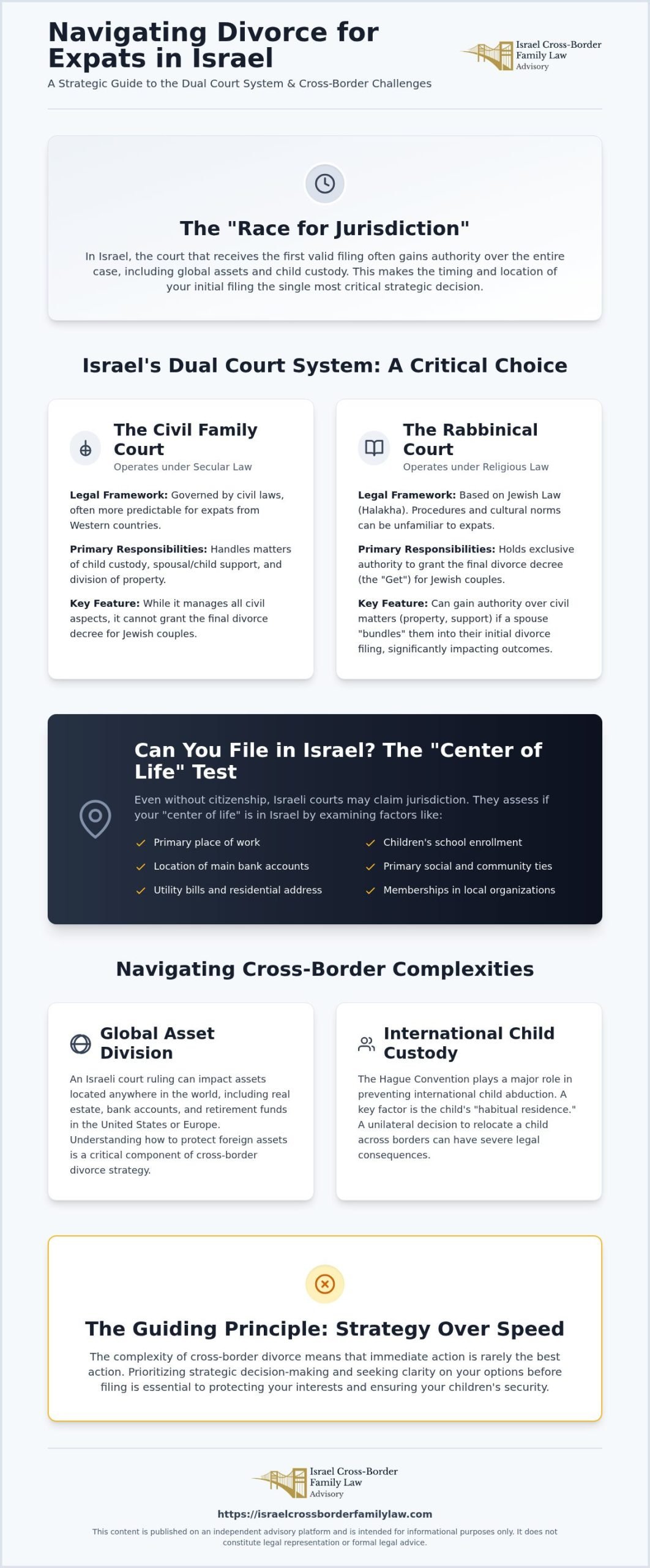
Navigating the Bridge: Strategy Before Action
Successful resolution of a Divorce for Expats Living in Israel requires more than just a basic understanding of the law. It demands a sophisticated legal strategy that accounts for the intersection of two distinct legal systems. While a local attorney can provide advice on Israeli statutes, they may lack the perspective necessary to manage cross-border complexities like US tax implications or international property enforcement. This content is published on an independent advisory platform and is intended for informational and advisory purposes only; it doesn’t constitute legal representation or formal legal advice.
The role of an independent advisory platform is to provide a comprehensive roadmap before you engage in litigation. Choosing an international lawyer who understands both Israeli and Western legal cultures is vital. You need a practitioner who recognizes that the “race for jurisdiction” isn’t just a local procedural hurdle but a global tactical decision. The psychological weight of early decisions is immense. You might feel an urgent pressure to sign agreements or file papers to end the uncertainty. However, making decisions in haste without a strategic framework can lead to irreversible losses regarding your assets or your relationship with your children.
The Cross-Border Advisory Process
Our advisory approach moves through specific phases to ensure nothing is overlooked. Phase 1 involves a detailed Jurisdictional Analysis and Risk Assessment. We evaluate the specific advantages and dangers of filing in different courts based on your unique family profile. Phase 2 focuses on Building the “Bridge” between your home country and Israel. This ensures that actions taken in the Israeli Family Court don’t conflict with your financial or legal standing in the United States. You can learn more about this structured approach by reviewing How It Works on our advisory page.
Clarity Before Commitment
The most effective way to protect your future is to seek a confidential case review before any formal legal steps are taken. This review allows you to analyze your situation in a neutral environment, away from the pressure of active court proceedings. For further education and expert insights into these complex topics, the YouTube channel Israel Family Law offers a wealth of helpful information tailored for English speakers. While the process is complex, a well-defined strategy makes it manageable. Get clarity before you commit. Request a confidential consultation.
Securing Your Future Across Borders
Managing a Divorce for Expats Living in Israel requires a proactive approach that prioritizes strategy over immediate action. You’ve learned that the choice between the Rabbinical and Family courts can fundamentally alter the division of your international assets and child custody arrangements. Early decisions, particularly regarding where you file, carry significant weight and often dictate the legal framework for your entire case. Protecting US-based retirement accounts and ensuring the security of your children under the Hague Convention are tasks that require a specialized cross-border strategy.
Our Anglo-focused legal advisory provides the steady guidance needed to navigate these multi-jurisdictional complexities with confidence. We offer deep expertise in US-Israel family law to help you build a bridge between two very different legal cultures. This content is published on an independent advisory platform and is intended for informational and advisory purposes only; it doesn’t constitute legal representation or formal legal advice. Legal services are only provided by licensed attorneys under a separate engagement. Get clarity before you commit. Request a confidential consultation.
While the path ahead may seem daunting, having a clear roadmap allows you to move forward with security and peace of mind.
Frequently Asked Questions
Navigating the legal landscape in a foreign country is challenging. This FAQ provides initial clarity on common concerns regarding Divorce for Expats Living in Israel. This content is published on an independent advisory platform and is intended for informational and advisory purposes only; it doesn’t constitute legal representation or formal legal advice.
Can I divorce in Israel if I was married in the US?
Yes, you can obtain a divorce in Israel even if your marriage ceremony took place in the United States. Israeli courts generally assume jurisdiction if at least one spouse is a resident of the country. While the marriage was civil, the process for ending it in Israel will still depend on your recognized religious status and whether the court views Israel as your “center of life.”
Does the Rabbinical Court have authority over non-Jewish expats?
No, the Rabbinical Court only holds jurisdiction over Jewish couples. If you are not Jewish, your divorce will be handled by the court of your specific religious community or by the civil Family Court. Expats with no religious affiliation or those from mixed-faith marriages typically resolve their legal matters through the civil system, which applies secular laws to property and custody.
What is a ‘Race for Jurisdiction’ in the Israeli legal system?
The “Race for Jurisdiction” refers to the tactical advantage gained by the spouse who files for divorce first. In the Israeli system, the first valid filing in either the Rabbinical Court or the Family Court usually determines which authority will rule on civil matters. For those managing a Divorce for Expats Living in Israel, this choice can significantly impact how assets and support are calculated.
Will I lose my US-based assets if I divorce in Israel?
Not necessarily, but you must be proactive. Israeli law generally follows an equal division of assets accumulated during the marriage, which includes global holdings like US bank accounts or property. However, enforcing an Israeli ruling on a US 401k or IRA requires specific legal steps in the United States. You need a coordinated strategy to protect these assets from unintended tax penalties or division errors.
Can my spouse stop me from leaving Israel with our children?
Yes, your spouse can request a “No-Exit” order, known as Tsav Ikuv Yetzia, to prevent children from leaving the country. These orders are common during divorce proceedings to ensure that custody and visitation are finalized before a child relocates. If you plan to travel or move, you must obtain written consent or a specific court order to avoid violating the Hague Convention.
Are US prenuptial agreements enforceable in Israeli courts?
US prenuptial agreements are not automatically recognized in Israel. To be enforceable, these contracts often need to be reviewed and approved by an Israeli court or a notary to ensure they comply with the Spousal Property Relations Law. It’s vital to have your existing agreement assessed early in the process to determine if it will hold up under Israeli legal standards.
How long does a typical expat divorce take in Israel?
The duration of a divorce depends on whether the parties agree on key terms. A mutual consent divorce can often be finalized within a few months. However, contested cases involving international assets, relocation claims, or complex custody disputes can easily extend beyond a year. The mandatory “Settlement of Dispute” mediation phase also adds several weeks to the initial timeline.
Do I need a lawyer in both the US and Israel for my divorce?
In many cross-border cases, coordination between legal professionals in both countries is essential. While an Israeli lawyer handles the local litigation, a US-based professional may be needed to manage “mirror orders” for retirement accounts or to protect property in the US. Using an advisory approach that bridges both systems helps you avoid legal deadlocks and ensures your global interests are fully protected.

Article by
Gabriel Lior
A Personal Journey That Became a Mission
The advisory was founded by an American father Gabriel Lior, LLB, MBA , global entrepreneur, and cross-border advisor who spent more than a decade navigating the Israeli family court system firsthand and now lives in Singapore with his son.
As a divorced parent in a cross-border family, Gabriel faced nearly every legal challenge a foreign parent can encounter in Israel — including child custody disputes, child support proceedings, property matters in Israel and abroad, false accusations, and complex immigration and relocation proceedings.
Over the years, he learned the hard way how difficult it is for non-Israeli parents to understand the system, identify the right legal strategy, and choose the right legal representation — especially when language, culture, and jurisdictional differences are involved. He also witnessed how foreign parents and new immigrants are often disadvantaged or taken advantage of by service providers and institutions simply because they lack local knowledge or fluency.
From Client to Advisor
To truly understand — and survive — the system, Gabriel pursued formal legal education in Israel, completing two Israeli law degrees, alongside a BA and MBA earned in the United States. This was never about becoming a practicing attorney, but about gaining a deep, structural understanding of how the system works — and where it breaks down for foreign parents.
This rare combination of:
Firsthand client experience
Israeli legal and US business education
International business and negotiation training
Decades of commercial execution
created a unique perspective – one that understands both sides of the table.
After years of litigation, persistence, and at times self-representation, he ultimately succeeded in securing custody of his son and relocating abroad through a rare legal victory in the Israeli Supreme Court — becoming one of the first fathers in Israel to do so under these circumstances.
Disclaimer
Important Disclaimer:
The information provided on this website and in its content is for general informational and educational purposes only and does not constitute legal advice, legal opinion, or legal representation.
Gabriel Lior is not licensed to practice law in Israel (nor is he interested in doing so) and does not provide legal services, despite having completed 2 Law Degrees. The services offered are advisory in nature and are intended to provide general guidance, strategic insight, and information regarding cross-border family law considerations.
No attorney-client relationship is formed by accessing this website, reading its content, or communicating with us.
Any decisions made based on this information are at your own discretion and risk. For legal advice specific to your situation, you should consult a licensed attorney in the relevant jurisdiction.
Where appropriate, we may refer clients to independent, licensed attorneys or professionals. Such referrals do not constitute legal representation and no liability is assumed for services provided by third parties.