This article is published on an independent advisory platform and does not constitute legal representation or an attorney-client relationship. Legal services are only provided by licensed attorneys under a separate engagement.
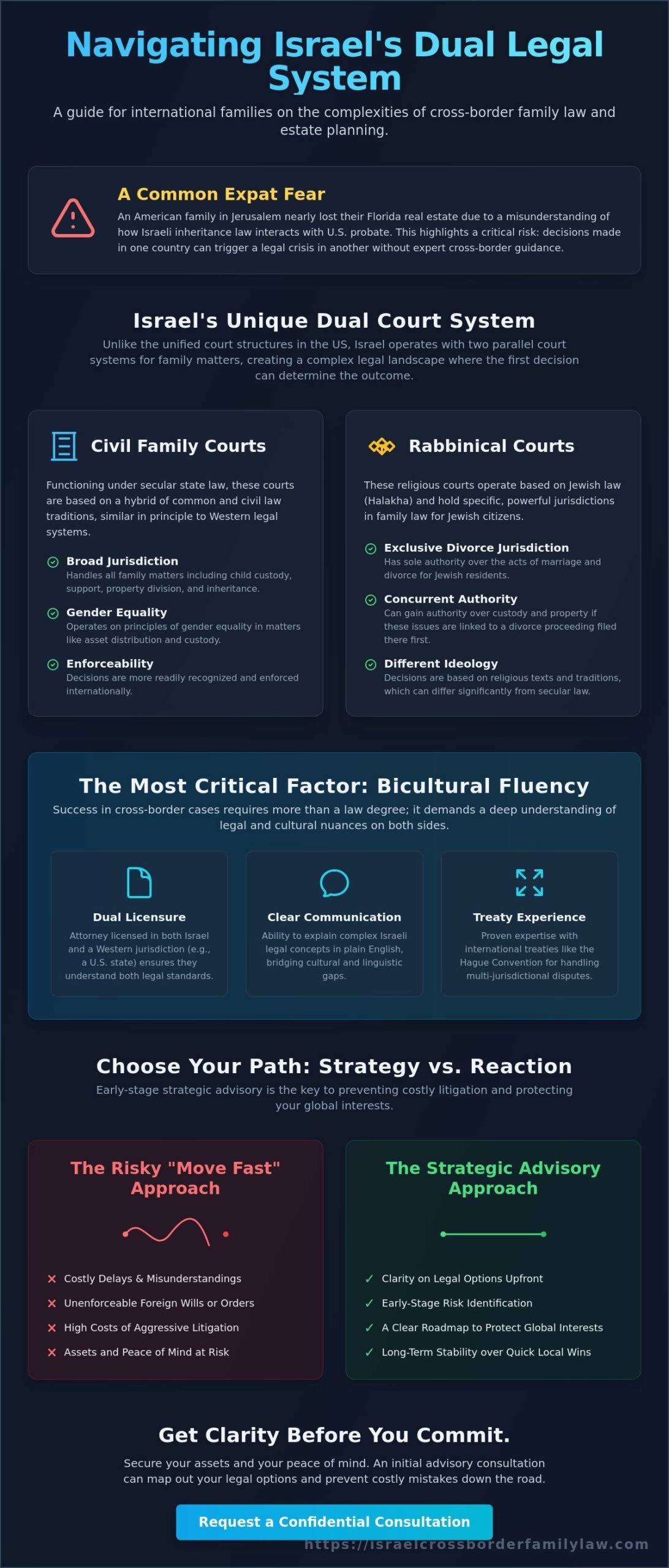
On October 14, 2023, an American family residing in Jerusalem realized that their Florida real estate holdings were at risk because of a misunderstanding of how IL inheritance laws interact with U.S. probate. It’s a common fear for expats who worry that a decision made in one country might inadvertently trigger a legal crisis in another. You’re likely already aware that the dual court system in IL, where Rabbinical and Civil courts hold concurrent jurisdiction, adds a layer of complexity that doesn’t exist in most Western legal frameworks.
Finding the right israel law firm is about more than just hiring a lawyer; it’s about securing a partner who understands the nuances of cross-border family matters. This guide explains how to navigate these systemic differences to ensure your strategy protects your interests on both sides of the ocean. We’ll examine the critical importance of bicultural legal counsel and provide a clear roadmap for securing your assets and your peace of mind. For more detailed insights, you can also view our resources on the Israel Family Law YouTube channel. Get clarity before you commit. Request a confidential consultation.
Key Takeaways
- Identify why bicultural fluency is the most critical factor when selecting an israel law firm to handle your international family matters.
- Navigate the complexities of Israel’s dual court system by understanding the functional differences between Civil and Rabbinical jurisdictions.
- Learn why a standard foreign will may not be sufficient for assets located in Israel and how to ensure your cross-border estate plan is enforceable.
- Discover how early-stage strategy and risk management can prevent the high costs and emotional toll of aggressive litigation.
- Gain the tools to map out your legal options and secure clarity before making significant financial or personal commitments.
Choosing an Israel Law Firm for Cross-Border Matters
Selecting an israel law firm involves more than checking a professional directory. For international families and expats, the stakes are higher because your life and assets span multiple jurisdictions. You need a partner who understands that Israel’s legal system is a unique hybrid of common law and civil law traditions. This complexity means that a decision made in a Tel Aviv courtroom can have lasting financial or custodial consequences in New York, London, or Toronto.
Many expats assume that any local lawyer can handle their case. However, bicultural fluency is just as vital as a legal license. You need someone who can translate not just the Hebrew language, but the cultural expectations that drive Israeli legal proceedings. Without this bridge, simple misunderstandings can lead to costly delays.
To better understand how professional guidance impacts family matters, watch this helpful video:
The Role of an International Legal Advisor
There’s a vital distinction between legal representation and strategic advisory services. Representation focuses on the “how” of a court case, while strategic advisory focuses on the “why” and the “what if.” Seeking clarity through an advisory platform before you commit to a specific firm can save you thousands of dollars. It allows you to identify risks early and build a roadmap that protects your global interests. You can learn more about how it works to see the value of this preliminary step.
What to Look for in a Cross-Border Attorney
While vetting an israel law firm, start with credentials. Ideally, the lead attorney should be licensed in both Israel and a Western jurisdiction, like a US state. This dual qualification ensures they understand the legal standards you’re accustomed to. Communication is the next pillar. They must explain complex Israeli concepts in plain English without hiding behind jargon. Finally, verify their specific experience with international treaties, such as the Hague Convention, to ensure they can handle multi-jurisdictional disputes effectively.
Get clarity before you commit. Request a confidential consultation.
This article is published on an independent advisory platform (not a law firm) and does not imply an attorney-client relationship. Legal services are only provided by licensed attorneys under a separate engagement.
The Complexity of Parallel Jurisdictions: US vs. Israel
International families often assume that the Israeli legal system mirrors the unified family court structures found in most U.S. states. However, the reality is a dual system where Civil Family Courts and Religious (Rabbinical) Courts operate with overlapping authority. This creates a unique legal landscape that requires a specialized israel law firm to navigate effectively. Decisions made in the first few days of a dispute can dictate which court hears your case; these choices often lead to very different outcomes based on the forum’s specific ideology and procedural rules.
Civil Courts vs. Rabbinical Courts
In IL, the Rabbinical Court has exclusive jurisdiction over the act of divorce itself for Jewish residents. Both the Civil Family Court and the Rabbinical Court can have authority over related matters like alimony, child support, and asset division. This overlap leads to the “Race for Jurisdiction.” The party that files first in their preferred court usually secures that forum’s control over the entire case. Many secular expats mistakenly believe religious courts won’t affect them. In reality, these courts apply to all Jewish citizens and residents regardless of their level of observance. Choosing the right forum is a strategic decision that impacts financial and parental rights for years.
How US Law Interacts with the Israeli System
Navigating cross-border matters involves understanding how local statutes align with international agreements. For example, divorce for international families often involves assets located in multiple countries. While the US-Israel Tax Treaty, originally signed in 1975, provides a framework for avoiding double taxation, it doesn’t solve every estate planning or support issue. Additionally, U.S. law regarding business in Israel can influence how corporate interests or trade-related assets are treated during a domestic dispute.
It’s a common misconception that a U.S. court order is automatically valid in IL. For a foreign judgment to be enforceable, it must undergo a formal recognition process in an Israeli court. The Israeli Supreme Court has set high standards for this process to ensure foreign orders don’t conflict with local public policy. Without these specific steps, your U.S. custody or support order may have no legal weight in Israel. You should seek an israel law firm that understands how to bridge these two systems. Get clarity before you commit. Request a confidential consultation.
This article is published on an independent advisory platform, not a law firm, and does not imply an attorney-client relationship. Legal services are only provided by licensed attorneys under a separate engagement.
Family Law and Estate Planning in a Cross-Border Context
Expats and international families often find that legal matters in IL don’t follow the same patterns as their home countries. Whether you’re managing a marriage or planning for the future, the interaction between two different legal systems creates layers of complexity. Engaging a professional israel law firm helps ensure that your family’s interests are protected under both jurisdictions while avoiding costly procedural errors.
International Divorce and Custody
Ending a marriage is difficult, but divorce and separation for international families introduces unique hurdles like jurisdictional disputes and relocation rights. If one parent wishes to move back to their home country with children, Israeli courts apply strict criteria to determine the child’s best interests. The Hague Convention is an international treaty designed to protect children from the harmful effects of abduction and retention across international borders by providing a legal procedure to bring about their prompt return. Without a clear strategy, families risk lengthy litigation in multiple countries simultaneously.
Cross-Border Wills and Estates
A common misconception is that a standard US will automatically covers assets in IL. In reality, the Israeli Succession Authority oversees the distribution of local assets, and they require specific documentation for foreign residents. Under the Israeli Succession Law of 1965, the estate of a person who lived in Israel at the time of their death is generally governed by Israeli law, regardless of their citizenship status. This can lead to unexpected results if your foreign will hasn’t been tailored to meet local requirements.
To avoid conflicting probate processes, consider these strategic steps:
- Asset Identification: You must identify all international bank accounts, real estate, and pensions before drafting documents to ensure nothing is overlooked.
- Dual-Country Planning: Wills should be drafted to compliment each other, ensuring they don’t accidentally revoke previous documents in another country.
- Financial Agreements: Prenuptial and postnuptial agreements can protect assets, but they must meet the formal requirements of both the Israeli Spousal Property Relations Law and relevant foreign statutes to be enforceable.
A qualified israel law firm can guide you through the process of registering a foreign probate order with the Israeli Registrar of Inheritance Affairs. This step is necessary to transfer title on Israeli real estate or access local bank accounts after a loved one passes away. Early planning prevents the Israeli Succession Authority from applying default distribution rules that might contradict your actual wishes.
Get clarity before you commit. Request a confidential consultation.
Strategic Decision-Making: Managing Risks and Expectations
Many expats and international families arrive in IL with legal expectations shaped by their home countries. They often assume that aggressive litigation is the standard path to justice. However, the reality within the IL legal system is quite different. A seasoned israel law firm will prioritize a risk-based strategy over a “fight-first” mentality. In this jurisdiction, aggressive posturing often leads to procedural delays and higher costs without improving the final outcome.
The IL court system is heavily burdened. Judges frequently look for pragmatic solutions rather than ideological victories. If you enter a dispute with the goal of “winning” at any cost, you may find yourself trapped in a cycle of litigation that lasts for years. Early-stage strategy is vital. It prevents the kind of long-term complications that arise when emotions drive legal decisions.
Strategy vs. Litigation
Success in cross-border cases depends on understanding where to file and when. IL has a unique dual-court system involving both Family Courts and Rabbinical Courts. The timing of your first filing can change your entire legal trajectory. This is why a strategic approach is superior to reflexive litigation. Mediation is often a mandatory first step under the 2016 Litigation Arrangement Law. Embracing this process rather than fighting it can save you significant time and resources. Out-of-court settlements allow families to maintain control over their future rather than leaving it to the discretion of a judge who may not understand your cultural background.
Understanding the Costs
Transparency is essential when managing a legal budget. You should have a clear understanding of how advisory fees and pricing work before you commit to a course of action. Beyond standard attorney fees, cross-border cases involve specific “hidden” costs that many families overlook. These include:
- Certified translations of foreign legal documents.
- Expert witnesses to testify on foreign law or international asset valuation.
- Travel expenses for witnesses or parties living abroad.
- Apostille certifications and international courier fees.
It’s tempting to seek out the lowest possible price for legal help. However, “cheap” advice in a complex international case often leads to expensive corrections later. A single mistake in a cross-border filing can result in jurisdictional disputes that take months to resolve. You aren’t just paying for paperwork; you’re paying for a strategy that mitigates these specific risks.
Get clarity before you commit. Request a confidential consultation.
This article is published on an independent advisory platform, not a law firm. The content provided is for informational and advisory purposes only and does not imply or establish an attorney-client relationship. Legal services are only provided by licensed attorneys under a separate, formal engagement.
The Advisory Approach: Getting Clarity Before You Commit
Deciding to hire an israel law firm is a significant step that often feels rushed by the pressure of a crisis. Most families find themselves forced into the legal system before they fully understand the long-term consequences of their choices. The Israel Cross Border Advisory functions as a strategic bridge; it allows you to step back and analyze your situation without the immediate pressure of litigation. By focusing on an advisory model, you can map out the jurisdictional risks between Israel and your home country before any papers are filed in court.
A confidential case review is the most effective way to gain this clarity. During this process, we examine the specific variables of your international life, such as your citizenship status, the location of your assets, and the habitual residence of your children. In Israel, the “race for jurisdiction” can be decided in a matter of hours, making early strategic planning vital. Taking this time to evaluate your options ensures you don’t lose control of your case to a system that operates very differently from the one you grew up with in the U.S., U.K., or Europe.
Resources for Expats and Foreigners
Navigating a foreign legal culture requires specialized knowledge. We provide tailored guidance through our section for-expats-foreign-nationals, which addresses the unique hurdles faced by the Anglo community in Israel. Visual learners should consult the Israel Family Law videos for clear explanations of complex topics like the Rabbinical courts and the Hague Convention. These resources help you:
- Understand the bicultural nuances of the Israeli legal system.
- Vet a potential israel law firm based on their experience with multi-jurisdictional cases.
- Identify the specific documents needed for cross-border enforcement.
- Learn how to communicate effectively with bilingual and bicultural attorneys.
Next Steps for Your Case
The best course of action is often to pause and breathe. Rushed decisions in family law frequently lead to years of unnecessary conflict. By requesting a confidential-case-review, you’re choosing a path of informed strategy rather than reactive emotion. This review identifies potential pitfalls in international custody or asset division that a standard local firm might overlook. It’s about protecting your future through deliberate, risk-based decision-making. Maintain control of your legal journey by gathering the facts first.
Get clarity before you commit. Request a confidential consultation.
Securing Your Family’s Future Across Borders
Navigating the intersection of US and Israeli legal systems requires a deliberate, strategy-first approach. International families often face significant risks when dealing with parallel jurisdictions, especially regarding the Israeli Succession Law of 1965 or the 1980 Hague Convention. It’s essential to recognize that the Israeli legal framework operates differently than many expats expect. Early decisions regarding jurisdiction can impact your case for years. Working with a dedicated israel law firm that understands the bicultural nuances of these two systems provides the necessary bridge for complex multi-jurisdictional matters. Our advisory model focuses on providing clear, honest explanations of risks without the pressure of immediate litigation. By prioritizing strategy over aggressive tactics, you gain the perspective needed to manage your international assets and family interests effectively. This calm, educational method ensures you aren’t making choices based on confusion or urgency. Instead, you’re building a foundation based on expertise and established legal precedents. Taking the time to understand these differences now will save you from complications later. We’re here to guide you through every step of this sophisticated process with the reassurance you deserve.
Get clarity before you commit. Request a confidential consultation.
This article is published on an independent advisory platform and does not constitute a law firm or an attorney-client relationship. Legal services are only provided by licensed attorneys under a separate engagement.
Frequently Asked Questions
Do I need a separate lawyer in both the US and Israel for my divorce?
You generally need separate legal representation in both jurisdictions because an American attorney cannot represent you in an Israeli court, and vice versa. Laws are strictly territorial. While a US decree might be recognized in Israel under the 1958 Recognition and Enforcement of Foreign Judgments Law, managing assets or custody on the ground requires a specialized israel law firm. Coordinating between two teams ensures that the strategy in one country doesn’t inadvertently damage your legal standing in the other.
Is a US will valid for property I own in Israel?
A US will is generally valid in Israel if it meets the formal requirements of the jurisdiction where it was signed, according to Section 76 of the Israeli Inheritance Law of 1965. However, you must still undergo a formal probate process in Israel to transfer title of local real estate or bank accounts. Without an Israeli-specific codicil or a clear “Israel-friendly” structure, the Registrar of Inheritance Affairs often requires expert opinions on foreign law. This requirement can increase costs and cause significant delays during the distribution of assets.
How long does the probate process take in Israel for foreign residents?
The probate process for foreign residents typically takes between 6 and 12 months, depending on the complexity of the estate and the responsiveness of the Inheritance Registrar. If the will is contested or requires an Expert Opinion on Foreign Law, the timeline often extends beyond 14 months. It’s critical to have a team on the ground to manage the translation of documents and the mandatory newspaper advertisements required by Israeli law. For further visual guidance on these timelines, you can view educational resources on the Israel Family Law YouTube channel at https://www.youtube.com/@IsraelFamilyLaw.
Can I enforce a US child support order in an Israeli court?
You can enforce a US child support order in Israel by filing a petition for recognition under the Enforcement of Foreign Judgments Law of 1958. The Israeli court will verify that the original order is final and that the defendant had a fair chance to present their case. Once recognized, the order is enforceable through the Execution Office, known as Hoza’a LaPoal. This agency has the authority to garnish wages or impose travel bans on the debtor to ensure compliance with the foreign ruling.
What is the difference between the Family Court and the Rabbinical Court?
The Family Court is a civil institution that applies secular law to matters like property division, while the Rabbinical Court operates under Jewish religious law, or Halacha. Under the “Race for Jurisdiction” principle, the court where a case is first filed usually gains the authority to hear it. This dual system creates a complex legal environment where the choice of venue can significantly alter the outcome of your divorce. Understanding the procedural nuances of each system is essential before filing any initial motions.
How do I choose the right Israel law firm if I don’t live in the country?
Choosing the right israel law firm from abroad requires identifying practitioners who are bicultural and bilingual to bridge the gap between different legal cultures. Look for firms that emphasize a “team on the ground” and have documented experience with multi-jurisdictional cases involving the US and Israel. You should prioritize firms that offer clear, strategy-based roadmaps rather than vague promises. Early decisions in cross-border litigation often have permanent consequences, so choosing a firm is a strategic decision that requires careful vetting.
Are prenuptial agreements signed in the US enforceable in Israel?
Prenuptial agreements signed in the US are generally enforceable in Israel, provided they don’t violate the Spouses (Property Relations) Law of 1973. For the agreement to be fully recognized, it must often be validated by an Israeli court or a notary, especially if the couple resides in Israel. If the agreement wasn’t signed with an understanding of Israeli law, a spouse might challenge its fairness. It’s common for courts to scrutinize whether there was full financial disclosure during the original signing process in the US.
What are the typical fees for an international family law case in Israel?
Fees for international family law cases in Israel vary based on the complexity of the cross-border assets and the level of conflict involved. Most firms charge hourly rates or set flat fees for specific stages, such as filing a petition or representing a client in a single hearing. Because these cases involve navigating two different legal systems, costs are typically higher than domestic cases. This is due to the need for document translations, apostilles, and expert legal opinions on foreign statutes. Get clarity before you commit. Request a confidential consultation.

Article by
Gabriel Lior
A Personal Journey That Became a Mission
The advisory was founded by an American father Gabriel Lior, LLB, MBA , global entrepreneur, and cross-border advisor who spent more than a decade navigating the Israeli family court system firsthand and now lives in Singapore with his son.
As a divorced parent in a cross-border family, Gabriel faced nearly every legal challenge a foreign parent can encounter in Israel — including child custody disputes, child support proceedings, property matters in Israel and abroad, false accusations, and complex immigration and relocation proceedings.
Over the years, he learned the hard way how difficult it is for non-Israeli parents to understand the system, identify the right legal strategy, and choose the right legal representation — especially when language, culture, and jurisdictional differences are involved. He also witnessed how foreign parents and new immigrants are often disadvantaged or taken advantage of by service providers and institutions simply because they lack local knowledge or fluency.
From Client to Advisor
To truly understand — and survive — the system, Gabriel pursued formal legal education in Israel, completing two Israeli law degrees, alongside a BA and MBA earned in the United States. This was never about becoming a practicing attorney, but about gaining a deep, structural understanding of how the system works — and where it breaks down for foreign parents.
This rare combination of:
Firsthand client experience
Israeli legal and US business education
International business and negotiation training
Decades of commercial execution
created a unique perspective – one that understands both sides of the table.
After years of litigation, persistence, and at times self-representation, he ultimately succeeded in securing custody of his son and relocating abroad through a rare legal victory in the Israeli Supreme Court — becoming one of the first fathers in Israel to do so under these circumstances.
Disclaimer
Important Disclaimer:
The information provided on this website and in its content is for general informational and educational purposes only and does not constitute legal advice, legal opinion, or legal representation.
Gabriel Lior is not licensed to practice law in Israel (nor is he interested in doing so) and does not provide legal services, despite having completed 2 Law Degrees. The services offered are advisory in nature and are intended to provide general guidance, strategic insight, and information regarding cross-border family law considerations.
No attorney-client relationship is formed by accessing this website, reading its content, or communicating with us.
Any decisions made based on this information are at your own discretion and risk. For legal advice specific to your situation, you should consult a licensed attorney in the relevant jurisdiction.
Where appropriate, we may refer clients to independent, licensed attorneys or professionals. Such referrals do not constitute legal representation and no liability is assumed for services provided by third parties.