For couples with deep ties to both Israel and the United States, divorce introduces a layer of cross-border complexity that can feel overwhelming. The fear that an Israeli court cannot assert jurisdiction over a 401k in New York, or that you will face a second, costly legal battle in the U.S. to enforce your rights, is a significant source of anxiety. These concerns, while understandable, often stem from a misunderstanding of international family law. The process for dividing US assets in an Israeli divorce is well-established and legally sound, provided you are guided by counsel with sophisticated, multi-jurisdictional expertise.
This comprehensive guide is designed to demystify this intricate process. We will navigate you through the legal framework governing the division of US-based property, investments, and retirement accounts within an Israeli divorce proceeding. You will gain a clear understanding of the Israeli court’s authority, the critical steps for disclosing, valuing, and equitably dividing these assets, and the mechanisms that ensure your final settlement is fully and legally enforceable in the United States, providing the clarity and security you require during this challenging time.
Jurisdiction for Dividing US Assets in Israeli Divorce
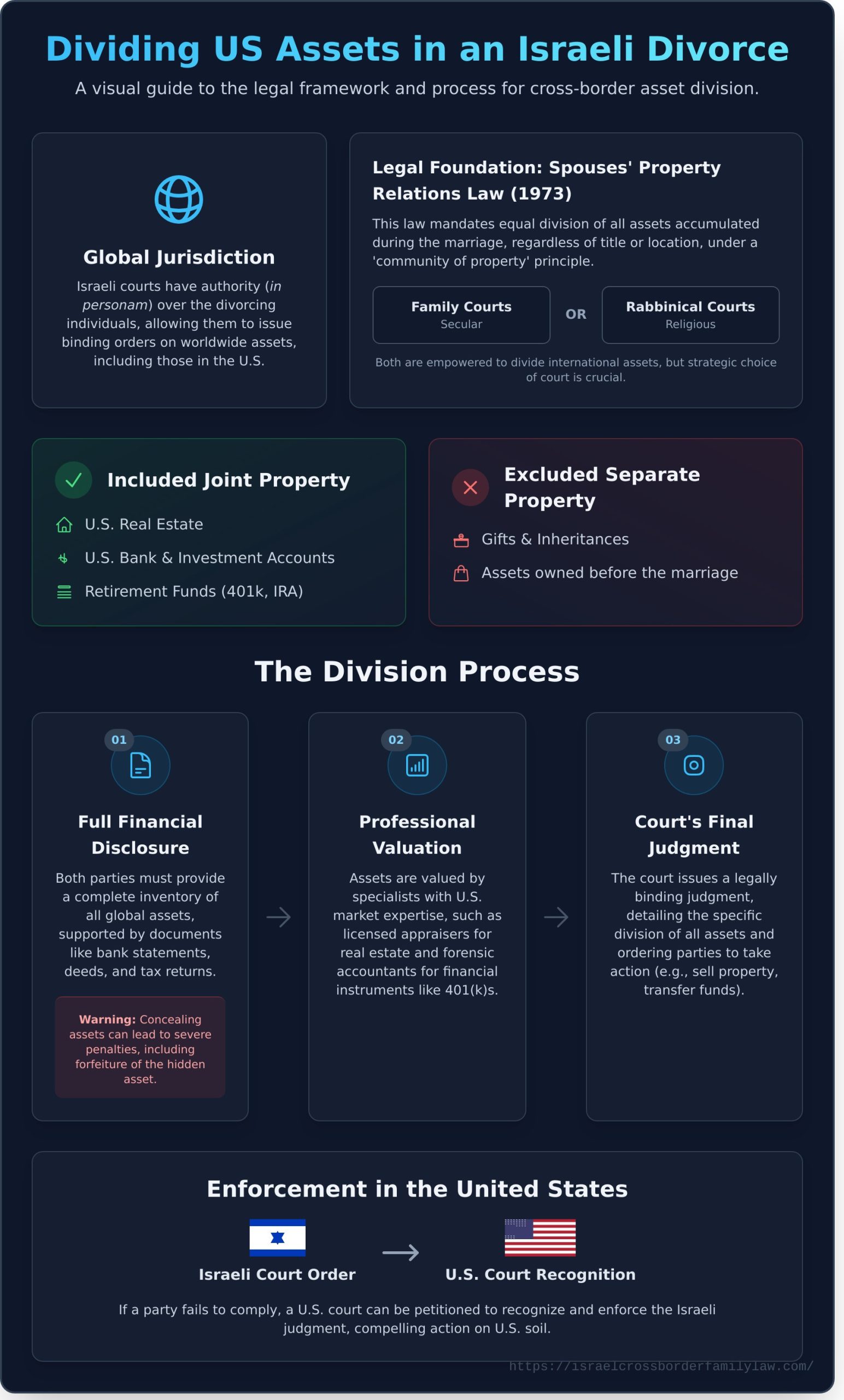
A primary concern for individuals is whether an Israeli court possesses the authority to adjudicate property located abroad. The answer is unequivocally yes. Israeli family law courts operate on the principle of in personam jurisdiction, meaning their authority is over the divorcing parties themselves, not necessarily the physical assets. This principle is the cornerstone of dividing US assets in an Israeli divorce, granting the court the power to issue binding orders concerning the couple’s entire global marital estate, including all property and financial accounts held within the United States.
For a deeper understanding of how this jurisdiction is applied in practice, the following video provides a valuable overview.
It is crucial to distinguish between the court’s power to order a division versus its ability to directly seize foreign property. An Israeli court cannot dispatch a bailiff to foreclose on a home in Florida. Instead, it issues a judgment that divides the value of the worldwide assets. The court will order the parties to take specific actions-such as selling a property, liquidating a stock portfolio, or transferring funds-to effectuate this division. The practical reality of dividing US assets in an Israeli divorce is that compliance is compelled by the court’s power over the individuals in Israel. Should a party refuse to comply, a US court may be petitioned to recognize the Israeli judgment, a process guided by international legal principles related to the enforcement of foreign judgments.
The Legal Foundation: Spouses’ Property Relations Law
The authority for dividing US assets in an Israeli divorce is grounded in Israel’s Spouses’ Property Relations Law (1973). This law establishes a presumption of a ‘community of property,’ often referred to as the ‘balancing of resources.’ It mandates that all assets accumulated by either spouse during the marriage are considered joint property and are to be divided equally upon divorce, regardless of title or geographic location. This includes:
- Real estate in the United States
- US bank and investment accounts
- Retirement funds, such as 401(k)s and IRAs
Assets excluded from this equal division typically include gifts, inheritances, and property owned by either spouse prior to the marriage.
Family Court vs. Rabbinical Court Jurisdiction
Israel maintains a dual court system for divorce proceedings: the secular Family Courts and the religious Rabbinical Courts (Batei Din). Both judicial bodies are legally empowered to adjudicate the division of marital property, including international assets. The strategic decision of which court to file in can have significant implications when dividing US assets in an Israeli divorce, as each may have different procedural nuances and judicial philosophies. Navigating this choice requires sophisticated legal counsel with deep experience in multi-jurisdictional asset division.
The Division Process: From Financial Disclosure to Court Order
Navigating the complexities of dividing us assets in an israeli divorce begins with a structured and legally mandated process designed to ensure a fair and equitable distribution of the marital estate. The Israeli Family Court oversees a methodical progression, starting with a comprehensive inventory of all global assets and culminating in a binding legal order. This process is rigorous, requiring meticulous attention to both Israeli legal principles and the practical realities of cross-border asset management. For couples with a multi-jurisdictional portfolio, engaging experienced counsel is paramount to protecting their financial interests throughout each critical stage.
Comprehensive Financial Disclosure of US Assets
The foundational step is a full and frank financial disclosure by both parties. Under Israeli law, there is an affirmative duty to reveal all assets and liabilities, irrespective of their location. This includes a complete inventory of US-based property, supported by verifiable documentation such as:
- Bank and brokerage account statements
- 401(k), IRA, and other retirement plan reports
- Deeds and title documents for real estate
- Federal and state income tax returns
- Corporate records for any US business interests
Should one spouse attempt to conceal assets, Israeli courts permit robust legal tools, including discovery motions and letters of request to US courts, to compel disclosure. The penalties for non-disclosure are severe, potentially resulting in the forfeiture of the hidden asset to the other spouse.
Valuation of Cross-Border Property
Once all US assets are identified, they must be professionally valued. This is a complex task that requires specialists with expertise in the US market. For instance, real estate in Florida or New York must be appraised by a licensed US appraiser. Similarly, valuing sophisticated financial instruments like US-based pensions, 401(k)s, or executive stock options necessitates the involvement of actuaries or forensic accountants familiar with US financial regulations and vesting schedules. Accurate valuation is critical, as it forms the basis for the court’s determination of an equitable division.
The Court’s Final Judgment
The final stage is the court’s judgment, which provides a detailed order for the division of the marital property. This legally binding document specifies precisely how each US asset will be allocated. The authority of the Israeli court to issue such comprehensive orders stems from its broad Israeli Family Law Jurisdiction, which extends to marital property regardless of its global location. Where physically splitting an asset is impractical, the court may order an equalization payment-a sum paid in ILS to balance the distribution. It is essential that the judgment’s language is precise and unambiguous to ensure it can be readily domesticated and enforced by courts within the United States.
Handling Specific Types of US Assets in an Israeli Divorce
Navigating the division of marital property located in the United States requires a sophisticated, multi-jurisdictional approach. An Israeli court order is the foundation, but its enforcement depends on precise adherence to US federal and state regulations. The process of dividing US assets in an Israeli divorce is not merely a matter of translation; it involves leveraging specific US legal instruments to execute the judgment of the Israeli court. This section provides expert guidance on managing the most common classes of US-based assets.
US Retirement Accounts: 401(k)s, IRAs, and Pensions
These complex financial instruments cannot be liquidated and divided like a standard bank account without incurring substantial tax penalties and early withdrawal fees. The exclusive legal mechanism for dividing most US employer-sponsored retirement plans is a Qualified Domestic Relations Order (QDRO). A QDRO is a distinct US court order that instructs a plan administrator to allocate a portion of a retirement account to a former spouse. For a QDRO to be valid, the Israeli divorce judgment must include specific, meticulously drafted language that meets the stringent requirements of both the retirement plan and US law.
US Real Estate: Homes, Apartments, and Investment Properties
For real property located in the US, the Israeli court’s decision must be implemented through established US legal procedures. Spouses typically have two primary options for division:
- Sale and Division: The property is sold on the US market, and the net proceeds are divided according to the percentages stipulated in the Israeli divorce agreement.
- Buyout: One spouse retains ownership of the property and compensates the other for their share of the equity.
Regardless of the chosen path, executing the division requires transferring the property’s title. This necessitates engaging a qualified US real estate attorney to draft and file a new deed in the relevant county, ensuring the transfer is legally binding and properly recorded.
Bank Accounts, Brokerage Accounts, and Investments
While procedurally simpler than retirement funds or real estate, dividing liquid assets still demands careful execution. Once the Israeli court issues a final judgment detailing the specific amounts or percentages to be transferred, that order must be presented to the US-based financial institutions. These institutions will require a certified and often apostilled copy of the judgment to execute the transfer of cash or securities. It is also critical to consider the tax consequences, such as potential capital gains taxes in the US, that may arise from the sale of stocks or other investments required to effectuate the division.
[
Download
](https://getautoseo.com/screenshots/getautoseocom_1768350548_hJHvsDvh.jpg)
Feedback & Recreate
Delete

Enforcing Your Israeli Divorce Judgment in the United States
A common and significant concern for individuals undergoing a divorce in Israel with assets in the US is whether an American court will honor the decisions made by an Israeli one. The misconception that a US court will simply disregard a foreign judgment is a source of considerable anxiety. However, due to established principles of international law, an Israeli divorce decree is a potent legal instrument that can be enforced on US soil, provided the correct legal procedures are followed.
Successfully executing the financial components of your divorce, particularly when dealing with an uncooperative party or US-based financial institutions, hinges on transforming your Israeli judgment into an order that is recognized and enforceable within the American legal system. This is not merely a formality; it is the critical step that provides access to powerful US enforcement mechanisms.
The Principle of Comity: Why US Courts Recognize Israeli Orders
The foundation for enforcing an Israeli judgment in the United States is the legal doctrine known as comity of nations. This is not a binding treaty obligation but rather a principle of mutual deference and respect between the judicial systems of sovereign countries. A US court will typically recognize and enforce a foreign judgment if certain fundamental standards of justice were met. Key criteria include:
- Proper Jurisdiction: The Israeli court must have had valid jurisdiction over the parties and the subject matter.
- Fair Procedures: The proceedings must have adhered to the principles of due process, ensuring the defendant received proper notice and a fair opportunity to be heard.
- No Conflict with Public Policy: The judgment must not violate the fundamental public policy of the US state where enforcement is sought.
Israeli family court judgments, which originate from a robust and sophisticated legal system, are consistently found to satisfy these requirements, making them strong candidates for recognition by US courts.
The Practical Steps of Domestication
The process of making an Israeli judgment enforceable in the US is known as “domestication.” This involves filing a formal petition or action in the appropriate US state court, typically in the jurisdiction where the assets are located or the other party resides. This petition must be accompanied by a certified copy of the final Israeli judgment and an official, certified English translation.
Once the US court domesticates the decree, it is converted into a local US judgment. This transformation is pivotal; your Israeli order now carries the full weight and authority of an American court order. This unlocks a range of powerful enforcement tools, including the ability to place liens on real estate, garnish wages, and levy bank accounts. This is the ultimate objective when dividing US assets in an Israeli divorce, as it compels compliance from reluctant ex-spouses and institutions. Navigating the procedural requirements of two distinct legal systems requires sophisticated, cross-border expertise. Consult with our cross-border team to ensure your rights are protected and your judgment is enforced effectively.
Key Pitfalls and Strategic Considerations
Successfully navigating the complexities of dividing US-domiciled assets within an Israeli legal framework requires more than standard family law counsel; it demands a sophisticated, multi-jurisdictional strategy. A failure to anticipate cross-border legal and financial nuances can lead to significant financial loss, protracted litigation, and unenforceable judgments. Protecting your financial future when dividing us assets in an israeli divorce is contingent upon proactive, expert guidance that bridges the gap between these two distinct legal systems.
US Tax Consequences of Asset Division
A common and costly error is overlooking the significant US tax implications of asset transfers. While IRS Section 1041 generally permits tax-free transfers of property between spouses incident to a divorce, this protection is not automatic. The structure of the settlement is critical; mischaracterizing a property settlement payment as alimony can trigger unintended tax liabilities. Furthermore, transfers involving trusts or substantial gifts can inadvertently create complex US gift and estate tax issues, demanding specialized tax and legal analysis from the outset.
The Critical Role of a Dual-Qualified Attorney
Engaging a single law firm with deep, proven experience in both Israeli and US law is the most effective strategic decision. This integrated approach offers critical advantages:
- Seamless Strategy: It eliminates the risk of miscommunication and conflicting advice that often arises when coordinating between separate Israeli and American legal teams.
- Proactive Enforcement: A dual-qualified team ensures the Israeli divorce judgment is drafted with the specific legal language required for immediate recognition and enforcement by US courts and financial institutions.
- Cost-Effectiveness: While seemingly a greater initial investment, this unified approach prevents the far greater long-term costs associated with correcting cross-border legal errors or litigating enforcement in a US court.
Ultimately, a successful outcome when dividing us assets in an israeli divorce depends on a cohesive legal strategy that is both globally informed and meticulously executed. To navigate these complex cross-border challenges, it is imperative to partner with a firm that possesses proven expertise in both jurisdictions. Our team of bicultural and dual-licensed attorneys is uniquely positioned to provide this seamless guidance.
Strategic Counsel for Complex Cross-Border Asset Division
Navigating the division of marital property across international borders introduces a significant layer of legal complexity. As this guide has outlined, Israeli Family Courts possess the jurisdiction to adjudicate on property located in the United States. However, successfully dividing us assets in israeli divorce hinges on a deep, nuanced understanding of both legal systems-from the initial financial disclosure to the critical step of enforcing your Israeli judgment on US soil.
The sophisticated nature of these proceedings demands representation by a firm with proven, dual-jurisdictional expertise. Our team of attorneys, licensed in both Israel and the US, offers decades of dedicated experience before the Israeli Family Courts and a demonstrable track record in enforcing Israeli judgments within the United States. Do not leave your financial future to chance.
Secure Your Cross-Border Assets. Schedule a Confidential Consultation Today.
With steadfast and knowledgeable counsel, you can navigate this process with confidence and secure a stable foundation for your next chapter.
Frequently Asked Questions
Do I need to hire separate lawyers in both Israel and the United States?
Engaging legal counsel in both jurisdictions is almost always a strategic necessity. While the Israeli Family Court maintains jurisdiction over the global marital estate, the practical enforcement of its orders concerning US-based assets-such as real property deeds or Qualified Domestic Relations Orders (QDROs) for retirement accounts-requires a US-admitted attorney. A firm with deep cross-border experience can provide seamless, integrated representation, coordinating between Israeli and US counsel to navigate these complex legal frameworks and protect your interests effectively.
What happens if my spouse refuses to disclose their US bank accounts or assets?
Israeli courts possess significant authority to compel full financial disclosure from both parties, regardless of asset location. Should a spouse refuse to cooperate, the court can impose sanctions, including awarding a disproportionate share of the known marital assets to the compliant party. Furthermore, our firm can leverage sophisticated US discovery procedures, such as subpoenas and letters rogatory, to uncover concealed accounts and ensure a comprehensive and equitable division of the entire marital estate is achieved.
How are debts located in the US divided in an Israeli divorce?
Under Israel’s Spouses’ Property Relations Law, debts incurred during the marriage for the benefit of the family unit are considered marital liabilities and are subject to equitable division, irrespective of their geographic location. This includes US-based obligations such as mortgages, credit card balances, and personal loans. A comprehensive financial analysis is conducted to balance all assets and liabilities, ensuring a fair and legally sound distribution of the complete net marital estate in the final divorce decree.
Can a US prenuptial agreement be enforced in an Israeli court?
A prenuptial agreement executed in the United States can be recognized and enforced by an Israeli court, provided it meets two key criteria: it must be valid under the laws of the US state where it was created, and its terms must not contravene Israeli public policy. The Israeli court will conduct a thorough review of the agreement’s validity and fairness. Having such an agreement properly authenticated and presented by experienced cross-border counsel is critical to its enforcement.
How long does the process of dividing US assets in an Israeli divorce typically take?
The timeline for dividing US assets in an Israeli divorce is highly variable and contingent on several factors, including the complexity of the asset portfolio, the level of cooperation between spouses, and the court’s caseload. A straightforward case with full disclosure might resolve within a year, whereas a contentious, multi-jurisdictional dispute involving business valuations or hidden assets can extend for several years. Our objective is to navigate this process efficiently while securing a comprehensive and favorable outcome for our clients.
What is the difference between marital property and separate property for US assets?
Marital property generally includes all assets acquired by either spouse from the date of marriage until separation, regardless of whose name is on the title. Conversely, separate property typically consists of assets owned prior to the marriage, or inheritances and gifts received by one spouse during the marriage. However, separate property can become marital property through processes like commingling, making a precise legal classification by experienced counsel essential for equitable distribution in your divorce proceedings.

Article by
Gabriel Lior
A Personal Journey That Became a Mission
The advisory was founded by an American father Gabriel Lior, LLB, MBA , global entrepreneur, and cross-border advisor who spent more than a decade navigating the Israeli family court system firsthand and now lives in Singapore with his son.
As a divorced parent in a cross-border family, Gabriel faced nearly every legal challenge a foreign parent can encounter in Israel — including child custody disputes, child support proceedings, property matters in Israel and abroad, false accusations, and complex immigration and relocation proceedings.
Over the years, he learned the hard way how difficult it is for non-Israeli parents to understand the system, identify the right legal strategy, and choose the right legal representation — especially when language, culture, and jurisdictional differences are involved. He also witnessed how foreign parents and new immigrants are often disadvantaged or taken advantage of by service providers and institutions simply because they lack local knowledge or fluency.
From Client to Advisor
To truly understand — and survive — the system, Gabriel pursued formal legal education in Israel, completing two Israeli law degrees, alongside a BA and MBA earned in the United States. This was never about becoming a practicing attorney, but about gaining a deep, structural understanding of how the system works — and where it breaks down for foreign parents.
This rare combination of:
Firsthand client experience
Israeli legal and US business education
International business and negotiation training
Decades of commercial execution
created a unique perspective – one that understands both sides of the table.
After years of litigation, persistence, and at times self-representation, he ultimately succeeded in securing custody of his son and relocating abroad through a rare legal victory in the Israeli Supreme Court — becoming one of the first fathers in Israel to do so under these circumstances.
Disclaimer
Important Disclaimer:
The information provided on this website and in its content is for general informational and educational purposes only and does not constitute legal advice, legal opinion, or legal representation.
Gabriel Lior is not licensed to practice law in Israel (nor is he interested in doing so) and does not provide legal services, despite having completed 2 Law Degrees. The services offered are advisory in nature and are intended to provide general guidance, strategic insight, and information regarding cross-border family law considerations.
No attorney-client relationship is formed by accessing this website, reading its content, or communicating with us.
Any decisions made based on this information are at your own discretion and risk. For legal advice specific to your situation, you should consult a licensed attorney in the relevant jurisdiction.
Where appropriate, we may refer clients to independent, licensed attorneys or professionals. Such referrals do not constitute legal representation and no liability is assumed for services provided by third parties.