This article is published on an independent advisory platform and does not constitute a law firm relationship or legal advice. Legal services are only provided by licensed attorneys under a separate engagement.
The most expensive mistake in an Israeli divorce isn’t the hourly legal fee, but the “Race for Jurisdiction” triggered by a single day’s delay. You likely feel that the dual-court system is designed to be complex, leaving you vulnerable to unexpected expenses as a cross-border family. This strategic guide provides an authoritative breakdown of the israeli divorce cost for 2026, offering the transparency you need to manage your international assets. We’ll explore the specific fee structures for Rabbinical and Family Courts, the costs associated with translating foreign legal documents, and how a mediation-first approach can save families significant sums in unnecessary litigation.
Understanding these financial variables is essential for navigating the Israeli legal landscape with confidence. You can gain deeper insights into these strategic considerations by viewing the resources on the Israel Family Law YouTube channel. Get clarity before you commit. Request a confidential consultation.
Key Takeaways
- Understand the three primary pillars of expense—professional fees, court administrative costs, and expert valuations—to establish a comprehensive financial plan.
- Learn how the strategic “Race for Jurisdiction” between different court systems can drastically alter your total israeli divorce cost and legal trajectory.
- Identify the necessary steps for valuing international assets, such as US real estate or retirement accounts, to ensure a fair balancing of resources within the Israeli system.
- Explore why a Consensual Divorce Agreement (Heskem Girushin) and mediation are significantly more cost-effective than proceeding to a contested trial.
- Gain clarity on the current 2026 fee structures for both the Family Court and the Rabbinical Court to prevent unexpected administrative expenses.
This article is published on an independent advisory platform, not a law firm. It doesn’t imply an attorney-client relationship. Legal services are only provided by licensed attorneys under a separate engagement.
Understanding the Components of Israeli Divorce Costs
Calculating the total israeli divorce cost requires looking beyond a single retainer fee. The legal landscape in Israel involves a unique dual-court system where jurisdiction can significantly impact your financial planning. Understanding Marriage and divorce in Israel is vital because the overlap between secular Family Courts and religious Rabbinical Courts creates specific procedural requirements. For international families, these complexities often lead to a higher baseline expense compared to local couples due to the multi-jurisdictional nature of their assets and residency status.
To better understand how these expenses are structured, watch this helpful video:
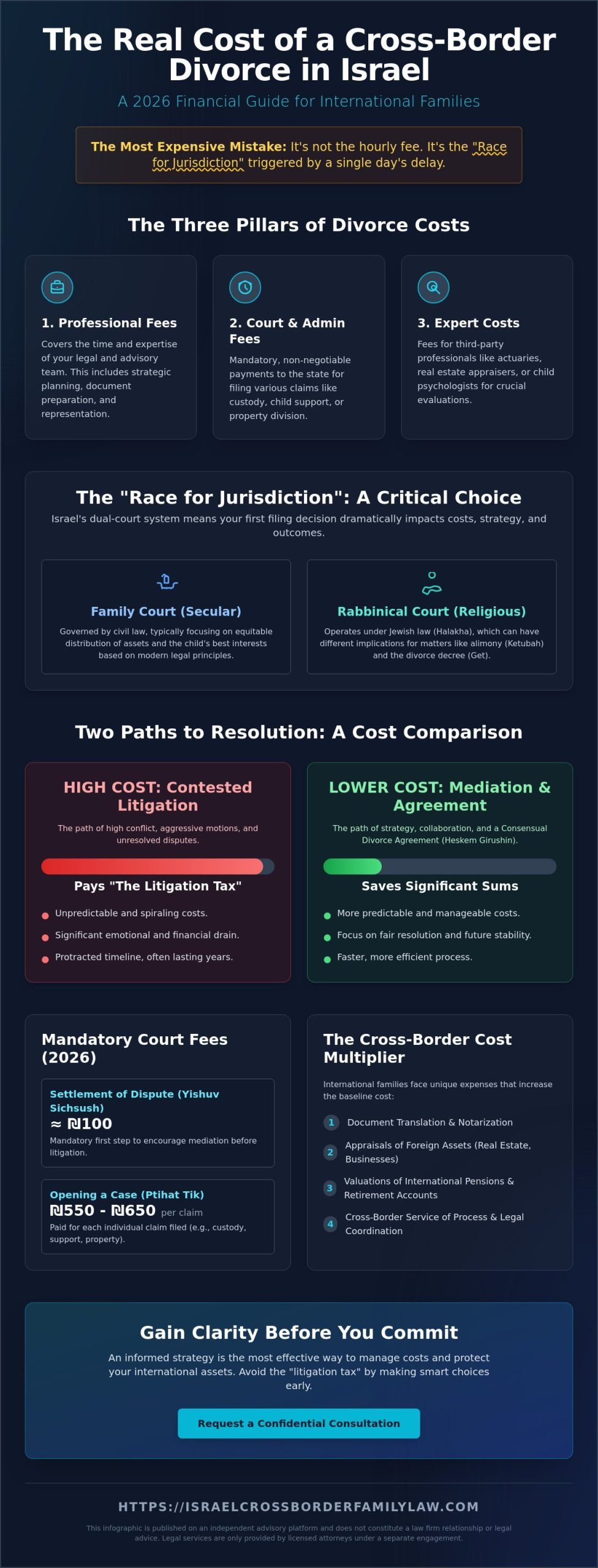
The financial commitment generally rests on three primary pillars. First, professional fees cover the time and expertise of your legal and advisory team. Second, administrative court fees are mandatory payments to the state, which vary depending on the number of claims filed, such as child support, custody, or property division. Third, expert costs involve third-party professionals like actuaries for pension division, real estate appraisers, or child psychologists for custody evaluations. International families often face additional costs for document translation, foreign asset appraisals, and cross-border service of process. An initial consultation is the most effective way to establish a financial roadmap and avoid unexpected expenses.
The Advisory vs. Representation Model
There’s a distinct difference between seeking strategic clarity and hiring a trial attorney for immediate litigation. An advisory model focuses on the big picture, helping you understand how the Israeli system interacts with your home jurisdiction. Many clients find value in this approach before committing to a specific legal path in a foreign environment. You can learn more about this strategic support by visiting our page About the Advisory. This stage is about risk-based decision-making rather than immediate conflict, ensuring you don’t overspend on unnecessary legal maneuvers.
The Emotional vs. Financial Cost
High-conflict litigation is the most significant drain on financial resources in the Israeli system. Every hour spent on aggressive motions or unresolved disputes adds to the final bill. The “litigation tax” is the price of unresolved conflict. Families who prioritize strategy over emotion often see a more predictable israeli divorce cost. Making informed choices early helps mitigate the financial impact of the complex cross-border challenges inherent in these cases. Get clarity before you commit. Request a confidential consultation.
This article is published on an independent advisory platform and does not constitute an attorney-client relationship. Legal services are only provided by licensed attorneys under a separate engagement.
Mandatory Court Fees and Administrative Expenses in 2026
Calculating the total israeli divorce cost requires a clear understanding of the baseline state fees. These are non-negotiable expenses paid directly to the treasury. In 2026, every proceeding must begin with a “Settlement of Dispute” (Yishuv Sichsush) application. This mandatory step carries a filing fee of approximately ₪100. It’s a prerequisite that stays proceedings for 45 to 60 days while parties attempt mediation under the guidance of the court’s Assistance Unit.
Once the stay is lifted, “Opening a Case” (Ptihat Tik) involves specific charges for each legal claim. Filing for divorce, child custody, or alimony usually costs between ₪550 and ₪650 per claim. If you file multiple claims separately, these fees accumulate quickly. You should consult the official court fees to verify the exact amounts for the current year; the Ministry of Justice adjusts these figures annually based on the Consumer Price Index.
Family Court vs. Rabbinical Court Fees
The financial implications of the “race for jurisdiction” extend to administrative costs. While filing fees in the Family Court (Bet Mishpat Le’inyane Mishpacha) and the Rabbinical Court (Beit Din) are broadly comparable, they aren’t identical. Filing the same issues in both venues simultaneously effectively doubles your administrative overhead. Beyond the initial filing, motions for temporary orders or injunctions carry additional costs. These typically range from ₪250 to ₪500 per motion. Appeals to higher courts, such as the District Court or the Great Rabbinical Court, require significantly higher deposits. These often exceed ₪2,500 to ensure the payment of costs if the appeal is dismissed.
Hidden Administrative Costs
International families often encounter logistical expenses inherent in cross-border litigation. Service of process for a party located in the United States or Europe involves international courier fees. It often requires specialized legal service providers, which can cost ₪1,500 or more. Any foreign-sourced evidence, such as US bank statements or property deeds, must meet strict evidentiary standards. This includes obtaining an Apostille, costing roughly ₪38 per document, and professional translations certified by an Israeli notary. In complex custody disputes, the court may mandate a social worker (Pash) report. While basic reports are state-funded, private psychological evaluations or parental fitness tests can cost between ₪10,000 and ₪25,000.
Strategizing these expenses early helps prevent budget exhaustion during the middle of a case. Get clarity before you commit. Request a confidential consultation.
The Financial Impact of the Race for Jurisdiction
The “race for jurisdiction” isn’t just a legal concept; it’s a primary driver of the total israeli divorce cost for international couples. In Israel, two separate court systems, the Civil Family Court and the Rabbinical Court, have concurrent authority over many aspects of a divorce. The court that receives the filing first typically determines the legal framework for the entire proceedings. For expats, this race often involves a third player: a court in their home country. Failing to file strategically can lead to parallel litigation, where you’re forced to pay for two sets of lawyers in two different time zones simultaneously.
Strategic filing acts as a method of long-term cost containment. When one spouse files in Israel and the other files in the UK or the US, the initial months of the case are spent litigating “where” the divorce should happen. You haven’t even begun discussing the division of assets or child support, yet you’re already spending tens of thousands of shekels on jurisdictional arguments. Proactive planning helps you avoid these duplicative costs by securing the most favorable and cost-effective forum from day one.
Jurisdictional Disputes and Legal Fees
Cross-border families face a high risk of multi-jurisdictional litigation. A common point of contention is the “Center of Life” (Merkaz Chaim) test. To prove or disprove that a family’s primary residence is in Israel, you may need to hire specialized experts. These experts analyze tax records, school enrollments, and travel history. Fees for these professionals often range from ₪15,000 to ₪40,000. You can find more detail on these complexities in our guide on Divorce & Separation for International Families.
Hague Convention Risks
The financial stakes escalate when children are involved. International child abduction or relocation disputes under the Hague Convention are among the most expensive legal battles. In Israel, securing an emergency stay-of-exit order (Tsav Ikur Yetzia) is a critical step to prevent a child from being removed from the country without consent. Legal fees for drafting and filing these emergency motions can range from ₪7,500 to ₪20,000, depending on the urgency. For a deeper understanding of these risks, the IsraelFamilyLaw YouTube channel provides several educational resources on International Custody & Relocation. Managing these risks early is the only way to keep your overall israeli divorce cost manageable.
Get clarity before you commit. Request a confidential consultation.
This article is published on an independent advisory platform and does not constitute a law firm or an attorney-client relationship.
Cross-Border Variables: Translation, Valuations, and International Assets
International families face a unique set of financial hurdles when calculating the total israeli divorce cost. The Israeli legal system operates under the principle of “Balancing of Resources” (Izun Mashabim), which requires an equitable distribution of all assets accumulated during the marriage. When those assets include US-based real estate, 401k plans, or Restricted Stock Units (RSUs), the complexity increases. Standard Israeli lawyers often lack the specific training to interpret American financial instruments. They might miss the tax nuances of a 401k or fail to properly value unvested stock options, leading to an unfair settlement that could cost you hundreds of thousands of shekels in the long run.
The Cost of Expertise
You’ll likely need to hire a dual-qualified expert witness to provide the court with an accurate valuation of foreign holdings. These professionals understand both Israeli family law and US tax codes. By 2026, the market rate for a comprehensive forensic accounting report that covers multi-jurisdictional assets typically ranges from ₪18,000 to ₪50,000. While this is a significant upfront expense, it protects your interests in complex portfolios. It’s also vital to consider how these assets impact other obligations, such as cross-border child support enforcement, where income from foreign dividends must be accurately reported to the Israeli courts.
Translation and Notarization
The Israeli Family Court conducts all proceedings in Hebrew. Any document drafted in English, such as a US prenuptial agreement or a decade of bank statements, must undergo a certified translation. In 2026, the standard rate for a “Notarized Translation” in Israel is approximately ₪250 to ₪480 per notarial page, which is defined as 250 words. A simple translation isn’t sufficient for evidence; the court requires a notary’s stamp to verify the accuracy of the Hebrew text. You can manage your israeli divorce cost by organizing your digital files early. Providing your legal team with clean, chronological PDFs reduces the billable hours spent on administrative sorting and high-priority translation requests.
Navigating these variables requires a strategy that accounts for both local regulations and foreign financial realities. Mistakes made during the valuation phase are often permanent and difficult to appeal. It’s better to invest in clarity now than to face the consequences of an undervalued asset later.
Get clarity before you commit. Request a confidential consultation to discuss your international asset portfolio.
Reducing Financial Risk through Strategy and Mediation
The total israeli divorce cost is rarely a fixed number. Instead, it’s the result of specific strategic choices made in the earliest stages of a case. For international families, the financial stakes are higher because assets are often spread across multiple jurisdictions. Adopting a “Strategy First” approach allows you to move away from reactive litigation and toward a controlled, predictable outcome. This advisory focuses on identifying risk factors before they turn into expensive legal battles.
A Consensual Divorce Agreement, known in Israel as a Heskem Girushin, serves as the primary tool for cost containment. While a contested trial can see legal fees climb well above ₪150,000 per spouse, a negotiated agreement focuses resources on solutions rather than procedural motions. This document settles matters of child support, asset division, and Get (religious divorce) requirements in a single, court-approved framework. By choosing this path, families avoid the ₪50,000 to ₪80,000 retainers often required just to initiate high-conflict litigation in the Family Court.
Financial transparency also plays a critical role in risk reduction. Voluntarily disclosing assets might seem counterintuitive in a high-stakes separation, but it prevents expensive discovery litigation. When one party suspects hidden wealth, they often hire forensic accountants and investigators, adding ₪25,000 to ₪60,000 to the bill. Voluntary disclosure eliminates the need for these experts and prevents the court from imposing heavy sanctions or unfavorable asset distributions.
Mediation as a Cost-Saving Tool
Mediation offers a structured alternative to the hourly billing cycles of traditional law firms. In the Israeli system, mediation sessions are typically charged at a flat rate per meeting, which provides immediate budget clarity. Beyond the direct savings, mediation significantly reduces the time to resolution. Data from the Israeli Ministry of Justice indicates that mediated settlements often conclude within 3 to 5 sessions. In contrast, trial-based cases involving international property can span 18 to 36 months, accumulating costs at every stage. You can learn more about how this advisory coordinates these processes by visiting How It Works.
Next Steps: Getting Clarity
The most expensive mistake an expat or foreign national can make is seeking “cheap” legal advice that fails to account for cross-border complexities. A local practitioner who doesn’t understand international tax treaties or pension transfers can inadvertently trigger tax liabilities that far exceed any savings in legal fees. A confidential case review is the essential first step to identify these specific risk factors. It allows you to build a strategy based on data rather than emotion.
Get clarity before you commit. Request a confidential consultation.
Securing Your Financial Future Through Strategic Planning
Managing the financial impact of a legal separation in Israel requires more than just a list of court fees. For international families, the total israeli divorce cost is often determined by the speed and precision of your initial jurisdictional strategy. Whether you’re navigating the Rabbinical courts or the Civil Family Court system, early decisions regarding international asset valuation and the professional translation of foreign documents can prevent thousands of shekels in unnecessary expenses. We’ve seen how the race for jurisdiction creates significant financial volatility for those who are unprepared for the dual-court system.
Our advisory platform draws on decades of experience in US-Israel cross-border law to help you manage these complex risks effectively. By prioritizing strategy-based risk management and considering mediation early, you can protect your global interests while minimizing administrative friction. It’s possible to navigate this transition with dignity and financial clarity when you have the right information at your disposal. Get clarity before you commit. Request a confidential consultation to discuss your specific situation. We are here to help you move forward with confidence.
This article is published on an independent advisory platform and does not constitute an attorney-client relationship. Legal services are only provided by licensed attorneys under a separate engagement. Get clarity before you commit. Request a confidential consultation.
Frequently Asked Questions
How much does a divorce lawyer in Israel cost on average?
Average fees for a complex cross-border divorce in Israel often range from ₪40,000 to over ₪150,000 depending on the case complexity. The Israeli Bar Association provides a recommended minimum fee schedule, but most international families hire private counsel with higher market rates. Total israeli divorce cost reflects the attorney’s experience and the number of hearings required in different jurisdictions. For more insights on navigating these complexities, watch this guide: https://www.youtube.com/@IsraelFamilyLaw
Is mediation always cheaper than going to court in Israel?
Mediation is almost always more cost-effective than litigation because it avoids the high price of multiple court appearances. A standard mediation session costs between ₪800 and ₪1,500 per hour, which is usually split between the parties. In contrast, a fully litigated divorce can easily double or triple your total legal spend through expert witness fees and discovery costs. It’s a strategic way to manage the israeli divorce cost while maintaining control over the outcome.
Do I have to pay court fees in both the Family Court and Rabbinical Court?
You only pay filing fees to the specific court where you open a file. As of 2024, opening a divorce file in the Rabbinical Court costs approximately ₪281, while filing for property division in the Family Court costs about ₪3,171. If a spouse opens a case in one court, the other might file counter-claims in that same court to avoid doubling administrative expenses. It’s important to understand which court serves your financial interests before paying these non-refundable fees.
What are the costs associated with translating US legal documents for Israeli courts?
Professional notarized translation of US documents typically costs between ₪250 and ₪450 per page. Israeli courts require Hebrew translations for all English evidence, including US bank statements, tax returns, or custody orders. For a standard ten-page document set, you should budget at least ₪3,500 for certified translations and notary stamps. Using a translator who understands legal terminology is vital to ensure the court interprets your foreign evidence correctly.
Can I avoid high costs by filing for divorce first?
Filing first doesn’t automatically reduce the total price, but it allows you to choose the forum that’s more strategically favorable. This “race of jurisdiction” can prevent expensive jurisdictional battles later in the process. By selecting the court system that aligns with your financial goals early, you might avoid the ₪20,000 to ₪50,000 fees associated with challenging a court’s authority or location. Strategy in the first 48 hours is often the most significant factor in long-term savings.
Are there extra fees for dividing assets located in the United States?
How much does it cost to enforce a foreign child support order in Israel?
Enforcing a foreign child support order usually costs between ₪15,000 and ₪30,000 in legal fees plus court filing costs. You must file a petition for the recognition of a foreign judgment under the Enforcement of Foreign Judgments Law. This process ensures the Israeli Enforcement and Collection Authority can legally garnish wages or seize assets to satisfy the debt. It’s a technical procedure that requires a deep understanding of international treaties and local regulations.
What happens if I cannot afford the legal fees for an Israeli divorce?
If you can’t afford legal fees, you can apply for assistance from the Legal Aid Department within the Ministry of Justice. Eligibility is based on income thresholds and the legal merits of your case. Alternatively, some NGOs provide pro bono support for specific populations, ensuring that financial status doesn’t prevent access to the Israeli legal system. You can also request that the court order your spouse to pay “temporary legal fees” if there’s a significant income disparity between you.

Article by
Gabriel Lior
A Personal Journey That Became a Mission
The advisory was founded by an American father Gabriel Lior, LLB, MBA , global entrepreneur, and cross-border advisor who spent more than a decade navigating the Israeli family court system firsthand and now lives in Singapore with his son.
As a divorced parent in a cross-border family, Gabriel faced nearly every legal challenge a foreign parent can encounter in Israel — including child custody disputes, child support proceedings, property matters in Israel and abroad, false accusations, and complex immigration and relocation proceedings.
Over the years, he learned the hard way how difficult it is for non-Israeli parents to understand the system, identify the right legal strategy, and choose the right legal representation — especially when language, culture, and jurisdictional differences are involved. He also witnessed how foreign parents and new immigrants are often disadvantaged or taken advantage of by service providers and institutions simply because they lack local knowledge or fluency.
From Client to Advisor
To truly understand — and survive — the system, Gabriel pursued formal legal education in Israel, completing two Israeli law degrees, alongside a BA and MBA earned in the United States. This was never about becoming a practicing attorney, but about gaining a deep, structural understanding of how the system works — and where it breaks down for foreign parents.
This rare combination of:
Firsthand client experience
Israeli legal and US business education
International business and negotiation training
Decades of commercial execution
created a unique perspective – one that understands both sides of the table.
After years of litigation, persistence, and at times self-representation, he ultimately succeeded in securing custody of his son and relocating abroad through a rare legal victory in the Israeli Supreme Court — becoming one of the first fathers in Israel to do so under these circumstances.
Disclaimer
Important Disclaimer:
The information provided on this website and in its content is for general informational and educational purposes only and does not constitute legal advice, legal opinion, or legal representation.
Gabriel Lior is not licensed to practice law in Israel (nor is he interested in doing so) and does not provide legal services, despite having completed 2 Law Degrees. The services offered are advisory in nature and are intended to provide general guidance, strategic insight, and information regarding cross-border family law considerations.
No attorney-client relationship is formed by accessing this website, reading its content, or communicating with us.
Any decisions made based on this information are at your own discretion and risk. For legal advice specific to your situation, you should consult a licensed attorney in the relevant jurisdiction.
Where appropriate, we may refer clients to independent, licensed attorneys or professionals. Such referrals do not constitute legal representation and no liability is assumed for services provided by third parties.