This article is published on an independent advisory platform, not a law firm, and does not imply an attorney-client relationship. Legal services are only provided by licensed attorneys under a separate engagement.
The financial consequences of parental kidnapping are often as damaging as the legal battle itself, creating a multi-generational debt trap for families unprepared for the realities of cross-border litigation. When a child is moved between the United States and Israel without consent, the left-behind parent faces an immediate and overwhelming surge in international expenses. You likely feel the weight of this uncertainty, wondering if your savings can withstand a battle involving legal teams in two different time zones. The reality of funding litigation in two judicial systems simultaneously can quickly deplete your assets and impact your long-term stability.
This article explains the specific financial risks you face and details how the Hague Convention allows for the shifting of these burdens to the abducting parent. You’ll learn how to structure your strategy to mitigate exposure and pursue the recovery of costs spent on your search in Israeli Shekels (ILS). Understanding these mechanisms is the first step toward protecting your future while seeking your child’s return. Get clarity before you commit. Request a confidential consultation.
Key Takeaways
- Analyze the total financial consequences of parental kidnapping, from immediate legal retainers to the high costs of maintaining a professional team on the ground in Israel.
- Explore how Hague Convention rules can shift the heavy burden of legal fees and recovery expenses from the left-behind parent to the taking parent.
- Identify hidden recovery costs such as private search efforts and lost wages, while planning for potential reimbursement in Israeli Shekels (₪).
- Gain insights into long-term liabilities, including civil suits for emotional distress and the complex impact of abduction on future child support claims.
- Implement strategic safeguards like Mirror Orders and cross-border financial agreements to mitigate economic exposure before an international move occurs.
Understanding the Scope of International Parental Abduction
This article is published on an independent advisory platform (not a law firm) and does not imply an attorney-client relationship. Legal services are only provided by licensed attorneys under a separate engagement.
Parental kidnapping in an international context rarely involves the dramatic scenarios seen in television dramas. Instead, it typically manifests as “wrongful removal” or “wrongful retention.” This happens when one parent takes a child across an international border without consent or refuses to return the child after a permitted visit. In the US-Israel corridor, these cases are frequent because of the high number of dual citizens and families with deep roots in both nations. Understanding the financial consequences of parental kidnapping begins with recognizing that this is not a standard custody dispute. While a custody case determines who is the better parent, a Hague Convention case focuses solely on which country has the legal jurisdiction to make that decision.
To better understand this concept, watch this helpful video:
The Israeli Central Authority, located within the Ministry of Justice, assists with the administrative aspects of these cases. However, many families find that private legal representation is necessary to navigate the speed and complexity of the Israeli Family Court system. Relying solely on government-to-government cooperation can lead to delays that complicate the legal landscape. A private team on the ground in Israel provides the strategic oversight required to manage both the legal and financial risks of a cross-border crisis.
The Hague Convention Framework
The 1980 Hague Convention on the Civil Aspects of International Child Abduction is the primary treaty governing these disputes. Its goal is the prompt return of children to their country of “habitual residence.” Determining where a child actually lives is a complex factual inquiry that carries heavy financial weight. If an Israeli court finds the child has become settled in IL, the left-behind parent may lose the ability to litigate in their home country. This shift often forces parents into an expensive, multi-year legal battle in a foreign language and jurisdiction. You can learn more about how these jurisdictional shifts occur by reviewing our guide on international custody relocation.
Why Early Decisions Dictate Final Costs
The financial consequences of parental kidnapping are often compounded by hesitation. In international law, speed is a strategic asset. A delay of just a few weeks can allow the taking parent to establish roots in Israel, making a return order harder to obtain. Filing in the wrong court or failing to secure emergency “stay of exit” orders in Israel can easily double your legal expenses. It’s common for families to face mounting costs just to correct procedural errors made in the first 72 hours of a search. Seeking clarity before making any commitments is the most effective way to control your total financial exposure. Get clarity before you commit. Request a confidential consultation.
Legal Fees and the Hague Convention Cost-Shifting
Managing an international abduction case requires a dual-track strategy. You don’t just hire one lawyer; you typically need a team on the ground in Israel and separate counsel in the United States. This necessity significantly increases the financial consequences of parental kidnapping. Fees vary by region, with US attorneys often billing hourly while Israeli practitioners might offer hybrid or stage-based arrangements. Coordinating these two teams is essential to ensure that filings in one country don’t contradict the strategy in the other. A lack of coordination often leads to redundant work, which can quickly drain a family’s liquid assets.
Article 26: Making the Taking Parent Pay
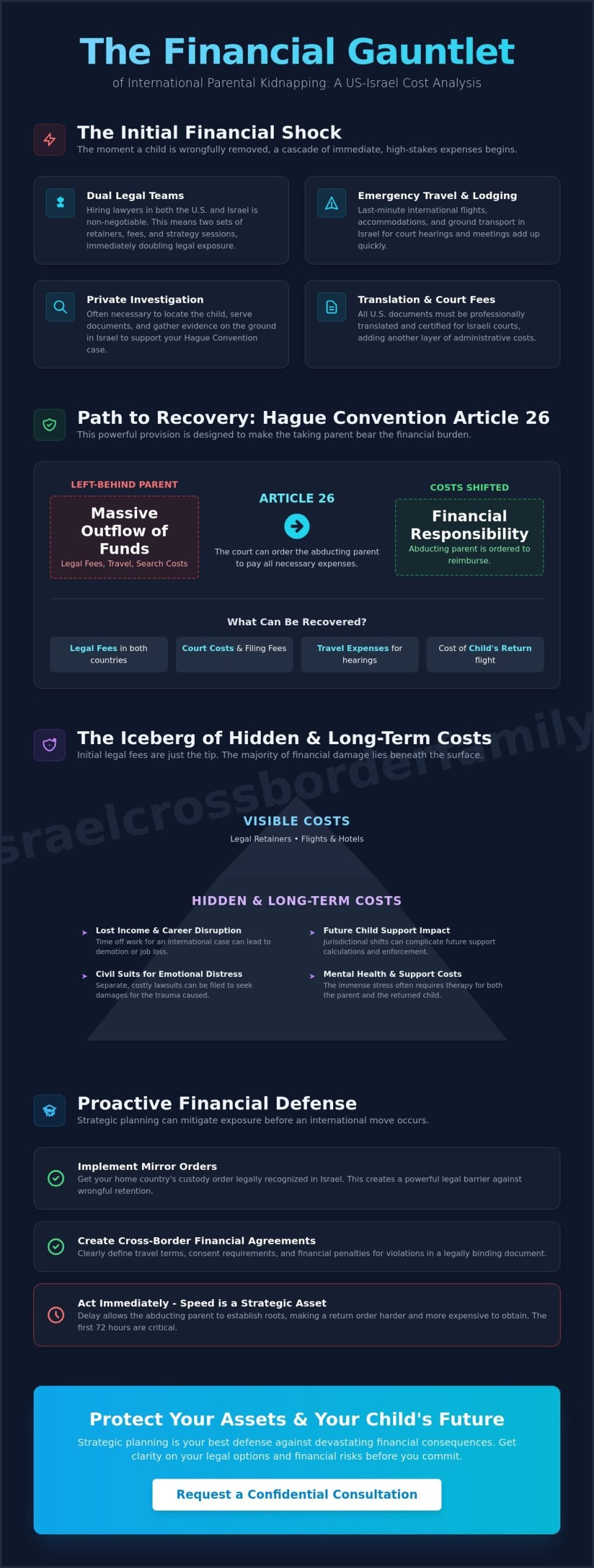
The Hague Convention includes a powerful tool for financial recovery that many parents overlook. Article 26 allows courts to order the abducting parent to pay for legal fees, travel costs, and the expenses related to the child’s return. In Israel, judges increasingly use this provision to deter “forum shopping” and penalize those who ignore court orders. If the court finds the removal was wrongful, they can order the taking parent to reimburse you in Israeli Shekel (₪). You can read more about these specific protections in our overview of the Hague Convention child abduction process. However, collecting these funds remains a challenge if the other parent has hidden assets or lacks steady income.
Litigation Costs in Israeli Family Courts
Beyond attorney fees, the Israeli legal system involves specific procedural costs that can surprise international families. Courts often appoint independent experts, such as child psychologists or social workers, to evaluate the child’s well-being and the risk of return. These experts bill the parties directly; costs can escalate if the case becomes highly contested. You’ll also face expenses for translating US court orders and birth certificates into Hebrew. An Apostille is a standard for international document authentication. Every document from the US must have this certification to be accepted by an Israeli judge. These administrative fees, while smaller than legal retainers, add up to thousands of shekels over the course of a trial.
Enforcing a fee order across borders is the final hurdle for many parents. An Israeli court order for ₪50,000 in legal fees isn’t automatically collectible in the US without further legal action. Strategic planning helps you identify which assets can be frozen or seized to satisfy these debts before the other parent moves them. Understanding these risks early allows you to make more informed choices about your litigation budget and recovery goals. It’s often helpful to speak with a cross-border advisor to assess your specific financial exposure. Get clarity before you commit. Request a confidential consultation.
Hidden Costs: Search, Recovery, and Lost Income
Legal retainers represent the most visible expense, but the true financial consequences of parental kidnapping often lie in the logistical shadow of the case. Locating a child who has been moved across international borders frequently requires the expertise of private investigators. While local law enforcement in Israel cooperates with Interpol, their resources are often stretched thin. Private firms specializing in cross-border recovery provide a dedicated focus that government agencies cannot always match. These services involve surveillance, digital forensics, and local ground work in various Israeli cities, which can quickly cost tens of thousands of shekels (₪).
The physical presence of the left-behind parent in Israel is often mandatory during key hearings. This necessitates last-minute international flights, which are notoriously expensive. Once in the country, the costs of short-term lodging in cities like Tel Aviv or Jerusalem can be staggering. Unlike a vacation, these stays are of indefinite duration, dictated by the court’s calendar rather than personal choice. You’re funding a temporary life in a foreign country while your primary expenses back home, such as mortgages and utilities, continue to accumulate.
Recovery and Search Expenses
Parents often struggle with the choice between waiting for state-led recovery or hiring private specialists. Speed is essential. Specialized recovery services offer speed, but they operate outside the subsidized framework of the Central Authority. Managing the financial drain of a multi-month legal battle away from home requires careful budgeting. It’s common to see families deplete their liquid savings just to maintain a presence in the jurisdiction where their child is being held. These out-of-pocket costs are rarely fully recovered, even with a favorable court order.
Administrative and Logistical Fees
The bureaucratic machinery of the Israeli legal system requires significant documentation. Every US order must be translated into Hebrew by a certified translator to be admissible in an Israeli Family Court. Professional translation rates for complex legal documents are often calculated per word or per page, adding another layer of expense. Similarly, serving legal papers to a parent who is actively hiding in Israel requires professional process servers who understand local regulations. To learn more about the broader landscape of these issues, you can watch this video on International Custody Challenges.
Beyond these direct costs, the impact on your career is a significant hidden factor. Many parents find it impossible to maintain full-time employment while spending weeks abroad or attending late-night meetings with legal teams across different time zones. If a return is ordered or visitation is granted, the court may mandate supervised visitation. These sessions often take place at a “Contact Center” (Merkaz Kesher) or under the supervision of a private professional. The cost of these supervised hours is typically shared or assigned to one parent, further increasing the ongoing financial burden. Get clarity before you commit. Request a confidential consultation.
Long-Term Financial Liabilities and Restitution
The return of a child under the Hague Convention marks the end of an immediate crisis, but the financial consequences of parental kidnapping often linger for years. A return order typically addresses the child’s location without resolving the underlying custody or support disputes. This means families often transition from an abduction case directly into high-stakes litigation over permanent custody and relocation rights. To prevent a repeat of the abduction, many parents must invest in “Mirror Orders.” These are reciprocal legal protections issued in both the United States and Israel to ensure that custody terms are recognized and enforceable in both jurisdictions. Securing these orders requires additional legal filings and coordination between your US and Israeli teams, adding a final layer of expense to the recovery process.
Child Support and Cross-Border Enforcement
Abduction cases frequently disrupt existing financial arrangements, especially child support. An abducting parent might attempt to file for support in an Israeli court, arguing that the child’s presence in the country entitles them to payments under local law. This tactic can lead to “conflicting orders,” where two different countries demand different support amounts. Successfully navigating these disputes requires a deep understanding of child support cross-border enforcement. You may face the cost of filing for the “domestication” of a US support order in Israel to ensure that your existing financial rights are respected and that you aren’t forced to pay support to a parent who wrongfully removed the child.
Restitution and Civil Penalties
In addition to the return of the child, the legal system provides pathways for the left-behind parent to seek civil restitution. This involves suing for the “tort” of parental kidnapping or the intentional infliction of emotional distress. Israeli courts have the authority to impose daily fines in Israeli Shekels (₪) if a parent is found in “Contempt of Court” for failing to comply with return orders. Restitution may include all costs incurred by the left-behind parent during the search. While these awards are intended to make the victim whole, the actual collection of funds depends on the taking parent’s assets and their presence in a jurisdiction where the order can be enforced.
The long-term budget for an international family must also account for future travel. If a court orders a child’s return to the US but allows the other parent to have visitation in Israel, the cost of trans-Atlantic flights for the next decade can reach hundreds of thousands of shekels. These recurring costs are a direct result of the initial abduction and require a sustainable financial strategy. To safeguard your financial future and ensure your court orders are robust, you should speak with a cross-border advisor about your long-term restitution options. Get clarity before you commit. Request a confidential consultation.
Strategic Risk Mitigation for International Families
The most effective way to manage the financial consequences of parental kidnapping is to implement robust safeguards before a dispute ever arises. International families moving between the United States and Israel should view legal planning as a form of insurance against the high costs of future cross-border litigation. Proactive strategies allow parents to define jurisdictional boundaries and financial penalties while relationships are still collaborative. This reduces the likelihood of a “wrongful retention” claim and ensures that both parties understand the significant economic risks of unilateral action. When you establish these rules early, you avoid the reactive, high-speed legal battles that often lead to the depletion of family assets.
Preventative Legal Measures
Strategic planning often involves drafting comprehensive financial agreements, such as prenuptial or postnuptial contracts, that specifically address the complexities of international relocation. These documents can include “Choice of Law” clauses to designate which country’s legal system will govern future custody or support disputes. By including specific “anti-abduction” clauses, parents can stipulate immediate financial penalties or the forfeiture of certain assets if a child is moved without written consent. You can explore how these agreements fit into broader family planning in our guide on divorce and separation for international families.
Another critical tool for risk mitigation is the use of passport bonds or financial sureties. In cases where a parent is considered a potential flight risk, an Israeli court can require that parent to deposit a significant sum in Israeli Shekels (₪) into a trust or court account. This bond serves as a powerful deterrent; if the parent fails to return the child after an agreed-upon visit, the funds are forfeited to the left-behind parent to cover the immediate costs of a Hague Convention search. Implementing “Mirror Orders” before a planned relocation ensures that the terms of a US custody agreement are already registered and enforceable in Israel, removing the need for expensive emergency filings during a crisis.
Moving Forward with Strategy
The value of a confidential case review cannot be overstated for families navigating the US-Israel corridor. A risk-based decision-making process allows you to identify potential vulnerabilities in your current custody arrangement before they become legal crises. This strategic approach is far more cost-effective than reacting to an abduction that has already occurred. By assessing your financial exposure early, you can take measured steps to secure your rights in both jurisdictions without the pressure of an active emergency. Professional guidance helps you bridge the gap between the “start-up nation” and global legal standards. Get clarity before you commit. Request a confidential consultation.
Securing Your Family’s Financial Future
Managing the financial consequences of parental kidnapping requires more than just legal expertise; it demands a comprehensive strategy that spans both the United States and Israel. By understanding the cost-shifting mechanisms of the Hague Convention and accounting for hidden recovery expenses in Israeli Shekels (₪), you can better prepare for the road ahead. Proactive measures like Mirror Orders and protective financial agreements aren’t just legal formalities. They’re essential tools that provide a layer of security for your family’s long-term stability and peace of mind.
Our advisory platform offers authoritative guidance for US-Israel cross-border families, focusing specifically on the intricacies of the Hague Convention and international custody. We prioritize a calm, strategy-based approach to help you navigate these complex jurisdictional waters without unnecessary exposure. You don’t have to face these multi-jurisdictional challenges alone. Get clarity before you commit. Request a confidential consultation today to discuss your specific situation and protect your rights with confidence.
Frequently Asked Questions
Is the taking parent responsible for the other parent’s legal fees?
Yes, the abducting parent can be held liable for your legal fees under Article 26 of the Hague Convention. Israeli courts have the authority to order the taking parent to reimburse you for attorney fees, travel costs, and all expenses related to the child’s return. These orders are issued in Israeli Shekels (₪), though you must typically pay your legal team upfront before seeking a reimbursement order from the judge.
Does insurance cover the costs of parental kidnapping?
Standard homeowners and life insurance policies almost never cover the costs associated with international parental abduction. While some specialized “kidnap and ransom” insurance riders exist for corporate executives, they are rarely found in standard family policies. Most parents must rely on personal assets or specialized non-profit grants to fund the search and recovery process, as these are considered civil legal matters rather than insured events.
What happens to child support payments if a child is abducted to Israel?
Abducting a child does not terminate an existing child support order, but the financial consequences of parental kidnapping often include a breakdown in payment enforcement. You may need to file a specific application in an Israeli court to domesticate your US support order. This prevents the abducting parent from attempting to stop payments or seeking a new, conflicting support order under the Israeli legal system.
Can I sue the parent who kidnapped our child for financial damages?
Yes, you can pursue a civil lawsuit for the “tort” of parental kidnapping or the intentional infliction of emotional distress. These civil claims allow you to seek compensation for your lost wages, the cost of private investigators, and the psychological impact on your family. These cases are handled separately from the Hague Convention return proceedings and can result in significant financial judgments against the abducting parent.
How much does a typical Hague Convention case cost in Israel?
The total cost varies based on the length of the litigation and the number of expert witnesses required. You should account for legal retainers in both the US and Israel, certified Hebrew translations, and court-mandated psychological evaluations. Because these cases require a “team on the ground” and rapid filings, the administrative and professional fees often reach tens of thousands of Israeli Shekels (₪) before a final decision is reached.
Are there resources for parents who cannot afford international legal fees?
Parents with limited means may qualify for assistance from the Israeli Legal Aid Department within the Ministry of Justice. Additionally, organizations like the National Center for Missing & Exploited Children (NCMEC) provide resources and may help connect parents with pro bono legal counsel. While the Central Authority handles administrative filings for free, private representation is often necessary to navigate the complex strategic elements of the Israeli Family Court system.
Can a parent be fined by the court for violating a return order?
Yes, Israeli judges can impose daily “Contempt of Court” fines if a parent refuses to return a child after a court order is issued. These fines are designed to create an immediate financial incentive for compliance and can accumulate to substantial amounts in Israeli Shekels (₪). If the parent continues to withhold the child, the court may also authorize the seizure of assets or issue a warrant for their arrest.
Will the US government pay for my travel to Israel to recover my child?
No, the US government does not provide funding for travel, lodging, or private legal fees in international custody cases. The Department of State offers administrative guidance and communicates with Israeli authorities, but the financial consequences of parental kidnapping are borne entirely by the family. You are responsible for all logistical costs, including short-notice international flights and temporary housing in Israel during the legal proceedings.

Article by
Gabriel Lior
A Personal Journey That Became a Mission
The advisory was founded by an American father Gabriel Lior, LLB, MBA , global entrepreneur, and cross-border advisor who spent more than a decade navigating the Israeli family court system firsthand and now lives in Singapore with his son.
As a divorced parent in a cross-border family, Gabriel faced nearly every legal challenge a foreign parent can encounter in Israel — including child custody disputes, child support proceedings, property matters in Israel and abroad, false accusations, and complex immigration and relocation proceedings.
Over the years, he learned the hard way how difficult it is for non-Israeli parents to understand the system, identify the right legal strategy, and choose the right legal representation — especially when language, culture, and jurisdictional differences are involved. He also witnessed how foreign parents and new immigrants are often disadvantaged or taken advantage of by service providers and institutions simply because they lack local knowledge or fluency.
From Client to Advisor
To truly understand — and survive — the system, Gabriel pursued formal legal education in Israel, completing two Israeli law degrees, alongside a BA and MBA earned in the United States. This was never about becoming a practicing attorney, but about gaining a deep, structural understanding of how the system works — and where it breaks down for foreign parents.
This rare combination of:
Firsthand client experience
Israeli legal and US business education
International business and negotiation training
Decades of commercial execution
created a unique perspective – one that understands both sides of the table.
After years of litigation, persistence, and at times self-representation, he ultimately succeeded in securing custody of his son and relocating abroad through a rare legal victory in the Israeli Supreme Court — becoming one of the first fathers in Israel to do so under these circumstances.
Disclaimer
Important Disclaimer:
The information provided on this website and in its content is for general informational and educational purposes only and does not constitute legal advice, legal opinion, or legal representation.
Gabriel Lior is not licensed to practice law in Israel (nor is he interested in doing so) and does not provide legal services, despite having completed 2 Law Degrees. The services offered are advisory in nature and are intended to provide general guidance, strategic insight, and information regarding cross-border family law considerations.
No attorney-client relationship is formed by accessing this website, reading its content, or communicating with us.
Any decisions made based on this information are at your own discretion and risk. For legal advice specific to your situation, you should consult a licensed attorney in the relevant jurisdiction.
Where appropriate, we may refer clients to independent, licensed attorneys or professionals. Such referrals do not constitute legal representation and no liability is assumed for services provided by third parties.