Your legal right to half of an Israeli property means very little if the equity is consumed by court-appointed receivers and high legal fees. For many expats and international families, the fear of a “deadlock” where a spouse refuses to sell can turn a valuable asset into a source of deep anxiety. You likely worry about communication barriers with Israeli authorities or the confusion between civil and religious court powers. It’s a complex situation, but you don’t have to navigate it blindly.
This guide offers a clear roadmap for dividing property in israel during international divorce with strategic foresight. You’ll learn how to protect your share of Israeli real estate value while minimizing the need for international travel. We’ll explore the costs of filing claims, such as the ₪568 fee for opening a standard divorce file in the Family Court, and explain how to manage asset liquidation from abroad. This information is published on an independent advisory platform to help you focus on strategy and risk management. It’s important to remember that this content provides educational guidance and does not constitute formal legal representation or an attorney-client relationship.
Key Takeaways
- Understand the concept of “Peiruk Shituf” and how owning an undivided interest dictates your legal strategy for asset liquidation.
- Learn how Section 37 of the Land Law provides a statutory right to demand a partition at any time when dividing property in israel during international divorce.
- Compare the three primary methods of dissolution to determine why a court-ordered sale is often more effective than a physical partition for residential apartments.
- Discover how to initiate the process from abroad by conducting remote title reviews and issuing strategic demand letters to avoid unnecessary travel.
- Identify how to claim “User Fees” (Dmei Shimush) to protect your financial interests if a spouse continues to live in the joint property during the proceedings.
Understanding Property Dissolution in the Israeli Legal System
Disclaimer: This content is published on an independent advisory platform and does not constitute a law firm or legal representation. The focus here is on strategy, risk management, and decision-making guidance. Formal legal services are provided only by licensed attorneys under a separate engagement.
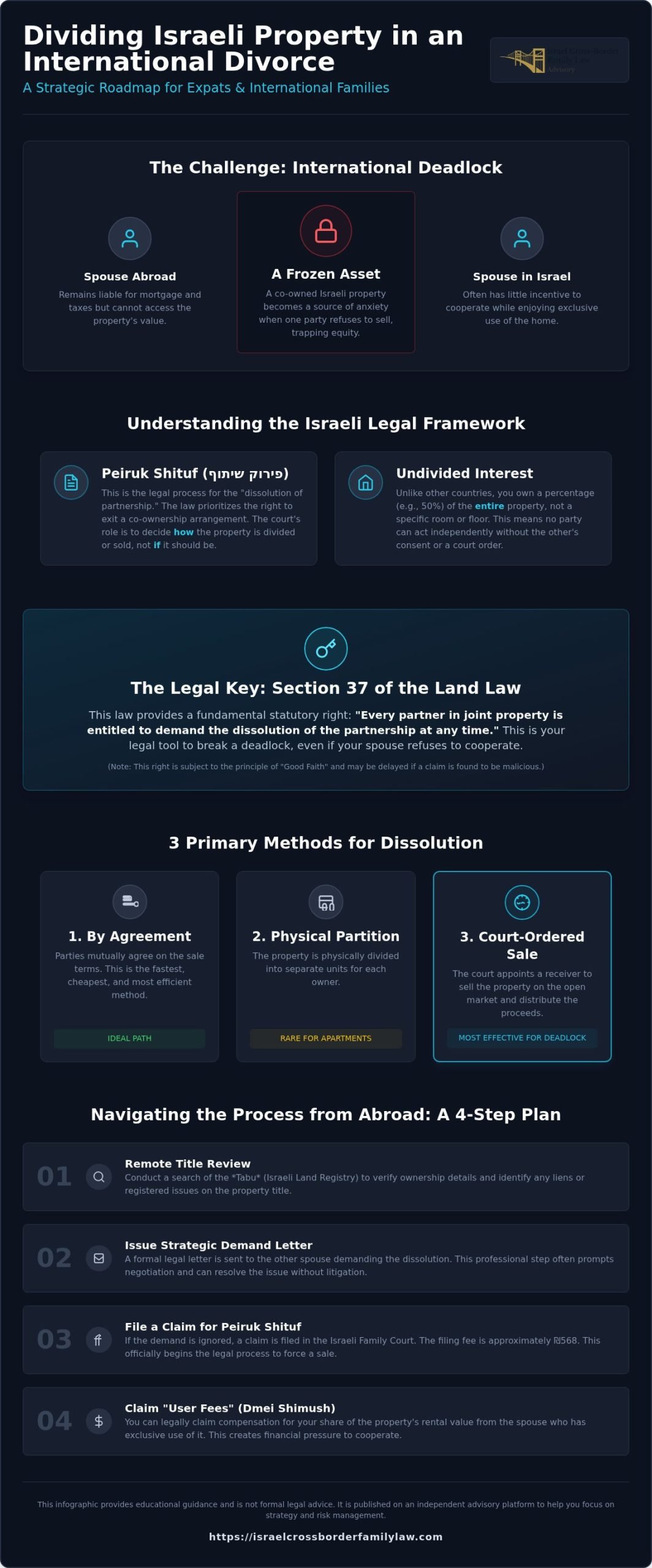
In Israel, the legal process of ending joint ownership is known as Peiruk Shituf, which translates to the dissolution of partnership. Unlike many jurisdictions where property might be physically partitioned, Israeli real estate is typically held as an “undivided interest.” This means each spouse owns a specific percentage of the entire apartment or land, rather than owning a particular room or floor. This technicality often creates friction when dividing property in israel during international divorce, as neither party can act independently without the other’s consent or a court order.
The right to exit a property partnership is a fundamental statutory right under the Land Law. This legal framework prevents a situation where one party is forced to remain in a financial relationship against their will. Common triggers for this process include Divorce in Israel, the distribution of inherited assets, or the collapse of a joint investment. Because the law prioritizes the freedom to dissolve the partnership, the court’s primary role is deciding how the sale happens, rather than if it should happen. This provides a vital safety valve for those facing a stalemate.
The Legal Concept of Shutafut
Joint ownership is officially recorded in the Tabu (Israeli Land Registry). While day-to-day management of a property might follow majority rule, the right to sell your share or demand the dissolution of the entire partnership is an individual right. This differs significantly from US principles like “joint tenancy with right of survivorship.” In Israel, co-ownership doesn’t automatically grant the survivor the other’s share. Instead, it’s treated as a partnership that can be terminated at any time. For those living abroad, understanding these nuances is essential for protecting equity. You can learn more about how these dynamics impact foreign nationals on our advisory page for expats.
Why International Families Face Stalemate
The Statutory Right to Exit: Section 37 of the Land Law
Disclaimer: This content is published on an independent advisory platform and does not constitute a law firm or legal representation. The focus here is on strategy, risk management, and decision-making guidance. Formal legal services are provided only by licensed attorneys under a separate engagement.
Section 37(a) of the Land Law serves as the cornerstone for anyone seeking to liquidate a joint asset. It explicitly states that every partner in joint property is entitled to demand the dissolution of the partnership at any time. For those dividing property in israel during international divorce, this statute provides a clear exit strategy even if the other spouse refuses to cooperate. It effectively eliminates the possibility of a permanent deadlock where one party is trapped in a financial arrangement they no longer desire. The law prioritizes the liquid nature of real estate over the desire of one partner to maintain a forced partnership.
However, this right is not entirely absolute. Israeli courts operate under the overarching principle of Good Faith. If a judge determines that a claim for dissolution is being used as a weapon to harass a spouse or is filed with purely malicious intent, they may exercise discretion to delay the proceedings. The goal is to ensure the process remains a tool for financial separation rather than emotional retribution. Courts look for a balance between the right to exit and the potential for undue harm to the other party, especially in complex cross-border scenarios where assets might be tied to residency or immigration status.
Magistrate Court vs. Family Court
While the Magistrate Court typically handles standard real estate disputes, the 1995 Family Court Law mandates that property issues between spouses or close relatives be heard in the Family Court. This distinction is vital because a Family Court judge has broader authority to consider the best interests of the family. They might, for instance, delay a sale to ensure children can finish a school year or to coordinate with other aspects of the divorce settlement. This integrated approach ensures that the property division isn’t handled in a vacuum but is part of a holistic resolution. If you are uncertain about which jurisdiction applies to your case, it is wise to seek a strategic review of your specific situation.
Can You Contract Out of Dissolution?
Partners sometimes include no-sale clauses in prenuptial or partnership agreements to provide long-term security. Section 37(b) of the Land Law acknowledges these agreements but imposes a strict three-year limit on their enforceability. After three years, a court has the power to order a dissolution regardless of what the contract says if it deems the sale just under the circumstances. This prevents people from being legally bound to a property indefinitely. Before dividing property in israel during international divorce, you should carefully review any existing financial agreements to understand how these statutory limits might impact your timeline and overall strategy.
Three Primary Methods for Dissolving Real Estate Partnerships
Disclaimer: This content is published on an independent advisory platform and does not constitute a law firm or legal representation. The focus here is on strategy, risk management, and decision-making guidance. Formal legal services are provided only by licensed attorneys under a separate engagement.
While the statutory right to exit a partnership is absolute, the specific mechanism for liquidation depends on the nature of the asset. The Israeli legal system recognizes three primary paths to end joint ownership, each with distinct tax implications and procedural requirements. For most families dividing property in israel during international divorce, selecting the right method is the difference between a clean break and years of litigation.
Partition in Kind (Chaluka Be’ein)
Chaluka Be’ein is the physical division of land into separate plots. Under the Land Law, this is technically the preferred method of the court because it preserves the owners’ rights to the land itself. However, it requires strict zoning approval and physical feasibility. If you own a three-bedroom apartment in Tel Aviv, you can’t simply build a wall down the middle to create two legal units. If the physical split results in plots of unequal value, the court may order tashlumei izun, or balancing payments, to compensate the party receiving the lesser share. Because of high urban density, this method is rarely applied to residential apartments.
Sale and Distribution of Proceeds
When a physical split is impossible or would cause significant loss to the owners, the court orders a sale. This is the most common outcome for divorcing couples. The property is sold as a single entity, and the net proceeds are distributed according to ownership percentages. Spouses can negotiate a private sale to a third party or one spouse can buy out the other’s share. If they can’t agree, the court may initiate a public auction. To ensure a fair result, the court appoints a licensed appraiser, known as a Shama, to set a minimum price. Navigating these valuations is a critical step, similar to the due diligence required when buying real estate in Israel as a US citizen.
Condominium Registration (Ribush Bayit Meshutaf)
For high-value assets or multi-unit buildings, Ribush Bayit Meshutaf offers a strategic alternative. This process turns a single registered asset into a condominium with multiple distinct units. Each partner then receives sole title to specific apartments within the building. This is often the most tax-efficient way to dissolve a cross-border partnership because it may defer the capital gains tax (Mas Shevach) that would otherwise be triggered by an immediate sale. It’s a complex administrative process but provides long-term flexibility for heirs or spouses who wish to retain their footprint in the Israeli market while ending the joint partnership.
Navigating the Dissolution Process from Abroad
Disclaimer: This content is published on an independent advisory platform and does not constitute a law firm or legal representation. The focus here is on strategy, risk management, and decision-making guidance. Formal legal services are provided only by licensed attorneys under a separate engagement.
Managing the liquidation of assets from across the Atlantic requires a structured approach to bypass the typical delays of the Israeli bureaucracy. The process of dividing property in israel during international divorce starts with data rather than litigation. You must first extract a Nessach Tabu (Title Registry) digitally. This document confirms the current ownership status, identifies any existing liens, and ensures there are no cautionary notes that could block a sale. Once the title is clear, the next strategic step is issuing a formal demand letter to the other spouse. This letter signals that you’re prepared to move to court while offering a window for a negotiated settlement, which is often the most cost-effective path for international families.
If negotiations fail, you must file a claim in the appropriate court. In 2026, the fee to open a standard divorce file in the Family Court is ₪568, while an application to settle a dispute costs ₪119. Following the filing, the court will appoint a licensed appraiser, known as a Shama, to determine the fair market value of the home. Appraisal fees for a standard family residence typically range between ₪2,000 and ₪5,000. This valuation serves as the baseline for either a buyout or a public sale. Because you are dividing property in israel during international divorce from abroad, these steps must be handled by someone with a physical presence in the local market to ensure deadlines are met and valuations are accurate.
The Power of Attorney (POA) and Logistics
Standard Power of Attorney documents used in the US are insufficient for the Israeli Land Registry. To act on your behalf, an advisor needs a specific Israeli POA. This document must be signed in the presence of a notary in your home country and then authenticated with an Apostille stamp to be legally recognized in Israel. This logistical hurdle is often where international cases stall. Ensuring your paperwork meets the exact standards of the Israeli authorities is critical for maintaining the momentum of your claim. You can review the full details of these requirements on our How It Works advisory page.
The Role of the Court-Appointed Receiver
If a spouse refuses to cooperate with a private sale, the court will appoint a Kones Nechasim, or Receiver. The receiver takes full control of the property, markets it, and manages the auction process. While this guarantees a sale, it comes at a high price. Receivership fees are typically a percentage of the sale price, often ranging from 4% to 6% plus 18% VAT. To protect your equity, it’s almost always better to pursue a “consent sale.” This allows you to hire a private realtor and maintain control over the marketing and final price, avoiding the heavy financial burden of a court-appointed official. If you’re facing a deadlock, reach out for a strategic consultation to explore how to avoid these unnecessary costs.
Strategic Considerations for Heirs and Divorcing Spouses
Disclaimer: This content is published on an independent advisory platform and does not constitute a law firm or legal representation. The focus here is on strategy, risk management, and decision-making guidance. Formal legal services are provided only by licensed attorneys under a separate engagement.
Success in cross-border property matters isn’t solely defined by obtaining a court order for sale. It’s measured by the financial efficiency of the exit and the preservation of equity. When dividing property in israel during international divorce, your early decisions set the trajectory for the entire case. One critical strategic tool is the claim for “User Fees,” known as Dmei Shimush. If one spouse maintains exclusive possession of the Israeli home while the other lives abroad, the party living outside the property may be entitled to monthly compensation equivalent to half the fair market rental value. This prevents the “squatting” spouse from benefiting financially from the delays in the legal process.
Taxation is another area where lack of foresight can lead to significant losses. Under current 2026 regulations, the standard Capital Gains Tax (Mas Shevach) for individuals is 25% on the real, inflation-adjusted gain. For high-income individuals, a surtax may bring the top marginal rate to approximately 30%. However, the US-Israel Tax Treaty provides a framework to mitigate double taxation. Understanding how these Israeli taxes interact with your US tax obligations is essential before signing any settlement agreement. A poorly timed sale can trigger liabilities that could have been avoided with a more structured approach to the liquidation.
Inheritance and Real Estate Stalemate
Property disputes often become more complex when they involve inherited assets. In many cases, a partner cannot even begin the dissolution process until a formal Israeli probate order, or Tzav Yerusha, is issued by the Inheritance Registrar. This creates a procedural hurdle for US residents who may be dealing with family members still living in Israel. Coordinating these two legal tracks requires a clear understanding of Inheritance Law in Israel for US Residents to ensure that the title is properly registered before the dissolution claim is filed in the Family Court.
Divorce and the Marital Home
In the context of dividing property in israel during international divorce, the court often applies the principle of “balancing of resources” (Izun Mashabim). This means the property division is rarely handled in isolation; it’s part of a broader calculation involving pensions, savings, and other global assets. These financial decisions frequently intersect with sensitive family dynamics, such as International Custody and Relocation. If children are involved, the timing of a home sale may be deferred to provide stability. It’s vital to look at the total picture rather than just the real estate. Get clarity before you commit. Request a confidential consultation.
Securing Your Israeli Real Estate Interests from Abroad
Disclaimer: This content is published on an independent advisory platform and does not constitute a law firm or legal representation. The focus here is on strategy, risk management, and decision-making guidance. Formal legal services are provided only by licensed attorneys under a separate engagement.
Successfully dividing property in israel during international divorce requires a bridge between two distinct legal cultures. You’ve learned that while the statutory right to exit a partnership is absolute, the financial outcome depends on the strategy you choose. By prioritizing a negotiated “consent sale” and understanding the impact of Israeli tax regulations, you can protect the equity you’ve built. Managing these complex logistics, from Apostille requirements to court valuations, is significantly easier when you have a clear roadmap.
Our specialized advisory for international families provides a calm, strategic approach to cross-border conflict. With a physical presence in both Tel Aviv and New York, we help you navigate the Israeli legal system without the need for constant international travel. Focus on making informed decisions rather than reacting to legal pressure. Get clarity before you commit. Request a confidential consultation.
Take the first step toward a clean financial break today. With the right foresight, you can move forward with confidence and security.
Frequently Asked Questions
Disclaimer: This content is published on an independent advisory platform and does not constitute a law firm or legal representation. The focus here is on strategy, risk management, and decision-making guidance. Formal legal services are provided only by licensed attorneys under a separate engagement.
Can I force my spouse to sell our house in Israel if they refuse to sign?
Yes, you can force a sale even if your spouse objects. Section 37(a) of the Land Law grants every partner the right to demand dissolution at any time. This prevents one party from being held hostage in a joint investment. When dividing property in israel during international divorce, the court will generally order a sale and distribution of proceeds if a physical split of the apartment or house is impossible.
How long does a property dissolution case take in Israeli Family Courts?
A contested property dissolution typically takes between 12 and 24 months in the Israeli Family Court. The timeline depends on the court’s schedule and the complexity of the valuation stage. While the legal right to exit is clear, the procedural steps, including the appointment of an appraiser and the marketing of the asset, require significant time to ensure a fair market outcome for both parties.
Do I have to travel to Israel to manage the sale of my property?
You don’t need to travel to Israel to manage the sale of your property. By using a specific Israeli Power of Attorney signed before a notary in the US and authenticated with an Apostille, your local advisor can handle all filings and registry updates. This is a common strategy for expats and international families who want to maintain their daily lives abroad while resolving their Israeli assets.
What are ‘Dmei Shimush’ and can I claim them during a divorce?
“Dmei Shimush” refers to user fees or rent that one spouse pays to the other for the exclusive use of a joint property. You can claim these fees during a divorce if your spouse remains in the Israeli home while you live elsewhere. The court calculates this based on half the fair market rental value as determined by a licensed appraiser, ensuring you receive a return on your share of the asset.
How much does it cost to file a dissolution claim in Israel from the US?
Filing a standard property dissolution claim in the Family Court costs ₪568 as of early 2026. If you first file an application to settle a dispute, the fee is ₪119. These are only the court fees; you must also budget for a licensed appraiser, which typically costs between ₪2,000 and ₪5,000 for a residential home, plus any professional advisory fees. All costs should be calculated in Israeli Shekels.
What is a ‘Kones Nechasim’ and why should I try to avoid one?
A “Kones Nechasim” is a court-appointed receiver who takes control of the property to manage its sale. You should try to avoid this because receivers charge high fees, often 4% to 6% of the sale price plus 18% VAT. It’s almost always more financially efficient to reach a “consent sale” agreement where you and your spouse manage the sale through private realtors, keeping more equity in your pocket.
How does the US-Israel tax treaty affect my property sale proceeds?
The US-Israel tax treaty is designed to prevent double taxation on the proceeds of your property sale. While you may owe a 25% Capital Gains Tax (Mas Shevach) in Israel, the treaty often allows you to claim a foreign tax credit on your US returns. This is vital when dividing property in israel during international divorce to ensure you don’t lose significant value to overlapping tax jurisdictions.
Can a US prenuptial agreement stop a property dissolution in Israel?
A US prenuptial agreement doesn’t automatically stop a dissolution in Israel. While Israeli courts respect valid financial agreements, Section 37(b) of the Land Law limits any “no-sale” clause to a maximum of three years. After this period, the court can order a sale if it’s deemed just. It’s essential to have your agreement reviewed for compliance with Israeli statutory limits before assuming your assets are protected.

Article by
Gabriel Lior
A Personal Journey That Became a Mission
The advisory was founded by an American father Gabriel Lior, LLB, MBA , global entrepreneur, and cross-border advisor who spent more than a decade navigating the Israeli family court system firsthand and now lives in Singapore with his son.
As a divorced parent in a cross-border family, Gabriel faced nearly every legal challenge a foreign parent can encounter in Israel — including child custody disputes, child support proceedings, property matters in Israel and abroad, false accusations, and complex immigration and relocation proceedings.
Over the years, he learned the hard way how difficult it is for non-Israeli parents to understand the system, identify the right legal strategy, and choose the right legal representation — especially when language, culture, and jurisdictional differences are involved. He also witnessed how foreign parents and new immigrants are often disadvantaged or taken advantage of by service providers and institutions simply because they lack local knowledge or fluency.
From Client to Advisor
To truly understand — and survive — the system, Gabriel pursued formal legal education in Israel, completing two Israeli law degrees, alongside a BA and MBA earned in the United States. This was never about becoming a practicing attorney, but about gaining a deep, structural understanding of how the system works — and where it breaks down for foreign parents.
This rare combination of:
Firsthand client experience
Israeli legal and US business education
International business and negotiation training
Decades of commercial execution
created a unique perspective – one that understands both sides of the table.
After years of litigation, persistence, and at times self-representation, he ultimately succeeded in securing custody of his son and relocating abroad through a rare legal victory in the Israeli Supreme Court — becoming one of the first fathers in Israel to do so under these circumstances.
Disclaimer
Important Disclaimer:
The information provided on this website and in its content is for general informational and educational purposes only and does not constitute legal advice, legal opinion, or legal representation.
Gabriel Lior is not licensed to practice law in Israel (nor is he interested in doing so) and does not provide legal services, despite having completed 2 Law Degrees. The services offered are advisory in nature and are intended to provide general guidance, strategic insight, and information regarding cross-border family law considerations.
No attorney-client relationship is formed by accessing this website, reading its content, or communicating with us.
Any decisions made based on this information are at your own discretion and risk. For legal advice specific to your situation, you should consult a licensed attorney in the relevant jurisdiction.
Where appropriate, we may refer clients to independent, licensed attorneys or professionals. Such referrals do not constitute legal representation and no liability is assumed for services provided by third parties.