This article is published on an independent advisory platform and is not a law firm. The information provided is for educational purposes only and does not constitute legal advice or an attorney-client relationship. For specific legal services tailored to your international family’s needs, consider consulting licensed attorneys, such as those at Israel Cross Border Law Firm, under a separate engagement.
In Israel, a financial agreement is not legally binding until it’s validated by a court, a critical distinction that catches international families off guard. Most couples assume a signed contract is final, yet a valid financial agreement in Israel requires a formal judicial approval to be enforceable. If you’re an international family, perhaps moving from New York, the transition to the Israeli legal landscape often reveals that foreign prenuptial agreements might not be recognized unless specific local steps are taken.
You likely feel that protecting your pre-marital assets or business interests should be straightforward, especially when you’ve already made good-faith arrangements. This guide will clarify the validation process, the specific role of the Rabbinical Court, and how to ensure your cross-border assets remain protected under both Israeli and international law. We’ll examine the strategic steps required to turn a draft into a binding legal shield that withstands the complexities of a multi-jurisdictional life.
Key Takeaways
- Learn why the Israeli legal default of ‘balancing of resources’ makes a formal financial agreement essential for protecting your independent assets.
- Understand the mandatory court validation process required to secure a legally binding agreement-in-israel that withstands judicial scrutiny.
- Identify the specific risks of conflicting orders between US and Israeli courts to ensure your cross-border assets remain protected in both jurisdictions.
- Discover how the Rabbinical Court’s role influences family law and why early strategic planning is vital for international families.
- Move from confusion to clarity by learning how to bridge different legal systems through informed, risk-based decision-making.
This article is published on an independent advisory platform and is not a law firm. The information provided is for educational purposes only and does not constitute legal advice or an attorney-client relationship. Legal services are only provided by licensed attorneys under a separate engagement.
What is a Financial Agreement (Heskem Mamon) in Israel?
A Heskem Mamon is the foundational legal document used in Israel to define how a couple’s assets will be managed and eventually divided. It serves as a specialized contract that allows you to opt out of the state’s default property laws. Without a validated agreement-in-israel, the government applies a standard set of rules to your finances that might not reflect your specific international circumstances. This document is essential for anyone entering a relationship with existing assets, business interests, or expectations that differ from local norms.
The law distinguishes between two main stages of these arrangements. You can create a pre-marriage agreement or a post-marriage version, but both require a formal stamp of approval to be effective. In the Israeli system, a simple handshake or a signed paper kept in a desk drawer is generally not enough. If the document hasn’t been through the mandatory validation process, it’s usually considered unenforceable in a court of law, leaving your assets vulnerable to default regulations.
The Default Legal Position in Israel
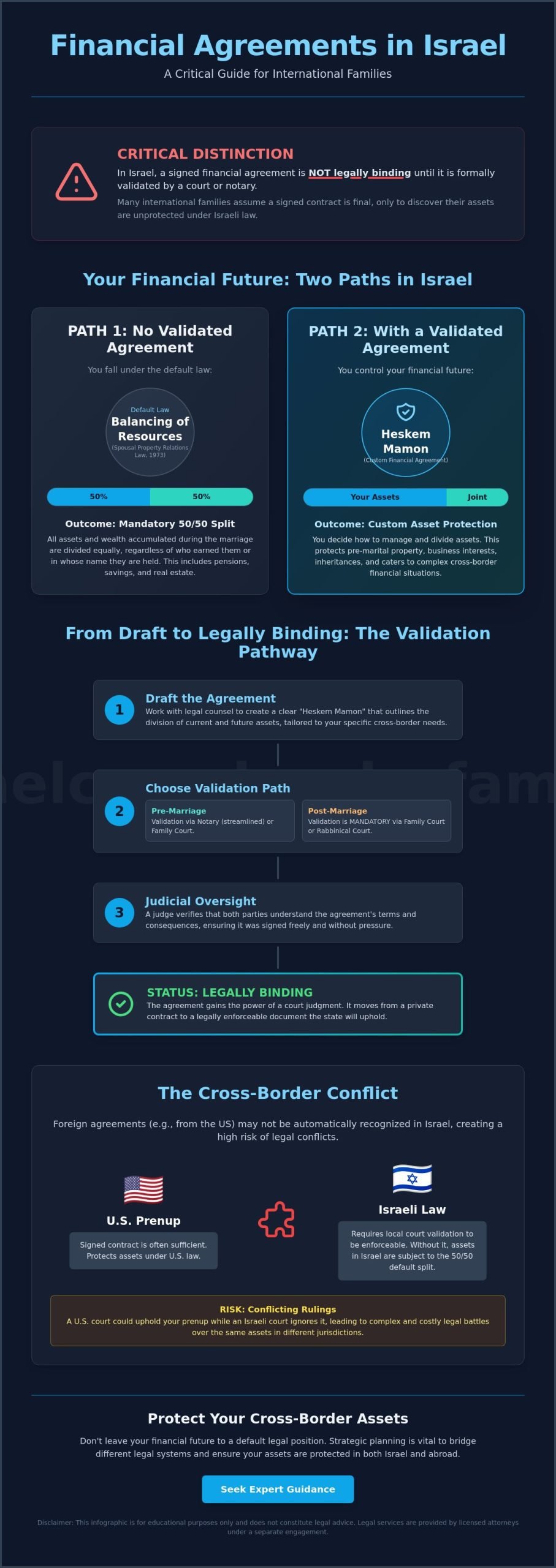
The Spousal Property Relations Law of 1973 is the governing statute for couples who don’t have a custom arrangement. This law establishes a system called the “balancing of resources,” which essentially mandates a 50/50 split of all property and wealth accumulated during the marriage. This includes pensions, savings, and real estate; even if these assets are held in only one partner’s name, the law assumes they are joint. For international families with high-value assets or cross-border business interests, this automatic equalization often creates significant financial risk that the default law doesn’t address.
Why a Standard Contract Isn’t Enough
In most Western jurisdictions, a signed contract is often sufficient to bind two parties, but family law in Israel operates differently. An agreement-in-israel requires judicial oversight to ensure that both individuals are entering the arrangement with a full understanding of their rights. This process prevents one party from being pressured into an unfair settlement without knowing the long-term consequences. The path to validation depends on your status:
- Notary Approval: This is generally available only for couples who are not yet married and provides a streamlined validation path.
- Court Validation: This is the mandatory path for couples who are already married, requiring a formal hearing in the Family or Rabbinical Court.
In Israel, a financial agreement is a court-approved framework, not just a private contract. This judicial confirmation is what gives the document its power. It moves the agreement from a private understanding to a binding legal judgment that the state will enforce. Seeking this clarity early ensures that your financial future is governed by your own strategy rather than a generic legislative default.
This article is published on an independent advisory platform and is not a law firm. The information provided is for educational purposes only and does not constitute legal advice or an attorney-client relationship. Legal services are only provided by licensed attorneys under a separate engagement.
Types of Family Law Agreements for International Couples
International families often face unique pressures that require specialized legal structures to ensure long term security. While the general Heskem Mamon is the foundation, the specific category of agreement you choose depends on your current marital status and your strategic goals. For those arriving in Israel with significant assets or business interests, a prenuptial agreement is the most common path to clarity. If you are already married, the postnuptial agreement-in-israel becomes the necessary tool to re-evaluate your financial landscape. Beyond these, families may need a Heskem Girushin during a divorce or separation to settle child custody and asset distribution in one binding document.
Prenuptial vs. Postnuptial Agreements
Timing dictates the validation procedure and the level of judicial involvement required. A prenuptial agreement is signed before the wedding ceremony takes place. At this stage, a qualified notary or a marriage registrar can provide the necessary validation. This is often faster and less formal than a court appearance. However, once the marriage is official, any new financial arrangement is considered a postnuptial agreement. These must be validated by the Family Court or the Rabbinical Court. The judge will personally verify that both partners understand the specific clauses and are signing without coercion. This judicial oversight is mandatory for the document to hold legal weight in the Israeli system.
Cohabitation Agreements (Yaduim BeTzibur)
In Israel, couples who live together without a formal marriage may be recognized as “Publicly Known” (Yaduim BeTzibur). This status grants many of the same rights as marriage, including potential claims to a partner’s property, pension, or savings. Many international residents are unaware that years of cohabitation could lead to a “balancing of resources” claim upon separation. A cohabitation agreement-in-israel allows you to define the relationship on your own terms rather than relying on default legal definitions. It protects individual assets like an inheritance or a pre-existing business from being merged into a joint estate. Without this clarity, you risk a lengthy court battle to prove which assets were never intended to be shared. If you are unsure which path fits your family, it’s wise to get clarity before you commit.
For couples who are not married but share children, a Parenting Agreement is essential. This document focuses on the welfare of the child rather than just finances. It covers custody schedules, educational choices, and child support payments. Since 2014, Israeli courts have placed a high priority on these agreements to reduce litigation and protect the child’s best interests. For international families, these documents often include relocation clauses to prevent one parent from moving the child out of the country without consent. Ensuring these terms are clear from the start provides a stable foundation for the children’s future and reduces the risk of cross-border custody disputes.
This article is published on an independent advisory platform and is not a law firm. The information provided is for educational purposes only and does not constitute legal advice or an attorney-client relationship. Legal services are only provided by licensed attorneys under a separate engagement.
The Cross-Border Challenge: US-Israel Agreement Conflicts
Families operating between the United States and Israel often face a legal paradox where an agreement valid in one country is ignored in the other. This friction creates the risk of conflicting orders, where a US court might demand an asset split that an Israeli court has already prohibited. For a cross-border agreement-in-israel to be effective, it must anticipate these judicial clashes before they occur. If you own property in Florida but live in Tel Aviv, you’re dealing with two distinct legal philosophies that don’t always communicate well with each other.
The most common pitfall is the assumption that a standard US prenuptial agreement will be automatically honored by an Israeli judge. Israeli law requires specific validation steps that many US states don’t mandate. If your document wasn’t validated by an Israeli court or a qualified notary, it may be treated as mere evidence of intent rather than a binding contract. The language used in these documents is equally vital. Discrepancies between a Hebrew translation and the English original can lead to years of litigation over the true intent of the parties. Ensuring both versions are identical in legal scope is a fundamental requirement for international families.
Enforceability of Foreign Agreements in Israel
Israeli courts evaluate foreign agreements based on several criteria, including whether there was full financial disclosure and if both parties had independent legal counsel. A significant hurdle is the “public policy” exception. If a foreign agreement contains clauses that an Israeli judge finds unconscionable or contrary to local values, they may strike those sections down. Cultural adaptation is just as important as professional translation. An agreement drafted in California may use terms like “community property” that don’t have a direct equivalent in the Israeli “balancing of resources” system, leading to confusion during enforcement.
Protecting Overseas Assets
When drafting an agreement-in-israel, you must explicitly list overseas assets such as US-based real estate, 401(k) accounts, or brokerage portfolios. Vague references to “all foreign property” are often insufficient to prevent a claim in an Israeli court. Using a “choice of law” clause can help, but it’s not a silver bullet. You must ensure that the chosen law doesn’t conflict with the mandatory provisions of Israeli family law. For many families, this means creating a document that satisfies the strictest requirements of both jurisdictions. You can explore more about these complexities in our guide for-expats-foreign-nationals.
A strategic approach requires drafting with the “worst-case” jurisdiction in mind. This means identifying which country’s court is most likely to intervene and ensuring the agreement is robust enough to survive that specific legal environment. By addressing these cross-border conflicts early, you move from a position of vulnerability to one of strategic clarity. Get clarity before you commit. Request a confidential consultation.
This article is published on an independent advisory platform and is not a law firm. The information provided is for educational purposes only and does not constitute legal advice or an attorney-client relationship. Legal services are only provided by licensed attorneys under a separate engagement.
The Validation Process: How to Make it Binding
Transforming a draft into a binding agreement-in-israel is a formal judicial procedure rather than a private administrative task. While you and your partner might reach a consensus in private, the state of Israel does not recognize the document as enforceable until a judge or authorized official verifies it. This step is designed to protect both parties. It ensures that neither person was pressured into signing away their rights without full comprehension of the legal consequences. Without this official court stamp, your financial planning remains a statement of intent rather than a legally recognized shield.
The judge’s role is not to simply rubber-stamp the document. During the validation hearing, the court will often ask specific questions to confirm that the agreement was entered into voluntarily. They may ask if you have read every page, if you understand the long-term financial implications, and if you had the opportunity to consult with independent counsel. Once the judge is satisfied, they will issue a Psak Din, which is a formal judgment. This gives your agreement the same legal power as any other court ruling in Israel, allowing for direct enforcement if the terms are ever breached.
Step-by-Step Validation Guide
- Dual-Language Drafting: For international families, the document should be drafted in both Hebrew and English. This prevents future claims of misunderstanding and ensures the intent is clear in both jurisdictions.
- Petition Filing: You must file a formal request for the “Approval of a Financial Agreement” with the relevant court. This starts the official process and places your case on the court’s calendar.
- The Validation Hearing: Both partners must attend this brief court session. The judge will verify your identities and confirm your mutual consent before signing the approval.
The Role of the Rabbinical Court
Couples often have the choice between the civil Family Court and the Rabbinical Court (Beth Din). While both can validate an agreement-in-israel, the Rabbinical Court is specifically focused on Jewish law. If you choose this path, the agreement often includes clauses related to the “Gett” or religious divorce. These clauses can be strategically important for preventing future delays in the religious divorce process. However, the decision of which court to use should be made with careful consideration of your specific family dynamic. If you need help determining the right path for your situation, request a confidential consultation to explore your options.
Seeking clarity before you commit to a specific court is vital. Each venue has its own procedural nuances and cultural atmosphere. For international families, the choice of court can also impact how the agreement is viewed by foreign authorities. Ensuring your validation process aligns with your broader global strategy is the final step in securing your financial future.
This article is published on an independent advisory platform and is not a law firm. The information provided is for educational purposes only and does not constitute legal advice or an attorney-client relationship. Legal services are only provided by licensed attorneys under a separate engagement.
Strategic Planning: Protecting Your Future in Israel
Successful long term residency in Israel requires a shift from emotional reactions to risk-based decision making. For international families, the financial decisions made during the first few years of Aliyah or relocation often dictate the stability of their estate for decades. An effective agreement-in-israel acts as a strategic bridge, aligning your Western expectations with the specific realities of the Israeli legal system. This isn’t just about preparing for a possible divorce; it’s about defining the commercial and personal boundaries of your life in a way that both jurisdictions will respect.
The impact of early decisions cannot be overstated. When couples move between countries, they often carry outdated assumptions about how their property is viewed by the state. In the “start-up nation,” where financial structures can be complex and multi-jurisdictional, clarity is your most valuable asset. Taking a proactive stance allows you to navigate these complexities with a sense of security. It ensures that your global interests, from US-based retirement funds to Israeli real estate, are managed under a framework that you have intentionally chosen rather than one imposed by default law.
Common Pitfalls for International Families
One of the most frequent mistakes is failing to update an old US prenuptial agreement after moving to Israel. Without local validation, these documents may not withstand a challenge in a local court. Another significant risk involves ignoring the balancing of pension and social security rights. Under Israeli law, these are often viewed as joint resources, and failing to address them can lead to unexpected financial shifts during a separation. Finally, many people attempt to use generic templates found online. These documents often lack the specific language required for IL court compliance and are frequently rejected by judges during the validation process.
Getting Clarity Before You Commit
Adopting an independent advisory approach allows you to build a strategy before entering a formal legal process. This stage is about understanding the inherent risks and cultural differences between legal systems. To prepare for a consultation with a cross-border lawyer, you should compile a detailed list of all global assets, including business interests and inheritances. This preparation allows for a more sophisticated analysis of your situation. By addressing these issues now, you move from a position of uncertainty to one of strategic control. Get clarity before you commit. Request a confidential consultation.
Securing Your Multi-Jurisdictional Legacy
Establishing a binding agreement-in-israel is the most effective way to replace the 1973 Spousal Property Relations Law with a framework that reflects your specific family values. We’ve examined how judicial validation transforms a private document into a powerful legal shield and why US-based prenups require local adaptation to be recognized. By addressing the role of the Rabbinical Court and the risks of conflicting international orders, you ensure your assets remain protected across borders. This strategic approach prevents the state from applying a default 50/50 split to your pre-marital or inherited wealth.
Our specialized advisory provides the authoritative guidance the Anglo expat community needs to bridge the gap between Western expectations and Israeli reality. We offer expertise in US-Israel cross-border jurisdictions to help you navigate these sophisticated multi-jurisdictional challenges. Get clarity before you commit. Request a confidential consultation. Taking this step creates a foundation of certainty for your family’s future in the start-up nation.
This article is published on an independent advisory platform and is not a law firm. The information provided is for educational purposes only and does not constitute legal advice or an attorney-client relationship. Legal services are only provided by licensed attorneys under a separate engagement.
Frequently Asked Questions
Is a US prenuptial agreement valid in Israel?
A US prenuptial agreement is not automatically valid in Israel and usually requires a local validation process to be enforceable. Israeli courts check if the document meets the standards of the Spousal Property Relations Law, including full disclosure and mutual consent. Without an official court stamp, your foreign document might only be treated as evidence of intent rather than a binding contract.
What happens if we don’t have a financial agreement in Israel?
Without a formal agreement, the Spousal Property Relations Law of 1973 dictates a 50/50 split of all assets accumulated during the marriage. This balancing of resources includes bank accounts, pensions, and real estate acquired after the wedding date. This default system applies regardless of whose name is on the title, which often conflicts with the expectations of international families.
Do we have to go to court to sign a financial agreement?
You must go to court to validate any agreement-in-israel signed after the wedding has taken place. For pre-marriage documents, you have the option of using a specially qualified notary or a marriage registrar. However, many couples still choose the Family Court to ensure the highest level of judicial scrutiny and long term enforceability.
Can we change a financial agreement after we are married?
You can modify a financial agreement at any time, but the changes won’t be binding until they are validated by a court. The process for an amendment is identical to the original validation procedure. Both partners must appear before a judge to confirm they understand the new terms and are consenting freely to the modifications.
What is the difference between a notary and a judge for agreements?
A notary can only validate agreements before the marriage ceremony, while a judge handles all post-marriage and divorce settlements. A judge performs a more rigorous check, personally questioning both parties to ensure they understand the legal consequences. This judicial oversight is what gives an agreement-in-israel the force of a court judgment.
Does a financial agreement in Israel cover child support?
While you can include child support terms in your agreement, the court always has the authority to override them if they don’t serve the child’s best interests. In Israel, the child is not a party to the parents’ contract. The Family Court will review these clauses independently to ensure the child’s needs are fully met according to current standards.
What happens to our US assets if we sign an agreement in Israel?
Your US assets can be protected under an Israeli agreement if they are explicitly listed with specific account numbers and addresses. To ensure these terms are honored in both countries, the document should include choice of law clauses. This prevents a situation where a US court ignores your Israeli agreement because it lacks specific cross-border terminology.
How long does the validation process take in the Israeli Family Court?
The validation process in the Family Court typically takes between 4 and 12 weeks from the date of filing the petition. This timeline depends on the specific court’s caseload and whether the judge requires additional clarifications. For international families, ensuring your documents are professionally translated into Hebrew beforehand can prevent unnecessary delays in the schedule.

Article by
Gabriel Lior
A Personal Journey That Became a Mission
The advisory was founded by an American father Gabriel Lior, LLB, MBA , global entrepreneur, and cross-border advisor who spent more than a decade navigating the Israeli family court system firsthand and now lives in Singapore with his son.
As a divorced parent in a cross-border family, Gabriel faced nearly every legal challenge a foreign parent can encounter in Israel — including child custody disputes, child support proceedings, property matters in Israel and abroad, false accusations, and complex immigration and relocation proceedings.
Over the years, he learned the hard way how difficult it is for non-Israeli parents to understand the system, identify the right legal strategy, and choose the right legal representation — especially when language, culture, and jurisdictional differences are involved. He also witnessed how foreign parents and new immigrants are often disadvantaged or taken advantage of by service providers and institutions simply because they lack local knowledge or fluency.
From Client to Advisor
To truly understand — and survive — the system, Gabriel pursued formal legal education in Israel, completing two Israeli law degrees, alongside a BA and MBA earned in the United States. This was never about becoming a practicing attorney, but about gaining a deep, structural understanding of how the system works — and where it breaks down for foreign parents.
This rare combination of:
Firsthand client experience
Israeli legal and US business education
International business and negotiation training
Decades of commercial execution
created a unique perspective – one that understands both sides of the table.
After years of litigation, persistence, and at times self-representation, he ultimately succeeded in securing custody of his son and relocating abroad through a rare legal victory in the Israeli Supreme Court — becoming one of the first fathers in Israel to do so under these circumstances.
Disclaimer
Important Disclaimer:
The information provided on this website and in its content is for general informational and educational purposes only and does not constitute legal advice, legal opinion, or legal representation.
Gabriel Lior is not licensed to practice law in Israel (nor is he interested in doing so) and does not provide legal services, despite having completed 2 Law Degrees. The services offered are advisory in nature and are intended to provide general guidance, strategic insight, and information regarding cross-border family law considerations.
No attorney-client relationship is formed by accessing this website, reading its content, or communicating with us.
Any decisions made based on this information are at your own discretion and risk. For legal advice specific to your situation, you should consult a licensed attorney in the relevant jurisdiction.
Where appropriate, we may refer clients to independent, licensed attorneys or professionals. Such referrals do not constitute legal representation and no liability is assumed for services provided by third parties.