This article is published on an independent advisory platform (not a law firm) and is for informational purposes only. It does not constitute legal advice or imply an attorney-client relationship.
What if the timing of your final divorce decree mattered more for your child’s future than the biological reality of their birth? For many expats and international families, the term “jew bastard” carries a heavy, derogatory weight from Western history, yet in the Israeli legal system, the concept of Mamzerut has nothing to do with being born out of wedlock. You likely believe that as long as you’re living separately from a former spouse, your new life and future children are legally protected. However, the Rabbinical Courts in IL operate under a specific halakhic framework where “illegitimacy” is defined strictly by the status of the mother’s previous marriage at the time of conception.
This guide provides a calm, authoritative analysis of the Mamzer status and its tangible consequences within Israeli law. You’ll learn how the “blacklist” maintained by the Ministry of Religious Services actually functions and why early strategic planning is essential for cross-border families. We will examine the specific risks of a mamzer designation and provide actionable knowledge on how to navigate new relationships and divorce proceedings safely to protect your children’s marriage prospects and legal standing in Israel.
Key Takeaways
- Distinguish between the common derogatory term “jew bastard” and the specific halakhic status of Mamzer, which is based on forbidden unions rather than birth outside marriage.
- Understand the mechanics of the Rabbinical Court’s “Marriage Restricted List” and why removal from this registry is exceptionally difficult once a designation is recorded.
- Identify the risks of “limbo marriages” where expats are legally divorced in their home countries but remain married under Israeli law, potentially impacting the status of future children.
- Learn how the legal principle of “presumption of paternity” functions in IL to provide certain protections for children born into complex family situations.
- Discover why a risk-based strategic review is essential for international families to navigate the overlap between civil and religious legal systems safely.
Defining Mamzerut: Slang vs. Israeli Legal Reality
This article is published on an independent advisory platform (not a law firm) and does not imply an attorney-client relationship.
In many Western cultures, the term “bastard” refers to a child born to parents who are not legally married. This concept of illegitimacy has largely disappeared from modern civil law in the U.S. and Europe. However, in Israel, the legal reality is governed by centuries-old religious frameworks. The derogatory slang phrase “jew bastard” is often used by those who don’t understand the specific legal status of Mamzerut. Under Israeli law, a child’s status is not determined by whether their parents are married, but by whether the union that produced them was biblically forbidden.
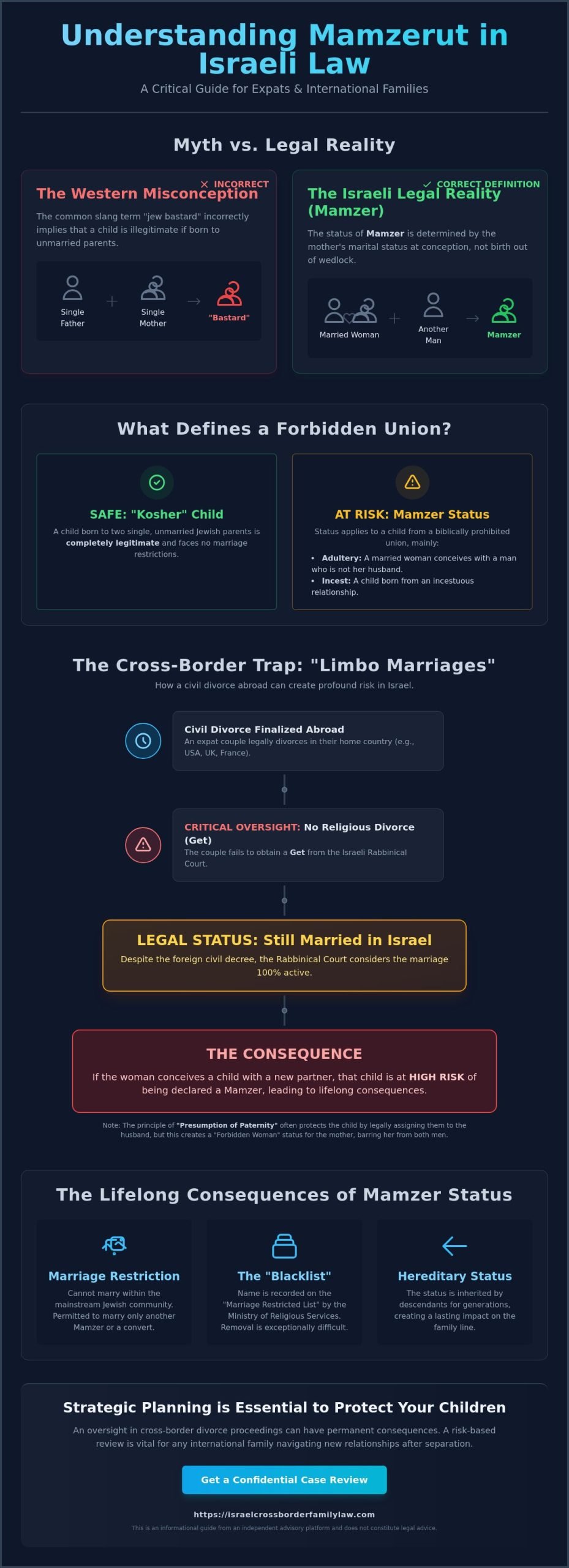
The Rabbinical Courts in IL hold exclusive jurisdiction over the personal status of Jewish citizens. This means their definitions dictate who can marry and who is restricted from the community. When Defining Mamzerut, it’s essential to understand that it only applies to children born from specific prohibited relationships, primarily adultery or incest. A child born to two single, unmarried parents is completely legitimate in the eyes of the Rabbinical Court. Unlike the colloquial “jew bastard” label, a Mamzer is specifically a child born from a union where the mother was legally married to a different man at the time of conception. The legal weight of this status is profound, as it creates a hereditary restriction on marriage that lasts for generations.
The Distinction Between Unmarried and Adulterous Unions
A common source of anxiety for expats is the belief that having a child while unmarried will lead to legal blacklisting. This is factually incorrect. In IL, a child born to a single mother and a single father faces no marriage restrictions. The specific risk arises when a woman is legally married to one man but conceives a child with another. Because the Rabbinical Court views the first marriage as active until a religious divorce (Get) is granted, the child is legally classified as a product of adultery. Many international families live in separation for years without realizing that, in the eyes of the IL legal system, they are still fully married, placing any future children at risk.
Why the Term Matters in 2026
Even in 2026, the influence of religious law remains a cornerstone of the Israeli legal landscape. Secular families often assume these rules don’t apply to them, yet the Ministry of Interior and the Rabbinical Courts coordinate closely on birth registrations and marriage eligibility. A simple administrative oversight in a cross-border divorce can have permanent consequences for the next generation. This makes it vital to seek clarity before you commit to new family structures. Understanding these risks through a strategic lens allows families to navigate the complex overlap between international civil law and Israeli religious requirements without fear.
Adultery and the Consequences for the Child
The legal framework in Israel employs a powerful mechanism known as Rob Haba’im, or the presumption of paternity, which serves as a shield for children born into complex marital situations. Under this principle, the Rabbinical Court assumes that any child born to a married woman is the biological offspring of her husband. This legal fiction is maintained even when there are doubts about the biological truth. While the term “jew bastard” is used colloquially to describe children born of forbidden unions, the Israeli legal system actually goes to great lengths to avoid applying the Mamzer status whenever possible. The goal is to preserve the child’s “kosher” status, ensuring they remain eligible to marry within the Jewish community.
However, this protection creates a specific legal status for the mother, often referred to as a “Forbidden Woman.” If a woman is found to have had an affair, she is biblically forbidden from both her husband and her lover. For those managing divorce and separation for international families, the timing of a new relationship is the most significant risk factor. If a child is conceived before the religious divorce is finalized, the presumption of paternity may be challenged, potentially triggering an investigation into the child’s status. Understanding the legal reality of ‘bastardy’ in Israel is vital for anyone navigating a cross-border separation, as the Rabbinical Court’s reach extends to Jewish families regardless of where they reside.
The Role of the ‘Get’ in Preventing Mamzerut
A civil divorce decree from a court in London, New York, or Toronto is not recognized as a termination of marriage by the Israeli Rabbinical Courts. For Jewish individuals, the marriage only ends when the husband delivers a “Get” to the wife. If a woman begins a new relationship after a civil divorce but before receiving a Get, any child born from that union is at risk of being labeled a Mamzer. This “limbo” state is a frequent trap for expats who believe their legal affairs are settled. Get refusal or administrative delays can inadvertently create a status crisis for future children, making it essential to seek professional guidance early in the process.
Paternity Testing Restrictions in Israel
Israel’s Genetic Information Law of 2000 strictly regulates DNA testing to protect children from being “bastardized.” In many cases, a court will actually block a paternity test if there’s a risk the results would prove a child was not fathered by the mother’s legal husband. The legal system prioritizes the “Best Interests of the Child” over biological accuracy. By preventing the biological truth from coming to light, the court ensures the child does not end up on a marriage-restricted list. This unique approach demonstrates the significant differences between Israeli law and Western systems, where biological truth is usually the primary focus of paternity disputes.
The Rabbinical Court Blacklist and Marriage Restrictions
The Rabbinical Court maintains a centralized, digital database known as the Reshimat Me’ukavei Nisuin, or the Marriage Restricted List. This registry isn’t merely an internal religious document. It’s a functional legal tool used by the Ministry of Interior to enforce personal status laws across the country. While a person might be derogatorily called a “jew bastard” in casual social settings, being placed on this official list has concrete legal consequences that can persist for centuries. Once a name is entered into this database, the individual is effectively barred from standard Jewish marriage within the State of Israel.
How the Status is Discovered
Status investigations, known as Birur Yahad, typically occur when a couple applies for a marriage license in IL. The Marriage Registrar doesn’t just look at the couple; they examine the family tree. If a parent’s prior divorce was not religious or if there’s a significant gap in the lineage, the file is flagged for a deeper probe. For international families moving to IL, this often comes as a sudden shock. They might have lived as a recognized family for 15 or 20 years abroad, only to find their child’s status questioned by the Rabbinate upon arrival. If the investigation finds the parents’ union was forbidden, the child is added to the list, and removal is exceptionally rare.
One of the most challenging aspects of Mamzerut is the “tenth generation” rule. Unlike Western concepts of illegitimacy that expire with the individual, this status is hereditary. It follows the lineage indefinitely, meaning the children and grandchildren of a Mamzer inherit the same restrictions. This is why understanding the Rabbinical Court Blacklist and Marriage Restrictions is so vital for those in complex marital situations. Because the status is permanent, the impact of a single “jew bastard” designation can alter a family’s legal standing in Israel for hundreds of years.
The Social and Legal Impact
A person with this status is legally barred from marrying most other Jews in Israel. They’re generally restricted to marrying other individuals with the same status or converts to Judaism. Because the Rabbinate holds a monopoly on Jewish marriage in IL, these restrictions are absolute within the state’s borders. The psychological weight on families is heavy, often leading to a sense of social “blacklisting.”
Many families turn to civil marriage alternatives, such as weddings in Cyprus or online ceremonies via Utah. While the Ministry of Interior registers these unions for civil purposes like taxes and health insurance, the Rabbinate does not recognize them as valid Jewish marriages. This creates a split legal identity that can be difficult to manage without a clear strategy. If you’re concerned about how your family history might affect your children, it’s wise to request a confidential case review to understand your specific risks before engaging with the authorities.
Cross-Border Risks for Expats and International Families
Expats often operate under the misconception that a civil divorce decree from a U.S. court provides a clean break from their previous life. In reality, thousands of international families live in a state of “limbo marriage” where they’re legally single in New York but remain fully married in the eyes of the Israeli Rabbinate. This multi-jurisdictional conflict is where the risk of a “jew bastard” designation becomes most acute. The Rabbinical Court asserts jurisdiction over Jewish expats worldwide, regardless of their current residence, if they have any significant link to Israel. These links can include property ownership, business interests, or even the 1975 US-Israel tax treaty, which the courts sometimes use to establish a “center of life” in IL. For a detailed look at moving children between these legal zones, see our guide on International Custody and Relocation.
US Civil Divorce vs. Israeli Religious Divorce
A U.S. judge has the power to divide assets and end a civil contract, but they cannot grant a Get. If an Anglo expat remarries in the U.S. based solely on a civil decree, any children from that second union are at immediate risk. We’ve seen cases where families discovered their children were on the restricted list decades later, simply because a religious divorce wasn’t finalized in 1995. The court’s memory is long, and its records are global. If the mother is still religiously married to her first husband, the second relationship is viewed as adulterous, and the “jew bastard” status is applied to the offspring by default.
Protecting Children in Cross-Border Jurisdictions
Protecting the status of your children requires strategic timing and a risk-based approach to filing. Decisions made in a U.S. court regarding child support cross-border enforcement can inadvertently impact how the Rabbinical Court views your case. Filing first in IL might provide certain tactical advantages, while filing in the U.S. might be better for asset protection. Early advisory is the only way to mitigate the risk that a child will be labeled a Mamzer by religious authorities. Before you take any legal steps in either country, it’s essential to request a confidential strategy session to map out your jurisdictional risks.
Strategic Planning: Navigating the Advisory Process
Managing the risk of a “jew bastard” designation requires more than just reactive legal defense; it demands a proactive, risk-based strategy. For international families, the intersection of civil and religious law is too complex to navigate through guesswork. A Confidential Case Review serves as the foundation for this process, allowing you to identify potential status issues before they become permanent entries in the Rabbinical Court’s database. By analyzing your family history through a strategic lens, you can make informed decisions that prioritize long-term security over short-term convenience.
Our advisory platform focuses on providing high-level strategic clarity rather than traditional legal representation. It’s vital to understand how it works: we provide the cross-border analysis you need to instruct your attorneys effectively. While we offer deep expertise in Israeli family law, this information is advisory in nature and does not constitute an attorney-client relationship. Legal services are only provided by licensed attorneys under a separate, formal engagement, ensuring that your strategic plan is executed with the highest level of professional oversight.
Seeking Clarity Before You Commit
You should never sign a financial settlement or a divorce agreement in the U.S. or Israel without a comprehensive analysis of the religious implications. In IL, the “race to the court” (Sambat Erka’ot) means that whoever files first often determines which court, civil or religious, will handle the case. This decision can have a direct impact on whether a child is later labeled a “jew bastard” by the Rabbinate. Bicultural and bilingual advisors act as a bridge, ensuring that your U.S.-based legal team understands the specific requirements of the Israeli system. This is particularly important when dealing with financial assets held in different currencies, such as savings in ₪ or property in the U.S., as the Rabbinical Court may view these assets through a different lens than a civil judge.
Next Steps for International Families
Education is your best defense against the complexities of the Israeli legal system. We recommend exploring the Israel Family Law YouTube channel to understand the nuances of status, custody, and divorce. When preparing for a consultation, gather your marriage certificates, any previous divorce decrees, and a clear timeline of your family’s movements between countries. This history is essential for assessing your current standing and identifying any “limbo” periods in your marital status. By taking these steps now, you can avoid the social and legal blacklisting that comes with status disputes. Get clarity before you commit. Request a confidential consultation to protect your children’s future and your own peace of mind.
Securing Your Family’s Legal Standing in Israel
Protecting your family from the permanent consequences of Mamzerut requires a sophisticated understanding of how international civil decrees interact with the Israeli Rabbinical Court. You’ve seen that the derogatory label of “jew bastard” is actually a specific, hereditary legal status in IL that can be avoided through proactive risk management. Resolving “limbo marriages” and ensuring the religious dissolution of previous unions are the most critical steps for any expat or cross-border family. Our team on the ground provides a calm, advisory approach focused on strategy and long-term risk mitigation for the international community.
With specialized expertise in US-Israel cross-border family law, we bridge the gap between complex legal systems to provide the clarity you need. Decisions made during the initial stages of a separation often carry the most weight for your children’s future marriage prospects and social standing in Israel. Get clarity before you commit. Request a confidential consultation. By adopting a strategic, informed approach today, you can navigate these challenges with confidence and secure your family’s legacy for generations to come.
Frequently Asked Questions
Is a child born out of wedlock considered a ‘bastard’ (mamzer) in Israel?
No, a child born to two unmarried parents is not a Mamzer under Israeli law. The derogatory term “jew bastard” is frequently misused by those unfamiliar with the halakhic system. In IL, the Rabbinical Courts only apply this status to children from specific forbidden unions, such as adultery or incest. As long as the mother is not religiously married to another man at the time of conception, the child is fully legitimate.
Can a mamzer ever be ‘cleared’ or have their status removed?
Removing a Mamzer designation is exceptionally rare and often impossible once the status is officially recorded. Because the status is hereditary, it remains with the individual and their descendants indefinitely. While the courts often use complex legal technicalities to avoid applying the status initially, once a name appears on the Marriage Restricted List, the legal path to removal is virtually non-existent for the affected family.
Does the mamzer status apply to non-Jewish citizens in Israel?
No, Mamzerut is a religious status that applies exclusively to Jewish citizens under the jurisdiction of the Rabbinical Courts. Other religious communities in IL, including Muslims, Christians, and Druze, are governed by their own respective personal status laws and religious tribunals. Civil law in Israel does not recognize the concept of “illegitimacy” for any citizen, regardless of their religious affiliation or background.
What happens if I remarry after a civil divorce but without a ‘Get’?
Remarrying without a Get creates a “limbo marriage” where your new relationship is viewed as adulterous by Israeli authorities. Even with a valid civil divorce from a foreign court, the Rabbinical Court considers your first marriage active until a religious divorce is granted. Any children born from the subsequent union face a high risk of being designated as Mamzerim, which permanently restricts their marriage rights in Israel.
Can a mamzer marry a convert or another mamzer?
Yes, a Mamzer is permitted to marry another individual with the same status or a convert to Judaism. These are the only groups they can legally wed through the Rabbinate within the State of Israel. This specific restriction is a primary reason why international families seek a “jew bastard” risk assessment before making long-term commitments or finalizing cross-border divorce agreements that could impact their children’s future.
How do the Rabbinical Courts find out about a child’s status?
The Rabbinical Courts typically identify status issues during marriage license applications or birth registrations at the Ministry of Interior. Authorities flag cases where a mother’s marital history shows a gap or a lack of a religious divorce from a previous spouse. A formal “Birur Yahad” investigation is then launched to verify the lineage of the child before the state issues any marriage-related certifications.
Does the mamzer status affect inheritance rights in Israel?
Mamzer status does not impact inheritance rights under the Israeli Succession Law of 1965. Civil courts manage estate matters and do not discriminate against individuals based on their religious status or marriage eligibility. A child will inherit from their biological parents according to civil law, regardless of whether the Rabbinical Court considers them legitimate for religious marriage purposes or community standing.
What is the ‘presumption of paternity’ and how does it protect children?
The principle of Rob Haba’im assumes that a child born to a married woman was fathered by her legal husband. This legal presumption is a vital tool used by the courts to protect children from being labeled as Mamzerim. By prioritizing this legal assumption over biological DNA testing, the Israeli system effectively shields the child from the lifelong consequences and social stigma of religious blacklisting.

Article by
Gabriel Lior
A Personal Journey That Became a Mission
The advisory was founded by an American father Gabriel Lior, LLB, MBA , global entrepreneur, and cross-border advisor who spent more than a decade navigating the Israeli family court system firsthand and now lives in Singapore with his son.
As a divorced parent in a cross-border family, Gabriel faced nearly every legal challenge a foreign parent can encounter in Israel — including child custody disputes, child support proceedings, property matters in Israel and abroad, false accusations, and complex immigration and relocation proceedings.
Over the years, he learned the hard way how difficult it is for non-Israeli parents to understand the system, identify the right legal strategy, and choose the right legal representation — especially when language, culture, and jurisdictional differences are involved. He also witnessed how foreign parents and new immigrants are often disadvantaged or taken advantage of by service providers and institutions simply because they lack local knowledge or fluency.
From Client to Advisor
To truly understand — and survive — the system, Gabriel pursued formal legal education in Israel, completing two Israeli law degrees, alongside a BA and MBA earned in the United States. This was never about becoming a practicing attorney, but about gaining a deep, structural understanding of how the system works — and where it breaks down for foreign parents.
This rare combination of:
Firsthand client experience
Israeli legal and US business education
International business and negotiation training
Decades of commercial execution
created a unique perspective – one that understands both sides of the table.
After years of litigation, persistence, and at times self-representation, he ultimately succeeded in securing custody of his son and relocating abroad through a rare legal victory in the Israeli Supreme Court — becoming one of the first fathers in Israel to do so under these circumstances.
Disclaimer
Important Disclaimer:
The information provided on this website and in its content is for general informational and educational purposes only and does not constitute legal advice, legal opinion, or legal representation.
Gabriel Lior is not licensed to practice law in Israel (nor is he interested in doing so) and does not provide legal services, despite having completed 2 Law Degrees. The services offered are advisory in nature and are intended to provide general guidance, strategic insight, and information regarding cross-border family law considerations.
No attorney-client relationship is formed by accessing this website, reading its content, or communicating with us.
Any decisions made based on this information are at your own discretion and risk. For legal advice specific to your situation, you should consult a licensed attorney in the relevant jurisdiction.
Where appropriate, we may refer clients to independent, licensed attorneys or professionals. Such referrals do not constitute legal representation and no liability is assumed for services provided by third parties.