A single court order in New York or Tel Aviv is rarely enough to protect a family living across two continents. When your life is split between the United States and Israel, standard custody rules often fail to address the multi-jurisdictional complexity of International Parenting Plans. You probably feel the pressure of managing high travel costs and the anxiety of navigating two different legal systems that don’t always communicate. It’s natural to worry about how a holiday visit might impact your child’s habitual residence or whether your current agreement would hold up in an Israeli Family Court.
This content is published on an independent advisory platform, not a law firm, and is intended for informational purposes. We understand the need for absolute clarity before you commit to a long-term arrangement. This guide explains how to build a sustainable framework for visitation and legal certainty across borders. You’ll learn about the practical necessity of “Mirror Orders,” the strategic importance of the mandatory “Settlement of Dispute” process in Israel, and how to reconcile the Jewish religious calendar with the U.S. school year to minimize conflict for your children.
Key Takeaways
- Learn why “Habitual Residence” is the most critical legal factor in determining which court system governs your family’s future across borders.
- Discover how to synchronize the Israeli Jewish holiday cycle with American school schedules to create a stable, predictable routine for your children.
- Understand the essential legal clauses required to make International Parenting Plans enforceable in both United States and Israeli jurisdictions.
- Explore the strategic use of “Mirror Orders” and mediation protocols to resolve cross-border disputes without resorting to immediate litigation.
- Identify why generic internet templates fail to address the specific “Race to the Court” dynamics unique to the Israeli legal landscape.
What is an International Parenting Plan in the US-Israel Context?
This content is published on an independent advisory platform and does not constitute formal legal advice or an attorney-client relationship. Legal services are only provided by licensed attorneys under a separate engagement.
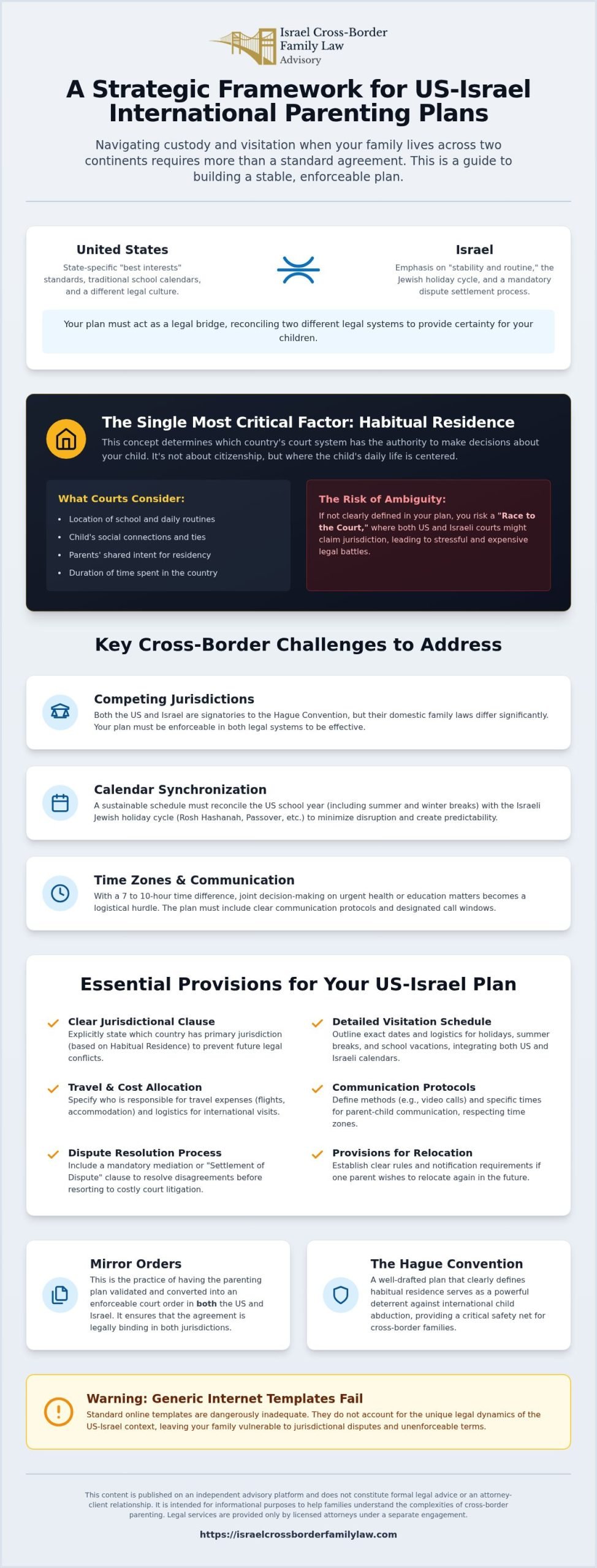
An international parenting plan is a comprehensive, written agreement that governs custody, visitation, and major life decisions for children who reside in different countries. For families moving between the United States and Israel, these documents must reconcile two very different legal cultures and sets of laws. While a domestic long-distance plan might focus on flight times and summer breaks, International Parenting Plans must account for jurisdictional authority, sovereign borders, and the risk of legal deadlock. It’s a legal bridge designed to provide stability when parents are thousands of miles apart.
To better understand this concept, watch this helpful video:
The US-Israel connection is unique because of competing legal philosophies. In 2026, Israeli courts are increasingly prioritizing “stability” and “routine” as the primary metrics for a child’s best interests, shifting away from the old “Tender Years Presumption.” This creates a complex landscape when one parent is in the US, where “best interests” might be interpreted differently across various states. You also have to manage the 7 to 10 hour time difference, which turns a simple phone call into a logistical hurdle. Using a standard template from the internet often leaves families vulnerable because it doesn’t address the specific requirements of The Hague Convention on the Civil Aspects of International Child Abduction, which serves as a critical safety net for cross-border families.
The Concept of Habitual Residence
Habitual residence is the most critical term in your plan because it determines which country’s courts have the power to make decisions about your child. Israeli and US courts don’t just look at citizenship; they examine where the child has established their daily life through school, social connections, and the parents’ shared intent. Under the Hague Convention, habitual residence is the country where a child has established their daily life and social ties through school, routine, and the shared intent of their parents. If you don’t define this clearly, you risk a “race to the court” where both jurisdictions might claim authority, leading to expensive and stressful litigation.
Cross-Border Decision Making
Managing “Joint Legal Custody,” or the right to make decisions about education, healthcare, and religious upbringing, is particularly challenging across time zones. A 10-hour gap means one parent might be asleep when an urgent school matter arises in Tel Aviv or New York. Your plan should include specific communication protocols and windows for calls that respect school and sleep schedules. It’s also vital to distinguish this from “Physical Custody,” which refers strictly to where the child actually sleeps. For more details on these distinctions, you can review our guide on international custody and relocation. Clear protocols help prevent minor misunderstandings from escalating into international legal disputes.
Key Legal Considerations: Jurisdiction, The Hague Convention, and Enforcement
This content is published on an independent advisory platform and does not constitute formal legal advice or an attorney-client relationship. Legal services are only provided by licensed attorneys under a separate engagement.
Establishing International Parenting Plans requires a deep understanding of how two sovereign legal systems interact. Unlike domestic agreements, these plans must address the risk of international child abduction. Both the United States and Israel are signatories to the Hague Convention, which provides a framework for the return of children under 16 who are wrongfully removed or retained. In Israel, the legal system takes these matters seriously; a Hague petition typically triggers an initial hearing within 15 days, with the law aiming for a final verdict within six weeks. Before reaching that stage, most families must navigate a mandatory “Settlement of Dispute” application, which as of January 2026 carries a filing fee of ₪119 in the Israeli Family Court.
The Role of Israeli Rabbinical Courts
Israel maintains a dual legal system where both civil Family Courts and religious Rabbinical Courts hold jurisdiction over certain family matters. This creates a “race for jurisdiction” dynamic. The court where a claim is first filed often determines which system will hear the case. While civil courts focus on secular “best interests” standards, Rabbinical courts apply Jewish religious law (Halacha), which can significantly influence visitation rights and custody outcomes. Choosing the wrong forum early in the process can have lasting consequences on your ability to maintain a cross-border connection. It’s vital to seek professional guidance to understand which court aligns best with your family’s specific needs before any papers are filed.
Enforcement and Mirror Orders
A common misconception is that a U.S. custody order is automatically valid in Israel. In reality, foreign judgments must be formally recognized and “domesticated” under the Foreign Judgments Enforcement Law of 1958. To bridge this gap, many families use “Mirror Orders.” This involves obtaining a court order in the destination country that recognizes and agrees to enforce the rulings of the original court. This is particularly relevant for child support cross-border enforcement, as financial obligations are often tied to the physical custody schedule. For a detailed look at how these systems cooperate, the U.S.-Israel child support enforcement guide provides essential context on the bilateral agreements that govern these financial transitions. Without these specific legal protections, your parenting plan may be unenforceable once the child crosses the border, leaving you with little recourse if the other parent decides to unilaterally change the terms of the agreement.
Structuring the Schedule: Reconciling the US and Israeli Calendars
This content is published on an independent advisory platform and does not constitute formal legal advice or an attorney-client relationship. Legal services are only provided by licensed attorneys under a separate engagement.
Designing the physical schedule for International Parenting Plans requires more than just looking at a map; it requires reconciling two calendars that rarely align. While American families focus on Thanksgiving and a long winter break in December, Israeli families are governed by the Jewish holiday cycle. This “Calendar Clash” often leads to friction if not addressed with specific provisions. Passover and the High Holidays move every year on the secular calendar. This can easily conflict with fixed U.S. school testing weeks or graduation ceremonies. Without a clear framework, parents often find themselves in a cycle of annual negotiations that increase tension and disrupt the child’s routine.
Stability for the child is the primary objective in any cross-border arrangement. In our experience, structuring “Block Time” is far more sustainable than trying to maintain frequent, short visits. Longer but less frequent stays allow the child to truly settle into their environment. A flight from Ben Gurion (TLV) to major U.S. hubs like JFK, EWR, or LAX takes a significant physical toll, often involving 11 to 15 hours in the air. Travel days should be treated as transition periods rather than visitation days. This allows the child to acclimate to a 7 to 10 hour time difference before the “quality time” actually begins.
Meaningful digital connections are the glue that holds the relationship together between physical visits. This goes beyond a quick “FaceTime” call. Effective plans specify windows for video calls that respect the child’s school and sleep schedule. It’s about quality interaction, such as reading a book together or sharing a screen to work on a project. Digital visitation is now a legally recognized component of parenting time in both U.S. and Israeli jurisdictions, providing a vital bridge across the ocean.
The Holiday Rotation Strategy
A successful rotation strategy balances Passover and the High Holidays against Thanksgiving and the December break. In Israel, “Chofesh Hagadol” (the big summer break) typically runs from July to late August. This may overlap with the earlier start of some U.S. school districts in mid-August. Your plan should explicitly state how these overlaps are handled. Creating a “floating” holiday provision for cultural celebrations ensures that neither parent feels they are losing out on significant family traditions due to the calendar’s shifts.
Travel Logistics and Safety
Financial clarity is essential for long-term peace. Your agreement must clearly allocate the high costs of international flights and “Unaccompanied Minor” fees. It should also specify who holds the child’s passports and require formal travel consent letters for every trip. For more on the legalities of moving children between countries, see our guide on international custody and relocation. These provisions act as a safeguard, ensuring that travel is predictable, transparent, and safe for everyone involved.
Critical Provisions Every US-Israel Parenting Plan Needs
This content is published on an independent advisory platform and does not constitute formal legal advice or an attorney-client relationship. Legal services are only provided by licensed attorneys under a separate engagement.
Trust is a vital foundation for any family, but it isn’t a substitute for a robust legal strategy. When parents live thousands of miles apart, International Parenting Plans must include “fail-safe” provisions that function even when communication breaks down. These clauses act as a roadmap for conflict, ensuring that minor disagreements don’t escalate into multi-jurisdictional litigation. A well-structured plan should require mandatory mediation in a neutral forum before either parent can file a new claim in an Israeli or U.S. court. This approach preserves resources and focuses on the child’s stability rather than legal posturing.
Financial transparency is another pillar of a sustainable plan. In Israel, the estimated essential needs of a child are between 1,600 to 2,250 ILS per month as of 2026. However, international travel costs can fluctuate wildly. Your agreement should include specific protocols for how child support might be adjusted if flight prices or “Unaccompanied Minor” fees increase significantly. It’s also wise to set “Red Lines” for travel, such as prohibiting visits to countries that aren’t signatories to the Hague Convention, which ensures that the child remains within a recognized legal framework at all times.
The ‘Stay of Exit’ (No-Fly) Order
One of the most unique aspects of the Israeli legal system is the “Tzav Ikur Yetzia,” or stay-of-exit order. This is often used to ensure that a parent doesn’t leave the country while legal matters are pending or to secure future child support. In a negotiated parenting plan, you can include provisions for how these orders are issued, maintained, or removed to allow for travel. If not handled correctly, an improperly managed stay-of-exit order can result in a parent or child being legally trapped in Israel at the airport, unable to return to their home or employment in the U.S. for months while the court reviews the case.
Anti-Abduction Clauses
To deter wrongful retention, your plan should incorporate specific language referencing international treaties. This includes explicitly stating that the child’s habitual residence is fixed and that any retention beyond the agreed dates constitutes an act of abduction. Some families utilize financial guarantees or bonds that are held in escrow and forfeited if the child isn’t returned on schedule. For a comprehensive understanding of these safeguards, you may review our resources on the Hague Convention and child abduction. To ensure your agreement includes these necessary protections, you should request a strategic review of your specific family circumstances.
Building a Sustainable Future: The Advisory Approach to Cross-Border Parenting
This content is published on an independent advisory platform and does not constitute formal legal advice or an attorney-client relationship. Legal services are only provided by licensed attorneys under a separate engagement.
Building a sustainable future for your family requires a philosophy of “Clarity Before Commitment.” In the complex landscape of International Parenting Plans, an early error in judgment or a poorly worded clause can lead to years of legal deadlock across two continents. Many families attempt to use generic “one-size-fits-all” templates found on the internet to save time or money. These often fail because they don’t account for the specific intersection of U.S. state laws and the Israeli “Race to the Court” dynamic. A template won’t tell you how to handle a stay-of-exit order or how to domesticate a foreign judgment in a way that both systems recognize. It simply won’t help you bridge the gap between two very different legal cultures.
The role of an international legal advisor is to serve as a bridge between these systems. We focus on strategy first and litigation last. Litigation in cross-border cases is notoriously expensive and emotionally draining for everyone involved. For instance, as of August 2026, a contested divorce in Israel can range from ₪55,000 to over ₪185,000. By prioritizing a strategic framework, you can often avoid these costs and create a more stable environment for your children. We help you understand the weight of early decisions, such as which court to file in first, before you make a commitment that might be difficult to reverse.
Mediation as a Cross-Border Tool
Mediation is frequently more effective than litigation for families living between the U.S. and Israel. It allows parents to create bespoke solutions that a judge might not have the authority or time to craft in a busy courtroom. The key is finding a mediator who understands both American and Israeli cultural nuances. They must be able to navigate the differences between a secular U.S. school year and the Israeli religious calendar, ensuring that neither parent feels their traditions are being sidelined. This collaborative approach focuses on the child’s stability rather than a legal victory. You can learn more about our specific approach and how it works on our advisory platform.
Next Steps for Your Family
If you’re ready to move forward, start by gathering your essential documentation. This includes birth certificates, any existing court orders, and a detailed travel history for your children. Consulting with multi-jurisdictional practitioners who understand both systems is vital to your success. They can provide the nuanced understanding required to ensure your plan is enforceable in both Tel Aviv and New York. Remember that a parenting plan is a living document. It must evolve as your child grows, their school needs change, and travel regulations shift. We recommend a strategic review of your plan every few years to ensure it still meets your family’s needs.
Get clarity before you commit. Request a confidential consultation.
Securing Your Family’s Cross-Border Future
This content is published on an independent advisory platform and does not constitute formal legal advice. Legal services are only provided by licensed attorneys under a separate engagement.
Managing a life between the United States and Israel requires more than just logistical planning; it demands a strategic legal framework that protects your parental rights and your child’s stability. Successful International Parenting Plans are built on a foundation of clear communication protocols, synchronized holiday schedules, and enforceable “Mirror Orders” that bridge the gap between two sovereign systems. By prioritizing these elements, you can mitigate the risks of jurisdictional disputes and ensure that your family remains connected despite the distance.
Our advisory platform focuses on strategy and risk management for families navigating the Hague Convention and international relocation. This proactive approach helps you understand the weight of early decisions before you make life-altering commitments. You can successfully navigate the “Race to the Court” dynamic and religious legal nuances with the right guidance. You don’t have to face these multi-jurisdictional complexities alone.
Get clarity before you commit. Request a confidential case review to discuss your cross-border parenting strategy. You can build a predictable, secure routine for your children across borders.
Frequently Asked Questions
This content is published on an independent advisory platform and does not constitute formal legal advice or an attorney-client relationship. Legal services are only provided by licensed attorneys under a separate engagement.
Is a US parenting plan automatically valid in Israel?
No, a U.S. court order isn’t automatically enforceable in Israel. You must formally domesticate the judgment through the Israeli Family Court under the Foreign Judgments Enforcement Law of 1958. Without this step, the Israeli authorities have no legal obligation to recognize or enforce the custody or visitation terms established in America.
What happens if one parent refuses to return the child after a summer visit in Israel?
This situation is legally classified as international child abduction under the Hague Convention, provided the child is under 16. You should file a petition immediately in the Israeli Family Court. The system is designed for speed; an initial hearing is typically scheduled within 15 days, and the court aims for a final verdict within six weeks to ensure the child’s return to their habitual residence.
How do we handle the cost of international flights for visitation?
Financial responsibility for travel is a negotiated term that should be explicitly detailed in your agreement. Plans often allocate costs based on each parent’s income or specify that the parent who relocated pays a larger share. It’s vital to include specific provisions for “Unaccompanied Minor” fees and decide who retains frequent flyer miles earned during these trips.
Can an Israeli Rabbinical court change a custody agreement made in the US?
Potentially, yes, if they gain jurisdiction through the “race for jurisdiction” dynamic. If a parent files a claim in the Rabbinical Court before the other parent files in the civil Family Court, the religious court may claim authority. This can lead to the application of religious law (Halacha), which might differ significantly from the secular “best interests” standards used in U.S. courts.
What is a ‘Mirror Order’ and do I really need one?
A Mirror Order is a secondary court order obtained in the destination country that identicalizes the terms of the original custody agreement. For US-Israel families, it’s a critical tool for legal certainty. It ensures that if a dispute arises while the child is in the other country, the local police and courts have a clear, domestic order they can immediately enforce.
How do we handle the time difference for ‘virtual visitation’ between Israel and the US?
Effective International Parenting Plans must account for the 7 to 10 hour time gap by setting specific communication windows. You should define these times based on the child’s local schedule to avoid calls during school hours or late at night. Most successful plans include at least two or three scheduled “digital windows” per week to maintain a consistent parental bond.
What should I do if I suspect the other parent is planning to relocate the child without my consent?
You should seek an immediate “Stay of Exit” order, known in Israel as a Tzav Ikur Yetzia. This prevents the child from being taken through border control at Ben Gurion Airport until the court can review the relocation merits. Acting quickly is essential, as once a child has left the country, the legal process becomes significantly more complex and expensive.
Can I include a ‘No-Fly’ order in my international parenting plan?
Yes, including a “No-Fly” provision is a standard safety measure in many International Parenting Plans. These clauses can prohibit travel to countries that don’t recognize the Hague Convention or require the traveling parent to post a financial bond before departure. This bond is held in escrow and forfeited if the child isn’t returned to their home country by the agreed date.

Article by
Gabriel Lior
A Personal Journey That Became a Mission
The advisory was founded by an American father Gabriel Lior, LLB, MBA , global entrepreneur, and cross-border advisor who spent more than a decade navigating the Israeli family court system firsthand and now lives in Singapore with his son.
As a divorced parent in a cross-border family, Gabriel faced nearly every legal challenge a foreign parent can encounter in Israel — including child custody disputes, child support proceedings, property matters in Israel and abroad, false accusations, and complex immigration and relocation proceedings.
Over the years, he learned the hard way how difficult it is for non-Israeli parents to understand the system, identify the right legal strategy, and choose the right legal representation — especially when language, culture, and jurisdictional differences are involved. He also witnessed how foreign parents and new immigrants are often disadvantaged or taken advantage of by service providers and institutions simply because they lack local knowledge or fluency.
From Client to Advisor
To truly understand — and survive — the system, Gabriel pursued formal legal education in Israel, completing two Israeli law degrees, alongside a BA and MBA earned in the United States. This was never about becoming a practicing attorney, but about gaining a deep, structural understanding of how the system works — and where it breaks down for foreign parents.
This rare combination of:
Firsthand client experience
Israeli legal and US business education
International business and negotiation training
Decades of commercial execution
created a unique perspective – one that understands both sides of the table.
After years of litigation, persistence, and at times self-representation, he ultimately succeeded in securing custody of his son and relocating abroad through a rare legal victory in the Israeli Supreme Court — becoming one of the first fathers in Israel to do so under these circumstances.
Disclaimer
Important Disclaimer:
The information provided on this website and in its content is for general informational and educational purposes only and does not constitute legal advice, legal opinion, or legal representation.
Gabriel Lior is not licensed to practice law in Israel (nor is he interested in doing so) and does not provide legal services, despite having completed 2 Law Degrees. The services offered are advisory in nature and are intended to provide general guidance, strategic insight, and information regarding cross-border family law considerations.
No attorney-client relationship is formed by accessing this website, reading its content, or communicating with us.
Any decisions made based on this information are at your own discretion and risk. For legal advice specific to your situation, you should consult a licensed attorney in the relevant jurisdiction.
Where appropriate, we may refer clients to independent, licensed attorneys or professionals. Such referrals do not constitute legal representation and no liability is assumed for services provided by third parties.