The following article is published on an independent advisory platform and does not constitute a law firm or an attorney-client relationship. Legal services are only provided by licensed attorneys under a separate engagement.
What if the US estate plan you’ve relied on for years becomes legally invisible the moment it enters the Israeli legal system? Many international families assume their documents travel across borders without friction, yet the rights of children from a previous marriage in inheritance are often compromised by the significant differences between the Israeli Succession Law of 1965 and US probate practices. It’s natural to feel uneasy about how a current spouse and children from a former relationship will navigate these rules, especially when conflicting laws can lead to unintended disinheritance.
This guide provides a clear strategy to bridge the gap between these two legal systems, ensuring your assets are distributed exactly as you intended. We’ll look at how to use prenuptial agreements and specific trust structures to secure your family’s future and prevent avoidable disputes. You’ll learn to identify the “blind spots” that often lead to family conflict in cross-border estates. Get clarity before you commit. Request a confidential consultation.
Key Takeaways
- Identify the unique risks international families face when US estate plans collide with Israeli succession rules.
- Understand the “remarriage trap” and how it can lead to the unintentional disinheritance of children from prior relationships.
- Learn how to safeguard the rights of children from a previous marriage in inheritance by utilizing specific Israeli legal instruments like Financial Agreements.
- Discover the critical differences between US probate and Israeli succession that could impact your family’s long-term security.
- Establish a clear strategy to bridge the gap between jurisdictions so your heirs don’t face unnecessary legal hurdles.
The following article is published on an independent advisory platform and does not constitute a law firm or an attorney-client relationship. Legal services are only provided by licensed attorneys under a separate engagement.
Understanding the “Blended Family” Inheritance Risk in Israel
For many expats and foreign nationals living in IL, the complexities of a blended family aren’t just emotional; they’re structural. When you have children from a previous relationship, the legal bridge between your US heritage and your Israeli life can become fragile. This fragility often leads to “unintentional disinheritance,” a situation where assets intended for children are diverted by default legal rules you didn’t know existed. It’s a common trap for international families who assume their intentions are protected by a standard US-style document.
Protecting the rights of children from a previous marriage in inheritance requires looking past the assumptions you brought from home. In the US, there’s a strong cultural expectation that children will eventually receive their share of the family estate. However, IL law operates on different defaults that prioritize the surviving spouse in ways that can permanently cut off your biological children from their inheritance. Without a proactive strategy, your children might find themselves legally excluded from assets you spent a lifetime building.
To better understand this concept, watch this helpful video:
The Anglo-Expat Dilemma
Many English speakers assume that because they have a US-drafted will, their “home country” rules will automatically follow them to IL. This is a risky assumption. Succession is the legal transfer of rights and obligations upon death in Israel, and it’s governed by local statutes that may not recognize foreign legal concepts without specific adaptation. Balancing the immediate financial needs of a current spouse with the long-term rights of children requires a strategic approach rather than a standard template. The emotional complexity of these situations is often high, but the legal complexity is even higher.
US vs. Israeli Legal Philosophies
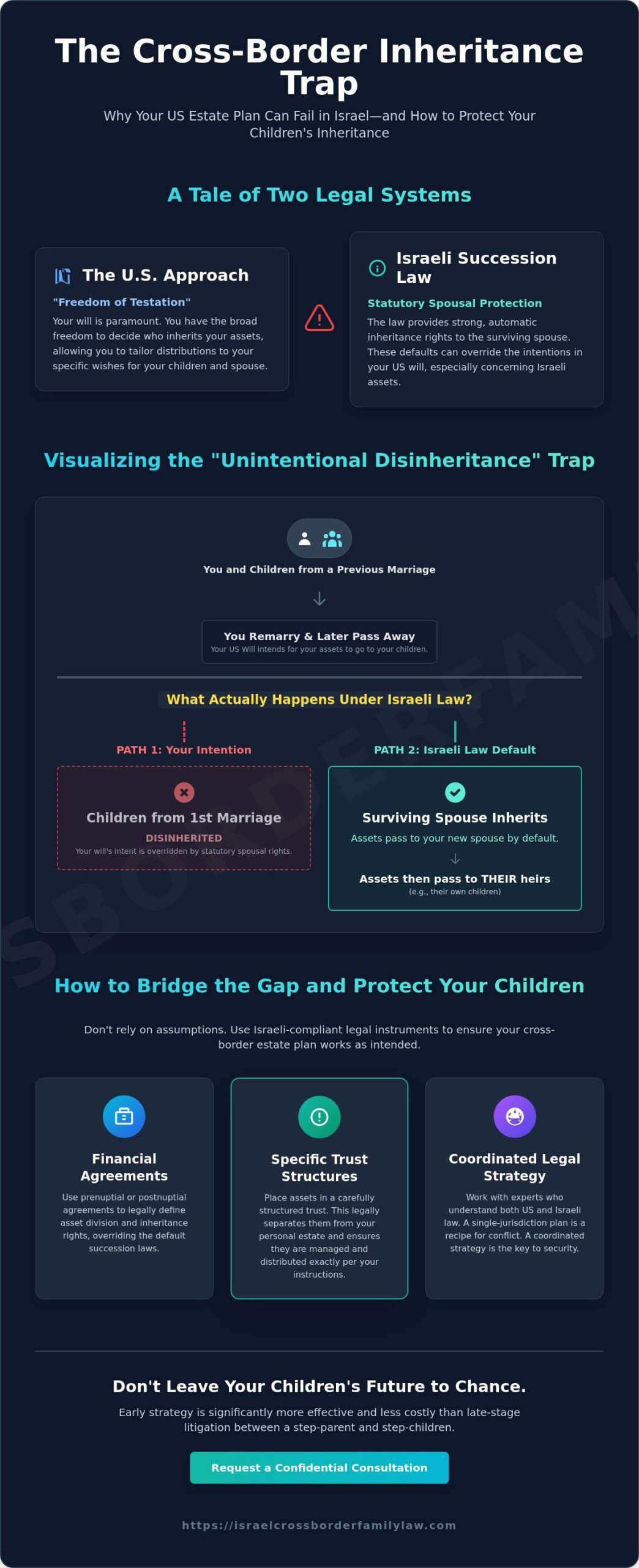
The US often champions “Freedom of Testation,” allowing you to leave your assets to almost anyone you choose. In contrast, IL law provides specific statutory protections that can override vague intentions. While your domicile might influence which law governs movable assets like bank accounts, Israeli real estate is almost always governed by IL law. This means your property in Jerusalem or Tel Aviv will follow Israeli succession rules regardless of what your US will says. A look at global inheritance laws shows that while many systems aim for fairness, the definition of “fair” varies wildly between jurisdictions. Early strategy is significantly more effective and less costly than late-stage litigation between a step-parent and step-children. It’s about understanding how it works before the crisis hits. Get clarity before you commit. Request a confidential consultation.
The following article is published on an independent advisory platform and does not constitute a law firm or an attorney-client relationship. Legal services are only provided by licensed attorneys under a separate engagement.
How Israeli Succession Law Treats Children from Previous Marriages
The Israeli Succession Law 5725-1965 serves as the primary framework for all inheritance matters within the country. It’s a comprehensive statute that dictates how an estate is handled when someone passes away, whether they left a will or not. Unlike many US jurisdictions that prioritize “testamentary freedom,” the Israeli system is designed with specific statutory defaults that favor the surviving spouse. This legal orientation can create unexpected hurdles for those trying to protect the rights of children from a previous marriage in inheritance, as the law doesn’t always align with the “common sense” expectations of Anglo expats.
When a person dies without a valid will in IL, they’re considered to have died “intestate.” In these cases, the law provides a rigid distribution formula. It’s also vital to distinguish between different types of heirs. Biological and adopted children are recognized as “legal heirs” with automatic rights. Step-children, regardless of the length or depth of the relationship, have no automatic standing under the Succession Law. If they aren’t explicitly named in a valid will, they’re legally excluded from the inheritance process. Most administrative aspects are handled by the Registrar of Inheritance Affairs, but any dispute or complexity typically moves the case to the Family Court for a judicial ruling.
The Default Split: Intestacy Rules
Under the standard intestacy rules, the estate is generally split 50/50 between the surviving spouse and the children of the deceased. While a 50% share for the children might sound fair, the spouse receives additional priorities that can complicate the estate. The surviving spouse is entitled to all “household goods” and the family car before the 50/50 split occurs. This often results in adult children from a previous marriage becoming co-owners of the family home alongside a step-parent. Such shared ownership is a frequent source of tension, especially if the children want to sell the asset while the step-parent wishes to remain in the property.
The Validity of Foreign (US) Wills in Israel
An Israeli court can technically enforce a will drafted in a US state like New York or California, but the process is far from automatic. Every estate in IL requires either a “Succession Order” for those without a will or a “Probate Order” to validate an existing one. For a foreign will to be accepted, it must meet the formal requirements of the place it was written or the requirements of Israeli law. If a US-drafted will is vague or fails to address specific Israeli assets, it becomes highly vulnerable to legal challenges from disgruntled heirs. You can request a confidential case review to assess whether your current documents are likely to withstand the Israeli probate process. Get clarity before you commit. Request a confidential consultation.
The following article is published on an independent advisory platform and does not constitute a law firm or an attorney-client relationship. Legal services are only provided by licensed attorneys under a separate engagement.
The Conflict: Surviving Spouse Rights vs. Children’s Expectations
A common sentiment among international families is the desire for the surviving spouse to “get everything first,” with the understanding that the children will inherit whatever remains later. While this approach is rooted in mutual trust, it often creates a significant legal vulnerability known as the “remarriage trap.” In a cross-border context, if a surviving spouse inherits the entire estate, those assets become part of their own legal domain. If that spouse later remarries or simply drafts a new will, they can legally direct the entire inheritance to their own biological children or a new partner. This effectively leaves the rights of children from a previous marriage in inheritance entirely dependent on the goodwill of a step-parent rather than legal certainty.
Many couples attempt to solve this using “Mutual Wills” or mirror wills, which are common in the US. However, Israeli law under Section 8A of the Succession Law imposes specific restrictions on these documents. Unless the will explicitly states otherwise, a surviving spouse in IL may be able to change their will after the first spouse passes away, provided they follow certain procedures. This creates a strategic “blind spot” where the first spouse’s children can be unintentionally disinherited years after the first parent’s death. Additionally, the “Right of Residence” often allows a surviving spouse to remain in the family home for a set period or even indefinitely, even if the children technically own 50% of the property. This can delay the children’s access to their inheritance for decades.
Statutory Protections for the Spouse
Israeli family law provides robust protections that make it difficult to leave a spouse with nothing. One such mechanism is “Maintenance from the Estate,” which allows a surviving spouse to claim monthly financial support for their basic needs before any assets are distributed to the children. This “Alimony from the Estate” concept ensures that the spouse’s standard of living is maintained, potentially depleting the liquid assets intended for the heirs. In IL, a spouse cannot be easily disinherited even by a clear and valid will; the law prioritizes their immediate welfare over the future expectations of adult children.
Risks for Children from Previous Marriages
Children from prior relationships face unique hurdles when trying to protect their interests. Unlike a spouse, adult children often find it nearly impossible to prove “financial dependence” to challenge a will that favors a step-parent. Beyond these structural risks, assets held in “Joint Accounts” with a new spouse often bypass the probate process entirely through the “Right of Survivorship” or similar banking clauses. This allows the surviving spouse to take immediate control of the funds, creating a risk of asset dissipation before the children have any legal standing to intervene. You can discuss these specific risks to determine how they apply to your family structure. Get clarity before you commit. Request a confidential consultation.
The following article is published on an independent advisory platform and does not constitute a law firm or an attorney-client relationship. Legal services are only provided by licensed attorneys under a separate engagement.
Proactive Strategies to Protect Your Children’s Inheritance
Planning for a blended family requires more than just good intentions. It demands a technical bridge between two different legal cultures. Before you commit to a specific plan, understanding how it works in the Israeli context is essential. Many families wait until a crisis occurs to seek help, but by then, the legal defaults may already be in motion. Proactive strategy allows you to define the rights of children from a previous marriage in inheritance before the complexity of a cross-border probate becomes an issue.
Financial Agreements (Prenups and Postnups)
In IL, a standard US prenuptial agreement may not provide the protection you expect. Israeli courts require specific validation for financial agreements to be legally binding, especially regarding inheritance matters. A “Financial Agreement” under the Property Relations Act of 1973 must be approved by a judge or a registrar to ensure both parties understand the implications. These agreements are powerful tools. They can explicitly state that certain assets are separate property and that a spouse waives their statutory inheritance rights in favor of children from a previous relationship. This provides a level of certainty that a simple will often cannot achieve on its own.
Dual-Jurisdiction Estate Planning
Managing assets in both the US and IL requires a “Two-Will Strategy.” This involves having a US-compliant will for your American accounts and property, and a separate Israeli will specifically tailored for your assets in IL. This prevents the administrative delays of translating and validating a foreign document in the Israeli Registrar’s office. You must also coordinate beneficiary designations on life insurance policies and IRAs. If these aren’t aligned with your Israeli documents, they could bypass your intended plan entirely. To avoid these issues, you can schedule a strategy session to align your global assets.
Another option to balance the needs of a spouse and children is the concept of a “Life Estate” or its Israeli equivalent. You can grant a surviving spouse the right to live in a property for their lifetime while the underlying ownership is immediately transferred to your children. This ensures the spouse has a home while guaranteeing the children’s eventual inheritance. You can find more examples of Estate Planning for International Families on our YouTube channel, which highlights common pitfalls for those with assets in multiple countries. Get clarity before you commit. Request a confidential consultation.
The following article is published on an independent advisory platform and does not constitute a law firm or an attorney-client relationship. Legal services are only provided by licensed attorneys under a separate engagement.
Navigating the Complexity: Why Strategy Matters
Navigating the dense thicket of international law requires a steady hand and a clear perspective. For families with ties to both the US and IL, the primary challenge is often the language of the law itself. While legal terminology can be opaque, “plain English” clarity is essential to ensure every family member understands their position and their future. A strategic approach acts as a bridge, connecting familiar US estate planning concepts with the specific requirements of the Israeli Succession Law. Protecting the rights of children from a previous marriage in inheritance is a multi-layered process that demands attention to detail in both jurisdictions. Without this bridge, documents that seem secure in one country can become entirely ineffective in the other, leaving heirs in a state of legal uncertainty.
Strategy Over Jargon
One-size-fits-all templates often fail in these situations because they don’t account for the unique friction points in cross-border inheritance. A will that works perfectly in California might not address the nuances of Israeli real estate or the complexities of the 1975 US-Israel tax treaty. Effective planning focuses on risk-based decision-making rather than simply filling out standard forms. By identifying potential conflicts early, such as the “remarriage trap” or joint account survivorship issues, you can build a robust plan that stands up to scrutiny in both countries. This proactive stance is far more effective and less expensive than trying to fix a broken estate plan during the probate process. It’s about building a strategy that respects the laws of both nations while prioritizing the rights of children from a previous marriage in inheritance.
For those managing a cross-border estate with assets in the United States, it is crucial to have professional oversight of your domestic documents; you can check out Massingill Attorneys & Counselors at Law for assistance with US-based estate planning and probate matters.
Getting Clarity Before You Commit
If you’re an expat remarrying in IL, your first steps should involve a thorough review of your global assets and current legal standing. Early decisions are the most powerful tools you have to prevent long-term family fractures and expensive court battles. Open communication is equally important. Involving adult children in the planning process can maintain family harmony and clarify your intentions before they become a source of legal dispute. By being transparent about your strategy, you reduce the likelihood of a child feeling the need to challenge a will later. We encourage you to seek a confidential case review to assess your specific risks and ensure your legacy is protected across all borders. Get clarity before you commit. Request a confidential consultation.
The following article is published on an independent advisory platform and does not constitute a law firm or an attorney-client relationship. Legal services are only provided by licensed attorneys under a separate engagement.
Securing Your Family’s Cross-Border Legacy
Protecting the rights of children from a previous marriage in inheritance requires moving beyond simple assumptions. You’ve seen how the Israeli Succession Law of 1965 creates specific defaults that can conflict with US-based plans, especially regarding the “remarriage trap” and shared property ownership. Balancing the immediate needs of a spouse with the long-term expectations of your children is a sophisticated task. It benefits from a proactive, multi-jurisdictional strategy.
Our bicultural and bilingual advisory team brings decades of experience in US-Israel cross-border law to help Anglo and expat families navigate these complexities. We focus on providing a seamless bridge between legal systems, helping you identify risks before they become disputes. Early strategy is the most effective way to ensure your assets are distributed exactly as you intend. Get clarity before you commit. Request a confidential consultation to assess your specific family needs. You can build a secure future for all your heirs through informed, strategic planning.
The following article is published on an independent advisory platform and does not constitute a law firm or an attorney-client relationship. Legal services are only provided by licensed attorneys under a separate engagement.
Frequently Asked Questions
Do children from a previous marriage have a legal right to inheritance in Israel?
Yes, biological and adopted children are recognized as first-degree heirs under the Succession Law of 1965. They possess the same legal standing as children from a current marriage. If a parent dies without a will, these children typically split 50% of the Israeli estate among themselves, while the surviving spouse receives the remaining half.
Can a US will protect my children’s rights to my apartment in Tel Aviv?
An Israeli court can enforce a US-drafted will, but it’s often an inefficient and risky strategy. Israeli real estate is strictly governed by local law, and a foreign document requires a “legal opinion on foreign law” to be validated. This adds significant time and expense to the probate process, making a separate Israeli will a much more secure option for local property.
What is the ‘spousal share’ in Israel if I die without a will?
Under the default intestacy rules, the surviving spouse inherits 50% of the entire estate plus all “household goods” and the family car. This often results in children from a previous relationship becoming involuntary co-owners of a home with a step-parent. This shared ownership can lead to long-term legal friction if the parties don’t agree on whether to sell or keep the asset.
Can I disinherit a child from a previous marriage under Israeli law?
Israeli law allows for full freedom of testation, meaning you can choose to disinherit a child through a valid will. Unlike some jurisdictions with “forced heirship” rules, IL doesn’t require you to leave a minimum percentage to your children. However, the rights of children from a previous marriage in inheritance are often defended in court through challenges based on “undue influence” or “lack of capacity” if the will is not drafted carefully.
How do Israeli courts handle step-children in inheritance disputes?
Step-children have no automatic inheritance rights under the Succession Law, regardless of how long they lived with the deceased. They are only considered heirs if they were legally adopted or are explicitly named as beneficiaries in a valid will. Without these specific legal steps, step-children are excluded from the distribution of assets by default.
Is a US trust valid for holding property in Israel for my children?
Israeli law doesn’t recognize the “trust” concept in the same way the US legal system does, which can lead to complications at the Land Registry. Registering Israeli property in a US trust often triggers complex tax issues or registration refusals. It’s generally more effective to use Israeli-specific legal structures to ensure assets are held securely for your heirs.
What happens if my Israeli spouse and US children disagree on the will?
When a dispute arises, the case is transferred from the Registrar of Inheritance Affairs to the Family Court for a judicial ruling. The court will examine the validity of the will and may consider “maintenance” claims from the spouse before distributing assets. This litigation can easily last 18 to 24 months, especially when heirs are residing outside of IL.
How long does the probate process take in Israel for a foreign resident?
The probate process for a foreign resident with Israeli assets typically takes between 6 and 12 months to complete. This timeline includes the mandatory 14-day publication period for public objections and the time required for certified translations of foreign documents. If the will is contested, the process can extend significantly beyond these initial estimates.

Article by
Gabriel Lior
A Personal Journey That Became a Mission
The advisory was founded by an American father Gabriel Lior, LLB, MBA , global entrepreneur, and cross-border advisor who spent more than a decade navigating the Israeli family court system firsthand and now lives in Singapore with his son.
As a divorced parent in a cross-border family, Gabriel faced nearly every legal challenge a foreign parent can encounter in Israel — including child custody disputes, child support proceedings, property matters in Israel and abroad, false accusations, and complex immigration and relocation proceedings.
Over the years, he learned the hard way how difficult it is for non-Israeli parents to understand the system, identify the right legal strategy, and choose the right legal representation — especially when language, culture, and jurisdictional differences are involved. He also witnessed how foreign parents and new immigrants are often disadvantaged or taken advantage of by service providers and institutions simply because they lack local knowledge or fluency.
From Client to Advisor
To truly understand — and survive — the system, Gabriel pursued formal legal education in Israel, completing two Israeli law degrees, alongside a BA and MBA earned in the United States. This was never about becoming a practicing attorney, but about gaining a deep, structural understanding of how the system works — and where it breaks down for foreign parents.
This rare combination of:
Firsthand client experience
Israeli legal and US business education
International business and negotiation training
Decades of commercial execution
created a unique perspective – one that understands both sides of the table.
After years of litigation, persistence, and at times self-representation, he ultimately succeeded in securing custody of his son and relocating abroad through a rare legal victory in the Israeli Supreme Court — becoming one of the first fathers in Israel to do so under these circumstances.
Disclaimer
Important Disclaimer:
The information provided on this website and in its content is for general informational and educational purposes only and does not constitute legal advice, legal opinion, or legal representation.
Gabriel Lior is not licensed to practice law in Israel (nor is he interested in doing so) and does not provide legal services, despite having completed 2 Law Degrees. The services offered are advisory in nature and are intended to provide general guidance, strategic insight, and information regarding cross-border family law considerations.
No attorney-client relationship is formed by accessing this website, reading its content, or communicating with us.
Any decisions made based on this information are at your own discretion and risk. For legal advice specific to your situation, you should consult a licensed attorney in the relevant jurisdiction.
Where appropriate, we may refer clients to independent, licensed attorneys or professionals. Such referrals do not constitute legal representation and no liability is assumed for services provided by third parties.