Could a single filing in an Israeli court determine the fate of the US-based RSUs and stock options you spent years accruing? For many expats, the realization that Israeli family law can reach across the Atlantic to impact Silicon Valley equity is a source of significant stress. If you are searching for a family lawyer for us tech worker in israel, you likely already recognize that your situation requires more than standard legal advice. You need a cross-border strategy that accounts for the dual Rabbinical and Civil court systems while protecting the complex financial instruments that define a high-tech career.
We understand that the intersection of international relocation and high-stakes asset division feels like a maze. It’s natural to feel anxious about how your mobility might be restricted or how pre-marital assets are treated under Israeli law. This guide provides strategic clarity, offering a framework to protect your tech equity and secure your family’s future. We will explore the risks of jurisdictional “races” and the practical steps to maintain international family mobility. This content is published on an independent advisory platform for informational purposes and does not constitute formal legal advice or an attorney-client relationship.
Key Takeaways
- Understand the strategic importance of the “Race to Court” and how the choice between Civil and Rabbinical systems can fundamentally change your legal trajectory.
- Learn how Israeli courts evaluate and divide high-tech career assets, specifically unvested RSUs and stock options, as part of marital property.
- Gain clarity on the significant legal barriers to international relocation and how the Hague Convention governs child custody for US families living in Israel.
- Discover how a family lawyer for us tech worker in israel can help validate foreign prenuptial agreements using local “mirror agreements” to ensure your assets are protected in both jurisdictions.
- Identify the “Center of Life” criteria used by Israeli courts to determine whether they have the authority to rule on your international financial and family matters.
The Intersection of US Tech Careers and Israeli Family Law
US tech workers in Israel often operate in a global financial ecosystem while living under a local legal framework that differs significantly from what they left behind in California or New York. The lifestyle of a tech expat, characterized by high-value equity packages and international mobility, creates specific legal vulnerabilities. Unlike standard domestic cases, these situations involve assets that are frequently subject to both US and Israeli regulations. This content is published on an independent advisory platform for informational purposes and does not constitute formal legal advice or an attorney-client relationship.
To better understand the tech landscape in Israel, watch this helpful video:
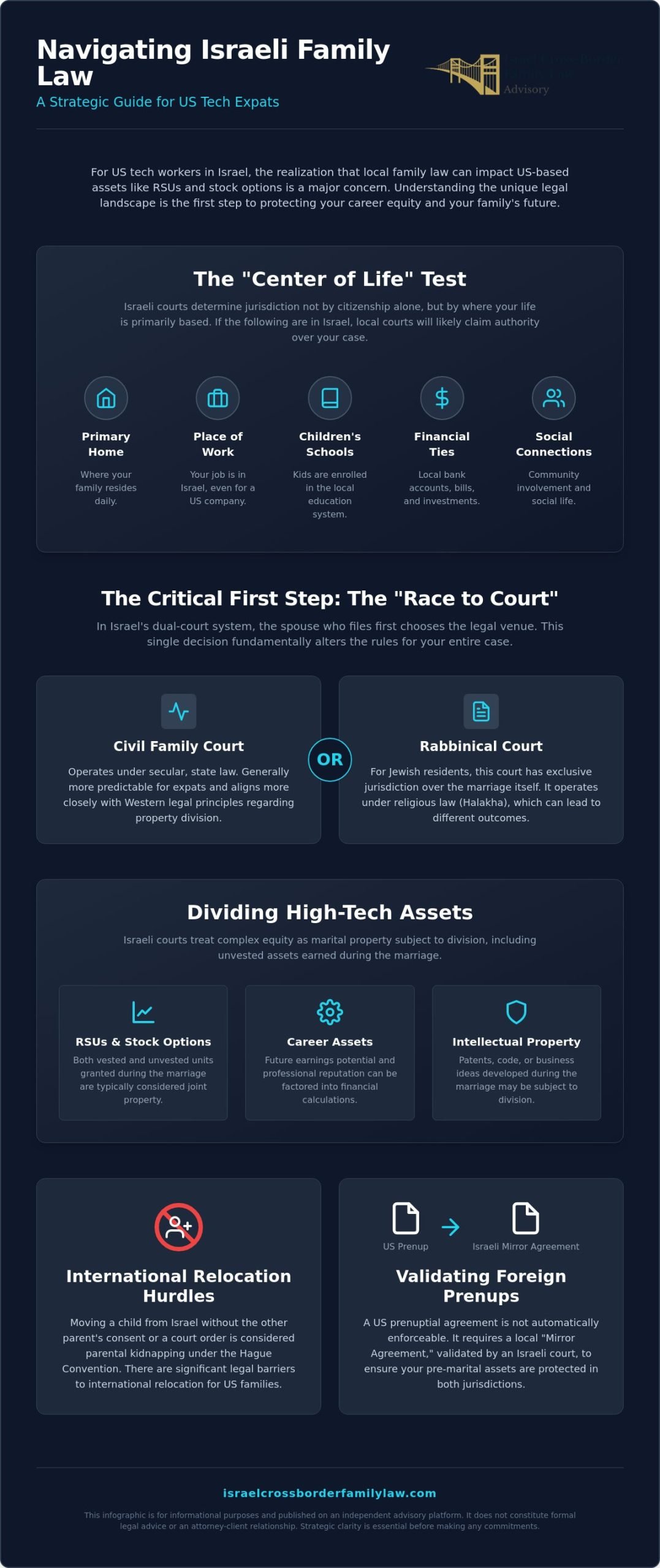
One of the most critical concepts to grasp is the “Center of Life” test. Israeli courts don’t rely solely on citizenship to determine jurisdiction. Instead, they look at where your daily life, family, and financial interests are concentrated. If you live in Israel, work for a local startup or the Israeli branch of a multinational, and your children attend local schools, the Israeli family court system will likely claim authority over your personal affairs. This applies even if you maintain a US bank account or own property in the States.
Many US citizens mistakenly believe their passport or the fact that their marriage was performed in a US civil court provides a layer of protection from local religious or civil laws. In reality, Israeli Marriage and Divorce Laws dictate that for Jewish residents, the Rabbinical courts have exclusive jurisdiction over the marriage itself, regardless of where the ceremony took place. This is why a family lawyer for us tech worker in israel acts as a strategic advisor, helping you navigate these overlapping systems before a crisis occurs.
Defining the “Anglo” Expat Experience in Israel
Expats from English-speaking countries often expect a legal system that mirrors the predictability of US common law. However, Israel’s dual-court system introduces a layer of complexity unfamiliar to most Americans. Standard Israeli legal advice might overlook the nuances of your US-based assets or the implications of the US-Israel tax treaty. A strategy that protects your career assets must be cross-border by design, accounting for how a decision in Tel Aviv might impact your tax obligations or asset vesting in the United States.
Initial Risks and Early Decision-Making
In international family disputes, early decisions carry immense weight. The choice of where to file and which court to approach first can dictate the rules for asset division and custody for years to come. Seeking clarity before making any formal commitments is the most effective way to manage these risks. For those just beginning to navigate these waters, reviewing Information for expats and foreign nationals can provide a necessary foundation. Understanding the differences between the systems is not just about legal defense; it’s about making informed choices for your family’s future.
Navigating Jurisdictional Complexity: The “Race to Court”
The “Race to Court,” known in Hebrew as Meroz Samchuyot, is perhaps the most distinctive and strategically significant feature of the Israeli legal system. In many jurisdictions, the choice of court is a matter of administrative convenience. In Israel, it is a procedural competition that can fundamentally alter the rules of your case. The spouse who files first has the power to choose between two parallel systems: the civil Family Court and the religious Rabbinical Court. This content is published on an independent advisory platform for informational purposes and does not constitute formal legal advice or an attorney-client relationship.
For a US tech worker, the forum determines the legal lens through which their US-based equity and Israeli earnings will be viewed. While both courts are bound by the Spouses’ Property Relations Law of 1973, they often interpret it differently, particularly regarding alimony and the division of complex assets. If one spouse files for divorce in the Rabbinical court and “attaches” matters of property and support to that claim, that court gains authority over those issues. This remains true even for secular or non-religious expats, provided they are Jewish under religious law. Gaining a clear understanding of how the jurisdictional process works is the first step in protecting your interests.
Civil Family Court vs. Rabbinical Court
The civil Family Court generally mirrors Western legal expectations, focusing on a strict 50/50 division of assets accumulated during the marriage. The Rabbinical Court, however, operates under Halacha (Jewish law). While it must respect civil property laws, its perspective on “rehabilitative alimony” or the valuation of future earning capacity can vary. Many expats are surprised to find that the Rabbinical system maintains exclusive jurisdiction over the actual dissolution of a Jewish marriage, but its reach into financial matters depends entirely on who wins the “race” to file first. Consulting a family lawyer for us tech worker in israel is essential to evaluate which forum aligns with your specific asset profile.
The International Jurisdictional Conflict
US citizens often wonder if they can bypass the Israeli system by filing in a US court. While you can initiate proceedings in the States, Israeli courts are often reluctant to cede jurisdiction if the family’s “Center of Life” is firmly established in Israel. This creates a risk of “Forum Non Conveniens” arguments, where a court decides it is not the appropriate place to hear the case. If dual-filing occurs, you may face conflicting orders from different countries. Strategy in these cases often involves seeking protective orders or negotiating jurisdictional agreements early to avoid a prolonged multi-country legal battle. A family lawyer for us tech worker in israel can help coordinate with US counsel to ensure your global interests are synchronized rather than in conflict.
High-Tech Assets: RSUs, Stock Options, and Intellectual Property
For many professionals in the startup ecosystem, the majority of their wealth is tied up in complex financial instruments rather than liquid savings. When a marriage dissolves, the valuation and division of these assets become the central focus of the dispute. In Israel, the default framework is “Resource Balancing,” which generally dictates an equal division of all assets accumulated during the marriage. This content is published on an independent advisory platform for informational purposes and does not constitute formal legal advice or an attorney-client relationship.
A family lawyer for us tech worker in israel must address the fact that Israeli courts often view unvested RSUs and stock options as marital property. Unlike some US jurisdictions that might only look at vested shares, Israeli judges frequently apply a “time rule” to determine what portion of a future vest belongs to the marital estate. This can be particularly stressful for workers whose equity is subject to the Section 102 tax track, where assets must be held by a trustee for at least 24 months to qualify for the preferred 25% capital gains rate. Dividing these assets requires a strategy that accounts for both the future value and the potential tax liabilities in both countries.
Treatment of Tech Equity in US vs. Israel
Understanding how the two systems differ is essential for any cross-border asset strategy. The following table highlights the primary distinctions in how property is typically handled:
| Feature | US (Equitable Distribution) | Israel (Resource Balancing) |
|---|---|---|
| Core Principle | Fair, but not always equal, division based on many factors. | Strict 50/50 division of assets gained during the marriage. |
| Unvested Equity | Treatment varies significantly by state and specific “vesting” tests. | Generally considered a marital asset if the work was done during marriage. |
| Future Earnings | Rarely factored into property division; usually handled via alimony. | Can be categorized as “Career Assets” or “Reputation Assets.” |
Intellectual Property and Future Earnings
Founders and early-stage employees face unique risks regarding intellectual property and future startup exits. Israeli family law has evolved to recognize “Career Assets,” which include the increased earning capacity one spouse developed while the other supported the household. This means a spouse might claim a portion of the value of a professional reputation or the potential windfall from a future M&A event. If you are involved in corporate leadership, you may find our guide on Navigating US-Israel M&A: Your Comprehensive Guide helpful for understanding the broader commercial context.
Finally, US-based retirement accounts like 401ks and IRAs present a significant hurdle. While an Israeli court can order the division of these funds, enforcing that order in the US requires specific legal instruments like a Qualified Domestic Relations Order (QDRO). Without careful coordination, you risk a situation where one spouse is ordered to pay out funds they cannot actually access without massive tax penalties. Consulting a family lawyer for us tech worker in israel is the only way to ensure your US retirement strategy survives an Israeli court’s scrutiny.
International Relocation and Custody for US Families
Many US families arrive in Israel with the assumption that they can return to the States at any time. However, once children are integrated into Israeli life, the legal reality changes significantly. If one parent wishes to move back to the US and the other does not consent, the Israeli court system becomes the primary gatekeeper of that decision. This content is published on an independent advisory platform for informational purposes and does not constitute formal legal advice or an attorney-client relationship.
The primary legal framework governing these situations is the Hague Convention on the Civil Aspects of International Child Abduction. This international treaty ensures that custody decisions are made in the child’s country of “habitual residence.” For a family lawyer for us tech worker in israel, defining this residence is a critical strategic task. If your children have lived in Israel for a year or more, attend local schools, and have established social ties, a court will likely view Israel as their habitual residence. This makes obtaining a relocation order to the US a complex and lengthy legal process that requires clear evidence of the move’s benefit to the child.
Custody and Child Support Across Borders
Custody norms in Israel differ from those in many US states. While shared custody is becoming more common, the “Tender Years Doctrine” still influences many decisions; it often creates a presumption that young children should remain with their mother. Additionally, child support for high-earning tech professionals is calculated based on specific Israeli formulas that may not align with US expectations. Understanding child support and cross-border enforcement is essential for maintaining financial stability and ensuring that orders are respected in both jurisdictions.
Preventing International Parental Abduction
To prevent a child from being removed from Israel without consent, courts frequently issue “Stay of Exit” orders, known as Tsav Ikur Yetzia Min HaAretz. These orders can be applied to both children and parents, effectively preventing international travel until a legal dispute is resolved. For US families, the Hague Convention and child abduction laws provide a protective framework, but they require swift action and precise filing. Creating a “relocation-proof” parenting plan early in your stay can help mitigate these risks and provide a clear path for future mobility.
If you are concerned about your ability to relocate or want to protect your parental rights, you should discuss your situation with a strategic advisor who understands how to bridge both legal systems.
Strategic Planning: Prenups and Advisory for Tech Workers
Strategic planning is the most effective way to manage the inherent risks of a cross-border lifestyle. For many professionals, this begins with a critical look at existing financial agreements. This content is published on an independent advisory platform for informational purposes and does not constitute formal legal advice or an attorney-client relationship. Relying on assumptions about how your US-based assets will be treated in a foreign court can lead to significant financial exposure.
A common misconception is that a US-drafted prenuptial agreement will be automatically enforced in Israel. While Israeli courts generally respect foreign contracts, they often require that such agreements be validated by an Israeli Family Court or a local notary to be fully binding. Without this formal validation, your US-based equity and intellectual property could still be subject to local “Resource Balancing” rules. A family lawyer for us tech worker in israel can help you determine if your current documentation meets these specific local standards or if additional steps are necessary to secure your assets.
The Mirror Agreement Strategy
To ensure comprehensive protection, many tech professionals utilize a “Mirror Agreement.” This is a secondary document drafted in Israel that reflects the terms of your US agreement but is formatted and executed to satisfy local law. This strategy is particularly vital for addressing RSU vesting schedules and potential startup exits, which are treated with high specificity in the Israeli system. By mirroring your US terms in a local context, you reduce the risk of a court interpreting your equity as a shared marital asset. You can learn more about how the advisory process works to help align these dual-jurisdiction documents.
Next Steps: Securing Your Future
Proactive planning isn’t just about preparing for a dispute; it’s about integrated financial and estate management. If you hold assets in both the US and Israel, your will and estate plan must account for the tax and inheritance laws of both nations. Integrating your family law strategy with your broader financial goals ensures that your career assets remain protected regardless of where you reside. A family lawyer for us tech worker in israel acts as a bridge between these systems, ensuring your decisions today don’t create liabilities tomorrow.
Gaining clarity before you commit to a specific legal path is essential for protecting your professional and personal interests. For more detailed insights into specific cross-border scenarios and asset protection, you can view the resources available on our YouTube channel at Israel Family Law. A confidential case review is often the best way to identify hidden risks and develop a framework that supports your long-term mobility and financial security.
Get clarity before you commit. Request a confidential consultation.
Strategic Clarity for Your Cross-Border Life
Navigating the intersection of US tech assets and Israeli family courts requires a proactive approach to risk management. The “Race to Court” and the valuation of unvested equity like RSUs can significantly impact your financial stability for years to come. Whether you are validating a prenuptial agreement through a mirror strategy or managing international relocation concerns, the weight of early decisions cannot be overstated. This content is published on an independent advisory platform for informational purposes and does not constitute formal legal advice or an attorney-client relationship.
This advisory platform specializes in strategy and risk management for complex international family matters. Our focus remains on the specific needs of high-net-worth tech professionals who operate across borders. If you need a family lawyer for us tech worker in israel, it’s essential to work with practitioners who understand the multi-jurisdictional complexity of your lifestyle. Get clarity before you commit. Request a confidential consultation.
Protecting your global interests is possible with the right framework in place. Take the first step toward securing your future today.
Frequently Asked Questions
Are US prenuptial agreements enforceable in Israeli family courts?
US prenuptial agreements are generally recognized in Israel, but they aren’t automatically enforceable. To ensure your agreement holds weight, it’s often necessary to have it validated by an Israeli Family Court or a local notary. This process confirms the agreement meets local standards and protects assets like tech equity from being redistributed under Israeli resource balancing laws. Without this validation, a spouse might successfully challenge the agreement’s terms during a local dispute.
How are RSUs and stock options divided in an Israeli divorce?
Israeli courts treat RSUs and stock options as marital property subject to equal division. Judges typically apply a “time rule” to determine what percentage of unvested equity was earned during the marriage. This means that even if your shares haven’t vested yet, your spouse may have a claim to a portion of their future value based on the time you worked while married. The valuation often requires expert financial analysis to account for future market volatility.
What is the “Race to Court” and how does it affect US citizens?
The “Race to Court” refers to the procedural competition between the civil Family Court and the religious Rabbinical Court. Since both systems have different approaches to alimony and asset division, the spouse who files first effectively chooses the legal framework for the case. For US citizens, this decision is critical as it dictates how international assets are evaluated and whether religious law will influence the financial outcome of the divorce.
Can I move back to the US with my children after a divorce in Israel?
Moving back to the US with your children requires either the other parent’s written consent or a specific relocation order from an Israeli court. Israel adheres to the Hague Convention, which prioritizes the child’s habitual residence. If your children are settled in Israel, a court may deny relocation unless you can prove the move is in the child’s best interest. Unauthorized removal can lead to immediate legal action under international abduction treaties.
How does Israel calculate child support for tech workers with high salaries?
Israel calculates child support by assessing the child’s actual needs and the relative income of both parents. For high-earning tech professionals, courts may look beyond basic needs to maintain the standard of living the children experienced during the marriage. Consulting a family lawyer for us tech worker in israel is vital to ensure these calculations account for complex income structures like bonuses, equity vests, and international cost of living differences.
Do I need a lawyer licensed in both the US and Israel?
While you don’t strictly need a lawyer licensed in both countries, you do need a strategic advisor who understands the intersection of both legal systems. This content is published on an independent advisory platform for informational purposes and does not constitute formal legal advice or an attorney-client relationship. A professional with cross-border experience can coordinate with US counsel to ensure your global assets and parental rights are protected in both jurisdictions simultaneously.
What happens to my US-based 401k or IRA in an Israeli divorce?
US-based retirement accounts like a 401k or IRA are considered marital assets in an Israeli divorce. While an Israeli judge can order their division, you will still need a Qualified Domestic Relations Order (QDRO) in the US to actually split the funds. Without careful coordination between Israeli orders and US financial regulations, you could face significant US tax penalties or early withdrawal fees that diminish the value of the account.
Can the Rabbinical court take jurisdiction over my US tech assets?
The Rabbinical court can gain jurisdiction over your US tech assets if a divorce claim is filed there first and includes property division. If the “Race to Court” is won by the spouse filing in the Rabbinical system, that court has the authority to rule on all attached financial matters. This includes international bank accounts, real estate, and equity portfolios, even if those assets are physically located in the United States.

Article by
Gabriel Lior
A Personal Journey That Became a Mission
The advisory was founded by an American father Gabriel Lior, LLB, MBA , global entrepreneur, and cross-border advisor who spent more than a decade navigating the Israeli family court system firsthand and now lives in Singapore with his son.
As a divorced parent in a cross-border family, Gabriel faced nearly every legal challenge a foreign parent can encounter in Israel — including child custody disputes, child support proceedings, property matters in Israel and abroad, false accusations, and complex immigration and relocation proceedings.
Over the years, he learned the hard way how difficult it is for non-Israeli parents to understand the system, identify the right legal strategy, and choose the right legal representation — especially when language, culture, and jurisdictional differences are involved. He also witnessed how foreign parents and new immigrants are often disadvantaged or taken advantage of by service providers and institutions simply because they lack local knowledge or fluency.
From Client to Advisor
To truly understand — and survive — the system, Gabriel pursued formal legal education in Israel, completing two Israeli law degrees, alongside a BA and MBA earned in the United States. This was never about becoming a practicing attorney, but about gaining a deep, structural understanding of how the system works — and where it breaks down for foreign parents.
This rare combination of:
Firsthand client experience
Israeli legal and US business education
International business and negotiation training
Decades of commercial execution
created a unique perspective – one that understands both sides of the table.
After years of litigation, persistence, and at times self-representation, he ultimately succeeded in securing custody of his son and relocating abroad through a rare legal victory in the Israeli Supreme Court — becoming one of the first fathers in Israel to do so under these circumstances.
Disclaimer
Important Disclaimer:
The information provided on this website and in its content is for general informational and educational purposes only and does not constitute legal advice, legal opinion, or legal representation.
Gabriel Lior is not licensed to practice law in Israel (nor is he interested in doing so) and does not provide legal services, despite having completed 2 Law Degrees. The services offered are advisory in nature and are intended to provide general guidance, strategic insight, and information regarding cross-border family law considerations.
No attorney-client relationship is formed by accessing this website, reading its content, or communicating with us.
Any decisions made based on this information are at your own discretion and risk. For legal advice specific to your situation, you should consult a licensed attorney in the relevant jurisdiction.
Where appropriate, we may refer clients to independent, licensed attorneys or professionals. Such referrals do not constitute legal representation and no liability is assumed for services provided by third parties.