This article is published on an independent advisory platform and does not constitute legal representation or an attorney-client relationship. Legal services are only provided by licensed attorneys under a separate engagement.
You might assume that being a legal heir in the United States automatically grants you access to a bank account or apartment in Tel Aviv, but without a specific local document, those assets remain legally frozen. Many international families are surprised to find that foreign probate documents are not recognized in IL until the local Registrar issues its own decree. If your loved one passed away without a will, the central question you face is: what is an israeli succession order? Known in Hebrew as a Tzav Yerusha, this document is the essential legal key required under the Succession Law, 5725-1965, to transfer ownership of any assets located within the country.
It’s natural to feel anxious when navigating a foreign court system, especially when the process for non-residents typically takes between four to eight months. We understand the confusion surrounding Hebrew legal terms and the fear of assets being locked away indefinitely. This guide provides a clear roadmap of the Tzav Yerusha process, explains who is legally entitled to the estate under the 1965 law, and offers strategies to avoid common delays. You’ll learn how to bridge the gap between US records and Israeli standards to secure your inheritance through strategic planning. Get clarity before you commit. Request a confidential consultation. For more insights, visit: https://www.youtube.com/@IsraelFamilyLaw
Key Takeaways
- Gain a clear understanding of what is an israeli succession order and why this official decree is the only legal path to accessing assets when a deceased person has not left a valid will.
- Identify the legal hierarchy of heirs under the Succession Law, 5725-1965, which dictates how estates are divided between surviving spouses, children, and other relatives.
- Learn the essential procedural steps for US heirs, including the requirement for Apostille stamps on foreign documents and the necessity of professional Hebrew translations.
- Understand the strategic importance of the ‘Foreign Legal Opinion’ and how to coordinate your Israeli inheritance process with US estate tax obligations to avoid common cross-border delays.
This article is published on an independent advisory platform and does not constitute legal representation or an attorney-client relationship. Legal services are only provided by licensed attorneys under a separate engagement.
Defining the Israeli Succession Order (Tzav Yerusha)
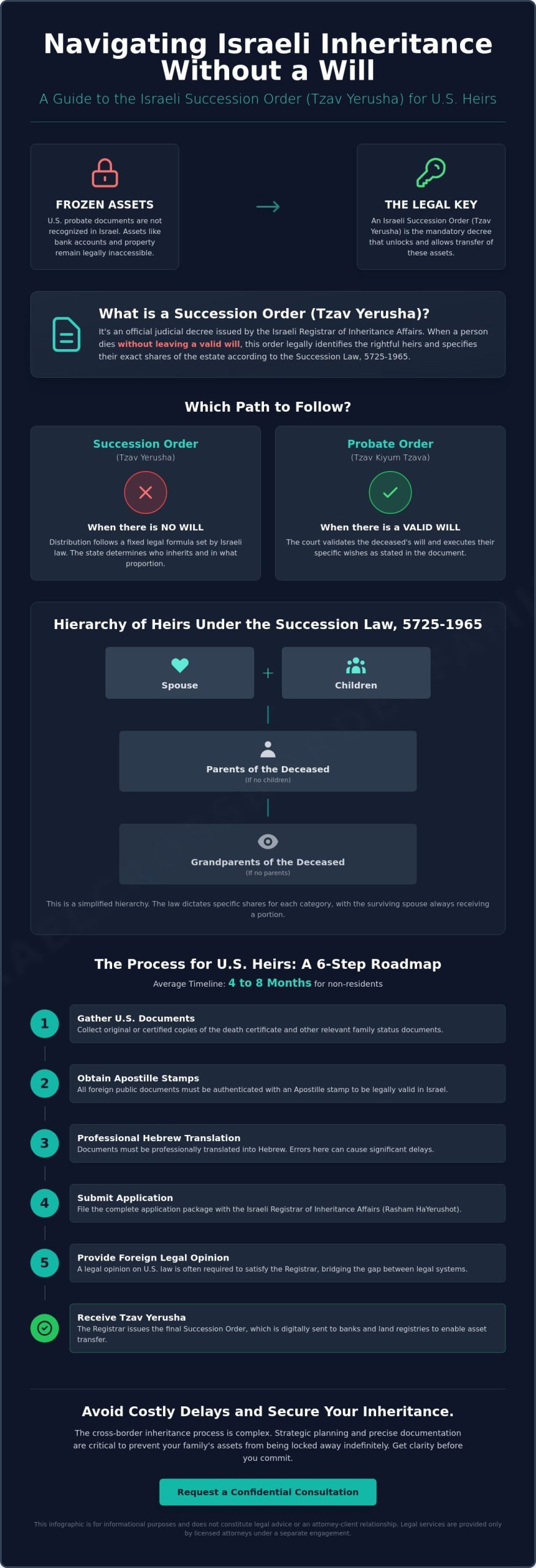
When an individual passes away leaving assets in IL but without a formal will, the legal process for distributing those assets is governed by a specific judicial decree. This document, known as a Succession Order or Tzav Yerusha, is the official ruling issued by the Israeli Registrar of Inheritance Affairs. It identifies the legal heirs and specifies their exact shares of the estate according to the default rules established by the state.
For many US-based families, the first step in this journey is understanding what is an israeli succession order and why it’s mandatory for cross-border estates. The Tzav Yerusha serves as the legal bridge between a deceased person’s estate and their rightful heirs under the Succession Law, 5725-1965. Without this decree, assets such as residential property or private bank accounts remain legally inaccessible to the family.
To better understand this concept, watch this helpful video:
Why You Need This Document for Israeli Assets
Israeli financial and governmental institutions operate under a strict local regulatory framework. They can’t release funds or transfer property titles based solely on foreign probate orders or US court documents. Whether you’re dealing with a bank in Tel Aviv or the Land Registry (Tabu), these entities require a locally validated order to proceed. The Registrar of Inheritance Affairs, or Rasham HaYerushot, is the administrative body responsible for reviewing these applications and ensuring the distribution aligns with IL law.
The impact of early decisions in this process is significant. Filing an application with errors or incomplete documentation can lead to lengthy delays or even indefinite asset freezes. Because the system is digital-first, a change implemented in 2023, once an order is issued, it’s sent directly to relevant registries. Starting with a clear strategy ensures that this digital hand-off happens smoothly rather than getting stuck in administrative review. You can explore more about these specific requirements for expats and foreign nationals to prepare effectively.
When a Succession Order Is Not the Right Path
It’s vital to distinguish between “intestate” and “testate” situations. If your loved one left a valid will, you’d typically apply for a Probate Order (Tzav Kiyum Tzava) rather than a Succession Order. While a Succession Order follows a fixed legal formula for distribution, a Probate Order focuses on validating and executing the specific wishes of the deceased. In complex cross-border situations, a family might find themselves navigating both systems if a US-based will exists but doesn’t meet certain IL legal standards. This often happens when the document wasn’t drafted with international assets in mind.
Get clarity before you commit. Request a confidential consultation.
This article is published on an independent advisory platform and does not constitute legal representation or an attorney-client relationship. Legal services are only provided by licensed attorneys under a separate engagement.
The Order of Heirs: Who Inherits Under Israeli Law?
Understanding what is an israeli succession order requires a look at the specific hierarchy of heirs defined by the state. Unlike some jurisdictions in the US where laws vary significantly by state, IL follows a unified national system established by the Succession Law, 5725-1965. This law prioritizes blood relations and marriage through a structured “parentelic” system. It ensures that the estate remains within the immediate family unless no such relatives exist.
The 1965 Succession Law provides a clear formula for distribution. If you’re a surviving spouse, you’re generally entitled to the deceased’s vehicle and movable household goods. Beyond these specific items, the remaining estate, including real estate and financial portfolios, is typically split; the spouse receives 50%, while the children share the other 50% equally. Applications for these decrees are processed by Israel’s Registrar of Inheritance, which ensures that the distribution follows these statutory requirements. If there are no children, the hierarchy moves upward to the deceased’s parents and then to grandparents and their descendants.
Spousal Rights and Common-Law Partners
IL law recognizes “Yaduim BeTzibur,” or common-law spouses, who often have the same inheritance rights as married couples. To qualify, the partners must have maintained a joint household at the time of death. This can create significant complexity for international families, especially if the surviving partner is not an IL citizen or resides abroad. Establishing the status of the relationship requires clear evidence to satisfy the Registrar. Families often benefit from reviewing their specific family tree before starting the application. You can begin this process by requesting a confidential case review to understand how these rules apply to your situation.
Rights of Children and Descendants
The law treats all children equally. It makes no distinction between “legitimate” and “illegitimate” children, and adopted children hold the same legal standing as biological ones. If a child of the deceased has already passed away, their own children (the deceased’s grandchildren) take their place in the hierarchy through the principle of representation. This ensures that a branch of the family isn’t excluded from the Tzav Yerusha simply because a parent died before the grandparent. Because these rules are fixed, they offer a sense of predictability, though they don’t allow for the flexibility often found in a drafted will.
Get clarity before you commit. Request a confidential consultation.
This article is published on an independent advisory platform and does not constitute legal representation or an attorney-client relationship. Legal services are only provided by licensed attorneys under a separate engagement.
Succession Order vs. Probate Order: Key Differences
Understanding what is an israeli succession order becomes much simpler when you compare it to its counterpart, the Probate Order (Tzav Kiyum Tzava). While both documents are official decrees from the Registrar of Inheritance Affairs, they serve different purposes based on the existence of a will. A Probate Order acts as a validation of a specific will, giving legal force to the deceased’s unique instructions. In contrast, a Succession Order creates a distribution plan from scratch based on the default legal formula found in the Succession Law of 1965.
The choice between these two paths isn’t optional; it’s dictated by the facts of the estate. If a valid will exists, you must seek a Probate Order. If there’s no will, or if the will is found to be invalid, the Succession Order becomes the necessary tool. Both processes share certain administrative requirements, such as a mandatory publication fee of approximately ₪130. This fee covers a public notice in a daily newspaper, which allows a window of time for potential creditors or unknown heirs to file objections before the Registrar issues a final decree. For US expats, the strategy depends entirely on whether a will was executed that specifically covers Israeli assets.
When a Foreign Will Exists
You can use a will signed in the US to distribute assets in IL, but it doesn’t happen automatically. The Israeli Registrar requires a “Foreign Legal Opinion” to confirm that the document is valid under the laws of the specific US state where it was signed. This is a critical step for expats and foreign nationals because the Registrar won’t simply take your word for it. Without this expert opinion, the court may default to a Succession Order, which might ignore the specific wishes laid out in your US estate plan. This complexity is why many families find that drafting a local Israeli will is a more efficient long-term strategy.
Common Pitfalls in Choosing the Wrong Path
One of the most costly mistakes is filing for a Succession Order only to have a will discovered later in the process. This mistake wastes the initial online application fee of approximately ₪505 and can reset the four to eight-month processing timeline. To avoid this, a strategic first step is searching the Israeli Will Registry. This search confirms if the deceased deposited a will for safekeeping, a service that costs approximately ₪125. Seeking clarity before you commit to a specific filing path prevents unnecessary fees and ensures you don’t inadvertently trigger an asset freeze by submitting conflicting information to the Registrar.
Get clarity before you commit. Request a confidential consultation.
This article is published on an independent advisory platform and does not constitute legal representation or an attorney-client relationship. Legal services are only provided by licensed attorneys under a separate engagement.
The Application Process for Foreign Residents
Applying for a legal decree from abroad involves specific administrative hurdles that differ from domestic filings. When families ask what is an israeli succession order application like for a US resident, the answer lies in the precision of the documentation. Because the system is now digital-first, errors in the initial submission can lead to immediate rejection or lengthy administrative holds. The process follows five primary steps designed to ensure the estate is distributed according to the Succession Law, 5725-1965.
- Step 1: Gather essential documents, most notably the original death certificate, which must bear an Apostille stamp from the issuing US state.
- Step 2: Draft the formal application in Hebrew. This includes identifying all legal heirs and their relationship to the deceased.
- Step 3: File the application electronically with the Registrar of Inheritance Affairs. The government fee for an online application is approximately ₪505.
- Step 4: Enter the mandatory publication phase. A notice is placed in Israeli newspapers for 14 days to alert potential creditors or heirs, requiring a fee of approximately ₪130.
- Step 5: Undergo review by the Administrator General. Once cleared, the Registrar issues the final digital order.
Handling US Documentation and Apostilles
An Apostille is a specialized certificate issued by a Secretary of State that authenticates a document for use in another country. For US heirs, this is mandatory. The Israeli Registrar won’t accept a standard death certificate or marriage license without it. Additionally, any English-language record requires a notarized Hebrew translation. These translations typically cost between ₪250 and ₪400 per page. If you’re struggling to locate records from US vital statistics offices, it’s best to address these gaps before starting the Israeli filing to prevent your application from being flagged. You can speak with an advisor about your documentation to ensure your file is complete.
The Role of the Administrator General (Appotrops HaKlali)
Every application involving a foreign resident is automatically transferred to the Administrator General for review. This government body acts as a supervisor to protect the rights of missing heirs or those who cannot represent themselves. It’s common to receive “queries” or requests for clarification during this phase. Responding promptly and accurately to these queries is the best way to prevent the process from stalling. While the total timeline for foreign residents typically ranges from four to eight months, the Administrator General’s specific review phase usually occupies two to four months of that window.
Get clarity before you commit. Request a confidential consultation.
This article is published on an independent advisory platform and does not constitute legal representation or an attorney-client relationship. Legal services are only provided by licensed attorneys under a separate engagement.
Strategic Considerations for Cross-Border Families
Managing an estate across two different legal systems requires a strategy that looks beyond simple document filing. When families ask what is an israeli succession order in the context of a global estate, they must consider how this local decree interacts with their obligations in the United States. For example, while IL does not levy an inheritance tax, the value of all Israeli assets must be accurately reported on the US Federal Estate Tax Return (Form 706) for US citizens or residents. Coordinating the timing and valuations between the two countries prevents conflicting records that could lead to audits or unnecessary tax liabilities.
Early legal strategy is also the most effective way to prevent disputes among family members. In cross-border situations, misunderstandings often arise from the inherent complexity of the 1965 Succession Law. By establishing a clear roadmap before the application is filed, heirs can reach a consensus on asset distribution and management. This is particularly important when a ‘Foreign Legal Opinion’ is required to explain US state law to the Israeli Registrar. Providing a robust, well-reasoned opinion from the start reduces the likelihood of the Registrar questioning the validity of the family’s claims. Get clarity before you commit. Request a confidential consultation.
Managing Heirs Living in Different Countries
Logistics often become a significant bottleneck for international families. Every heir living outside of IL must be properly represented in the proceedings, which typically requires a Power of Attorney (POA). This document must be signed either at an Israeli consulate or before a local notary and then authenticated with a state-level Apostille. There are also instances where an heir may choose to ‘renounce’ their share, legally known as סתלקות (Histalkut), in favor of a sibling or the surviving spouse. This decision must be documented correctly and submitted before the decree is issued to avoid complex title transfers later. You can learn more about how we guide families through these logistical challenges by reviewing how it works.
Next Steps: From Order to Asset Transfer
Obtaining the Tzav Yerusha is a major milestone, but it doesn’t automatically put money in your pocket. To release funds from an Israeli bank, you must present the digital order along with specific compliance forms. Israeli banks have strict anti-money laundering protocols and may require additional documentation from foreign heirs before transferring funds abroad. For real estate, the order must be registered at the Land Registry (Tabu). This registration is the final act that allows you to legally sell or lease the inherited property. Success in these final stages depends entirely on the accuracy of the decisions made during the initial application process.
This article is published on an independent advisory platform and does not constitute legal representation or an attorney-client relationship. Legal services are only provided by licensed attorneys under a separate engagement.
Securing Your Cross-Border Legacy
Navigating an estate between two countries requires more than just filling out forms. It demands a strategic approach that accounts for the 1965 Succession Law and the specific administrative requirements of the Registrar of Inheritance. By now, you should have a clear understanding of what is an israeli succession order and how it functions as the mandatory legal decree for estates without a valid will. Whether you’re managing property in Jerusalem or bank accounts in Tel Aviv, the precision of your initial application determines how quickly you can access these assets.
Our advisory focuses on the unique needs of Anglo families and expats. We provide the expertise required to handle complex Hebrew translation and Apostille requirements while ensuring your Israeli filings coordinate with US estate tax obligations. Early decisions regarding the ‘Foreign Legal Opinion’ and heir representation can prevent years of administrative delays. You don’t have to navigate this foreign system alone. With a steady guide, you can move forward with confidence and clarity.
Get clarity before you commit. Request a confidential consultation.
This article is published on an independent advisory platform and does not constitute legal representation or an attorney-client relationship. Legal services are only provided by licensed attorneys under a separate engagement.
Frequently Asked Questions
How long does it take to get a Succession Order in Israel?
For foreign residents, the process of obtaining a Succession Order typically takes between four to eight months. This timeline depends on the complexity of the estate and how quickly the family can provide authenticated documents. Applications involving heirs in the United States often require additional time for the mandatory review by the Administrator General.
Can I apply for an Israeli Succession Order if I live in the United States?
Yes, you can apply for the order from the United States without being physically present in IL. The application process is now digital-first, which allows for electronic filing with the Registrar of Inheritance Affairs. However, you must provide original US documents with Apostille stamps and notarized Hebrew translations to satisfy the Registrar’s requirements for non-residents.
Is there an inheritance tax in Israel for US citizens?
IL does not have an inheritance tax, regardless of the heir’s citizenship or place of residence. However, heirs are subject to a real estate appreciation tax, known as Mas Shevach, if they later decide to sell an inherited property. This tax is calculated based on the property’s value appreciation from the original purchase date by the deceased, not the date of inheritance.
What happens if a family member objects to the Succession Order?
If a family member or creditor files an objection during the 14-day publication period, the Registrar will transfer the case to the Family Court. This shifts the process from an administrative review to a formal legal dispute. Such objections can significantly extend the timeline and require a judge to determine the rightful distribution of the estate assets.
Do I need to fly to Israel to handle the succession process?
You don’t need to fly to IL to handle the succession process or manage the estate assets. Most heirs coordinate the entire procedure through a Power of Attorney signed at an Israeli consulate or authenticated via Apostille in their home state. This allows a local representative to navigate the Registrar’s requirements and interact with banks or the Land Registry on your behalf.
What is a ‘Foreign Legal Opinion’ and why is it required for heirs abroad?
A ‘Foreign Legal Opinion’ is a formal document that explains the laws of a specific US state to the Israeli Registrar. It’s required for non-residents to confirm that the estate distribution aligns with the laws of the deceased’s last place of residence. This document is a critical component for those asking what is an israeli succession order and how it applies to their cross-border situation.
Can I sell the deceased’s Israeli apartment before the Succession Order is issued?
You cannot legally complete the sale or transfer of an Israeli apartment until the Succession Order is issued and registered at the Land Registry (Tabu). While you might sign a preliminary agreement, the official transfer of title requires the final decree. Attempting to sell property before this step is finalized can lead to legal complications and the freezing of transaction funds at the bank.
What documents do I need from the US to start the process in Israel?
To start the process, you need the original death certificate and any marriage or birth certificates that prove your relationship to the deceased. Every US-issued document must have an Apostille stamp from the Secretary of State in the issuing jurisdiction. Once you have these authenticated records, they must be translated into Hebrew by a notary to be accepted by the Israeli Registrar.

Article by
Gabriel Lior
A Personal Journey That Became a Mission
The advisory was founded by an American father Gabriel Lior, LLB, MBA , global entrepreneur, and cross-border advisor who spent more than a decade navigating the Israeli family court system firsthand and now lives in Singapore with his son.
As a divorced parent in a cross-border family, Gabriel faced nearly every legal challenge a foreign parent can encounter in Israel — including child custody disputes, child support proceedings, property matters in Israel and abroad, false accusations, and complex immigration and relocation proceedings.
Over the years, he learned the hard way how difficult it is for non-Israeli parents to understand the system, identify the right legal strategy, and choose the right legal representation — especially when language, culture, and jurisdictional differences are involved. He also witnessed how foreign parents and new immigrants are often disadvantaged or taken advantage of by service providers and institutions simply because they lack local knowledge or fluency.
From Client to Advisor
To truly understand — and survive — the system, Gabriel pursued formal legal education in Israel, completing two Israeli law degrees, alongside a BA and MBA earned in the United States. This was never about becoming a practicing attorney, but about gaining a deep, structural understanding of how the system works — and where it breaks down for foreign parents.
This rare combination of:
Firsthand client experience
Israeli legal and US business education
International business and negotiation training
Decades of commercial execution
created a unique perspective – one that understands both sides of the table.
After years of litigation, persistence, and at times self-representation, he ultimately succeeded in securing custody of his son and relocating abroad through a rare legal victory in the Israeli Supreme Court — becoming one of the first fathers in Israel to do so under these circumstances.
Disclaimer
Important Disclaimer:
The information provided on this website and in its content is for general informational and educational purposes only and does not constitute legal advice, legal opinion, or legal representation.
Gabriel Lior is not licensed to practice law in Israel (nor is he interested in doing so) and does not provide legal services, despite having completed 2 Law Degrees. The services offered are advisory in nature and are intended to provide general guidance, strategic insight, and information regarding cross-border family law considerations.
No attorney-client relationship is formed by accessing this website, reading its content, or communicating with us.
Any decisions made based on this information are at your own discretion and risk. For legal advice specific to your situation, you should consult a licensed attorney in the relevant jurisdiction.
Where appropriate, we may refer clients to independent, licensed attorneys or professionals. Such referrals do not constitute legal representation and no liability is assumed for services provided by third parties.