Receiving a court order demanding your child’s return to another country under the Hague Convention is a profoundly distressing experience, placing you at the center of a complex international legal battle. The fear for your child’s safety and the overwhelming confusion of navigating multi-jurisdictional law can be paralyzing. However, it is critical to recognize that a return order is not the final word. A sophisticated legal strategy, grounded in a deep understanding of the available defenses against a Hague Convention return order, provides a powerful pathway to protect your family and uphold your child’s best interests. This comprehensive guide is engineered to deliver that critical understanding. We will meticulously detail the six primary legal defenses available to challenge a return order, offering strategic insights specifically tailored to the unique legal landscape of US-Israel cases. Our objective is to equip you with the clarity needed to navigate this challenging process, understand the arguments that can be made on your child’s behalf, and identify the expert legal counsel essential for representing your case effectively.
Understanding the Hague Convention and the ‘Wrongful Removal’ Standard
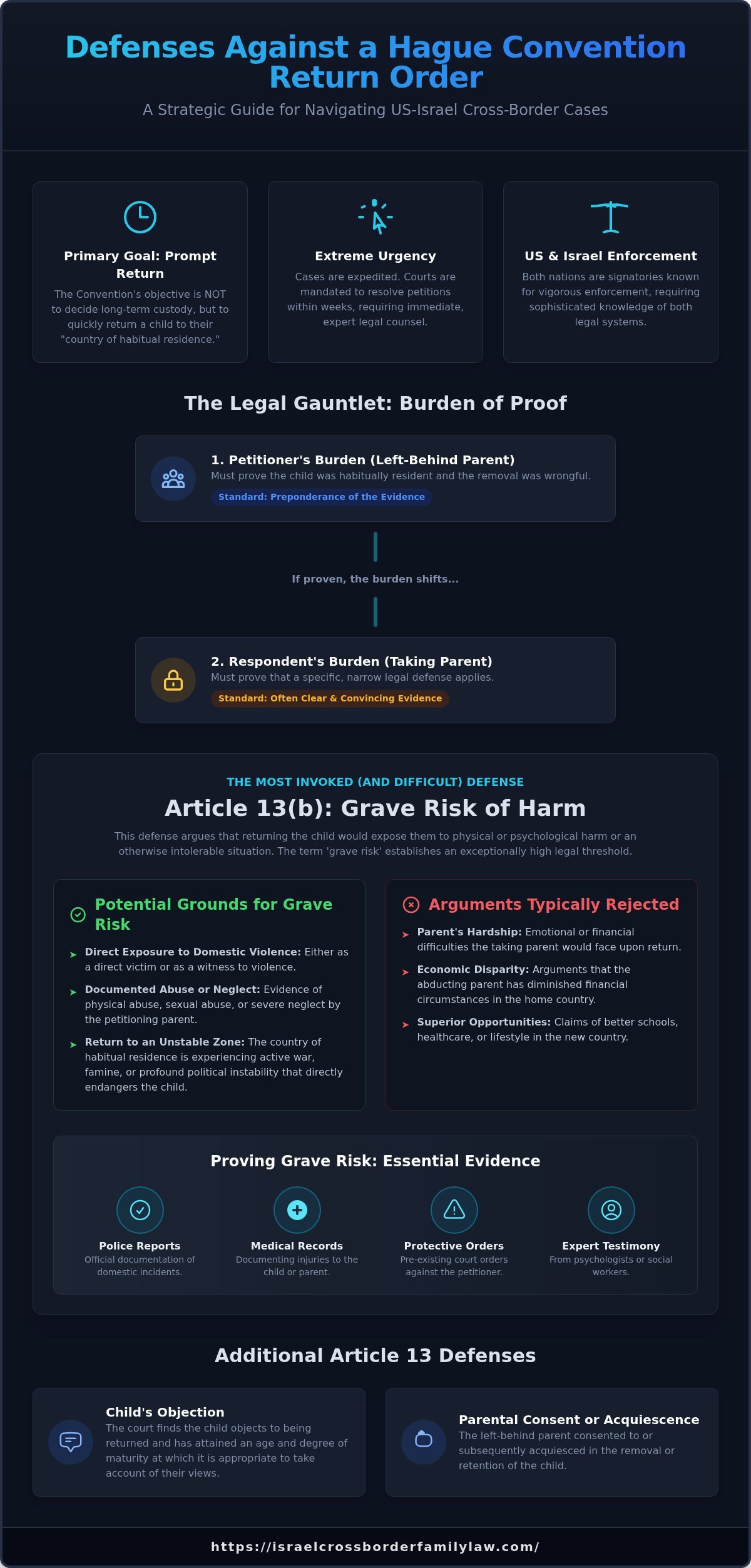
When facing an international child custody dispute, it is imperative to comprehend the foundational legal framework governing these complex cases. The primary objective of the Hague Convention on the Civil Aspects of International Child Abduction is not to determine long-term custody, but to secure the prompt return of a child who has been wrongfully removed from their country of “habitual residence.” The treaty operates on a powerful premise: custody disputes should be resolved by the courts of the child’s home country. A “wrongful removal” or “retention” under Article 3 of the Convention occurs when a child is taken from their country of habitual residence in breach of the custody rights of the left-behind parent. This jurisdictional focus means the court hearing the Hague petition will not delve into who is the “better” parent. Instead, its inquiry is narrowly tailored to one question: was the removal wrongful and should the child be returned for the home country’s courts to decide custody? For a deeper understanding of the legal strategies involved, the following video provides a valuable overview:
These cases are treated with extreme urgency. Courts in signatory nations are mandated to act expeditiously, often resolving petitions within weeks, not months. This accelerated timeline underscores the critical need for immediate, expert legal counsel to prepare and present a robust case.
The Presumption of Return
The court’s starting point in every Hague case is a strong presumption that the child must be returned. The petitioner, or the left-behind parent, bears the initial burden of proof. They must establish by a preponderance of the evidence that the child was habitually resident in their country and that the removal was wrongful. Once this is proven, the burden shifts to the responding parent to prove that an exception applies. The various defenses against a Hague Convention return order are narrow, specific exceptions to this powerful, overarching rule.
How Hague Cases Work in the US and Israel
Both the United States and Israel are signatories to the Convention and are known for their vigorous enforcement of its principles. In the U.S., the treaty is implemented through a federal statute, the International Child Abduction Remedies Act (ICARA). Israeli Family Courts are similarly well-versed in handling these expedited proceedings. Navigating a cross-border case between these two jurisdictions requires a sophisticated understanding of both legal systems. For a more detailed examination of the treaty’s mechanics, please see our main Hague Convention overview.
The Article 13(b) Defense: Grave Risk of Physical or Psychological Harm
Among the limited defenses against hague convention return order, the exception outlined in Article 13(b) is the most frequently invoked, yet it remains the most challenging to substantiate. This defense asserts that a child should not be returned if there is a grave risk that their return would expose them to physical or psychological harm or otherwise place them in an intolerable situation. The term ‘grave risk’ establishes an exceptionally high threshold; it signifies a risk that is severe, substantial, and likely to materialize upon the child’s return. It is not sufficient to argue that the child’s life would be less comfortable or that the taking parent would suffer emotional or financial hardship. Courts in Israel and other signatory nations interpret this defense narrowly to prevent it from undermining the Convention’s core objective of prompt return. The burden of proof on the respondent is significant, often requiring what U.S. courts define as ‘clear and convincing evidence’ to succeed.
What Constitutes a ‘Grave Risk’?
A grave risk must be specific and severe, moving far beyond the typical difficulties associated with a child readjusting to a previous environment. Courts will consider evidence of serious threats to the child’s well-being, such as:
- Direct exposure to domestic violence, whether as a victim or a witness.
- Documented instances of physical abuse, sexual abuse, or severe neglect by the petitioning parent.
- Return to a country experiencing active war, famine, or profound political instability that directly endangers the child.
Conversely, arguments based on a parent’s diminished financial circumstances, the perceived superiority of the educational system in the new country, or the general emotional distress of the taking parent are consistently deemed insufficient to meet the Article 13(b) standard.
Evidence Required to Prove Grave Risk
Successfully mounting an Article 13(b) defense requires robust, objective, and compelling evidence. Mere allegations are inadequate; a court requires a well-documented case. Essential evidentiary components often include police reports, medical records documenting injuries, and pre-existing court orders such as restraining or protective orders. A critical element, as outlined in the official text of the Hague Abduction Convention, is demonstrating the prospective harm. Expert testimony from child psychologists, psychiatrists, or social workers who can professionally assess the specific psychological harm to the child is often indispensable. Furthermore, it may be necessary to present evidence that the legal and social welfare systems of the child’s home country are unable or unwilling to provide adequate protection, thereby making the risk upon return unavoidable.
Article 13 Defenses: Child’s Objection and Parental Consent
Beyond the high-threshold defense of grave risk, Article 13 of the Hague Convention provides two additional, yet equally sophisticated, affirmative defenses for a responding parent. These are the child’s objection to being returned and the petitioning parent’s prior consent or subsequent acquiescence to the removal. Critically, these arguments are subject to a lower burden of proof-a ‘preponderance of the evidence’-meaning the court must be convinced it is more likely than not that the defense has been established. Unlike the grave risk defense, which focuses on the environment in the home country, these defenses against hague convention return order center on the subjective state of mind of the child or the actions of the petitioning parent. However, even when proven, the court retains ultimate discretion and may still order the child’s return.
The Child’s Objection to Return
A court may refuse to order the return of a child if it finds the child objects to being returned and has attained an age and degree of maturity at which it is appropriate to take account of their views. This establishes a two-part test: age and maturity. There is no definitive age set by the Convention, but Israeli courts, consistent with international jurisprudence, give substantial weight to the views of older children, typically those aged 12 and above. To assess maturity and the authenticity of the objection, the court may conduct a private in-camera interview with the child or appoint a child psychologist to provide an expert opinion, ensuring the child’s stated wishes are their own and not the product of parental influence.
Consent or Subsequent Acquiescence
This defense focuses entirely on the conduct of the parent seeking the child’s return. A court may deny a return petition if the responding parent can demonstrate that the petitioner either consented to the removal or retention beforehand, or subsequently acquiesced to it after the fact. The evidence for this must be clear and unambiguous.
- Consent refers to an active, express, or implied agreement prior to the child’s removal. This could be evidenced by written agreements, emails discussing school enrollment in Israel, or active participation in planning the move.
- Acquiescence involves a passive acceptance of the new situation. Examples include a significant and unexplained delay in filing the Hague petition, helping the other parent set up a new life in Israel, or making statements to third parties that indicate an acceptance of the child’s new residence.
In both scenarios, a vague or casual comment is insufficient. The court must be satisfied that the petitioner’s actions demonstrated a clear and unequivocal abandonment of their right to demand the child’s summary return under the Convention.
Procedural and Jurisdictional Defenses: Time Limits and Human Rights
Beyond the substantive arguments centered on family dynamics and child welfare, the Hague Convention provides for several procedural and jurisdictional defenses. These are more technical in nature, focusing on the timing of the legal action and fundamental principles of human rights. While less frequently utilized than the defenses found in Article 13, they represent critical tools in a comprehensive legal strategy for complex international child custody disputes.
Article 12: More Than One Year Has Passed
Article 12 of the Convention establishes a critical time-based defense. If return proceedings are initiated more than one year after the date of the wrongful removal or retention, the court is not automatically bound to order the child’s return. However, this defense is contingent upon a crucial second element: the responding parent must present compelling evidence that the child is now “well settled” in their new environment. Israeli family courts will meticulously evaluate various factors to determine if a child is well settled, including:
- Integration into a new school and academic progress.
- The formation of meaningful friendships and social connections.
- Involvement in community activities, sports, or religious life.
- The overall stability and permanence of the child’s new home life.
It is vital to understand that even if both conditions are met, this defense is not absolute; the court retains the discretion to order a return if it deems it appropriate.
Article 20: Violation of Fundamental Freedoms
The Article 20 defense is an exceptional provision, reserved for the most extreme circumstances and interpreted very narrowly by courts worldwide. This defense permits a court to refuse a return if doing so would violate the fundamental principles of human rights and fundamental freedoms of the requested state. This is not an inquiry into the child’s best interests but a high-level review of core human rights. A potential, albeit rare, example would be a case where returning a child would expose them to a clear and present danger of persecution. Successfully mounting these types of defenses against a Hague Convention return order is exceedingly difficult, as Israeli and U.S. courts have set an exceptionally high evidentiary bar. Navigating the nuances of these highly technical defenses requires sophisticated legal counsel. For expert guidance on your specific cross-border case, we invite you to contact our experienced legal team.
Building Your Defense Strategy in a US-Israel Hague Case
Successfully challenging an international child abduction claim requires more than simply asserting a defense. Constructing viable defenses against Hague Convention return order petitions is a sophisticated legal process, demanding a meticulously prepared, evidence-based strategy. The unique cross-border nature of US-Israel cases introduces additional layers of complexity, where understanding judicial perspectives in both nations is paramount to protecting your parental rights and your child’s well-being.
Gathering Critical Evidence
The burden of proof rests on the parent opposing the return. Therefore, the immediate and thorough collection of admissible evidence is the foundation of your case. This evidence must be compelling enough to overcome the Convention’s presumption of return. Key documentation includes:
- Communications: Emails, text messages, and social media conversations that establish the child’s habitual residence or the other parent’s consent or acquiescence to the move.
- Official Records: School enrollment documents, medical reports, and therapy records that demonstrate the child is well-settled in their new environment.
- Third-Party Testimony: Sworn affidavits from teachers, doctors, therapists, or family members who can attest to the child’s integration or the potential harm of a return.
- Expert Evaluations: A psychological evaluation of the child and/or parent can be instrumental in substantiating claims of grave risk of harm or demonstrating a mature child’s objection to returning.
Why Specialized Counsel is Non-Negotiable
Navigating the procedural and evidentiary nuances between the U.S. and Israeli legal systems is a formidable challenge. A law firm with deep, multi-jurisdictional experience understands how evidence is presented and perceived in each country’s courts. This bicultural legal insight is critical when building effective defenses against Hague Convention return order petitions. Our team possesses the specific cross-border expertise required to represent clients in these complex international family law matters; learn more about our advisory.
Taking the Next Step
Hague Convention proceedings are expedited and operate on an extremely compressed timeline. Delay can significantly prejudice your case and limit your strategic options. Protecting your child and your rights requires immediate, decisive action guided by experienced legal counsel. If you are facing a petition for the return of your child, do not wait. We strongly urge you to seek expert legal advice to understand the specific defenses that may apply to your situation. Request a Confidential Case Review to discuss your options with our team.
Securing Your Child’s Future: Strategic Defense in Hague Convention Cases
Successfully mounting defenses against a Hague Convention return order requires a profound understanding of the treaty’s narrow exceptions. As this guide has demonstrated, affirmative defenses such as the Article 13(b) grave risk of harm or a child’s mature objection are subject to a high burden of proof and strict judicial scrutiny, demanding a meticulously prepared case, especially in multi-jurisdictional matters between the U.S. and Israel. These high-stakes international custody disputes demand sophisticated strategic counsel. Our dedicated team brings decades of combined experience in US-Israel cross-border family law, possessing a deep, nuanced understanding of how both US and Israeli courts interpret Hague Convention defenses. We are committed to providing the robust advocacy necessary to protect your child’s best interests. If you are facing the complexities of a Hague Convention petition, we invite you to contact our experienced US-Israel legal team for a confidential consultation. Taking decisive, informed action is the first step toward securing a stable future for your family.
Frequently Asked Questions
What is the standard of proof for each Hague Convention defense?
The standard of proof for most defenses against Hague Convention return order, such as consent or the child being well-settled, is a “preponderance of the evidence.” This means the court must be convinced it is more likely than not that the defense applies. However, for the Article 13(b) grave risk of harm defense, a higher standard of “clear and convincing evidence” is required, demanding a much stronger and more compelling level of proof from the responding parent.
How long does a Hague Convention case typically take in the United States or Israel?
Hague Convention cases are expedited proceedings in both jurisdictions. In the United States, a case can be resolved in several weeks to a few months, depending on the specific court’s calendar. In Israel, the process is exceptionally swift, with courts typically mandated to issue a decision within six weeks of the application’s filing. However, any subsequent appeals will necessarily extend this timeline, adding complexity to these multi-jurisdictional matters.
If I successfully defend against a return order, does that mean I get full custody?
No. A successful defense against a return order is not a determination of custody. The Hague Convention’s sole purpose is to decide which country’s courts have the proper jurisdiction to hear the custody case. Prevailing in the Hague proceeding simply means that the custody dispute will be litigated in the courts of the country where the child currently resides, such as Israel, rather than the country from which they were removed. The underlying custody battle remains to be resolved.
Can the left-behind parent also face criminal charges for international parental kidnapping?
Yes. Hague Convention proceedings are civil remedies and are entirely separate from any potential criminal actions. The left-behind parent may concurrently pursue criminal charges for international parental kidnapping under the laws of their country, such as the International Parental Kidnapping Crime Act (IPKCA) in the U.S. The outcome of the civil Hague case does not preclude or resolve these distinct criminal proceedings, which can carry severe penalties, including imprisonment and fines.
What are undertakings and how can they be used to overcome a grave risk defense?
Undertakings are formal, legally binding promises made by the petitioning parent to the court to mitigate risks alleged by the respondent. To overcome a grave risk defense, a petitioner might offer undertakings such as funding separate housing for the child and respondent upon return, covering all legal fees in the home country, and agreeing to court orders that prevent contact until protective measures are in place. These measures are designed to assure the court of the child’s safety.
How much does it cost to hire a lawyer for a Hague Convention case?
The cost of retaining experienced legal counsel for a Hague Convention case in Israel is significant and varies based on case complexity. Legal fees can range from approximately ₪50,000 to over ₪150,000. Factors influencing the final cost include the need for expert witnesses, such as child psychologists, the volume of evidence to be presented, and whether the initial decision is appealed to a higher court. A detailed fee structure should be discussed during your initial consultation.

Article by
Gabriel Lior
A Personal Journey That Became a Mission The advisory was founded by an American father Gabriel Lior, LLB, MBA , global entrepreneur, and cross-border advisor who spent more than a decade navigating the Israeli family court system firsthand and now lives in Singapore with his son.
As a divorced parent in a cross-border family, Gabriel faced nearly every legal challenge a foreign parent can encounter in Israel — including child custody disputes, child support proceedings, property matters in Israel and abroad, false accusations, and complex immigration and relocation proceedings. Over the years, he learned the hard way how difficult it is for non-Israeli parents to understand the system, identify the right legal strategy, and choose the right legal representation — especially when language, culture, and jurisdictional differences are involved. He also witnessed how foreign parents and new immigrants are often disadvantaged or taken advantage of by service providers and institutions simply because they lack local knowledge or fluency. From Client to Advisor To truly understand — and survive — the system, Gabriel pursued formal legal education in Israel, completing two Israeli law degrees, alongside a BA and MBA earned in the United States. This was never about becoming a practicing attorney, but about gaining a deep, structural understanding of how the system works — and where it breaks down for foreign parents. This rare combination of: Firsthand client experience Israeli legal and US business education International business and negotiation training Decades of commercial execution created a unique perspective – one that understands both sides of the table. After years of litigation, persistence, and at times self-representation, he ultimately succeeded in securing custody of his son and relocating abroad through a rare legal victory in the Israeli Supreme Court — becoming one of the first fathers in Israel to do so under these circumstances.
Disclaimer
Important Disclaimer: The information provided on this website and in its content is for general informational and educational purposes only and does not constitute legal advice, legal opinion, or legal representation. Gabriel Lior is not licensed to practice law in Israel (nor is he interested in doing so) and does not provide legal services, despite having completed 2 Law Degrees. The services offered are advisory in nature and are intended to provide general guidance, strategic insight, and information regarding cross-border family law considerations. No attorney-client relationship is formed by accessing this website, reading its content, or communicating with us. Any decisions made based on this information are at your own discretion and risk. For legal advice specific to your situation, you should consult a licensed attorney in the relevant jurisdiction. Where appropriate, we may refer clients to independent, licensed attorneys or professionals. Such referrals do not constitute legal representation and no liability is assumed for services provided by third parties.