
This article is published on an independent advisory platform and does not constitute legal representation or legal advice. Legal services are only provided by licensed attorneys under a separate engagement.
Could simply sharing a home in Tel Aviv or Jerusalem carry the same legal weight as a formal marriage ceremony? For many expats, the concept of common law marriage in Israel for foreigners, known locally as Yeduim BaTzibur, is often misunderstood as a casual lifestyle choice rather than a binding legal status. You likely recognize that Israel lacks civil marriage, but it’s natural to feel uncertain about how a shared household impacts your assets in your home country or your residency status.
With an estimated 180,000 couples in Israel living in common law arrangements, this status is a functional reality for many. This guide provides the clarity you need to protect your international interests and understand the obligations that arise when the law views you as a publicly known couple. We examine the May 2024 Supreme Court ruling on financial intent, the seven year graduated procedure for foreign spouses, and the 2026 tax reporting changes that affect your global portfolio. Understanding these cross border complexities is the first step toward making informed decisions about your future. Get clarity before you commit. Request a confidential consultation.
This article is published on an independent advisory platform and does not constitute legal representation or legal advice. Legal services are only provided by licensed attorneys under a separate engagement.
Key Takeaways
- Understand how cohabitation in IL can lead to the legal status of “Yeduim BaTzibur” and why many expats acquire these rights and obligations unintentionally.
- Identify the specific evidence Israeli courts use to validate common law marriage in Israel for foreigners, ranging from shared household expenses to social recognition.
- Learn how the “Joint Property Doctrine” creates risks for your international assets, potentially allowing Israeli courts to divide property located in the US.
- Explore the complexities of ending a common law relationship, including the potential involvement of religious courts and the strategic importance of jurisdictional choice.
- Discover how a tailored financial agreement can provide clarity and protect your global interests before you commit to a shared life in Israel.
This article is published on an independent advisory platform and does not constitute legal representation or legal advice. Legal services are only provided by licensed attorneys under a separate engagement.
What is Common Law Marriage in Israel (Yeduim BaTzibur)?
Israeli law recognizes a unique status called Yeduim BaTzibur, which translates to “known in public.” It is a legal reality that often catches expats by surprise. You don’t need a ceremony or a license to enter this status. Instead, the law looks at the reality of your daily life. If you live as a couple and manage a joint household, the state may view you as legally bound. For a deeper look at the historical context, the concept of Yeduim BaTzibur in Israel has evolved as a pragmatic solution to the country’s lack of civil marriage options.
Yeduim BaTzibur is a legal status based on a couple’s shared life and household, recognized by the state regardless of whether the relationship has received religious or formal registration.
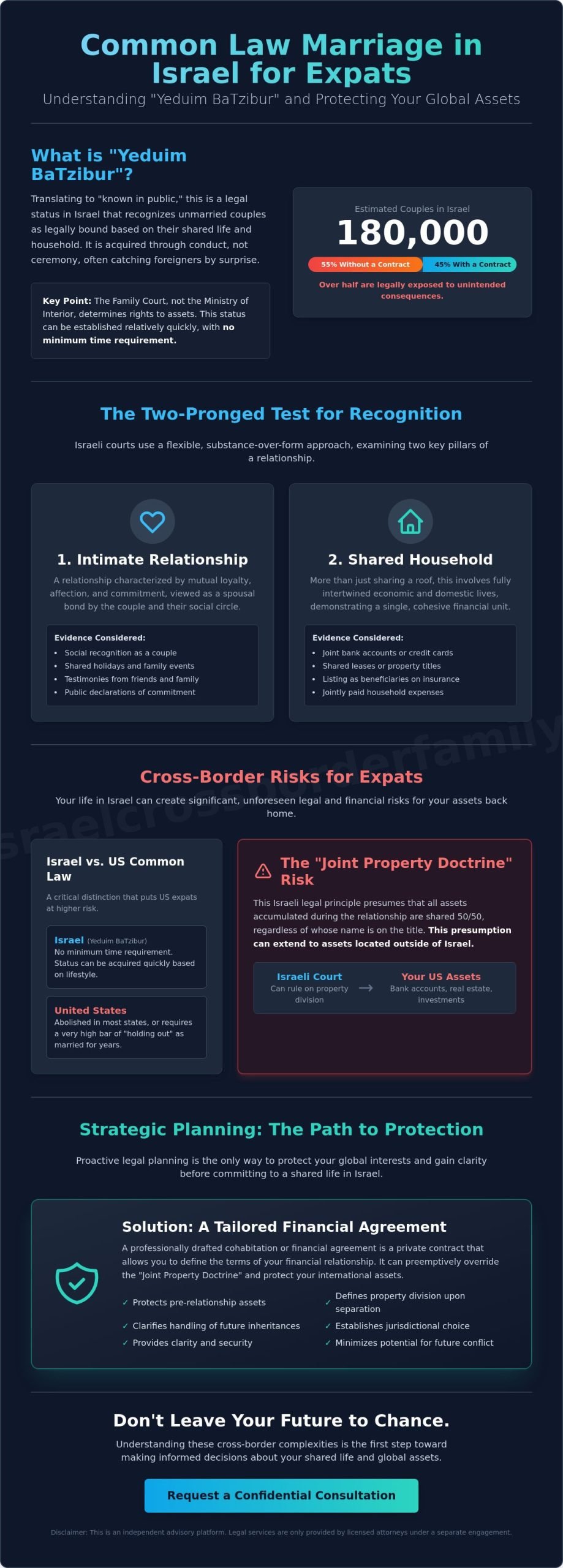
Confusion often arises between the roles of the Ministry of Interior and the Family Court. The Ministry of Interior handles administrative matters, such as residency visas for foreign partners. The Family Court, however, is where the heavy lifting happens regarding assets and rights. These courts use a two-pronged test: an intimate relationship and a shared household. About 180,000 couples in Israel currently live under this status, yet only 45% have a legal contract to govern their relationship. This leaves thousands of individuals exposed to unintended legal consequences.
The Difference Between IL and US Common Law
In many US states, common law marriage is either abolished or requires a very high bar of “holding out” as married for many years. Israeli law is different. There is no minimum time requirement. A couple can fall under this status relatively quickly. The May 6, 2024, Supreme Court ruling clarified that the court now requires clear evidence of intent to share financial and legal consequences. Simply sharing a lease isn’t always enough. The court looks for joint bank accounts or being listed as beneficiaries on insurance policies. It’s about the reality of your partnership, not just the duration of your cohabitation.
Why Foreigners Choose Common Law Status
Many common law marriage in Israel for foreigners cases begin with the search for legal residency. If you are an expat partnered with an Israeli, you can enter a 7-year “graduated procedure” to obtain legal status. This is longer than the 5-year process for married couples, but it allows interfaith or same-sex partners to build a life together without leaving the country to marry. Beyond residency, this status provides access to state health insurance and social security benefits. It’s a practical path for those who face ideological or religious barriers to traditional marriage in IL. However, it comes with significant risks if you don’t understand the cross-border implications. Get clarity before you commit. Request a confidential consultation.
This article is published on an independent advisory platform and does not constitute legal representation or legal advice. Legal services are only provided by licensed attorneys under a separate engagement.
Legal Requirements for Recognition in Israel
The threshold for being considered “publicly known” in IL involves a rigorous two-pronged test. First, the couple must maintain an intimate relationship characterized by mutual loyalty and affection. Second, they must manage a shared household. This is not merely about residing at the same address. It involves a “common roof” where economic and domestic lives are fully intertwined. The legal requirements for common-law marriage in Israel are deliberately flexible. This allows courts to prioritize the substance of the relationship over its formal registration.
Courts analyze several types of evidence to determine status. Joint bank accounts and shared leases are the most common indicators. However, social perception is equally vital. If your neighbors, friends, and family treat you as a married couple, the court is likely to do the same. Some couples choose to formalize their status via a “Domestic Union Card” or other private registrations. While these aren’t marriage certificates, they serve as strong evidence of intent. A Financial Agreement, or Heskem Mamon, remains the most powerful tool for clarity. It allows you to define exactly which assets remain separate, preventing the court from applying the “Joint Property Doctrine” by default.
Evidence of a Shared Household
Financial co-mingling is a primary indicator for IL judges. They look for a shared physical address and evidence of mutual support in daily expenses. Testimonies from acquaintances often carry significant weight. If an expat partner is listed as a dependent on health insurance or a beneficiary on a pension fund, the court views this as clear evidence of a shared life. These details matter. They transform a casual cohabitation into a legally recognized partnership with long-term consequences.
The Role of Intent in Foreigner Status
Can you become a common law spouse by accident? For many, the answer is yes. Many foreigners arrive in IL and begin living with a partner without realizing they are triggering legal obligations. Navigating the common law marriage in Israel for foreigners requires a strategic approach to these unintended commitments. This is particularly risky when dealing with residency. You can learn more about how this status affects your legal standing on our page for expats and foreign nationals.
To mitigate this risk, some couples sign a “Declaration of Non-Commitment.” This document clarifies that cohabitation is for convenience or companionship, not for creating marital-like obligations. It’s a strategic move for those with significant international assets who want to maintain their financial independence. Get clarity before you commit. You may request a confidential case review to assess your specific situation.
This article is published on an independent advisory platform and does not constitute legal representation or legal advice. Legal services are only provided by licensed attorneys under a separate engagement.
Cross-Border Risks: How Israel Common Law Affects US Assets
Many expats believe their US-based assets are shielded from local claims because they never signed a marriage certificate. This assumption is often incorrect. In IL, the “Presumption of Property Sharing” applies to common law couples just as it does to married ones. If the court determines you are in a committed partnership, assets accumulated during your time together may be divided equally. This includes US real estate, 401(k) plans, and brokerage accounts. A Law Library of Congress report on Israeli common law marriage highlights that these obligations arise from the reality of the relationship rather than a formal contract.
Israeli courts may claim jurisdiction over your global assets if your “center of life” is firmly established in IL. This means a judge in Tel Aviv could potentially issue orders regarding the sale or division of a vacation home in Florida or a rental property in New York. Additionally, the risk of “rehabilitative maintenance,” known as Mezonot Shikum, exists for non-married partners. If one partner becomes financially dependent on the other during the relationship, the court may order monthly payments to support that partner after a split. These obligations can last for several years, depending on the length of the cohabitation and the disparity in income.
Inheritance and Estate Planning
Under the Israeli Inheritance Law of 1965, a common law partner possesses the same automatic inheritance rights as a legal spouse. If you die without a valid Israeli will, your partner may inherit a significant portion of your estate by default. This often creates a direct conflict with US-based estate plans or wills drafted under different state laws. For cross-border families, a “Dual-Jurisdiction” approach is essential. You must ensure that your Israeli estate plan recognizes your US assets and that your US will accounts for the specific rights granted to common law partners under IL law.
Protecting Pre-Existing Assets
The most effective way to manage these risks is through a Financial Agreement, or Heskem Mamon. For foreigners, this document is vital to ring-fence assets acquired before moving to IL or inherited during the relationship. Without a clear agreement, the lines between separate and shared property often blur over time. You can protect your financial future by seeking a confidential case review to discuss strategic planning for your international portfolio. Get clarity before you commit. Informed decisions today prevent complex litigation tomorrow.
This article is published on an independent advisory platform and does not constitute legal representation or legal advice. Legal services are only provided by licensed attorneys under a separate engagement.
Terminating a Common Law Relationship in IL
Terminating a common law marriage in Israel for foreigners is often perceived as a simple contractual end. Many believe that without a marriage certificate, walking away is a clean break. This is a common misconception. While you don’t need a formal civil divorce, the legal reality is far more complex. In certain cases, if there is a legal doubt regarding your marital status, the Rabbinical Court may require a “Get,” or religious divorce, even if you never had a religious ceremony. This concept, known as Safek Kiddushin, can create unexpected hurdles for expats who wish to remarry or finalize their status.
The “Race to the Court” is another critical factor in IL. This occurs when one partner files a claim in the Family Court while the other files in the Rabbinical Court. Each court has its own approach to property division and maintenance. The first to file generally secures the jurisdiction. This makes early strategic planning essential. You can find more detailed guidance on these jurisdictional battles on our page regarding divorce and separation for international families.
Financial Claims Upon Separation
Separation triggers the right to claim a share of assets accumulated during the relationship. This includes pensions, business interests, and even real estate held in only one partner’s name. The court also recognizes “Rehabilitative Alimony,” or Mezonot Shikum. This is a monthly payment designed to support a financially dependent partner for a set period after the split. The length of your cohabitation directly impacts these payouts. A couple who lived together for 12 years will face vastly different financial obligations than a couple who separated after 18 months.
International Custody and Relocation
When children are involved, the stakes rise significantly. The Hague Convention on the Civil Aspects of International Child Abduction applies to all parents, regardless of their marital status. If one parent attempts to relocate to their home country with a child without the other’s written consent, it can be viewed as an international abduction. This right to block relocation exists even if you were never married. We provide a detailed explanation of these risks in our video, “International Custody in Israel.” If you are facing a separation, contact us for a strategic evaluation to protect your parental rights and global interests.
This article is published on an independent advisory platform and does not constitute legal representation or legal advice. Legal services are only provided by licensed attorneys under a separate engagement.
Strategic Planning for International Couples
Proactive strategy is the only reliable way to manage the inherent complexity of common law marriage in Israel for foreigners. Waiting until a relationship dissolves to understand your rights often leads to costly, reactive litigation. For international couples, the goal is to create a professional legal home that respects both Israeli and US standards. This requires a deep understanding of how local cohabitation rules interact with global financial structures. Seeking clarity before you move in together or merge finances is not a sign of distrust; it is a strategic step toward long-term security.
Successful cross-border planning relies on strategy-based decision-making. This involves identifying potential risks, such as the 2026 tax reporting changes or the “Joint Property Doctrine,” before they become legal crises. As your assets grow in either country, you should update your legal documents to reflect your current financial intentions. Documenting these intentions early prevents the court from making assumptions about your partnership during a future split. In a multi-jurisdictional context, silence is often interpreted as consent to local property sharing rules.
The Role of the Cross-Border Advisor
Life in the “Start-up Nation” moves fast. Expats often prioritize career and integration, leaving legal formalities for later. However, generic Israeli templates for cohabitation agreements frequently fail international families. These templates rarely account for US-based 401(k) accounts, family trusts, or the specific requirements of US state probate courts. A sophisticated advisory approach ensures that your financial agreements are enforceable across borders. You can learn more about our methodology and how it works to bridge these two distinct legal systems effectively.
Final Recommendations for Expats
Don’t assume your US citizenship or the lack of a marriage license protects your pre-existing assets in IL. The Israeli legal system prioritizes the reality of your shared life over formal documentation. If you are an expat living in a committed relationship, the state may already view you as a “publicly known couple” with all the accompanying obligations. To protect your global portfolio, you must be intentional about how you structure your household and finances.
- Document your financial intentions in writing as soon as cohabitation begins.
- Ensure your Israeli Financial Agreement specifically mentions and ring-fences your US-based real estate and retirement funds.
- Review your estate plan to account for the automatic inheritance rights granted to common law partners in IL.
Get clarity before you commit. Request a confidential consultation.
This article is published on an independent advisory platform and does not constitute legal representation or legal advice. Legal services are only provided by licensed attorneys under a separate engagement.
Securing Your Future as a Cross-Border Couple
Israeli law transforms your daily cohabitation into a binding legal status with significant global implications. You’ve seen how the lack of a formal ceremony doesn’t prevent the state from recognizing your partnership or claiming jurisdiction over international property. Whether you are navigating the seven year graduated procedure for residency or managing the 2026 tax reporting changes, the reality of your shared life creates immediate legal obligations that require proactive management.
Navigating common law marriage in Israel for foreigners requires a strategy that bridges two distinct legal systems. By documenting your financial intentions through a dual-jurisdiction agreement, you ring-fence your assets and provide your family with certainty. Our advisory specializes in US-Israel cross-border family law, providing authoritative guidance for the Anglo expat community with a focus on risk-based strategy and asset protection. You don’t have to navigate these complexities alone. Taking the time to seek professional clarity today ensures that your international interests remain secure regardless of what the future holds.
Get clarity before you commit. Request a confidential consultation.
This article is published on an independent advisory platform and does not constitute legal representation or legal advice. Legal services are only provided by licensed attorneys under a separate engagement.
Frequently Asked Questions
Is common law marriage recognized for foreigners in Israel?
Yes, Israel recognizes the status of “Yeduim BaTzibur” for foreigners and citizens alike. This status grants couples many of the same rights as legally married spouses, including residency benefits and social security. To be recognized, you must prove you maintain an intimate relationship and manage a shared household together in IL.
Do I need a lawyer to be recognized as a common law spouse in IL?
While you can submit administrative forms alone, professional guidance is essential for navigating the complex seven-year graduated procedure for residency. A strategic advisor ensures that your evidence meets the stringent requirements set by the Population and Immigration Authority. They also help you draft financial agreements to prevent unintended legal obligations during your stay.
Can my common law partner claim my assets in the US?
Yes, your partner can potentially claim a share of your US assets under the “Presumption of Property Sharing.” If an IL court determines your center of life is in Israel, it may claim jurisdiction over your global portfolio. This includes real estate, retirement accounts, and business interests located in the US or elsewhere.
What happens to my visa if my common law relationship ends?
Your legal status in IL is tied to your partnership, so your visa may be revoked if the relationship terminates. According to proposed July 2025 regulations, overstaying your visa by more than 30 days after a split could result in a cooling-off period of up to five years. You must act quickly to assess your independent residency options.
Is a US prenuptial agreement valid for common law partners in Israel?
A US prenuptial agreement may not be automatically enforceable in IL without proper validation by an Israeli court. To protect yourself, you need a Financial Agreement that specifically addresses common law marriage in Israel for foreigners. This document must be tailored to satisfy both Israeli family law and your specific US jurisdictional requirements.
Do I need a “Get” (religious divorce) if we were only common law partners?
In certain circumstances, the Rabbinical Court may require a religious divorce if there is a “legal doubt” regarding your marital status. This often occurs if the court suspects the relationship met the requirements for a religious marriage. This requirement can complicate your ability to remarry in IL or finalize property settlements after a separation.
How long do we have to live together to be considered Yeduim BaTzibur?
Israeli law does not mandate a specific minimum time period for recognition as a common law couple. Instead, the court examines the quality of the relationship and the shared nature of the household. While some administrative bodies look for evidence of cohabitation over several months, the May 2024 Supreme Court ruling prioritizes financial intent over mere duration.
Can a common law spouse inherit my property in Israel?
Yes, a common law spouse possesses automatic inheritance rights under the 1965 Inheritance Law, provided there is no conflicting will. If you die without a valid Israeli will, your partner may inherit a significant portion of your estate by default. It’s vital to update your estate plan to reflect the 2026 tax reporting changes for foreign assets.

Article by
Gabriel Lior
A Personal Journey That Became a Mission
The advisory was founded by an American father Gabriel Lior, LLB, MBA , global entrepreneur, and cross-border advisor who spent more than a decade navigating the Israeli family court system firsthand and now lives in Singapore with his son.
As a divorced parent in a cross-border family, Gabriel faced nearly every legal challenge a foreign parent can encounter in Israel — including child custody disputes, child support proceedings, property matters in Israel and abroad, false accusations, and complex immigration and relocation proceedings.
Over the years, he learned the hard way how difficult it is for non-Israeli parents to understand the system, identify the right legal strategy, and choose the right legal representation — especially when language, culture, and jurisdictional differences are involved. He also witnessed how foreign parents and new immigrants are often disadvantaged or taken advantage of by service providers and institutions simply because they lack local knowledge or fluency.
From Client to Advisor
To truly understand — and survive — the system, Gabriel pursued formal legal education in Israel, completing two Israeli law degrees, alongside a BA and MBA earned in the United States. This was never about becoming a practicing attorney, but about gaining a deep, structural understanding of how the system works — and where it breaks down for foreign parents.
This rare combination of:
Firsthand client experience
Israeli legal and US business education
International business and negotiation training
Decades of commercial execution
created a unique perspective – one that understands both sides of the table.
After years of litigation, persistence, and at times self-representation, he ultimately succeeded in securing custody of his son and relocating abroad through a rare legal victory in the Israeli Supreme Court — becoming one of the first fathers in Israel to do so under these circumstances.
Disclaimer
Important Disclaimer:
The information provided on this website and in its content is for general informational and educational purposes only and does not constitute legal advice, legal opinion, or legal representation.
Gabriel Lior is not licensed to practice law in Israel (nor is he interested in doing so) and does not provide legal services, despite having completed 2 Law Degrees. The services offered are advisory in nature and are intended to provide general guidance, strategic insight, and information regarding cross-border family law considerations.
No attorney-client relationship is formed by accessing this website, reading its content, or communicating with us.
Any decisions made based on this information are at your own discretion and risk. For legal advice specific to your situation, you should consult a licensed attorney in the relevant jurisdiction.
Where appropriate, we may refer clients to independent, licensed attorneys or professionals. Such referrals do not constitute legal representation and no liability is assumed for services provided by third parties.
Related Insights & Resources

Navigating the Israeli Family Court Process: A Comprehensive Guide for Foreigners
Engaging in a family law matter within a foreign jurisdiction is an inherently complex and...Read More →
Objecting to a Will in Israel: A Strategic Guide for International Families
This article is published on an independent advisory platform and does not constitute legal representation...Read More →
Avocat de la famille transfrontalier Israël-États-Unis : Naviguer les conflits juridiques internationaux
Dans le monde du droit de la famille transfrontalier entre les États-Unis et Israël, la...Read More →