This article is published on an independent advisory platform and does not constitute legal representation or an attorney-client relationship. Legal services are only provided by licensed attorneys under a separate engagement.
Last month, a family in New York discovered that their late relative’s estate in Tel Aviv was being distributed according to a will signed under questionable circumstances just days before his passing. It’s a heavy burden to realize that objecting a will in israel is your only path to justice while you’re living abroad and dealing with a legal system that feels foreign. You likely feel that the combination of language barriers and unfamiliar probate laws makes an already emotional time feel nearly impossible to manage.
We understand that protecting your family’s legacy requires more than just emotion; it requires a calculated strategy. This guide will help you understand the specific legal grounds for a contest, such as undue influence or formal defects, and the strict filing requirements you must meet. We’ll examine the procedural steps and the strategic risks involved, giving you the clarity needed to make an informed decision about your inheritance rights before you commit to a legal process. Get clarity before you commit. Request a confidential consultation.
Key Takeaways
- Identify the specific legal grounds required to contest a document, such as proving a lack of testamentary capacity or the presence of undue influence.
- Understand the formal procedure for objecting a will in israel, from drafting the statement of objection to navigating the Registrar of Inheritance Affairs.
- Learn how international residents can manage Hebrew-language proceedings and provide testimony from abroad through modern logistical solutions like video conferencing.
- Perform a comprehensive cost-benefit analysis to weigh potential legal fees in ₪ (ILS) against the total value of the estate and the emotional impact on the family.
This article is published on an independent advisory platform (not a law firm). The information provided is for educational purposes only and does not constitute an attorney-client relationship. Legal services are only provided by licensed attorneys under a separate engagement.
Understanding the Will Objection Process in Israel
The process of objecting a will in Israel involves a formal legal challenge to the validity of a testamentary document. While global inheritance laws share common themes, Israel’s Succession Law of 1965 establishes a specific framework centered on the “freedom of the testator.” This principle means the court’s primary goal is to fulfill the deceased’s actual wishes, even if those wishes seem unfair to certain family members. Contesting a will requires demonstrating that the document doesn’t reflect the true will of the testator due to reasons like undue influence, lack of capacity, or procedural flaws.
To better understand the foundations of Israeli wills, watch this helpful video:
Most proceedings begin at the office of the Registrar of Inheritance Affairs, known as Rasham HaYerusha. It’s a common mistake to confuse an “objection” with a “request for clarification.” An objection seeks to disqualify the will entirely or in part. Conversely, a request for clarification asks the court to interpret ambiguous language within an otherwise valid will. Distinguishing between these two strategies is vital for international families managing assets across borders. Successfully objecting a will in israel requires a deep understanding of these procedural nuances.
The Probate Order Requirement
A will doesn’t grant immediate authority over assets. To execute a will, beneficiaries must obtain a Probate Order (Tzav Kiyum Tzeva’ah) from the Registrar. Once an application is filed, it’s published in national newspapers and the Official Gazette. This starts a mandatory window, usually 14 days, for any party to file an objection. You can monitor the Registrar’s online database to see if an application has been submitted for a family member’s estate. If the window passes without a challenge, the Registrar may grant the order, making it much harder to contest the distribution later.
Who is Eligible to Object?
Only an “interested party” has the legal standing to challenge a will. Under Israeli law, this typically includes heirs under intestacy (those who’d inherit if no will existed) or beneficiaries named in a previous, valid will. Creditors also have standing if the will’s execution affects their ability to collect debts. For expats and international families, determining standing is often the first hurdle when objecting a will in israel. Early strategic planning helps clarify whether you have the right to intervene before the estate is distributed. Legal systems differ significantly, and what grants standing in London or New York may not apply in Tel Aviv.
Get clarity before you commit. Request a confidential consultation.
This article is published on an independent advisory platform and does not constitute an attorney-client relationship. Successfully objecting a will in israel requires more than a sense of unfairness; it demands a rigorous legal foundation based on the Succession Law, 5725-1965. Israeli courts operate on the principle that the “will of the deceased must be honored,” meaning the burden of proof rests heavily on the challenger to demonstrate that the document does not reflect the testator’s true desires.
Legal Grounds for Objecting to an Israeli Will
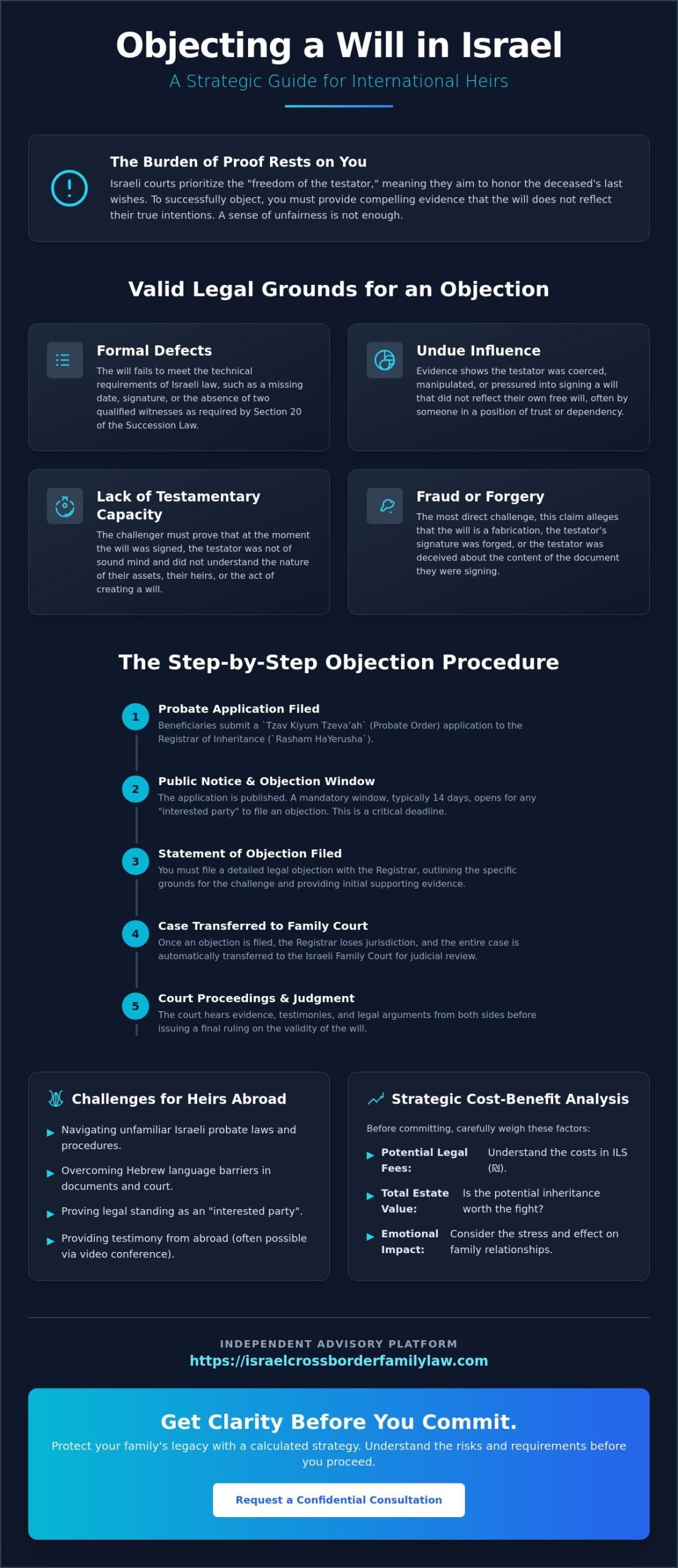
The legal framework for challenges generally falls into four categories. Formal defects involve technical errors, such as a missing date or the absence of two qualified witnesses required for a “will in writing” under Section 20. While Section 25 allows a court to overlook minor technical flaws if the authenticity is clear, substantial defects often lead to invalidation. Fraud and forgery represent the most direct attacks, where a party claims the signature is not genuine or that the document was physically altered. In these instances, forensic handwriting experts are typically appointed by the court to provide a professional assessment of the document’s physical integrity.
Capacity and Medical Evidence
The mental state of the testator is a frequent focal point in probate litigation. Under Section 26 of the Succession Law, a will is void if it was made by a minor, a person declared legally incompetent, or by someone who “did not know how to understand the nature of a will” at the time of its creation. This specific legal standard is known as testamentary capacity. To prove a lack of capacity, international families often must secure retroactive medical opinions. These reports are drafted by geriatric psychiatrists or neurologists who review years of medical records to determine the testator’s cognitive state on the specific date the will was signed. Israeli law recognizes the concept of “lucid intervals,” meaning a person with fluctuating dementia may still legally execute a will during a documented period of clarity. Expert medical opinions in these cases often range in cost from ₪7,000 to ₪18,000, depending on the volume of medical history requiring analysis.
Proving Undue Influence in Israeli Courts
Undue influence occurs when a beneficiary exerts improper pressure that overcomes the testator’s free will. Israeli judges apply a rigorous four-part test to determine if such influence existed. This test examines the testator’s level of independence, the extent of the assistance provided by the beneficiary, the testator’s degree of isolation from other family members, and the specific circumstances surrounding the drafting of the document. A critical factor is the beneficiary’s involvement; under Section 35, if a beneficiary took an active part in preparing the will or served as a witness, their gift is usually voided automatically. The court looks for a “dependency relationship” where the deceased relied entirely on the beneficiary for daily needs, making them vulnerable to coercion.
Navigating these grounds requires a strategic approach to evidence gathering before the probate process advances too far. Get clarity before you commit. Request a confidential consultation to understand how these legal standards apply to your family’s specific situation.
The Step-by-Step Procedure for Filing an Objection
The process of objecting a will in israel begins with the drafting of a formal statement known as the Ketav Hitnagdut. This document is not a simple letter of complaint; it’s a structured legal pleading that must detail the specific factual and legal grounds for the challenge. You must file this statement with the Registrar of Inheritance Affairs (Rasham Yerusha) and pay the required filing fees in Israeli Shekels (₪). These fees are mandatory and the Registrar won’t process the file until the payment is confirmed through the government payment gateway.
Once the objection is filed, the Registrar’s administrative role ends. Because the Registrar lacks the authority to adjudicate disputes, the file is automatically transferred to the Family Court. This transition marks the start of formal litigation. The court oversees a rigorous evidentiary stage where both sides present their case. This phase often involves the cross-examination of witnesses and the submission of expert testimony, such as medical reports regarding the deceased’s mental capacity or forensic analysis of signatures. The process concludes with a final judgment where the court decides to uphold the will, void specific sections, or revoke the entire document.
Deadlines and Time Constraints
Speed is critical when you’re considering objecting a will in israel. The standard window for filing is just 14 days following the publication of the probate notice in the national press or the official gazette. While it’s possible to request an extension, the court typically requires “special reasons” to grant one. These reasons must be documented and explain why the objector couldn’t file within the original timeframe. If the Probate Order has already been issued, the legal hurdle becomes significantly higher. You would then need to file a separate petition to revoke the order, which involves proving that new evidence has come to light that wasn’t available during the initial period.
From the Registrar to the Family Court
The transfer from the Registrar to the Family Court changes the nature of the case from a bureaucratic filing to a judicial trial. The Family Court judge will first schedule a preliminary hearing. This session is vital in the Israeli system because it allows the judge to narrow the scope of the dispute and assess the strength of the evidence. It’s often the point where judges suggest mediation or settlement to avoid a lengthy trial. If no settlement is reached, the case moves into discovery and full hearings. Understanding this progression is essential for international families who may be used to different procedural rhythms in their home countries. Get clarity before you commit. Request a confidential case review.
Challenges for Heirs Living Outside of Israel
Managing an inheritance dispute from thousands of miles away introduces layers of logistical and procedural complexity. When objecting a will in israel, international families often find that the distance is less of a hurdle than the systemic differences between the Israeli legal landscape and their home jurisdictions. Success in these cases requires a “team on the ground” approach to bridge the gap between foreign evidence and Israeli court requirements.
The Israeli legal system relies on specific international treaties to manage cross-border disputes. The Hague Convention on the Taking of Evidence Abroad (1970) provides a framework for obtaining testimony and documents from witnesses located in the US or Europe. However, relying on these treaties can be time-consuming. Strategic planning often involves determining whether it’s more efficient to fly a witness to Israel or to petition the court for a video link. While Israeli courts have increased their use of remote technology since 2020, judges still maintain discretion over whether video testimony carries the same evidentiary weight as an in-person appearance.
Language and Translation Requirements
The Hebrew-language legal system presents a significant barrier for English-speaking families. Under Israeli civil procedure, all foreign evidence must be translated and notarized before it can be submitted to the court. This includes medical records, bank statements, and affidavits from the US or UK. Using a bicultural approach is essential because legal nuances can easily be lost in translation. A term that seems clear in English might not have a direct equivalent in Israeli probate law, potentially weakening the objection.
- All foreign documents require an Apostille or consular authentication to be recognized by Israeli authorities.
- Certified translation costs typically start at ₪250 per page, depending on the complexity of the text.
- Misinterpreted testimony in a translated affidavit can lead to contradictions during cross-examination.
For more detailed guidance on how these rules apply to your specific situation, see our resources For Expats and Foreign Nationals.
Managing a Case Remotely
Litigating a case from a different time zone requires a highly structured communication strategy. A local representative in Israel, acting under a formal Power of Attorney (POA), serves as the essential link to the court. If the POA is signed outside of Israel, it must be authenticated at an Israeli consulate or through an Apostille process to be valid. This document allows the case to move forward without the physical presence of the objector at every procedural hearing.
Time zones and remote communication affect litigation strategy in practical ways. A seven to ten hour difference between Israel and North America means that urgent decisions must often be coordinated during narrow windows of time. Video guidance available on the Israel Family Law YouTube channel provides further insight into how international clients can effectively participate in their cases despite the distance. Serving legal documents to beneficiaries located in the US or Europe also requires adherence to international service protocols, which can add ₪2,500 to ₪5,000 to the initial costs of the proceedings.
Get clarity before you commit. Request a confidential consultation.
This article is published on an independent advisory platform and does not constitute legal representation or legal advice. Legal services are only provided by licensed attorneys under a separate engagement. No attorney-client relationship is formed by reading this content.
Strategic Considerations: Before You File an Objection
Deciding to move forward with objecting a will in israel is a choice that carries long-term financial and personal consequences. Before you submit a formal challenge to the Registrar of Inheritance Affairs, you must look beyond the legal merits of your case. You need to evaluate whether the potential inheritance justifies the high cost of litigation. In the Israeli legal system, estate disputes can last between two to four years; during this time, assets often remain frozen and inaccessible.
The financial commitment is substantial. Legal fees for complex estate litigation in Israel frequently start at ₪50,000 and can exceed ₪150,000 for high-value estates involving international assets. Beyond your own legal costs, you must consider the emotional toll. Litigation often creates a permanent rift in family relationships that no court judgment can repair. If there’s a path toward a settlement, it’s usually the more efficient route for international families who don’t want to be tied to Israeli court schedules for years.
Israeli law encourages alternative dispute resolution. Most inheritance disputes are referred to a mandatory mediation process known as “Mahut” sessions. These meetings allow families to discuss a compromise in a confidential setting before the case moves to a full trial in the Family Court. Additionally, you must check the will for a “No-Contest” or In Terrorem clause. While Israeli courts don’t always enforce these if the objection is based on genuine “good faith” concerns, a failed challenge could theoretically lead to the total forfeiture of your existing share in the estate.
Risk-Based Decision Making
Success depends on the quality of your evidence, not just the sincerity of your claims. Before filing, you must determine if you can access the necessary proof, such as medical records from the time the will was signed or testimony regarding undue influence. If the court dismisses your objection, you may be ordered to pay the other party’s legal costs, which can range from ₪15,000 to ₪40,000 or more. You must have a clear understanding of the estate’s inventory; houses, bank accounts, and business interests; before committing your resources to a legal battle.
Initial Steps Toward Resolution
The most effective way to protect your interests is to begin with a professional assessment of your standing. Navigating the intersection of Israeli law and international family dynamics is complex. A Confidential Case Review provides a structured environment to analyze your evidence and weigh the risks of objecting a will in israel against the potential rewards. This step ensures you aren’t making an emotional decision that could lead to financial loss.
Strategy matters more than speed in these cases. Get clarity before you commit. Request a confidential consultation.
This article is published on an independent advisory platform and does not constitute legal representation or an attorney-client relationship.
Securing Your Interests within the Israeli Legal Landscape
Successfully navigating the process of objecting a will in israel requires more than just a list of grievances; it demands a deep understanding of the Israeli Family Court system and the Succession Law of 1965. International families often face unique hurdles, from jurisdictional conflicts to the logistical challenges of managing a case from abroad. It’s vital to recognize that the legal standards applied in Israel often differ significantly from those in the U.S. or U.K., making a bicultural approach essential for any strategic filing.
Deciding whether to challenge a testamentary document is a high-stakes choice that impacts both family dynamics and financial futures. Early decisions often dictate the ultimate outcome of a case, so gathering accurate information before taking formal legal steps is crucial. We specialize in providing advisory support for English-speaking expats and international heirs who need to bridge the gap between different legal cultures. By focusing on risk assessment and clear strategy, you can move forward with confidence.
Get clarity before you commit. Request a confidential consultation.
We’re here to help you navigate these complexities with the care and expertise your family deserves.
This article is published on an independent advisory platform (not a law firm) and does not imply an attorney-client relationship. Legal services are only provided by licensed attorneys under a separate engagement.
Frequently Asked Questions
How long do I have to object to a will in Israel?
You generally have 14 days from the date the application for a probate order is published in the newspaper or the official gazette. While this window is brief, the Registrar of Inheritance Affairs or the Family Court can grant extensions if you provide a valid reason for the delay. Acting quickly is essential because once a probate order is issued, the legal burden of proof shifts significantly against the objector.
Can I contest an Israeli will if I live in the United States?
You can absolutely contest a will from the United States or any other country. Israeli law allows for international litigation, and many bicultural teams frequently manage cases for beneficiaries living abroad. Modern technology and specific court regulations permit many procedural steps to happen remotely. You’ll still need a team on the ground to manage the local requirements in the Israeli court system effectively.
What are the most common reasons an Israeli court voids a will?
The court most frequently voids a will due to lack of testamentary capacity or undue influence. According to the Inheritance Law of 1965, if the testator didn’t understand the nature of the document or was pressured by a beneficiary, the will is invalid. Formal defects, such as missing signatures or witnesses, also lead to successful results when objecting a will in israel. Each case requires specific evidence to meet these legal thresholds.
Do I need to travel to Israel to testify in a will contest?
You don’t necessarily need to travel to Israel to provide testimony. Under the Israeli Civil Procedure Rules, courts may allow witnesses to testify via video conference if certain technical and legal conditions are met. This is a common arrangement for international families. Your legal team can coordinate with the court to ensure your testimony is heard without the need for an expensive cross-border flight.
What is the cost of filing an objection to a will in Israel?
The mandatory court filing fee for an objection is approximately ₪1,000, though this figure is adjusted annually by the Ministry of Justice. This fee doesn’t include attorney fees, expert witness costs, or potential court costs if the objection is dismissed. It’s vital to calculate these expenses early to build a sound strategy for objecting a will in israel without facing unexpected financial strain during the process.
Can a will be contested after the probate order is already issued?
You can contest a will after the probate order is issued, but you must meet the strict criteria of Section 72 of the Inheritance Law. You’ll need to present new evidence that wasn’t available when the original order was made. The court will also evaluate why you didn’t file the objection earlier. These cases are significantly more complex than standard disputes and require a high level of expertise.
How does the court decide if someone was under “undue influence”?
Judges use a four-part test established by the Supreme Court to identify undue influence. They examine the deceased person’s independence, the level of isolation from other family members, and whether a specific beneficiary was involved in the actual drafting of the will. If the testator was physically or mentally dependent on a single person, the court may suspect the document doesn’t reflect their true wishes.
Is mediation mandatory in Israeli inheritance disputes?
Mediation is a standard part of the process in the Israeli Family Court system. Before a full trial begins, parties are usually referred to the Unit for the Settlement of Disputes or an external mediator. The goal is to reach a settlement that preserves family relationships and avoids the high costs of formal litigation. Most disputes in Israel are resolved through this structured negotiation rather than a final court judgment.
Get clarity before you commit. Request a confidential consultation.
For more insights on Israeli inheritance law, visit: https://www.youtube.com/@IsraelFamilyLaw

Article by
Gabriel Lior
A Personal Journey That Became a Mission
The advisory was founded by an American father Gabriel Lior, LLB, MBA , global entrepreneur, and cross-border advisor who spent more than a decade navigating the Israeli family court system firsthand and now lives in Singapore with his son.
As a divorced parent in a cross-border family, Gabriel faced nearly every legal challenge a foreign parent can encounter in Israel — including child custody disputes, child support proceedings, property matters in Israel and abroad, false accusations, and complex immigration and relocation proceedings.
Over the years, he learned the hard way how difficult it is for non-Israeli parents to understand the system, identify the right legal strategy, and choose the right legal representation — especially when language, culture, and jurisdictional differences are involved. He also witnessed how foreign parents and new immigrants are often disadvantaged or taken advantage of by service providers and institutions simply because they lack local knowledge or fluency.
From Client to Advisor
To truly understand — and survive — the system, Gabriel pursued formal legal education in Israel, completing two Israeli law degrees, alongside a BA and MBA earned in the United States. This was never about becoming a practicing attorney, but about gaining a deep, structural understanding of how the system works — and where it breaks down for foreign parents.
This rare combination of:
Firsthand client experience
Israeli legal and US business education
International business and negotiation training
Decades of commercial execution
created a unique perspective – one that understands both sides of the table.
After years of litigation, persistence, and at times self-representation, he ultimately succeeded in securing custody of his son and relocating abroad through a rare legal victory in the Israeli Supreme Court — becoming one of the first fathers in Israel to do so under these circumstances.
Disclaimer
Important Disclaimer:
The information provided on this website and in its content is for general informational and educational purposes only and does not constitute legal advice, legal opinion, or legal representation.
Gabriel Lior is not licensed to practice law in Israel (nor is he interested in doing so) and does not provide legal services, despite having completed 2 Law Degrees. The services offered are advisory in nature and are intended to provide general guidance, strategic insight, and information regarding cross-border family law considerations.
No attorney-client relationship is formed by accessing this website, reading its content, or communicating with us.
Any decisions made based on this information are at your own discretion and risk. For legal advice specific to your situation, you should consult a licensed attorney in the relevant jurisdiction.
Where appropriate, we may refer clients to independent, licensed attorneys or professionals. Such referrals do not constitute legal representation and no liability is assumed for services provided by third parties.