This article is published on an independent advisory platform (not a law firm) and does not constitute legal representation or an attorney-client relationship. Legal services are only provided by licensed attorneys under a separate engagement.
What if the US will you spent years perfecting carries no legal weight in an Israeli court until you navigate a specific, local validation process? Many international families assume their existing estate plans are globally bulletproof, yet the reality of succession law in israel often presents a different picture. It’s natural to feel concerned about the complexity of cross-border assets or the differences between secular and religious courts. You want to ensure your family’s inheritance remains secure and that the probate timeline doesn’t stretch into years of uncertainty.
We understand these anxieties and provide the clarity you need to move forward. This guide offers an authoritative overview of Israeli inheritance rules, specifically focusing on how they impact estates involving both US and Israeli assets. We’ll walk you through the legal hierarchy of heirs established by the Succession Law of 1965, the 14-day window for filing objections, and the strategic roadmap for validating a foreign will. Our goal is to help you make informed choices through a strategy-based approach. Get clarity before you commit. Request a confidential consultation.
Key Takeaways
- Understand that this guide is published by an independent advisory platform for informational purposes and does not establish an attorney-client relationship.
- Learn how succession law in israel utilizes the “Parental Lineage” system to distribute assets to spouses and children when no valid will is in place.
- Discover the complexities of cross-border estates, including why a US will requires a foreign law expert opinion to be validated by Israeli courts.
- Gain a clear overview of the Israeli probate process, from filing the initial petition to the mandatory cooling-off period following public notice.
- Identify strategic planning tools, such as mutual wills, to streamline the transition of assets and protect international family interests.
Understanding Succession Law in Israel: The Statutory Framework
This article is published on an independent advisory platform (not a law firm) and does not constitute legal representation or an attorney-client relationship. Legal services are only provided by licensed attorneys under a separate engagement.
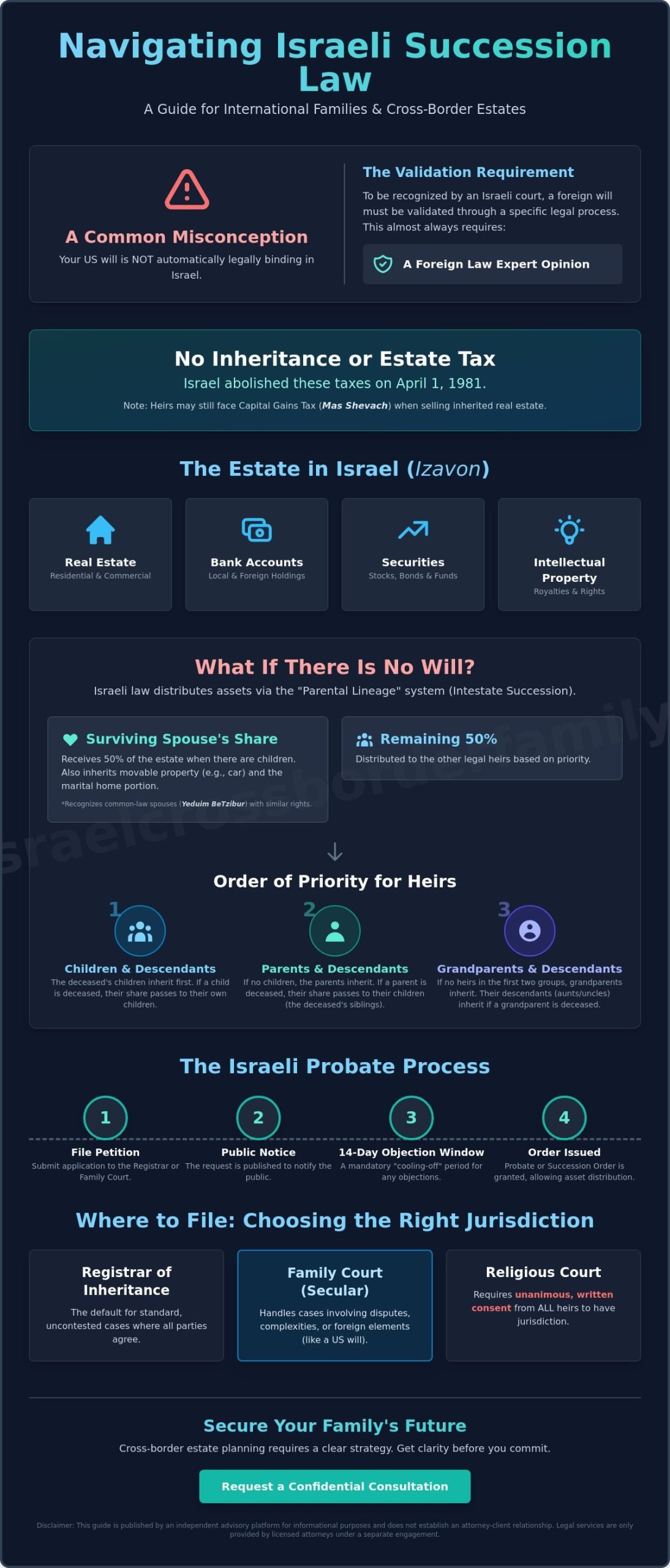
The foundational pillar of succession law in israel is the Succession Law of 1965. This statute governs how assets are distributed after death, whether a person left a will or died intestate. One of the most significant aspects of the Israeli framework is that the state abolished inheritance and estate tax on April 1, 1981. While there are no current plans to reintroduce these taxes as of May 2026, heirs must still consider potential Capital Gains Tax, known as Mas Shevach, if they eventually sell inherited real estate. The law defines the “Estate”, or Izavon, broadly; it encompasses residential real estate, commercial holdings, bank accounts, stocks, and intellectual property rights.
The Israeli Legal System operates through two primary bodies for these matters. The Registrar of Inheritance Affairs handles standard, uncontested applications, while the Family Court steps in when complexities, foreign elements, or disputes arise. Israeli law applies to any person who was a resident of the country at the time of their passing or anyone who left property within its borders. This means even if you live in the US, owning an apartment in Tel Aviv brings that specific asset under the local legal framework. To better understand the practical side of managing assets across borders, watch this helpful video:
Secular vs. Religious Jurisdiction
While the secular Family Court and the Registrar are the default authorities, religious courts, such as Rabbinical Courts, also hold jurisdiction over succession. However, a religious court can only rule on an inheritance if all heirs provide their written, informed consent. Without unanimous agreement, the case remains in the secular system. It’s vital to seek clarity on which court to use before filing any petitions because this initial choice affects the procedural style and the interpretation of specific rights. For those managing these details from abroad, exploring resources for expats and foreign nationals can help clarify how these systems interact.
The Definition of Heirs Under Israeli Law
Under Section 2 of the law, heirs are defined as those entitled to inherit either by law or by a valid will. The statute prioritizes blood relatives, specifically children and their descendants, parents, and grandparents. The surviving spouse occupies a unique position, typically receiving a significant portion of the estate along with specific personal effects. Israeli law also recognizes common-law spouses, known as Yeduim BeTzibur. If a couple lived together and managed a joint household without being married to others, the surviving partner may have the same inheritance rights as a legally wed spouse under the 1965 statute. Understanding these definitions is the first step toward a strategic roadmap for estate distribution.
The Order of Inheritance: When There Is No Will (Intestacy)
This article is published on an independent advisory platform (not a law firm) and does not constitute legal representation or an attorney-client relationship. Legal services are only provided by licensed attorneys under a separate engagement.
If a person passes away without leaving a valid will, the succession law in israel determines how their assets are distributed through a process called intestate succession. This framework uses a “Parental Lineage” system to establish a clear priority among relatives. It’s a rigid structure that doesn’t account for personal preferences or unique family dynamics. For international families with heirs living in different jurisdictions, understanding this hierarchy is the first step in identifying potential risks to the estate.
Priority Tiers in Intestate Succession
The law divides potential heirs into three distinct tiers. Tier 1 includes the deceased’s children and their descendants. If there are no descendants, Tier 2 covers the parents and their descendants, such as siblings, nieces, and nephews. Tier 3 includes grandparents and their descendants. Distribution follows the “per stirpes” method, which means if a child has passed away, their share passes directly to their own children. This ensures assets remain within specific family branches.
Rights of the Surviving Spouse
The surviving spouse occupies a protected position and typically receives 50% of the entire estate. Along with this share, they are entitled to the deceased’s passenger car and standard household chattels. If the couple was married for at least three years and lived together in an apartment that is part of the estate, the spouse may inherit the deceased’s entire share of that specific property. These rules aim to protect the spouse’s standard of living, though the exact distribution can vary if there are no surviving children. You might find it helpful to request a review of your family’s structure to see how these rules apply.
The distribution of an intestate estate is an automatic legal process, but it isn’t always the most efficient path for cross-border families. If the search for heirs across all three tiers proves unsuccessful, the assets don’t simply vanish. Under the 1965 law, the estate will eventually escheat to the State of Israel. This is a final resort used only when no legal relatives can be identified. For expats, this highlights the importance of maintaining clear family records to avoid assets being lost to the state due to a lack of documentation.
Cross-Border Jurisdiction and Conflict of Laws
This article is published on an independent advisory platform (not a law firm) and does not constitute legal representation or an attorney-client relationship. Legal services are only provided by licensed attorneys under a separate engagement.
Managing an estate that spans both the US and Israel introduces a sophisticated layer of legal friction. While the succession law in israel grants local courts jurisdiction over any assets physically located within the country, these courts do not automatically recognize probate orders issued by US state courts. This means that even if a New York or California court has already validated a will, your heirs must still initiate a separate legal process in Israel to claim local property or bank accounts. Failure to address these jurisdictional differences early often leads to “intestacy by default,” where a foreign will is deemed unreadable or invalid by local standards, forcing the estate into the rigid statutory distribution tiers discussed previously.
Validating a Foreign Will in Israel
Technically, a US will can be valid in Israel if it meets the formal requirements of the place where it was signed. However, the practical process of validation is both rigorous and costly. When the deceased was not a resident of Israel, the court typically requires a “Havat Daat”, which is a formal expert opinion on foreign law. This document proves to the Israeli Registrar that the will is valid under the laws of the specific US state. These expert opinions generally range in cost from 3,000 to 7,000 ILS. Additionally, all foreign documents must bear an Apostille certification and be accompanied by notarized Hebrew translations. The court will examine both “formal validity”, the technical signing of the document, and “essential validity”, whether the instructions themselves contradict Israeli public policy.
The Risk of Conflicting Estate Plans
One of the most significant risks for international families is the unintentional revocation of a carefully crafted plan. Many standard US will templates include a “boilerplate” clause that revokes all prior wills. If you sign a new US will after creating an Israeli one, you might accidentally nullify your local arrangements. To prevent this, many families choose to “silo” their assets by creating jurisdiction-specific documents. By using international wills or separate local instruments with clear “carve-out” clauses, you ensure that your US plan stays in the US and your Israeli plan remains enforceable here. This strategic separation helps avoid multi-jurisdictional litigation and ensures your assets are distributed according to your specific wishes rather than a default legal formula. Get clarity before you commit. Request a confidential consultation.
The Israeli Probate Process: From Petition to Distribution
This article is published on an independent advisory platform (not a law firm) and does not constitute legal representation or an attorney-client relationship. Legal services are only provided by licensed attorneys under a separate engagement.
The procedural requirements for succession law in israel are highly structured and increasingly digitized. The process officially begins with filing a petition for either an Inheritance Order, for those who died intestate, or a Probate Order, for those with a valid will. As of May 2026, the Israeli Registrar of Inheritance encourages digital efficiency by offering a lower fee of 538 NIS for online applications compared to 652 NIS for manual submissions. Once the petition is filed, a mandatory notice is published in a daily newspaper at a cost of 215 NIS. This publication triggers a 14-day cooling-off period where any interested party may file an objection to the will or the proposed distribution.
After the publication period ends, the file undergoes a review by the Counsel for the Attorney General through the office of the Administrator General, known as HaApotropos HaKlali. Their role is to ensure the application complies with the Succession Law of 1965 and that no legal rights, such as those of minors or missing heirs, are overlooked. If the file is straightforward and complete, the Succession Order is typically issued within 40 to 50 days of the initial submission.
Executing an Estate as a Non-Resident
Managing these administrative steps from abroad requires a strategic approach. Non-residents must typically appoint a local representative to handle interactions with the Registrar and ensure all documents meet local standards. While the statutory timeline for simple cases is relatively short, cross-border estates involving US residents often take 3 to 6 months to finalize. This extended duration accounts for the time needed to obtain Apostille certifications and the mandatory “Declaration of Death” if the individual passed away outside of IL. These early procedural decisions significantly impact the overall efficiency of the distribution.
Managing Israeli Real Estate after Probate
Once the probate or inheritance order is issued, the final step involves updating the Land Registry, commonly referred to as the Tabu. Heirs must submit the court order to the registry to legally transfer the title into their names. This step is critical for anyone intending to sell or lease the property. If the inheritance occurs alongside other life transitions, understanding the intersection of divorce and separation for international families can help clarify how shared property interests are treated. US citizens should remain aware that while Israel has no estate tax, a Capital Gains Tax of 25% may apply when the inherited asset is eventually sold. To ensure your family is prepared for these requirements, you should speak with a legal professional to coordinate your cross-border strategy.
This article is published on an independent advisory platform (not a law firm) and does not constitute legal representation or an attorney-client relationship. Legal services are only provided by licensed attorneys under a separate engagement.
Strategic Planning for Cross-Border Successions
Effective estate management within the framework of succession law in israel requires more than just a set of documents; it demands a comprehensive strategy that bridges two distinct legal cultures. Families often feel pressured to sign waivers or commitments during the initial stages of a probate process without fully understanding the long-term tax or jurisdictional consequences. Seeking clarity before making these commitments is vital. For example, while a US trust is a common tool for tax efficiency, its treatment by Israeli tax authorities depends heavily on the residency of the beneficiaries and the nature of the assets. Strategic planning ensures that your international asset protection doesn’t inadvertently trigger unnecessary reporting requirements or local tax liabilities.
For couples with significant assets in IL, the “Mutual Will” serves as a specific strategic tool under Section 8a of the Succession Law. Unlike separate individual wills, a mutual will allows spouses to create joint, reciprocal instructions that limit the ability of the surviving spouse to change the distribution plan unilaterally. This provides a layer of security for families who want to ensure that assets eventually pass to their children or other designated heirs, regardless of future changes in family structure. When coordinated with US estate plans, these documents prevent the “conflict of laws” that often delays the distribution of cross-border estates.
Risk-Based Decision Making
Many international families fall into common pitfalls, such as failing to update their estate plans after Aliyah or a divorce. A US will drafted before moving to the “start-up nation” may not account for the specific requirements of the Israeli Registrar, leading to the expensive validation processes discussed in previous sections. Early decisions regarding how to title property or structure bank accounts have a profound impact on family harmony and the eventual probate timeline. To better understand the strategy behind preparing these documents, watch this helpful video:
The Importance of Bicultural Legal Guidance
Navigating the intersection of US and Israeli law is not merely a translation task; it’s a cultural one. Bilingual attorneys act as a critical bridge, ensuring that the intent of a US testator is accurately reflected within the Israeli legal system. Having a “team on the ground” allows for real-time interaction with the Registrar of Inheritance and the Land Registry (Tabu), which is essential for effective estate administration. This collaborative approach helps international families navigate the inherent complexity of multi-jurisdictional successions with confidence. Get clarity before you commit. Request a confidential consultation.
This article is published on an independent advisory platform (not a law firm) and does not constitute legal representation or an attorney-client relationship. Legal services are only provided by licensed attorneys under a separate engagement.
Securing Your Family’s Multi-Jurisdictional Legacy
Navigating succession law in israel requires a proactive approach to prevent the complexities of cross-border assets from overwhelming your heirs. We’ve explored how the 1965 statute dictates distribution when no will exists and the procedural rigor required to validate foreign documents. By siloing assets and utilizing tools like mutual wills, you protect your family from the delays of multi-jurisdictional litigation and ensure your intentions are honored in both jurisdictions.
Our team provides a seamless professional home with a physical presence on the ground in both Tel Aviv and New York. With decades of collective experience in cross-border family law, our bicultural attorneys are qualified to practice in both Israel and the US. This unique dual-qualification allows us to act as a strategic bridge between the legal systems of the “start-up nation” and global markets. Get clarity before you commit. Request a confidential consultation today to ensure your estate plan remains robust and enforceable across every border.
This article is published on an independent advisory platform (not a law firm) and does not constitute legal representation or an attorney-client relationship. Legal services are only provided by licensed attorneys under a separate engagement.
Frequently Asked Questions
Is there an inheritance tax in Israel for US citizens?
No, Israel does not impose an inheritance or estate tax, as the state abolished these taxes on April 1, 1981. However, US citizens or residents receiving more than $100,000 from a foreign estate must file Form 3520 with the IRS. While the inheritance itself is tax free in Israel, heirs should prepare for a 25% Capital Gains Tax if they eventually sell inherited real estate.
Can I probate a US will in Israel without traveling there?
You can complete the entire probate process without traveling to Israel by appointing a local representative through a Power of Attorney. This document must be authenticated with an Apostille or signed at an Israeli consulate. Most applications are now processed through the Registrar’s online portal, which carries a reduced filing fee of 538 NIS compared to the manual submission fee of 652 NIS.
What happens if an heir cannot be located in a cross-border succession?
If an heir is missing, the Administrator General manages their portion of the estate until the individual is located or for a statutory period of 15 years. The court typically requires proof of a diligent search, including specific newspaper advertisements. If no heirs are found after all legal avenues are exhausted, the assets eventually escheat to the State of Israel under the Succession Law of 1965.
How long does it take to get an Israeli Probate Order (Tzav Kiyum Tzavaat)?
A standard Israeli Probate Order is typically issued within 40 to 50 days of a completed application. This timeframe includes the mandatory 14 day period for public objections that follows the newspaper publication. If the case involves a non-resident deceased person, the requirement for a foreign law expert opinion often extends the total process to a window of 3 to 6 months.
Do I need a separate will for my assets in Israel if I already have one in the US?
While a US will can be legally valid, having a separate Israeli will is highly recommended to avoid the complexity of succession law in israel regarding foreign documents. Validating a US will requires a foreign law expert opinion that generally costs between 3,000 and 7,000 ILS. A local will ensures a faster probate process and prevents your Israeli assets from being frozen during multi-jurisdictional disputes.
Can a common-law spouse inherit under Israeli succession law?
Yes, a common-law spouse, known as Yadua B’Tzibur, has the same inheritance rights as a married spouse under the 1965 statute. To qualify, the couple must have lived together as a family unit and managed a joint household at the time of death. Once the relationship is proven to the court, the surviving partner is usually entitled to 50% of the estate and the couple’s car.
What is the role of the Administrator General in the probate process?
The Administrator General reviews all probate and inheritance petitions to ensure they comply with the law and protect the rights of minors or missing heirs. They act as a procedural watchdog, verifying that all legal requirements have been met before the Registrar issues a final order. Their intervention is a standard step that occurs after the 14 day public objection window has closed.
How do I transfer an inherited Israeli apartment into my name?
To transfer the title, you must submit the final Probate or Succession Order to the Land Registry, commonly known as the Tabu. This administrative filing legally records the heirs as the new owners of the property. It’s a necessary step that must be completed before you can sell the apartment, lease it to tenants, or use the property as collateral for a mortgage.

Article by
Gabriel Lior
A Personal Journey That Became a Mission
The advisory was founded by an American father Gabriel Lior, LLB, MBA , global entrepreneur, and cross-border advisor who spent more than a decade navigating the Israeli family court system firsthand and now lives in Singapore with his son.
As a divorced parent in a cross-border family, Gabriel faced nearly every legal challenge a foreign parent can encounter in Israel — including child custody disputes, child support proceedings, property matters in Israel and abroad, false accusations, and complex immigration and relocation proceedings.
Over the years, he learned the hard way how difficult it is for non-Israeli parents to understand the system, identify the right legal strategy, and choose the right legal representation — especially when language, culture, and jurisdictional differences are involved. He also witnessed how foreign parents and new immigrants are often disadvantaged or taken advantage of by service providers and institutions simply because they lack local knowledge or fluency.
From Client to Advisor
To truly understand — and survive — the system, Gabriel pursued formal legal education in Israel, completing two Israeli law degrees, alongside a BA and MBA earned in the United States. This was never about becoming a practicing attorney, but about gaining a deep, structural understanding of how the system works — and where it breaks down for foreign parents.
This rare combination of:
Firsthand client experience
Israeli legal and US business education
International business and negotiation training
Decades of commercial execution
created a unique perspective – one that understands both sides of the table.
After years of litigation, persistence, and at times self-representation, he ultimately succeeded in securing custody of his son and relocating abroad through a rare legal victory in the Israeli Supreme Court — becoming one of the first fathers in Israel to do so under these circumstances.
Disclaimer
Important Disclaimer:
The information provided on this website and in its content is for general informational and educational purposes only and does not constitute legal advice, legal opinion, or legal representation.
Gabriel Lior is not licensed to practice law in Israel (nor is he interested in doing so) and does not provide legal services, despite having completed 2 Law Degrees. The services offered are advisory in nature and are intended to provide general guidance, strategic insight, and information regarding cross-border family law considerations.
No attorney-client relationship is formed by accessing this website, reading its content, or communicating with us.
Any decisions made based on this information are at your own discretion and risk. For legal advice specific to your situation, you should consult a licensed attorney in the relevant jurisdiction.
Where appropriate, we may refer clients to independent, licensed attorneys or professionals. Such referrals do not constitute legal representation and no liability is assumed for services provided by third parties.