This article is published on an independent advisory platform and is not a law firm; it does not constitute an attorney-client relationship. Legal services are only provided by licensed attorneys under a separate engagement.
Imagine your child sitting in a Tel Aviv office, struggling to explain their grief to a Hebrew-speaking therapist when their primary language is English. Finding effective therapy and support for children of divorce abroad often feels like a secondary battle in an already exhausting international legal process. You’re likely worried about language barriers, time zone conflicts, or whether therapy records might be used as evidence in a future court hearing. It’s a heavy burden to carry while trying to maintain a sense of normalcy for your family across borders.
This guide provides the clarity you need to navigate these complexities using expert-led strategies and resource comparisons. We’ll explore the benefits of local versus remote support, examine the shift toward joint custody in IL as the “Tender Years Doctrine” phases out in 2026, and compare therapy costs that typically range from $100 to $250 per session. We also include expert insights from our YouTube channel, @IsraelFamilyLaw, to help you make informed decisions. Get clarity before you commit. Request a confidential consultation.
Key Takeaways
- Identify how the “Third Culture Kid” dynamic impacts your child’s identity and sense of home during an international separation.
- Compare the benefits of local Israeli therapy with remote support to ensure your child maintains cultural and linguistic continuity.
- Understand the role of “Machon” experts in the IL Family Court system and how they evaluate your child’s mental health.
- Develop a strategic plan for therapy and support for children of divorce abroad that addresses relocation-related anxiety and long-term stability.
- Learn to coordinate co-parenting strategies across borders to provide a consistent emotional environment in both the US and Israel.
This article is published on an independent advisory platform and is not a law firm; it does not constitute an attorney-client relationship. Legal services are only provided by licensed attorneys under a separate engagement.
Understanding the Unique Stressors for Children of Divorce Abroad
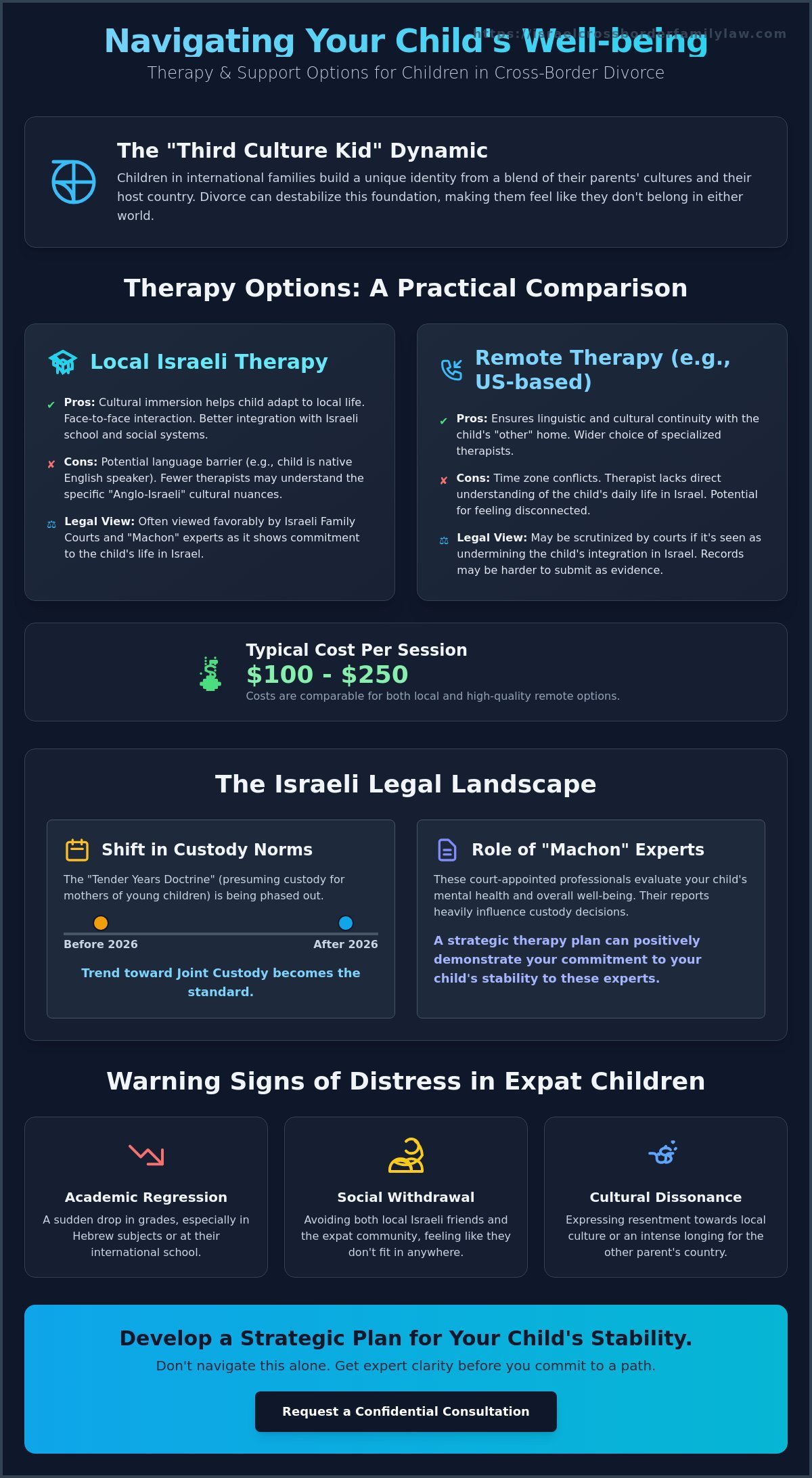
Children in international families often navigate a complex identity dynamic known as the “Third Culture Kid” (TCK) experience. They build their sense of self from a blend of their parents’ cultures and the environment in IL, rather than a single national identity. When a marriage dissolves, this delicate foundation often feels unstable. Securing effective therapy and support for children of divorce abroad requires recognizing that these children aren’t just processing a separation; they’re losing their primary anchor in a foreign land.
The psychological toll is compounded by the loss of an extended support network. In a domestic divorce, a child might turn to grandparents, cousins, or lifelong family friends for stability. For expat families, these figures are often thousands of miles away. This isolation can intensify the effects of divorce on children, leading to a deeper sense of abandonment or confusion about where they truly belong.
To better understand the logistical and emotional weight of these transitions, watch this helpful video:
The Definition of Cross-Border Family Stress
International divorce differs from domestic separation because it often involves a “loss of familiar landmarks.” This isn’t just about a house or a room; it’s about the loss of a specific cultural and linguistic safety net. Statistics from a 2026 NIH study indicate that parental separation is associated with a 1.5 to 2 times increased risk for adolescent adjustment problems. In a cross-border context, this risk is heightened by relocation anxiety. When parents live in different countries, the child may fear that choosing one parent means losing an entire country or culture. Early intervention is critical to prevent these fears from manifesting as long-term trauma.
Identifying Warning Signs in Expat Children
Parents should look for behavioral changes that specifically reflect their child’s struggle with their environment. While some regression is common, expat children may show unique signs of distress:
- Academic Regression: A sudden drop in grades or interest, particularly in Hebrew language subjects or at international schools where they previously felt comfortable.
- Social Withdrawal: Avoiding both local Israeli peers and the expat community, often signaling that they don’t feel they “fit” in either world anymore.
- Cultural Dissonance: Expressing resentment toward the local culture or a sudden, intense longing for the “other” parent’s country, often used as a coping mechanism to escape local stress.
Addressing these signs early through a strategic international custody and relocation plan can help mitigate the impact of these unique stressors. Get clarity before you commit. Request a confidential consultation.
This article is published on an independent advisory platform and is not a law firm; it does not constitute an attorney-client relationship. Legal services are only provided by licensed attorneys under a separate engagement.
Comparing Therapy and Support Options for International Families
Selecting the right therapy and support for children of divorce abroad requires a sophisticated understanding of both clinical needs and cultural context. For families living in IL, the decision isn’t merely about finding a provider; it’s about identifying a professional who understands the Anglo-Israeli experience. In major Israeli cities, family therapy sessions typically cost between $100 and $250, but the value of the session depends heavily on the child’s ability to communicate without linguistic barriers. Choosing a modality that aligns with the child’s developmental stage and current environment is a critical first step in establishing a stable emotional foundation.
Therapeutic Modalities for Children
Play therapy serves as a vital bridge for younger children who may struggle to express complex emotions in a second language. By using toys and creative activities, therapists in IL can bypass language gaps and help children process the trauma of a cross-border separation. For older children and adolescents, Cognitive Behavioral Therapy (CBT) is often more effective. This modality focuses on managing relocation-related anxiety and the internal conflict of dual-citizenship identities. It helps teens develop practical coping strategies for the unique stressors of a multi-jurisdictional life. It’s essential to seek therapists who are bicultural or bilingual, as they can navigate the nuances of both the child’s home culture and their life in Israel.
Non-Clinical Support Networks
Support isn’t limited to the therapist’s office. International school counselors in IL play a pivotal role in the support ecosystem. They see the child’s daily interactions and can identify academic regression or social withdrawal early on. Additionally, community-based organizations catering to English-speaking families provide a sense of belonging that clinical settings sometimes lack. Many families also leverage digital communities to help children maintain ties with their “other” home country. These platforms allow children to interact with peers who share similar cross-border lives, reducing the feeling of isolation that often follows a divorce or separation in international families.
Parental coaching is another often overlooked resource. By managing your own cross-border stress through professional guidance, you create a more resilient environment for your child. Early decisions regarding these support systems can significantly alter the child’s long-term adjustment. If you’re feeling overwhelmed by the options, you can request a confidential case review to explore how to integrate these strategies into your broader family plan. Get clarity before you commit. Request a confidential consultation.
This article is published on an independent advisory platform and is not a law firm; it does not constitute an attorney-client relationship. Legal services are only provided by licensed attorneys under a separate engagement.
In-Person vs. Remote Therapy: A Practical Comparison
The choice between in-person and remote therapy and support for children of divorce abroad often rests on the balance between immediate local needs and long-term cultural continuity. By May 2026, teletherapy has evolved from a backup option into a primary care method. Modern hybrid models now allow families to access specialists across borders while maintaining a local safety net. While online sessions are often more affordable, typically ranging from $60 to $150 per session, in-person care in IL provides a physical presence that remote platforms cannot replicate. Logistics matter. A lot. Managing a seven to ten hour time difference between Israel and the US requires a disciplined schedule and a commitment to digital privacy.
Benefits of Local In-Person Support in IL
Local therapy offers immediate crisis intervention capabilities that are essential for high-conflict situations. A therapist based in Israel can act as a direct liaison with the child’s school, attending meetings or providing guidance to teachers who see the child daily. These professionals have a deep understanding of the specific nuances within the Israeli educational and legal systems. They help build a local “village” for the child. This physical presence ensures the child feels anchored in their current residence, which is vital when their other parent may be thousands of miles away.
When Remote Support from the US Makes Sense
Remote therapy is often the superior choice for maintaining continuity of care. If a child recently moved from the US to Israel, keeping their existing therapist can prevent the trauma of “starting over” with a stranger. It also provides access to specialized English-speaking pediatric psychologists who might not be available in smaller Israeli communities. Connecting with a therapist who shares the child’s native cultural background allows them to express themselves without the pressure of cultural translation. Subscription-based platforms, which often cost between $260 and $400 per month for weekly sessions, can make this specialized care more accessible for international families.
Coordinating between these two worlds requires a clear strategy. You must verify if your international insurance coverage extends to out-of-country providers and ensure all digital platforms comply with strict privacy standards. Early decisions regarding the delivery of care can impact future international custody and relocation proceedings. Get clarity before you commit. Request a confidential consultation.
This article is published on an independent advisory platform and is not a law firm; it does not constitute an attorney-client relationship. Legal services are only provided by licensed attorneys under a separate engagement.
Legal Implications: Therapy and the Israeli Family Court System
The intersection of clinical care and legal strategy is often where parents feel the most vulnerable. When arranging therapy and support for children of divorce abroad, you must understand that the Israeli Family Court operates under the “best interests of the child” principle. This standard is the primary lens through which judges view any therapeutic intervention. In IL, the court has a unique dual-jurisdiction system. While Rabbinical Courts handle marriage and divorce for Jewish couples, civil Family Courts manage child custody and support. Since July 2016, Israeli law has mandated that all couples seeking divorce must first attend dispute resolution meetings through court-affiliated units. These units often recommend therapy as part of a preliminary assessment of the family’s needs.
One specific feature of the Israeli system is the role of the “Appointed Expert,” or Machon. These are private institutes or social service units appointed by the court to evaluate a child’s mental health and the parents’ capabilities. If your child is already in therapy, the court-appointed expert may seek input from the current therapist. Judges generally view proactive therapy as a sign of responsible, child-focused parenting. It demonstrates a commitment to stability during a period of intense upheaval, which is particularly relevant in 2026 as the “Tender Years Doctrine” continues to be phased out in favor of joint custody arrangements.
Confidentiality Realities in IL Courts
Confidentiality in IL courts is not absolute. While therapist-client privilege is a recognized concept, it is more restricted than what many US expats might expect. A judge has the authority to override this privilege if they believe the information is vital to the child’s safety or development. This possibility often creates fear that therapy records will be used as a weapon in litigation. To mitigate this risk, it’s wise to choose a therapist who has experience working with the international community and understands the specific legal boundaries of the Israeli system. They can provide support while maintaining a professional distance from the adversarial aspects of the case.
Therapy as a Strategic Choice
Seeking support early is a strategic decision that can impact the narrative of your case. It shows the court that you’re prioritizing the child’s emotional health over legal posturing. In complex cases involving the Hague Convention, documented therapeutic support can sometimes help illustrate the child’s emotional state and their “habitual residence.” You can learn about international custody and relocation to see how therapy requirements are often integrated into formal cross-border agreements. If you need to understand how these legal nuances apply to your specific situation, reach out for a strategic guidance session. Get clarity before you commit. Request a confidential consultation.
This article is published on an independent advisory platform and is not a law firm; it does not constitute an attorney-client relationship. Legal services are only provided by licensed attorneys under a separate engagement.
Building a Long-Term Support Strategy for Your Child
A sustainable strategy for therapy and support for children of divorce abroad must extend far beyond the immediate crisis of separation. It requires a proactive architecture that bridges the gap between their daily life in IL and their connections in the US or other home countries. As children grow, their emotional and developmental needs evolve. A support network that served a six year old will likely require significant adjustment for an adolescent navigating the complexities of dual citizenship and multi-jurisdictional identity. By 2026, the trend in mental health has shifted toward preventive care and the cultivation of emotional literacy as a core life skill. This long-term view ensures that the child doesn’t just survive the divorce but develops the resilience to thrive in a global environment.
Developing a Cross-Border Co-Parenting Plan
Consistency is the primary anchor for children moving between different legal and cultural systems. Creating a “Transition Plan” helps manage the “re-entry” period after a child visits a parent abroad. This phase is often marked by emotional “jet lag” as the child adjusts to different household rules and cultural expectations. Parents should strive for consistent messaging regarding the child’s support system. If one parent supports therapy while the other dismisses it, the child may feel forced to choose sides, which undermines the therapeutic process. You can find more structured guidance on managing these dynamics in our overview of divorce and separation for international families. Standardizing emotional support across both households reduces the child’s cognitive load and provides a predictable emotional environment.
Seeking Professional Clarity
The inherent complexity of cross-border situations means that early decisions have a significant impact on long-term outcomes. A strategy-based approach to both family law and mental health allows you to anticipate risks before they become crises. This involves regular “check-ins” with bicultural professionals who can monitor the child’s identity health and adapt the support network as needed. Seeking clarity before making commitments is essential to building a legally sound and emotionally stable framework for your family.
To deepen your understanding of the intersection between Israeli law and family stability, watch our guidance on Israel Family Law. Navigating these challenges alone is rarely the most effective path. Get clarity before you commit. Request a confidential consultation to discuss a tailored strategy for your child’s long-term wellbeing.
This article is published on an independent advisory platform and is not a law firm; it does not constitute an attorney-client relationship. Legal services are only provided by licensed attorneys under a separate engagement.
Securing Your Child’s Future Across Borders
Supporting a child through an international separation requires a strategy that balances psychological health with the realities of the Israeli legal system. You’ve learned that the “Tender Years Doctrine” is rapidly phasing out in 2026, making joint custody and shared parenting the new standard in IL. Whether you choose in-person support in Tel Aviv or remote specialists from the US, the goal remains the same: creating a stable, bilingual environment that respects your child’s complex identity. It’s about building a bridge between two worlds while maintaining a sense of home.
Integrating effective therapy and support for children of divorce abroad into your formal agreements is a strategic choice. It demonstrates to the Family Court and court-appointed experts that you’re prioritizing long-term stability over short-term conflict. As an independent advisory platform, we focus on risk-based decision-making to help expats and Anglos navigate these multi-jurisdictional challenges with confidence. Expertise in the intersection of US and Israeli systems is vital to ensuring your child’s emotional needs are legally protected.
Get clarity before you commit. Request a confidential consultation. Your proactive decisions today will define your child’s resilience for years to come.
This article is published on an independent advisory platform and is not a law firm; it does not constitute an attorney-client relationship. Legal services are only provided by licensed attorneys under a separate engagement.
Frequently Asked Questions
Is therapy confidential in the Israeli Family Court system?
Therapy is not absolutely confidential in IL. While therapist-client privilege is a recognized concept, judges have the authority to override this privilege if they believe the information is vital to the child’s safety or development. This often occurs when a court-appointed expert, or Machon, evaluates the family. You should work with a professional who understands these legal boundaries to protect your child’s privacy while meeting court requirements.
Can I use a US-based therapist for my child while living in Israel?
Yes, you can utilize a US-based specialist through teletherapy platforms. This is a common choice for therapy and support for children of divorce abroad when maintaining cultural and linguistic continuity is a priority for the child. As of 2026, remote sessions are widely accepted and typically cost between $60 and $150 per session. It’s important to verify that the therapist is comfortable navigating international practice requirements.
How do I find an English-speaking child psychologist in Israel?
You can find English-speaking professionals through specialized directories like the Israel Association for Marital and Family Therapy or Anglo-focused organizations such as Get Help Israel. Many international schools in Tel Aviv and Jerusalem also maintain vetted lists of bilingual counselors who understand the expat experience. These professionals are essential for children who may struggle to express complex emotions in a Hebrew-only clinical environment.
Will putting my child in therapy affect my custody case in IL?
Proactive therapy is generally viewed positively by Israeli judges as a sign of responsible parenting. It demonstrates a commitment to the child’s emotional stability during the transition to joint custody, which is increasingly ordered by courts in 2026. However, if therapy is used as a tool to alienate the other parent, it can become a point of contention during evaluations by court-ordered social service units.
What is the “best interests of the child” standard in cross-border cases?
This standard prioritizes the child’s physical, emotional, and developmental needs over the personal preferences of the parents. In cross-border cases, courts specifically examine the child’s habitual residence and the potential impact of moving between different legal systems. A 2026 study found that children who experience divorce in early childhood have higher adjustment risks, so IL courts focus on minimizing disruption to the child’s established support network.
What happens if my ex-spouse refuses to consent to therapy for our child?
You can petition the Israeli Family Court for a specific order to initiate therapy and support for children of divorce abroad even without the other parent’s consent. Under the July 2016 dispute resolution law, couples must first attend a meeting at the court’s Social Services Unit. If mediation fails and the court determines that therapy is necessary for the child’s wellbeing, a judge can authorize treatment over the other parent’s objection.
How does the Hague Convention impact therapy for children in relocation cases?
The Hague Convention primarily focuses on the “habitual residence” of the child rather than custody merits. However, therapy records can sometimes be used to establish the child’s emotional integration into a specific country or to argue that a return would cause grave psychological harm. Since late 2025, courts have been applying clearer rules to determine habitual residence, making documented therapeutic support a relevant factor in these complex proceedings.
Are there specific support groups for expat children in Tel Aviv or Jerusalem?
Yes, several organizations in IL provide support groups specifically for English-speaking children. Organizations like the Association of Americans and Canadians in Israel (AACI) or community centers in Anglo-heavy neighborhoods often host these sessions. These groups help children process the unique “Third Culture Kid” dynamic by connecting them with peers who are also navigating the complexities of cross-border family transitions.

Article by
Gabriel Lior
A Personal Journey That Became a Mission
The advisory was founded by an American father Gabriel Lior, LLB, MBA , global entrepreneur, and cross-border advisor who spent more than a decade navigating the Israeli family court system firsthand and now lives in Singapore with his son.
As a divorced parent in a cross-border family, Gabriel faced nearly every legal challenge a foreign parent can encounter in Israel — including child custody disputes, child support proceedings, property matters in Israel and abroad, false accusations, and complex immigration and relocation proceedings.
Over the years, he learned the hard way how difficult it is for non-Israeli parents to understand the system, identify the right legal strategy, and choose the right legal representation — especially when language, culture, and jurisdictional differences are involved. He also witnessed how foreign parents and new immigrants are often disadvantaged or taken advantage of by service providers and institutions simply because they lack local knowledge or fluency.
From Client to Advisor
To truly understand — and survive — the system, Gabriel pursued formal legal education in Israel, completing two Israeli law degrees, alongside a BA and MBA earned in the United States. This was never about becoming a practicing attorney, but about gaining a deep, structural understanding of how the system works — and where it breaks down for foreign parents.
This rare combination of:
Firsthand client experience
Israeli legal and US business education
International business and negotiation training
Decades of commercial execution
created a unique perspective – one that understands both sides of the table.
After years of litigation, persistence, and at times self-representation, he ultimately succeeded in securing custody of his son and relocating abroad through a rare legal victory in the Israeli Supreme Court — becoming one of the first fathers in Israel to do so under these circumstances.
Disclaimer
Important Disclaimer:
The information provided on this website and in its content is for general informational and educational purposes only and does not constitute legal advice, legal opinion, or legal representation.
Gabriel Lior is not licensed to practice law in Israel (nor is he interested in doing so) and does not provide legal services, despite having completed 2 Law Degrees. The services offered are advisory in nature and are intended to provide general guidance, strategic insight, and information regarding cross-border family law considerations.
No attorney-client relationship is formed by accessing this website, reading its content, or communicating with us.
Any decisions made based on this information are at your own discretion and risk. For legal advice specific to your situation, you should consult a licensed attorney in the relevant jurisdiction.
Where appropriate, we may refer clients to independent, licensed attorneys or professionals. Such referrals do not constitute legal representation and no liability is assumed for services provided by third parties.