This article is published on an independent advisory platform, not a law firm. The content is informational and advisory only; it does not constitute legal representation or legal advice. An attorney-client relationship is only established through a separate, signed engagement with a licensed attorney.
What if your decision to move forward with a new relationship became the catalyst for a legal battle over your children? This question is a primary source of anxiety for many expats and international families who fear the new partner impact on child custody israel. You likely worry that a co-parent might use your personal life as leverage, or that the conservative views of the Rabbinical court regarding cohabitation could jeopardize your stability. It’s natural to feel protective of your rights while seeking a fresh start.
This guide provides the legal clarity you need to navigate these multi-jurisdictional complexities. You’ll learn how the Israeli system evaluates new family dynamics and discover strategic steps to introduce a partner without compromising your custody status. We’ll preview the “Best Interests of the Child” standard and define what constitutes a “material change in circumstances.” For further guidance, you can explore the resources at https://www.youtube.com/@IsraelFamilyLaw.
Get clarity before you commit. Request a confidential consultation.
Key Takeaways
- Learn why the “Best Interests of the Child” remains the supreme guiding principle and how the Israeli legal system views new relationships as legally neutral by default.
- Identify the specific legal threshold for a “Significant Change in Circumstances” required to justify a modification of your current custody arrangement.
- Understand the distinct approaches of the Family Court versus the Rabbinical Court regarding cohabitation and how these jurisdictions weigh parental conduct.
- Discover a strategic timeline for introducing a partner to your children to minimize the new partner impact on child custody israel and maintain stability.
- Prepare an effective response strategy for handling objections or legal threats from a co-parent regarding your new relationship.
This article is published on an independent advisory platform, not a law firm. The content is informational and advisory only; it does not constitute legal representation or legal advice. An attorney-client relationship is only established through a separate, signed engagement with a licensed attorney.
Does a New Partner Automatically Change Child Custody in Israel?
Entering a new relationship after a divorce is a significant personal milestone, yet for international families, it often brings a wave of legal anxiety. You might worry that your ex-spouse will use your new partner as a reason to reopen a closed case. In the Israeli legal system, the mere existence of a new romantic partner doesn’t trigger an automatic review of your custody arrangements. The law protects your right to move on with your life, provided those choices don’t negatively affect your children. Understanding the new partner impact on child custody israel starts with recognizing that your parental fitness is evaluated independently of your relationship status.
To better understand how judges approach these delicate family dynamics, watch this helpful video:
The Legal Standard: Best Interests of the Child
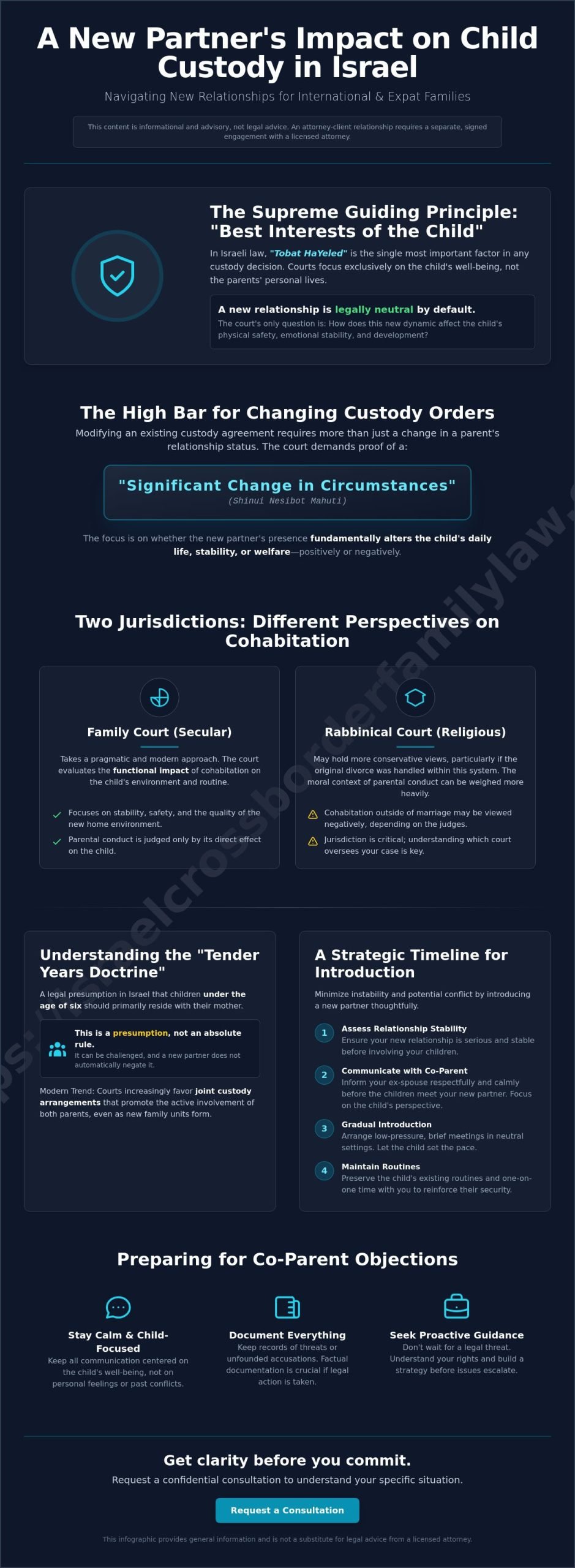
Israeli courts prioritize Tobat HaYeled, or the Best Interests of the Child, above all other considerations. This isn’t a vague concept; it’s a rigorous standard that focuses on the child’s physical safety, emotional stability, and developmental needs. When a new person enters the household, the court doesn’t judge the morality of the relationship. Instead, it looks at how this change affects the child’s environment. Social workers, known as Pekidat Sa’ad, may be appointed to evaluate the new household member. They assess whether the new partner provides a supportive presence or creates conflict. Their role is to distinguish between your private romantic life and your functional ability to parent in a stable setting.
When the ‘Tender Years Doctrine’ Applies
In IL, a legal presumption called the “Tender Years Doctrine” suggests that children under the age of six should remain in the primary custody of their mother. While this presumption is strong, it isn’t absolute. A new partner doesn’t automatically negate this doctrine, nor does it give the other parent an immediate “win” in court. When assessing the new partner impact on child custody israel for young children, judges look for continuity of care. If the introduction of a partner leads to a proposed international custody relocation, the court will scrutinize the move intensely. Modern trends show that Israeli courts are increasingly favoring joint custody arrangements. They recognize that children benefit from the active involvement of both parents, even as new family units form.
Get clarity before you commit. Request a confidential consultation.
This article is published on an independent advisory platform, not a law firm. The content is informational and advisory only; it does not constitute legal representation or legal advice. An attorney-client relationship is only established through a separate, signed engagement with a licensed attorney.
Legal Grounds for Modification: When a New Relationship Matters
Israeli law requires a high threshold to modify an existing custody order. This threshold is known as Shinui Nesibot Mahuti, or a significant change in circumstances. A new relationship often acts as the catalyst for this legal review if it fundamentally shifts the child’s daily life. While your private life is your own, the court takes notice when cohabitation begins. This is because living with a partner often impacts financial arrangements, including alimony or child support, depending on the terms of your original divorce agreement.
Beyond logistics, the court evaluates the emotional landscape. If a new partner actively undermines the other parent, it may lead to claims of parental alienation. Israeli judges are increasingly sensitive to situations where a third party interferes with the established parental bond. The new partner impact on child custody israel is most pronounced when the court perceives a threat to the child’s psychological stability or the co-parenting relationship. It’s helpful to request a confidential case review to understand how your specific circumstances might be viewed by the court.
The New Partner as a ‘Significant Change’
Not every move-in requires a court update, but substantial shifts do. A Significant Change is a shift that fundamentally alters the child’s daily environment or safety. Courts generally prefer a stable, long-term relationship over a “revolving door” of temporary partners. Frequent changes in the household can be viewed as destabilizing for children. If you’re considering a permanent move-in, it’s wise to assess how this changes the child’s routine before your ex-spouse files a motion. Get clarity before you commit.
Safety Risks and Background Checks
The court’s primary concern is always protection. If a new partner has a documented history of violence, substance abuse, or criminal activity, the court may intervene immediately. This could lead to restricted visitation or a temporary change in custody to ensure the child’s safety. Transparency is your strongest defense. Proactively sharing a partner’s background or introducing them slowly can prevent high-conflict litigation. Understanding the potential new partner impact on child custody israel allows you to make risk-based decisions that protect your family’s future.
This article is published on an independent advisory platform, not a law firm. The content is informational and advisory only; it does not constitute legal representation or legal advice. An attorney-client relationship is only established through a separate, signed engagement with a licensed attorney.
Family Court vs. Rabbinical Court: Different Views on Cohabitation
The dual-court system in IL creates a complex environment for parents entering new relationships. Understanding the new partner impact on child custody israel depends heavily on which court hears your case. You may find yourself in either the secular Family Court (Bet Mishpat LeInyanei Mishpacha) or the religious Rabbinical Court (Bet Din Rabbany). This split jurisdiction often leads to the “Race to Jurisdiction” (Merotz HaSamchuyot). In this race, the first parent to file a claim often determines which court will govern the proceedings. For a parent who has started dating, the choice of court can significantly influence how their personal life is scrutinized.
The Family Court’s Secular Lens
The Family Court operates with a focus on civil law and psychological welfare. Judges here rely heavily on expert testimony and reports from social workers to determine the best interests of the child. They are generally less concerned with the “morality” of a new relationship and more focused on how the partner interacts with the children. If the new partner provides a stable, supportive presence, the court often views the relationship as a positive addition to the child’s life. This secular approach is a core part of divorce for international families who are used to Western legal standards. The court’s primary goal is to ensure that the household remains a functional and safe environment regardless of romantic choices.
The Rabbinical Court’s Perspective
The Rabbinical Court evaluates cases through the lens of Jewish law (Halacha). While they are legally bound to uphold the “best interests of the child” standard, their interpretation of “moral character” can differ from secular views. Standards of modesty or traditional conduct may influence a judge’s perception of a parent’s fitness. For example, cohabiting before marriage might be viewed with more scrutiny in this jurisdiction. Additionally, a new relationship can impact financial matters like “Wife Alimony” (Mezonot Isha), as the court may rule that the financial support from a new partner reduces the ex-spouse’s obligations. If your case is in the Rabbinical system, maintaining a low profile during active litigation is often a strategic necessity.
For Anglos and expats, this dual system is often the most confusing aspect of the Israeli process. The new partner impact on child custody israel is rarely about a single rule, but rather about how your lifestyle fits within the specific culture of the court handling your case. Making informed choices early in the process can prevent your personal life from becoming a central point of conflict. Get clarity before you commit. Request a confidential consultation.
This article is published on an independent advisory platform, not a law firm. The content is informational and advisory only; it does not constitute legal representation or legal advice. An attorney-client relationship is only established through a separate, signed engagement with a licensed attorney.
How to Introduce a New Partner to Your Child and Co-Parent
Strategy is just as important as legal knowledge when managing the new partner impact on child custody israel. While the law doesn’t explicitly dictate how you conduct your personal life, the way you introduce a new partner can either de-escalate or trigger a custody battle. Taking a measured, transparent approach demonstrates parental responsibility and reduces the likelihood that a co-parent will feel the need to involve the court. By following a structured timeline, you protect your children’s emotional well-being and strengthen your legal position.
Step 1: Timing and Stability Assessment
Stability is the primary metric used by social workers during evaluations. For this reason, waiting six to twelve months before introducing a partner to your children is often the most legally sound recommendation. This timeframe allows you to confirm the longevity of the relationship before it becomes a factor in your child’s environment. If you’re unsure about the timing, consulting with a child psychologist can provide an objective assessment of your child’s readiness. Social workers and judges look for consistency; showing that you’ve prioritized your child’s adjustment over a new romantic interest reflects positively on your parental fitness.
Step 2: Communicating with the Co-Parent
Transparency is a tool for risk management, not a request for permission. Notifying your ex-spouse before the children meet your partner helps minimize their “threat response” and prevents them from hearing the news unexpectedly from a child. Frame this communication as a courtesy intended to maintain a stable co-parenting environment. It’s often helpful to use written communication or dedicated parenting apps to document the notice. For more insights on managing these interactions, you can view the guidance available at Israel Family Law. Providing basic information about the partner’s background can often prevent unnecessary motions for background checks or restrictive orders.
Step 3: The Gradual Introduction
Start with neutral, public-place meetings to keep the pressure low for everyone involved. Avoid overnight stays during the initial phase, as these can trigger “moral” objections, particularly if your case is being heard in the Rabbinical court. If your new partner lives abroad, the introduction requires even more careful planning to address potential relocation fears. Keep records of positive interactions and ensure the new partner respects the “step-parent” boundary to avoid claims of parental alienation. Taking these steps helps ensure the new partner impact on child custody israel remains legally neutral.
Get clarity before you commit. To discuss the specifics of your situation, contact us to schedule an introductory call.
This article is published on an independent advisory platform, not a law firm. The content is informational and advisory only; it does not constitute legal representation or legal advice. An attorney-client relationship is only established through a separate, signed engagement with a licensed attorney.
Navigating Objections and Protecting Your Parental Rights
When an ex-spouse threatens to “take the kids” because of your new relationship, it’s easy to react with immediate panic. However, it’s vital to remain steady. In the context of the new partner impact on child custody israel, a verbal threat is not a legal order. You shouldn’t stop visitation or unilaterally change the existing schedule based on a co-parent’s anger. Doing so could make you appear as the uncooperative party in the eyes of a judge. Instead, focus on maintaining a documented, stable routine that demonstrates your commitment to your child’s welfare.
If your co-parent moves forward with a “Motion to Modify Custody,” the court will look for evidence of a material change that harms the child. It’s during these high-conflict situations that the court might appoint a Apotropos LeDin, or a Guardian ad Litem. This professional represents the child’s independent voice, ensuring that the legal battle doesn’t overshadow the child’s actual needs. Their assessment often carries significant weight, focusing on the child’s emotional bond with both parents and the stability of the new household dynamic.
Responding to Threats of Litigation
It’s important to differentiate between empty threats and actionable legal filings. Many threats made in the heat of an argument never result in a courtroom battle. If a motion is actually filed, your response should be based on facts rather than emotion. You’ll need to show that your new relationship hasn’t negatively affected your parenting capacity or the child’s safety. A Confidential Case Review can help you assess the actual legal risk before you respond to aggressive posturing from a co-parent.
Protecting the Status Quo
Courts in IL generally favor the status quo because it provides the child with a sense of security. If your child is thriving, attending school regularly, and maintaining a healthy relationship with both parents, the court is often reluctant to disrupt that balance. You can protect your position by gathering evidence of the child’s well-being in the new setup. This might include school reports, feedback from therapists, or documentation of the child’s participation in extracurricular activities. Showing that the new partner impact on child custody israel has been minimal or even positive is your strongest defense.
The complexities of the Israeli system mean that early decisions have long-term consequences. Don’t wait for a crisis to understand your rights. Get clarity before you commit. Request a confidential consultation.
This article is published on an independent advisory platform, not a law firm. The content is informational and advisory only; it does not constitute legal representation or legal advice. An attorney-client relationship is only established through a separate, signed engagement with a licensed attorney.
Securing Your Future and Protecting Your Family
Managing the new partner impact on child custody israel is fundamentally about maintaining stability and prioritizing the child’s best interests over personal conflict. You’ve learned that while a new relationship is legally neutral, the way you introduce a partner and handle objections from a co-parent can define your legal standing. Whether navigating the secular Family Court or the religious Rabbinical Court, your success depends on strategic timing and proactive transparency. It’s essential to recognize that early decisions regarding cohabitation or relocation carry lasting implications for your custody arrangement.
This platform specializes in the unique complexities of cross-border US-Israel family law. With expertise in both civil and religious jurisdictions, the advisory-first approach provides international families with the steady guidance needed to bridge divergent legal systems. This ensures you can move forward with your personal life while protecting your parental rights and the emotional security of your children. You don’t have to navigate these multi-jurisdictional challenges alone.
Get clarity before you commit. Request a confidential consultation.
This article is published on an independent advisory platform, not a law firm. The content is informational and advisory only; it does not constitute legal representation or legal advice. An attorney-client relationship is only established through a separate, signed engagement with a licensed attorney.
Frequently Asked Questions
Can my ex-husband block my new partner from being around our children in Israel?
An ex-spouse cannot unilaterally block your new partner from being around your children without a specific court order based on proven safety risks. In the Israeli legal system, your right to form new relationships is protected unless those choices demonstrably harm the child’s well-being. If your co-parent attempts to restrict access without cause, the court will likely view this as an interference with your parental rights rather than a legitimate concern about the new partner impact on child custody israel.
Does moving in with a new partner affect child support payments in IL?
A parent’s new partnership or remarriage does not automatically alter the other parent’s child support obligations in IL. While your household expenses may change when moving in with a partner, the legal responsibility for child support remains tied to the biological parents’ incomes and the child’s established needs. However, cohabitation may impact “wife alimony” (Mezonot Isha) if your original divorce agreement contains specific clauses regarding future relationships or shared living arrangements.
What if my new partner is not Jewish and we are in the Rabbinical Court?
Relationships involving a non-Jewish partner may face higher scrutiny if your case is heard within the Rabbinical Court system. While all Israeli courts must prioritize the “Best Interests of the Child,” religious jurisdictions often evaluate a parent’s “moral character” through the lens of traditional Jewish law. This cross-cultural complexity is why many expats prefer the secular Family Court, where psychological reports and expert testimony carry more weight than religious standards of conduct.
Can I lose custody if I have a child with my new partner?
You won’t lose custody simply for having a child with a new partner. The Israeli court system recognizes the formation of new family units as a natural progression after divorce. Your custody status is based on your ongoing ability to provide a stable and safe environment for your existing children. A change would only be considered if the new family dynamic creates a significant change in circumstances that negatively affects the child’s welfare.
Do I need my ex-spouse’s permission to introduce a new partner?
You don’t need your ex-spouse’s legal permission to introduce a new partner, but transparency is a vital strategy for risk management. Notifying the co-parent before the children meet the partner helps prevent a “threat response” that could lead to unnecessary litigation. By providing advance notice, you demonstrate a commitment to cooperative co-parenting and reduce the likelihood of a co-parent claiming that you’re acting impulsively or destabilizing the child’s life.
How long should I wait before my new partner stays the night when I have the kids?
Waiting six to twelve months before allowing a new partner to stay the night is the standard “legally safe” recommendation in IL. This timeframe demonstrates that the relationship is stable and not a fleeting “revolving door” situation. Immediate overnight stays can be viewed as a destabilizing factor by social workers (Pekidat Sa’ad), especially if the child is still adjusting to the parental separation or if the case is being heard in the Rabbinical Court.
Can the court order a background check on my new boyfriend or girlfriend?
The court can order an evaluation of your new partner if there are documented concerns regarding the child’s safety. This process often involves a social worker assessing the partner’s background, living situation, and character. While a formal criminal background check isn’t always automatic, any history of violence or substance abuse will be heavily scrutinized. Proactive transparency about a partner’s stability is often the best way to prevent the court from imposing restrictive visitation orders.
Will my new partner be required to testify in a custody hearing?
It’s rare for a new partner to be required to testify, but the court may call them if their conduct is a central issue. Most often, the court relies on the professional assessments provided by social workers who’ve interviewed the partner and observed their interactions with the children. Understanding the new partner impact on child custody israel involves preparing for the possibility that your partner’s lifestyle and background will be part of the official legal record in high-conflict cases.

Article by
Gabriel Lior
A Personal Journey That Became a Mission
The advisory was founded by an American father Gabriel Lior, LLB, MBA , global entrepreneur, and cross-border advisor who spent more than a decade navigating the Israeli family court system firsthand and now lives in Singapore with his son.
As a divorced parent in a cross-border family, Gabriel faced nearly every legal challenge a foreign parent can encounter in Israel — including child custody disputes, child support proceedings, property matters in Israel and abroad, false accusations, and complex immigration and relocation proceedings.
Over the years, he learned the hard way how difficult it is for non-Israeli parents to understand the system, identify the right legal strategy, and choose the right legal representation — especially when language, culture, and jurisdictional differences are involved. He also witnessed how foreign parents and new immigrants are often disadvantaged or taken advantage of by service providers and institutions simply because they lack local knowledge or fluency.
From Client to Advisor
To truly understand — and survive — the system, Gabriel pursued formal legal education in Israel, completing two Israeli law degrees, alongside a BA and MBA earned in the United States. This was never about becoming a practicing attorney, but about gaining a deep, structural understanding of how the system works — and where it breaks down for foreign parents.
This rare combination of:
Firsthand client experience
Israeli legal and US business education
International business and negotiation training
Decades of commercial execution
created a unique perspective – one that understands both sides of the table.
After years of litigation, persistence, and at times self-representation, he ultimately succeeded in securing custody of his son and relocating abroad through a rare legal victory in the Israeli Supreme Court — becoming one of the first fathers in Israel to do so under these circumstances.
Disclaimer
Important Disclaimer:
The information provided on this website and in its content is for general informational and educational purposes only and does not constitute legal advice, legal opinion, or legal representation.
Gabriel Lior is not licensed to practice law in Israel (nor is he interested in doing so) and does not provide legal services, despite having completed 2 Law Degrees. The services offered are advisory in nature and are intended to provide general guidance, strategic insight, and information regarding cross-border family law considerations.
No attorney-client relationship is formed by accessing this website, reading its content, or communicating with us.
Any decisions made based on this information are at your own discretion and risk. For legal advice specific to your situation, you should consult a licensed attorney in the relevant jurisdiction.
Where appropriate, we may refer clients to independent, licensed attorneys or professionals. Such referrals do not constitute legal representation and no liability is assumed for services provided by third parties.