This article is published on an independent advisory platform and does not constitute legal representation or legal advice. Legal services are only provided by licensed attorneys under a separate engagement.
What if the most powerful move in an Israeli divorce isn’t filing first, but choosing not to race at all? Many international families fear the “Divorce Race” between the Rabbinical and Family courts, worried that one wrong step will trap their global assets in a system they don’t fully understand. Choosing expat divorce mediation Israel allows you to bypass this uncertainty. It’s a strategic tool designed to keep you in control rather than leaving your family’s future to the discretion of a judge. You’ve likely realized that splitting assets between the US and Israel, while managing language barriers, requires a more nuanced approach than standard litigation.
We understand that you want to minimize emotional trauma for your children and achieve total financial clarity regarding your global property. This guide provides the strategic roadmap you need to move forward with confidence. You’ll learn how to secure a fair, legally binding agreement and understand the verified 2026 court fees and mandatory procedures. We will preview the essential steps to protect your interests in a cross-border environment, helping you make an informed choice. Get clarity before you commit. Request a confidential consultation.
Key Takeaways
- Understand the “Divorce Race” and how mediation helps you avoid the risks associated with the parallel jurisdictions of Israeli courts.
- Learn what to expect during mandatory “Mahut” meetings to navigate early legal requirements without making unintended commitments.
- Discover how expat divorce mediation Israel provides a specialized framework for dividing complex international assets like US pensions and Israeli property.
- Adopt a strategy based approach that prioritizes long-term financial clarity and your children’s well-being over emotional reactions.
- Identify how to choose a mediator who bridges the gap between the Israeli legal system and your cultural background.
This article is published on an independent advisory platform and does not constitute legal representation or legal advice. Legal services are only provided by licensed attorneys under a separate engagement.
Understanding the ‘Divorce Race’ and the Strategic Role of Mediation
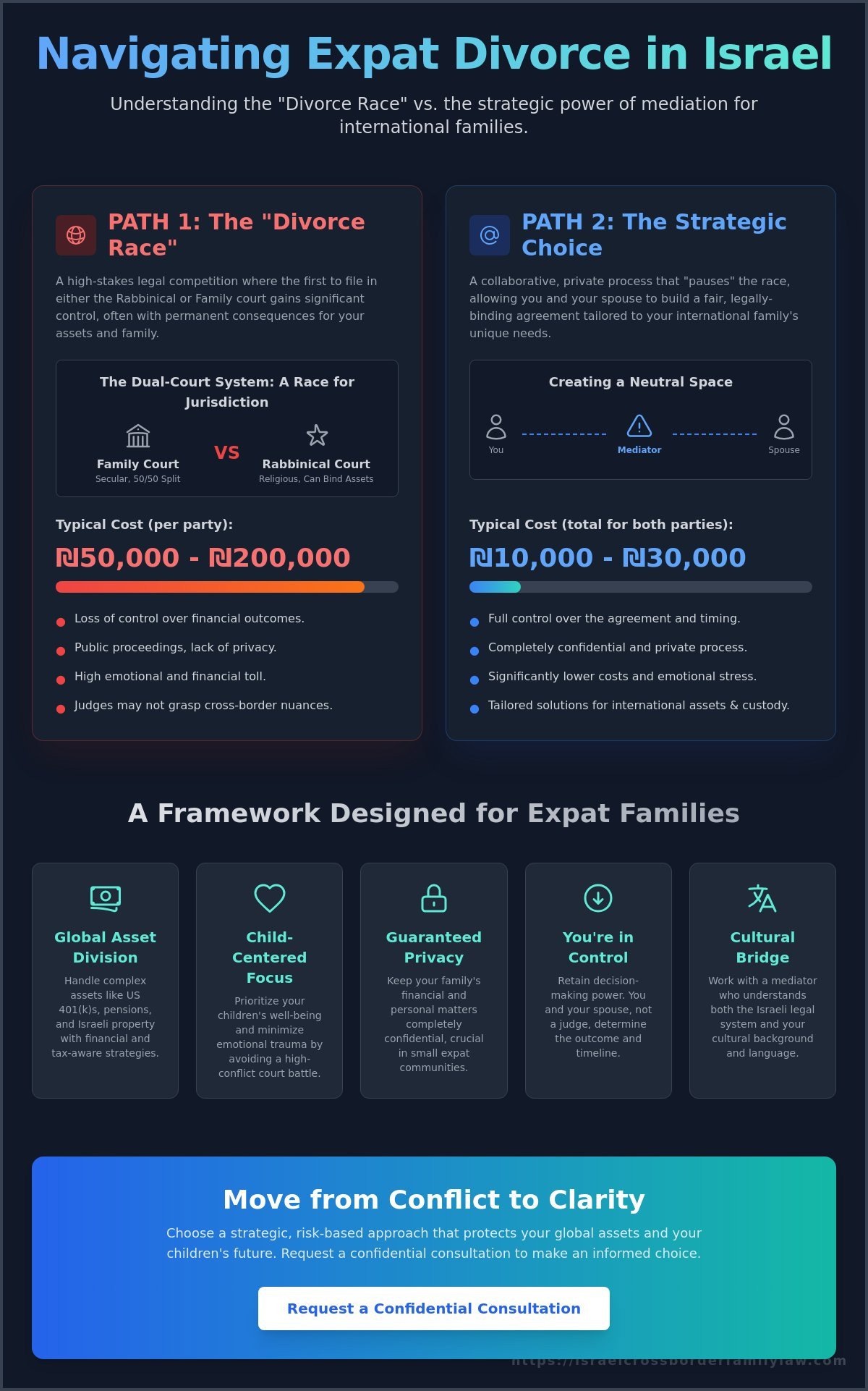
In Israel, the process of ending a marriage involves a unique legal phenomenon known as Meroz Samchuyot, or the “Race for Jurisdiction.” This race occurs because two different court systems have the power to hear your case: the civil Family Court and the religious Rabbinical Court. For international families, this isn’t just a procedural quirk. It’s a high stakes competition where the court that receives a valid filing first typically gains the authority to decide critical issues like property division and child support. This initial decision can have permanent consequences, as each court may apply different standards to your global assets or lifestyle choices.
The Israeli legal system creates a complex environment where being the second to file can feel like losing control before the process even begins. However, expat divorce mediation Israel offers a vital strategic alternative. Instead of rushing into a courtroom that may not align with your cultural values or financial reality, mediation allows you to “pause” the race. By choosing a collaborative path, you retain the power to make decisions together rather than handing that authority to a judge who may not grasp the nuances of your international life.
To better understand how this process works in practice, watch this helpful video:
The Dual-Court System: Family vs. Rabbinical
The Rabbinical Court has exclusive authority over the actual act of divorce for Jewish couples, known as the Get. However, if one spouse “binds” civil matters like alimony or property to their divorce suit in the Rabbinical Court, that court can take over those issues. Conversely, the civil Family Court operates on secular principles, generally adhering to the Spouses (Property Relations) Law of 1973, which mandates a 50/50 split of assets. For an expat, being pulled into the Rabbinical Court for property matters can be volatile, especially if you are navigating foreign business interests or non-traditional family structures. Mediation bypasses this volatility by creating a neutral space where the rules are set by your specific needs, not by which court door was opened first.
Why Expats Benefit Most from Collaborative Resolution
The financial argument for mediation is compelling. In IL, contested litigation frequently costs each party between ₪50,000 and ₪200,000, while a successful expat divorce mediation Israel process typically costs between ₪10,000 and ₪30,000 in total. Beyond the savings, international families often face complexities that local courts might overlook, such as the tax implications of liquidating a US-based 401(k) or the logistics of international holiday travel. Mediation provides the flexibility to address these “cross-border” details in a private setting. This is particularly important in small, tight-knit international communities where privacy is a priority. Choosing a strategic, risk-based approach ensures that you protect your future without the public exposure of a courtroom battle. You can learn more about how this applies to your situation by exploring our guide on divorce for international families.
Get clarity before you commit. Request a confidential consultation.
This article is published on an independent advisory platform and does not constitute legal representation or legal advice. Legal services are only provided by licensed attorneys under a separate engagement.
The Mandatory ‘Mahut’ Process: A Roadmap for Expats
In IL, the path to divorce begins with a mandatory step known as the “Request for Settlement of Dispute.” This is not an immediate move into litigation. Instead, it triggers a cooling-off period mandated by the Law for the Settlement of Disputes in Family Matters. For those considering expat divorce mediation Israel, this phase is the first encounter with the local judicial bureaucracy. The process begins with a simple application and a fee of ₪119, which initiates a 45 to 60 day “stay of proceedings.” During this window, neither spouse can file active claims in court, providing a strategic opportunity to explore settlement before the “divorce race” accelerates.
The process is managed by The Mediation Department through units known as Assistance Units (Yechidat Siyuah). These units are staffed by social workers and legal advisors who facilitate up to four mandatory meetings. Their role is to help you identify the core issues of your dispute and determine if mediation is a viable path. They don’t make legal rulings. Instead, they act as a bridge to help families avoid the high costs and emotional toll of the courtroom. Understanding how our process works can help you prepare for these meetings with a clear strategy in mind.
What to Expect in Your First Mahut Meeting
The first meeting is purely informational. No binding decisions are made, and you aren’t required to reach an agreement. For expats, the challenge is often communicating complex international lives to a local social worker. You have a legal right to an interpreter if you aren’t fluent in Hebrew. It’s essential to exercise this right to ensure your perspective is accurately recorded. You should enter this meeting prepared to discuss your “Anglo” reality; this includes explaining why foreign holidays, international school schedules, or assets held abroad require a specialized approach that differs from standard local cases.
Strategic Decisions After the Initial Meeting
Once the initial meetings conclude, you’ll be presented with four options. You can continue with the court’s assistance unit, move to a private mediator, try other dispute resolution methods, or proceed to litigation. Choosing private expat divorce mediation Israel is often superior for international families. Private mediators generally offer more time and a deeper understanding of cross-border complexities, such as US tax implications or foreign pension splits. Every decision made during this cooling-off period impacts your long-term litigation rights. Moving forward with a clear, risk-based plan is the best way to maintain control over your family’s future. You can start this process by requesting a confidential review of your situation.
Get clarity before you commit. Request a confidential consultation.
This article is published on an independent advisory platform and does not constitute legal representation or legal advice. Legal services are only provided by licensed attorneys under a separate engagement.
Managing Cross-Border Assets and International Custody
International families often lead “split” lives, where residency is established in Israel but significant assets remain in the United States or Europe. This creates a layer of complexity that a standard Israeli divorce agreement simply cannot handle. For instance, an Israeli judge might divide local bank accounts with ease, but they may not understand the tax penalties associated with liquidating a US 401(k) or the specific wording required for a foreign pension plan. Using expat divorce mediation Israel allows you to draft a customized agreement that addresses these multi-jurisdictional nuances before they become legal liabilities.
Dividing Global Assets Without Litigation
In many cases, sophisticated mediation involves more than just the spouses. It often requires the input of international forensic accountants who can value assets across borders and ensure transparency. When comparing Mediation Vs Litigation, the ability to bring in specialized experts to prevent double taxation is a significant advantage. A mediated settlement can be structured to satisfy both the Israeli Tax Authority and the IRS, ensuring that your financial clarity isn’t lost to avoidable fees or penalties. This strategic approach helps you move from uncertainty to a clearly defined financial future.
International Parental Responsibility and Relocation
Determining the “best interests of the child” is significantly more complex when parents have different cultural backgrounds or potential plans to relocate. Agreements must address potential “triggers” for relocation, such as a parent wanting to return to their home country or move to a different region within Israel. By focusing on International Custody and Relocation during the mediation process, you can include specific clauses regarding travel consent and the Hague Convention. These protections help prevent future conflicts and provide a clear roadmap for global travel, ensuring both parents remain active in the child’s life regardless of geography.
Enforceability: Will Your Agreement Hold Up Abroad?
For an agreement to be binding in Israel, it must be validated by the Family Court or Rabbinical Court. Once validated, it carries the same weight as a court judgment. However, international families must also consider how these decisions are viewed by foreign authorities. US courts generally recognize Israeli judgments under the principle of “comity,” provided the process was fair and both parties were represented. This is especially critical for Cross-Border Child Support Enforcement. Ensuring your expat divorce mediation Israel results in a globally recognized document is the only way to protect your long-term interests across multiple borders.
Get clarity before you commit. Request a confidential consultation.
This article is published on an independent advisory platform and does not constitute legal representation or legal advice. Legal services are only provided by licensed attorneys under a separate engagement.
Preparing for Success: A Strategy and Risk-Based Approach
Approaching expat divorce mediation Israel with a strategic mindset is the most effective way to protect your future. Success in this process requires a fundamental shift from emotional reactions to risk-based decision making. When emotions run high, it’s easy to make impulsive commitments that lead to long-term financial or legal complications. You must seek total clarity before making any written commitments, no matter how informal they may seem. An informed choice is the balance between legal risk and personal goals.
Preparation begins with organizing your documentation for the mediation table. For international families, this goes beyond simple bank statements. You should gather five years of tax returns from both the US and Israel, recent valuations of all global real estate, and detailed statements for foreign pensions or 401(k) accounts. Having these facts ready prevents delays and ensures that the mediation is based on reality rather than assumptions. This level of organization is a key part of how it works when navigating complex cross-border separations.
Defining Your ‘Must-Haves’ vs. ‘Nice-to-Haves’
We recommend using a “Needs vs. Solutions” framework tailored for international lifestyles. Instead of focusing on a specific asset, identify the underlying need, such as “maintaining a specific standard of living in a high-cost area like Tel Aviv.” Prioritize long-term stability over short-term “wins.” In the context of expat divorce mediation Israel, the idea of “winning” is a misconception. A truly successful outcome is an agreement that provides financial certainty and minimizes the chance of returning to court in the future.
The Role of Independent Advisory in Mediation
A common mistake is assuming that a mediator who is also a lawyer will protect your individual interests. A mediator is a neutral facilitator, not your advocate. You still need an independent advisor to review drafts for “hidden” risks that a local mediator might overlook. For example, a clause that seems standard in Israel could have unintended consequences for your US tax status or your ability to claim foreign tax credits. Using a strategy-based approach helps you manage the emotional undercurrent of the breakup while keeping your commercial and personal objectives in focus. Before you sign any binding documents, request a confidential review to ensure your strategy is sound.
Get clarity before you commit. Request a confidential consultation.
This article is published on an independent advisory platform and does not constitute legal representation or legal advice. Legal services are only provided by licensed attorneys under a separate engagement.
Moving Forward: From Conflict to Clarity
Transitioning from the initial shock of a marital breakdown to a structured resolution is a significant milestone for any family. For an expat, this often means moving from a state of crisis to becoming an international resident with a clear, actionable plan. By choosing expat divorce mediation Israel, you replace the unpredictability of the “divorce race” with a controlled and confidential process. A successful outcome depends heavily on selecting a mediator who understands the intersections of the Israeli legal system and Anglo cultural expectations. You need a professional who recognizes that your family’s future isn’t just about local regulations; it’s about maintaining global connections and financial security across borders.
To gain a deeper understanding of the fundamentals of this process, we recommend viewing the educational resources available on our YouTube channel, @IsraelFamilyLaw. These videos provide a clear overview of the mediation basics every international family should know before entering the room. Understanding the basics helps remove the “fear of the unknown” that often drives conflict in the early stages of a separation. This knowledge allows you to focus on strategy rather than anxiety as you begin the transition toward your new reality.
Next Steps for International Families in Israel
Before you attend your first mandatory Mahut meeting, take the time to vet cross-border professionals who specialize in your specific situation. This isn’t just about finding a mediator; it’s about finding a strategic partner who understands multi-jurisdictional asset division and international custody. You should look for someone who is bicultural and bilingual to ensure nothing is lost in translation. You can find detailed information on how it works to ensure you are fully prepared for each stage of the process. Taking these initial steps early helps you maintain a position of strength and clarity from day one.
Requesting a Confidential Case Review
An early, strategic assessment of your legal position is invaluable. It allows you to identify potential risks before they escalate into costly court battles. To maximize the value of a consultation, prepare a summary of your global assets and any specific concerns regarding international travel or relocation. This preparation ensures that the advisory you receive is tailored to your unique circumstances as an expat. Moving from conflict to clarity requires a commitment to making informed, risk-based choices. Get clarity before you commit. Request a confidential consultation to begin building your roadmap toward a stable future.
Final Reminder: This content is for informational purposes and does not create an attorney-client relationship. Legal services are only provided by licensed attorneys under a separate engagement.
This article is published on an independent advisory platform and does not constitute legal representation or legal advice. Legal services are only provided by licensed attorneys under a separate engagement.
Securing Your Future Through Strategic Planning
Navigating the complexities of the Israeli legal system requires more than just local knowledge. It demands a strategy that bridges the gap between your life in Israel and your interests abroad. By choosing expat divorce mediation Israel, you avoid the volatility of the dual-court system and ensure that multi-jurisdictional assets are handled with precision. You now have a roadmap for the mandatory Mahut process and a clearer understanding of how to protect your children across borders. Our authoritative expertise in complex disputes and deep understanding of the Anglo-Israeli experience provide the steady guidance you need.
We specialize in US-Israel cross-border family law to help you achieve a fair, enforceable agreement without the trauma of prolonged litigation. It’s possible to move forward with confidence when you have the right information. Get clarity before you commit. Request a confidential consultation today to begin your transition from conflict to clarity. We are here to support you in making informed, risk-based decisions for your family’s next chapter.
This article is published on an independent advisory platform and does not constitute legal representation or legal advice. Legal services are only provided by licensed attorneys under a separate engagement.
Frequently Asked Questions
Is divorce mediation mandatory for expats living in Israel?
Yes, participation in the initial Dispute Settlement process is required by law for everyone, including expats. Under the Law for the Settlement of Disputes in Family Matters, you must file a request and attend up to four meetings at the court’s assistance unit before any litigation can begin. This creates a 45 to 60 day cooling-off period designed to encourage amicable solutions rather than immediate court battles.
Can I mediate my divorce in English if my spouse prefers Hebrew?
You can absolutely mediate in English, even if your spouse prefers to speak Hebrew. Many professionals specialize in expat divorce mediation Israel and are qualified to conduct bilingual sessions that accommodate both parties. In mandatory court-affiliated meetings, you also have a legal right to an interpreter to ensure you fully understand the proceedings and that your perspective is accurately recorded.
How long does the mediation process typically take for international families?
A successful mediation process generally concludes within three to six months. This is significantly faster than contested litigation in the Israeli court system, which frequently extends for one to three years. The exact timeline depends on the complexity of your global assets and how quickly both parties can reach a consensus on critical issues like property and custody.
Is an Israeli mediated agreement enforceable in the United States?
Yes, US courts generally recognize and enforce Israeli family law judgments under the principle of comity. For the agreement to be enforceable abroad, it must first be validated by an Israeli Family or Rabbinical Court to give it the force of a judgment. It’s essential that the document is drafted to satisfy both Israeli legal standards and US due process requirements to ensure long-term protection.
What happens if we can’t reach an agreement during the Mahut process?
If the mandatory Mahut meetings don’t result in an agreement, you have several strategic options. You can choose to extend the cooling-off period to continue with private expat divorce mediation Israel, explore other dispute resolution methods, or proceed to litigation. Once the stay of proceedings expires, the party who filed the initial request has a 15-day window to decide where to file their claims.
Do I need my own lawyer if we are already using a mediator?
Yes, it’s highly recommended to have an independent advisor review any mediated agreement before you sign it. A mediator is a neutral facilitator who doesn’t represent either spouse or provide individual legal protection. An independent professional ensures that “hidden” risks, such as US tax implications or foreign pension splits, are properly addressed to protect your personal interests.
Can we settle child custody and relocation through mediation?
Yes, mediation is an ideal forum for resolving complex custody and relocation issues tailored to international lifestyles. You can draft specific clauses regarding travel consent, holiday schedules, and Hague Convention protections that a standard court ruling might overlook. This allows you to define the “best interests of the child” based on your family’s unique cross-border reality.
How much does divorce mediation cost in Israel compared to court?
Divorce mediation in Israel typically costs between ₪10,000 and ₪30,000 in total, which is shared between the parties. In contrast, contested litigation fees often start at ₪50,000 per person and can escalate beyond ₪200,000. Mediation also helps you avoid high court filing fees for property claims, which can reach ₪3,447 for non-fixed sums in the civil Family Court system.

Article by
Gabriel Lior
A Personal Journey That Became a Mission
The advisory was founded by an American father Gabriel Lior, LLB, MBA , global entrepreneur, and cross-border advisor who spent more than a decade navigating the Israeli family court system firsthand and now lives in Singapore with his son.
As a divorced parent in a cross-border family, Gabriel faced nearly every legal challenge a foreign parent can encounter in Israel — including child custody disputes, child support proceedings, property matters in Israel and abroad, false accusations, and complex immigration and relocation proceedings.
Over the years, he learned the hard way how difficult it is for non-Israeli parents to understand the system, identify the right legal strategy, and choose the right legal representation — especially when language, culture, and jurisdictional differences are involved. He also witnessed how foreign parents and new immigrants are often disadvantaged or taken advantage of by service providers and institutions simply because they lack local knowledge or fluency.
From Client to Advisor
To truly understand — and survive — the system, Gabriel pursued formal legal education in Israel, completing two Israeli law degrees, alongside a BA and MBA earned in the United States. This was never about becoming a practicing attorney, but about gaining a deep, structural understanding of how the system works — and where it breaks down for foreign parents.
This rare combination of:
Firsthand client experience
Israeli legal and US business education
International business and negotiation training
Decades of commercial execution
created a unique perspective – one that understands both sides of the table.
After years of litigation, persistence, and at times self-representation, he ultimately succeeded in securing custody of his son and relocating abroad through a rare legal victory in the Israeli Supreme Court — becoming one of the first fathers in Israel to do so under these circumstances.
Disclaimer
Important Disclaimer:
The information provided on this website and in its content is for general informational and educational purposes only and does not constitute legal advice, legal opinion, or legal representation.
Gabriel Lior is not licensed to practice law in Israel (nor is he interested in doing so) and does not provide legal services, despite having completed 2 Law Degrees. The services offered are advisory in nature and are intended to provide general guidance, strategic insight, and information regarding cross-border family law considerations.
No attorney-client relationship is formed by accessing this website, reading its content, or communicating with us.
Any decisions made based on this information are at your own discretion and risk. For legal advice specific to your situation, you should consult a licensed attorney in the relevant jurisdiction.
Where appropriate, we may refer clients to independent, licensed attorneys or professionals. Such referrals do not constitute legal representation and no liability is assumed for services provided by third parties.