This article is published on an independent advisory platform and does not constitute legal representation or an attorney-client relationship. Legal services are only provided by licensed attorneys under a separate engagement.
Imagine the sudden weight of receiving a redundancy notice while working in a foreign city, only to realize your divorce decree in Israel still mandates monthly payments you can no longer afford. You likely feel a deep sense of uncertainty about which court holds the power to help you and how you can possibly prove a foreign job loss to a domestic judge. Modifying spousal support due to job loss abroad is a sophisticated jurisdictional puzzle where the location of your filing is just as critical as the reason for your financial change.
We understand that managing international family law is complex and often creates anxiety over potential enforcement actions like travel bans in Israel. This guide explains how to navigate the legal complexities of adjusting alimony payments when your financial situation changes while living or working across international borders. You’ll gain a clear understanding of the “material change” standard and a roadmap for filing modification requests internationally. Get clarity before you commit. Request a confidential consultation, and find additional guidance on our YouTube channel at https://www.youtube.com/@IsraelFamilyLaw.
Key Takeaways
- Understand the concept of Continuing Exclusive Jurisdiction and why the court that issued your original order often retains the power to modify it, even if you have relocated to Israel.
- Learn the legal requirements for modifying spousal support due to job loss abroad, specifically how to prove your change in circumstances is substantial, involuntary, and unforeseen.
- Discover a structured approach to gathering multi-jurisdictional financial disclosures and translating foreign termination letters to meet domestic court standards.
- Identify the hidden risks of international litigation, such as the potential for a modification request to trigger a full audit of your global asset portfolio.
This article is published on an independent advisory platform and does not constitute legal representation or an attorney-client relationship. The information provided is for educational purposes only. Legal services are only provided by licensed attorneys under a separate engagement.
What Does Modifying Spousal Support Mean in a Cross-Border Context?
In its simplest form, modifying Alimony is a formal legal process designed to adjust support payments when a significant life event makes the original court order inequitable. When you live and work across international borders, this process becomes significantly more complex. It’s no longer just a matter of showing a pay stub to a local judge. Instead, you must determine which country’s legal system has the authority to change the rules of your divorce decree. This is a strategic decision that requires a deep understanding of how different systems interact.
Cross-border cases are unique because they involve a clash of jurisdictions. You might have a divorce decree from a court in New York or London, but you are now living in Israel and working for a global firm. If you lose your position, modifying spousal support due to job loss abroad requires you to identify if the original court still holds exclusive jurisdiction or if the Israeli courts can intervene. Making the wrong move early on, such as stopping payments abruptly without a court order, carries high risk in IL. This can lead to severe enforcement actions, including travel bans that prevent you from leaving the country to find new work. Seeking clarity through an advisory like divorce and separation for international families is a vital first step.
The Role of International Treaties
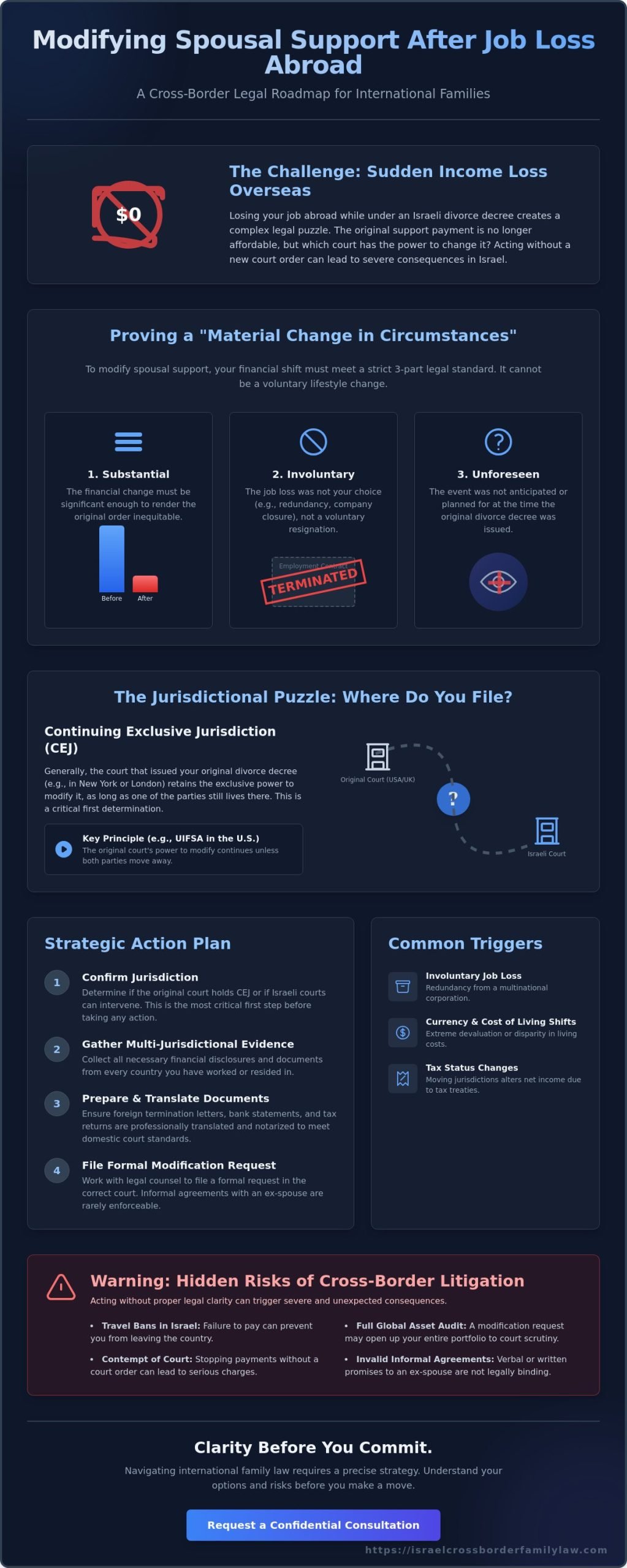
International treaties and domestic statutes like the Uniform Interstate Family Support Act (UIFSA) in the U.S. play a pivotal role in these cases. UIFSA generally dictates that the state that issued the original order maintains the power to modify it as long as one party still resides there. The Israeli legal system views foreign alimony orders differently than child support. While Israel is a party to the 2007 Hague Child Support Convention, spousal support often falls under different reciprocal agreements. You must seek clarity before making any verbal or written commitments to an ex-spouse regarding payment changes. These informal agreements are rarely recognized by the court and can leave you vulnerable to contempt charges.
Common Triggers for International Modification
Several specific scenarios often necessitate a request for modification in a cross-border environment. These include:
- Involuntary job loss: Being laid off from a multinational corporation where your compensation was tied to a specific foreign currency or market.
- Cost of living shifts: A significant disparity between the expenses in a U.S. metropolitan area and the cost of maintaining a household in IL.
- Tax status changes: Moving between jurisdictions can drastically alter your net take-home pay due to different tax treaties or local filing requirements.
Get clarity before you commit. Request a confidential consultation.
This article is published on an independent advisory platform and does not constitute legal representation or an attorney-client relationship. The information provided is for educational purposes only. Legal services are only provided by licensed attorneys under a separate engagement.
Proving a ‘Material Change in Circumstances’ While Working Overseas
To succeed in modifying spousal support due to job loss abroad, you must meet a specific legal threshold known as a “material change in circumstances.” This standard requires you to prove that your financial shift is substantial, involuntary, and was not contemplated at the time of your divorce decree. In cross-border litigation, a material change is defined as a substantial, involuntary, and unforeseen shift in a party’s financial circumstances, such as an overseas redundancy or extreme currency devaluation, that renders the original support order inequitable. Simply choosing to leave a high-paying position for a lifestyle change does not qualify. You must demonstrate that the job loss was beyond your control, such as a company-wide redundancy or the closure of a regional office.
Documenting these events requires meticulous attention to detail. Foreign termination letters and severance package agreements must be presented clearly. If you receive a lump-sum severance, the court will likely view this as continued income for a set period rather than an immediate loss of funds. Additionally, you must satisfy the “good faith” requirement. This means providing evidence of active efforts to find new employment within the local Israeli market or the broader international sector. Judges look for a consistent trail of applications, interviews, and networking efforts to confirm you aren’t intentionally remaining underemployed.
Overcoming Evidence Barriers
Presenting foreign documents to a domestic court involves more than just a simple photocopy. You will need certified translations for all employment contracts, termination notices, and foreign bank statements. In some complex cases, it’s beneficial to use expert testimony to explain the nuances of foreign labor markets to a judge in IL or the U.S. This helps the court understand why finding a comparable salary in a different economy might take longer than expected. Understanding your status as an expat or foreign national is a critical part of this evidentiary strategy.
Currency and Inflation Factors
A major factor often overlooked in local litigation is the impact of currency volatility. The USD/ILS exchange rate in 2026 can fundamentally change the real-world value of a support order issued years prior. If your income is earned in Shekels but your support is mandated in Dollars, a shift in the rate can make an once-sustainable payment impossible. Similarly, significant inflation differences between the U.S. and Israel can erode the purchasing power of the recipient or the financial stability of the payer. What appears to be a “safe” number in one currency might become unsustainable in another due to these macroeconomic shifts. If you are struggling with modifying spousal support due to job loss abroad because of these factors, you should request a confidential review of your situation to understand your risks.
Get clarity before you commit. Request a confidential consultation.
This article is published on an independent advisory platform and does not constitute legal representation or an attorney-client relationship. The information provided is for educational purposes only. Legal services are only provided by licensed attorneys under a separate engagement.
Navigating Jurisdictional Challenges: Where Do You File?
Determining the correct venue is often the most contentious part of modifying spousal support due to job loss abroad. Most legal systems operate under the principle of Continuing Exclusive Jurisdiction (CEJ). This concept means the court that finalized your divorce retains the sole authority to modify the alimony amount. As long as one party remains in that original jurisdiction, that court is usually the only place you can file. You can’t simply choose a new court because it’s more convenient or closer to your current home in Israel.
The situation changes if both parties have relocated. For example, if you and your ex-spouse both moved from New York to Tel Aviv, the original court may lose its exclusive hold on the case. However, don’t assume you can automatically file in IL. You must weigh the cost of litigating in a foreign court against the potential long-term savings. Engaging in “forum shopping” by trying to file in a jurisdiction you perceive as friendlier can backfire. Courts often view this as a bad-faith tactic; this can lead to your petition being dismissed or result in financial sanctions. Strategy-based decision-making is essential here to avoid wasting resources on a court that lacks the power to help you.
Enforcement vs. Modification
It’s vital to distinguish between a court’s power to enforce an order and its power to modify it. An Israeli court might help an ex-spouse collect unpaid funds, but it doesn’t automatically have the authority to change the monthly amount set by a foreign judge. This differs significantly from child support cross-border enforcement, where international treaties provide clearer paths for modification. In Israel, a “stay of exit” order, or travel ban, is a powerful enforcement tool. It’s often used as leverage in spousal support disputes. This makes it even more important to resolve modification issues before arrears accumulate and trigger such severe restrictions.
Service of Process Abroad
When you initiate the process of modifying spousal support due to job loss abroad, you must follow the Hague Service Convention. This treaty ensures that the modification petition is legally recognized in both countries. A common mistake is assuming that an informal notification, such as an email or a text message, is sufficient. Without formal service of process, any ruling you obtain might be unenforceable in the other country. It’s a technical area where early errors can cause years of delays and significant legal expenses. Get clarity before you commit. Request a confidential consultation.
This article is published on an independent advisory platform and does not constitute legal representation or an attorney-client relationship. The information provided is for educational purposes only. Legal services are only provided by licensed attorneys under a separate engagement.
Step-by-Step Guide to Requesting an Alimony Modification
Successfully modifying spousal support due to job loss abroad requires a disciplined, multi-step strategy. You can’t simply file a petition and hope for a favorable outcome. You must first analyze the legal foundation of your existing obligations. This structured approach helps ensure your request is built on solid ground before it ever reaches a judge’s desk.
- Step 1: Audit your decree. Review your original divorce settlement for specific modification clauses. Some agreements contain “anti-Lepis” provisions. These are clauses that specifically waive the right to future modifications even if circumstances change significantly.
- Step 2: Gather multi-jurisdictional disclosures. You’ll need tax returns and wage statements from both Israel and the country where the order originated. Transparency is your greatest asset when proving a genuine loss of income.
- Step 3: Determine the correct forum. Based on your current residency and the language in your decree, verify if the original court still holds jurisdiction. As discussed in previous sections, this is a critical jurisdictional hurdle.
- Step 4: File the Motion to Modify. Once the forum is confirmed, your legal team will file a formal Petition for Relief. This document must clearly outline the material change in your financial status.
- Step 5: Discovery and Mediation. Before a full hearing, you’ll likely engage in international discovery. This is the process of exchanging evidence. Mediation often follows to seek a settlement without the high cost of a trial.
The Importance of Temporary Orders
The legal process for modifying spousal support due to job loss abroad can take months. During this time, you should request “pendente lite” relief. This is a temporary court order that reduces your payments while the full case is pending. It’s a vital protection against the accumulation of arrears. You must avoid “self-help,” which is the dangerous practice of stopping payments without a court’s blessing. In IL, non-payment can lead to immediate enforcement actions. If you’re concerned about your current obligations, you should request a confidential review to explore your options.
Mediation as a Cross-Border Solution
International litigation is expensive. Remote mediation via Zoom has become a standard, effective way to resolve disputes without the need for international travel. It allows both parties to negotiate in a neutral environment. If an agreement is reached, it is drafted into a “Consent Order.” This document is designed to be enforceable in both the U.S. and IL courts. For a deeper look at these dynamics, watch this video for more on Divorce and Separation for International Families. Understanding how it works can help you decide if mediation is the right path for your family.
Get clarity before you commit. Request a confidential consultation.
This article is published on an independent advisory platform and does not constitute legal representation or an attorney-client relationship. The information provided is for educational purposes only. Legal services are only provided by licensed attorneys under a separate engagement.
Strategic Decision-Making: Why Clarity Matters Before You Commit
Before you initiate the process of modifying spousal support due to job loss abroad, you must evaluate the commercial reality of your situation. International litigation involves significant hidden costs that go far beyond standard filing fees. You must account for international travel, the necessity of certified translations for every foreign document, and the potential need for dual-qualified counsel who understand both the US and Israeli legal landscapes. These expenses can quickly accumulate, making a strategic cost-benefit analysis essential before taking formal legal action.
You also need to consider the risk of a counter-suit. A request to modify support often triggers a reciprocal demand for full financial transparency. This could lead to a comprehensive audit of your global assets, including properties or investments in IL that may not have been fully addressed in the original decree. A confidential case review allows you to map out these potential outcomes across two legal systems before you make a public filing. Our advisory serves as the bridge between US and Israeli legal cultures, ensuring you understand the strategic implications of every move you make.
Avoiding the Pitfalls of Cross-Border Litigation
The early decisions you make regarding where you file can haunt you for years. If you choose the wrong jurisdiction, you may find yourself bound by local laws that are far less favorable than those of the original court. It’s essential to understand the difference between legal representation, which focuses on courtroom advocacy, and cross-border strategy, which focuses on long-term risk management. You can learn more about how it works to see how we help international families navigate these high-stakes choices through informed planning.
Next Steps for Expats and International Families
Your first step should be a thorough audit of your current support order to identify any “red flags” that might complicate a modification. Gathering your documents early allows you to present a clear, undisputed narrative of your financial change when modifying spousal support due to job loss abroad. For those concerned about the financial commitment of a strategic review, we provide transparent information on our pricing structures to help you plan effectively.
Get clarity before you commit. Request a confidential consultation to gain clarity on your specific cross-border situation.
This article is published on an independent advisory platform and does not constitute legal representation or an attorney-client relationship. Legal services are only provided by licensed attorneys under a separate engagement.
Securing Your Financial Future Across Borders
Managing the intersection of foreign employment changes and domestic legal obligations requires a strategic approach that prioritizes jurisdictional clarity and meticulous documentation. Successfully modifying spousal support due to job loss abroad depends on your ability to prove a material change in circumstances while respecting the rules of Continuing Exclusive Jurisdiction. By auditing your original decree and gathering multi-jurisdictional financial disclosures, you can avoid common pitfalls like travel bans or contempt charges in IL. It’s essential to understand how these systems interact before making any commitments to an ex-spouse.
Our bicultural and bilingual advisory team brings decades of experience in US-Israel cross-border law to help you map out potential outcomes. We provide a specialized focus on the unique needs of Anglo expats and international families. Get clarity before you commit. Request a confidential consultation to discuss your strategy and risk-based options. Taking the right steps today ensures your financial obligations remain equitable as you move forward into your next chapter.
This article is published on an independent advisory platform and does not constitute legal representation or an attorney-client relationship. The information provided is for educational purposes only. Legal services are only provided by licensed attorneys under a separate engagement.
Frequently Asked Questions
Can I stop paying spousal support immediately if I lose my job abroad?
You cannot stop paying immediately without risking severe legal sanctions. modifying spousal support due to job loss abroad requires a formal court order to be legally valid. Stopping payments unilaterally, even with a genuine loss of income, can lead to the accumulation of arrears and enforcement actions such as travel bans in Israel. It’s essential to seek a temporary order to reduce your obligations while your modification case is pending.
Which country has jurisdiction to modify my alimony if we both moved to Israel?
Jurisdiction usually remains with the court that issued the original order under the principle of Continuing Exclusive Jurisdiction. If both parties have relocated to Israel, the original court may lose its exclusive hold, but this depends on the specific laws of the issuing state. You should never assume that an Israeli court can automatically modify a foreign decree. Determining the correct forum requires a strategic review of the original decree’s language.
How do I prove my job loss to a US court while I am living in Tel Aviv?
You can prove your job loss by providing certified translations of termination letters and severance agreements to the court. Digital infrastructure now allows for many hearings to take place via remote platforms, reducing the need for international travel. You must provide multi-jurisdictional financial disclosures, including bank statements and tax returns from both countries, to demonstrate that your financial shift is substantial, involuntary, and was not previously contemplated.
Does the US-Israel tax treaty affect how much alimony I should pay?
The US-Israel tax treaty can influence your net take-home pay, which is a factor courts consider when determining support amounts. While US tax laws changed how alimony is taxed for orders after 2018, Israel maintains its own set of tax regulations for support payments. These differences can create a disparity between your gross income and your actual ability to pay, making it a relevant factor in your international modification strategy.
What happens if my ex-spouse refuses to accept service of the modification papers?
If an ex-spouse refuses to accept service, you must follow the procedures outlined in the Hague Service Convention to ensure the petition is legally recognized. Courts can sometimes authorize alternate methods of service, such as through a designated agent, if you can prove the other party is intentionally evading. You must strictly adhere to international service rules to avoid having your case dismissed on technical grounds or facing unnecessary delays.
Can an Israeli court change a spousal support order issued by a US court?
An Israeli court generally does not have the authority to change a spousal support order issued by a US court. While Israeli courts can assist in the enforcement and collection of funds, the power to modify the actual amount usually stays with the original issuing judge. Attempting to modifying spousal support due to job loss abroad in the wrong country can lead to wasted legal fees and potential sanctions for forum shopping.
Is it possible to modify alimony if my income decreased due to currency exchange rates?
It is possible to seek a modification if extreme currency exchange fluctuations create a material change in your financial circumstances. If you earn income in Shekels but are required to pay in Dollars, a shift in the USD/ILS rate can make an once-sustainable payment impossible. You must demonstrate that these macroeconomic shifts have fundamentally altered your ability to meet the original obligation, rendering the current support order inequitable under today’s market conditions.
What are the risks of ignoring a support order while I am unemployed overseas?
Ignoring a support order while unemployed can lead to severe consequences, including contempt of court and the issuance of a stay of exit order in Israel. Arrears will continue to accrue at the original rate, often with added interest, until a judge formally approves a change. These debts are difficult to discharge and can result in the seizure of assets or restrictions on your ability to travel internationally for new work.

Article by
Gabriel Lior
A Personal Journey That Became a Mission
The advisory was founded by an American father Gabriel Lior, LLB, MBA , global entrepreneur, and cross-border advisor who spent more than a decade navigating the Israeli family court system firsthand and now lives in Singapore with his son.
As a divorced parent in a cross-border family, Gabriel faced nearly every legal challenge a foreign parent can encounter in Israel — including child custody disputes, child support proceedings, property matters in Israel and abroad, false accusations, and complex immigration and relocation proceedings.
Over the years, he learned the hard way how difficult it is for non-Israeli parents to understand the system, identify the right legal strategy, and choose the right legal representation — especially when language, culture, and jurisdictional differences are involved. He also witnessed how foreign parents and new immigrants are often disadvantaged or taken advantage of by service providers and institutions simply because they lack local knowledge or fluency.
From Client to Advisor
To truly understand — and survive — the system, Gabriel pursued formal legal education in Israel, completing two Israeli law degrees, alongside a BA and MBA earned in the United States. This was never about becoming a practicing attorney, but about gaining a deep, structural understanding of how the system works — and where it breaks down for foreign parents.
This rare combination of:
Firsthand client experience
Israeli legal and US business education
International business and negotiation training
Decades of commercial execution
created a unique perspective – one that understands both sides of the table.
After years of litigation, persistence, and at times self-representation, he ultimately succeeded in securing custody of his son and relocating abroad through a rare legal victory in the Israeli Supreme Court — becoming one of the first fathers in Israel to do so under these circumstances.
Disclaimer
Important Disclaimer:
The information provided on this website and in its content is for general informational and educational purposes only and does not constitute legal advice, legal opinion, or legal representation.
Gabriel Lior is not licensed to practice law in Israel (nor is he interested in doing so) and does not provide legal services, despite having completed 2 Law Degrees. The services offered are advisory in nature and are intended to provide general guidance, strategic insight, and information regarding cross-border family law considerations.
No attorney-client relationship is formed by accessing this website, reading its content, or communicating with us.
Any decisions made based on this information are at your own discretion and risk. For legal advice specific to your situation, you should consult a licensed attorney in the relevant jurisdiction.
Where appropriate, we may refer clients to independent, licensed attorneys or professionals. Such referrals do not constitute legal representation and no liability is assumed for services provided by third parties.