What if resolving your US-Israel legal dispute never required you to board a single flight? For many international families and expats caught between two legal systems, that question feels almost too good to be true. Yet virtual mediation for cross-border disputes is quietly changing the way people reach legally sound agreements, without the cost of international travel, without courtroom confrontation, and without the disorienting experience of arguing your case in a foreign language before a foreign judge.
You already know how complicated this situation feels. Conflicting laws, time zone gaps, and the very real fear of making an irreversible mistake in a legal system you don’t fully understand, these aren’t abstract concerns. They’re the daily reality for anyone managing a divorce, inheritance dispute, or family matter that touches both US and Israeli law.
This guide is written to give you clarity. You’ll learn how virtual mediation works across the US-Israel corridor, whether settlements reached this way can be legally binding in both countries, and what you need to consider before choosing this path. Think of it as a strategic overview, not legal advice, but an honest starting point for making a more informed decision.
Key Takeaways
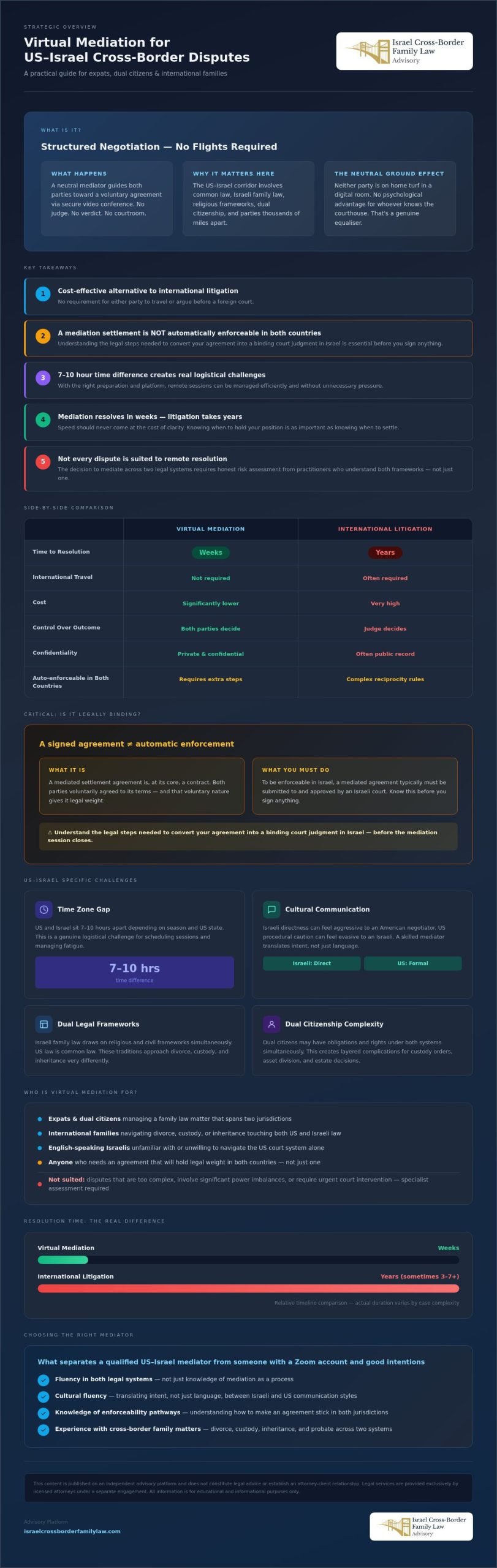
- Virtual mediation for cross-border disputes offers US-Israel families a structured, cost-effective alternative to international litigation — without requiring either party to travel or argue their case before a foreign court.
- A mediation settlement is not automatically enforceable in both countries; understanding the legal steps needed to convert your agreement into a binding court judgment in Israel is essential before you sign anything.
- The 7-10 hour time difference between the US and Israel creates real logistical challenges, but with the right preparation and platform, remote sessions can be managed efficiently and without unnecessary pressure.
- Mediation typically resolves in weeks rather than years — but speed should never come at the cost of clarity; knowing when to hold your position is just as important as knowing when to settle.
- Not every dispute is suited to remote resolution, and the decision to mediate across two legal systems requires honest risk assessment from practitioners who understand both frameworks, not just one.
Understanding Virtual Mediation for US-Israel Legal Disputes
Virtual mediation for cross-border disputes is, at its core, a structured negotiation process conducted through secure digital platforms, typically video conferencing tools designed for confidential legal proceedings. A neutral third party, the mediator, guides both sides toward a voluntary agreement without imposing a decision. No judge. No courtroom. No verdict handed down by someone who may not understand the full context of your situation.
That last point matters more than it might seem, especially when the dispute involves two countries with fundamentally different legal traditions, languages, and cultural expectations around conflict resolution.
The US-Israel corridor is not a standard international context. It involves a unique intersection of common law principles, Israeli family law rooted in religious and civil frameworks, dual citizenship complications, and the practical reality that one party is often thousands of miles away. Generic online dispute resolution platforms can handle straightforward commercial disagreements. They are rarely built for the layered complexity of a cross-border divorce, an inheritance dispute spanning two probate systems, or a custody arrangement that must hold up in both Tel Aviv and New York.
The Shift from Physical Courts to Digital Rooms
The early 2020s accelerated the legal world’s acceptance of remote proceedings in ways that would have seemed unlikely a decade earlier. Courts in both the US and Israel adapted to virtual hearings out of necessity, and what emerged was a broader recognition: physical presence isn’t always required for a fair process. For parties in different time zones, the digital room actually creates something valuable. Neither side is on home turf. There’s no psychological advantage for the party who walked into a familiar courthouse. That “neutral ground” effect is real, and it reduces one of the most common sources of perceived unfairness in international disputes.
Core Differences Between US and Israeli Legal Mindsets
Israeli communication culture tends toward directness. What feels blunt or even aggressive to an American negotiator may simply be standard professional candor in an Israeli context. Conversely, the more formal, structured cadence of US legal proceedings can read as evasive or unnecessarily slow to an Israeli counterpart.
A skilled mediator who understands both systems doesn’t just translate language. They translate intent. They know when a sharp Israeli response reflects frustration rather than bad faith, and when an American party’s procedural caution reflects genuine concern rather than delay tactics. This cultural fluency is what separates a mediator qualified for this corridor from one who simply has a Zoom account and good intentions.
Virtual mediation is well-suited to expats, dual citizens, and cross-border families who need a resolution that will hold legal weight in both countries. If you’re managing a family law matter that touches both systems, understanding how these processes work for foreign nationals is a practical first step before any formal engagement.
This content is published on an independent advisory platform and does not constitute legal advice or establish an attorney-client relationship. Legal services are provided exclusively by licensed attorneys under a separate engagement.
The Legal Framework: Is Remote Mediation Binding in Israel and the US?
A mediation session ends. Both parties have agreed. The mediator closes the digital room. Now comes the question that actually matters: is any of this enforceable?
The short answer is yes, but only if the right steps follow. The longer answer is where most people get into trouble.
A mediated settlement agreement is, at its core, a contract. Both parties have voluntarily agreed to its terms, and that voluntary nature is precisely what gives it legal weight. In both the US and Israel, a signed settlement agreement can be enforced as a binding contract through the civil courts, provided it meets the formal requirements of each jurisdiction. The agreement doesn’t enforce itself, though. Turning it into something a court will act on requires deliberate follow-through.
Intersections with the Israeli Court System
In Israel, the path to enforcement depends heavily on which court has jurisdiction over your matter. This is a distinction that catches many international families off guard, and it’s one of the most consequential early decisions you’ll face.
Israeli family law operates across two parallel systems: the civil Family Courts and the Rabbinical Courts. For Jewish couples, matters such as divorce (get), division of marital assets, and related financial arrangements may fall under Rabbinical Court jurisdiction, depending on how proceedings are initiated. Child custody and support, by contrast, typically fall within the Family Court’s domain, though there is overlap and the first court to gain jurisdiction often retains it.
This matters for virtual mediation for cross-border disputes because a settlement agreement reached remotely must be submitted to the appropriate Israeli court for ratification in order to carry enforcement weight. A Family Court can convert your agreement into a consent judgment, which is then enforceable as a court order. A Rabbinical Court operates under different procedural rules and may require additional steps, particularly where a religious divorce is involved. Choosing the wrong forum, or failing to anticipate which forum will govern, can undermine an otherwise well-constructed agreement.
Early strategic decisions carry significant weight here. Understanding how the advisory process works before you enter mediation is not optional preparation; it’s risk management.
Cross-Border Enforcement Mechanisms
On the US side, enforcement of international mediated settlements varies by state. Some states have adopted the Uniform Mediation Act, which provides a degree of procedural protection for mediation communications and agreements. Others rely on general contract law principles. In either case, a settlement agreement ratified as a court judgment in Israel has a stronger claim to recognition in US courts than an unratified private contract, because most states will honor foreign court judgments under principles of comity, provided basic due process standards were met.
Enforcing specific financial obligations, such as child support or alimony, across the Atlantic adds another layer. Neither country automatically enforces the other’s support orders without a formal recognition process. The US has reciprocal enforcement arrangements with a number of foreign countries, and Israel maintains its own framework for recognizing foreign judgments under the Foreign Judgments Enforcement Law of 1958. Practically, this means a support order must be registered and recognized in the receiving country before it can be collected.
One strategy used to address this gap is the Mirror Order: a parallel court order obtained in the second jurisdiction that mirrors the terms of the original order, creating simultaneous enforceability in both countries without requiring a separate recognition proceeding each time circumstances change.
For a detailed breakdown of how support obligations are handled across borders, the guidance on child support cross-border enforcement covers the practical steps involved in making these orders stick.
One additional consideration worth flagging: the Singapore Convention on Mediation, which came into force in 2020, created a direct enforcement mechanism for international commercial mediation settlements among signatory states. As of the time of writing, Israel has not ratified the Convention, which means it does not currently apply to US-Israel commercial disputes in the way parties sometimes assume. Family law matters are excluded from the Convention’s scope regardless. This is a fact worth confirming with a qualified practitioner as the legal landscape continues to develop.
If you’re weighing whether a remote settlement will hold up on both sides of the Atlantic, getting clarity on jurisdiction before you sign anything is the most important step you can take. Request a confidential case review to understand which courts will govern your specific situation.
This content is published on an independent advisory platform and does not constitute legal advice or establish an attorney-client relationship. Legal services are provided exclusively by licensed attorneys under a separate engagement.
Virtual Mediation vs. International Litigation: Comparing the Paths
Choosing between mediation and litigation isn’t just a procedural decision. It’s a decision about how much of your time, money, and emotional energy you’re prepared to spend, and how much control you’re willing to hand to a stranger in a robe.
International litigation involving two jurisdictions is expensive in ways that aren’t always obvious at the outset. You’re not just paying one set of legal fees. You’re paying for dual representation: an attorney qualified in US law, an attorney qualified in Israeli law, and in many cases, coordination costs between them. Add international travel, document translation, and the possibility that proceedings in one country will be delayed by proceedings in the other, and the financial exposure grows quickly. Virtual mediation for cross-border disputes compresses much of that overhead. Sessions are conducted remotely, the process is structured to reach resolution within weeks rather than years, and both parties typically share a single neutral professional rather than funding two adversarial legal teams simultaneously.
Privacy is another dimension where mediation holds a clear advantage. Court proceedings in both the US and Israel are generally part of the public record. What you say, what you own, and what you’ve agreed to can become accessible to anyone who knows where to look. Mediation is confidential by design. What’s discussed in the digital room stays there, which matters significantly for families managing sensitive financial arrangements, business interests, or reputational concerns.
The High Cost of Conflict in Two Jurisdictions
When both US and Israeli courts are actively involved in a dispute, the risk of conflicting judgments is real. One court may issue an interim order while the other is still in early proceedings. Each side may be tempted to file first in the jurisdiction they believe is more favorable, a dynamic sometimes called “racing to the courthouse.” This forum shopping doesn’t just drive up costs; it creates legal instability that can take years to untangle. Mediation removes the incentive to race. Both parties sit down together, and the agreement they reach is shaped by their actual needs rather than by which court moved faster. For expats and international families navigating this specific corridor, understanding the full picture before engaging any formal process is essential. The guidance available for expats and foreign nationals outlines the strategic considerations that apply before any filing takes place.
Control Over the Outcome
Litigation hands your future to a judge who will apply the law as written, with limited flexibility for the specific circumstances of your life. Mediation keeps decision-making authority with the people who actually understand those circumstances: you and the other party.
That flexibility becomes especially important when the dispute involves complex or non-standard assets. A tech startup with equity split between a US parent company and an Israeli subsidiary doesn’t fit neatly into standard asset division frameworks. Dual-country real estate, pension entitlements governed by different national systems, and deferred compensation tied to Israeli stock options all require creative structuring that a court order may not accommodate. A negotiated settlement can address these assets in ways that reflect their actual value and complexity, rather than forcing them into legal categories that don’t quite fit.
Speed matters here too. A mediated resolution reached in weeks preserves the value of time-sensitive assets. Years of litigation can erode that value significantly, sometimes irreversibly.
This content is published on an independent advisory platform and does not constitute legal advice or establish an attorney-client relationship. Legal services are provided exclusively by licensed attorneys under a separate engagement.
Best Practices for a Successful Cross-Border Virtual Session
Preparation separates a productive virtual mediation for cross-border disputes from one that stalls, collapses, or produces an agreement neither party fully understood when they signed it. The technology is the easy part. The harder work happens before the session begins.
Choosing the Right Platform
Not all video conferencing tools are built for legally sensitive proceedings. For US-Israel matters, your platform needs to meet a minimum standard across three criteria: end-to-end encryption, a clear no-recording policy (or explicit consent protocols if recording is permitted), and breakout room functionality. Breakout rooms aren’t a convenience feature here; they’re operationally essential. A mediator needs to move between parties privately, replicate the “caucus” dynamic of in-person mediation, and maintain confidentiality between sessions. Platforms that lack this functionality force workarounds that slow the process and introduce security gaps.
Managing the Time Difference
The 7-10 hour gap between US time zones and Israel Standard Time is a genuine logistical constraint, not a minor scheduling inconvenience. Early morning sessions for the US party, typically between 8:00 and 10:00 AM Eastern, align reasonably well with late afternoon in Israel. Agreeing on session windows in advance, and committing to them in writing, prevents the passive pressure that comes from one party feeling rushed because it’s already 7:00 PM on their side of the Atlantic.
Keep sessions to a maximum of two to three hours at a time. Cognitive fatigue compounds across time zones, and decisions made in the final stretch of a long session deserve the same clarity as those made at the start. Build in scheduled breaks and set a firm end time before you begin.
Know Your BATNA Before You Sit Down
Your Best Alternative to a Negotiated Agreement is the outcome you’d face if mediation fails entirely. In a US-Israel context, that typically means parallel litigation in two jurisdictions, with all the cost and uncertainty that entails. Knowing your BATNA clearly before the first session gives you a rational benchmark for evaluating any proposed settlement. It also prevents the common mistake of accepting unfavorable terms simply because the process feels exhausting.
Selecting a Mediator With Dual-System Experience
A mediator who understands US family law but has limited exposure to Israeli legal frameworks, or vice versa, creates a hidden risk. They may inadvertently guide parties toward an agreement that’s structurally sound in one jurisdiction but unenforceable or problematic in the other. Dual qualification, or at minimum substantive cross-border experience in the US-Israel corridor specifically, is a non-negotiable credential for this context.
Preparation Checklist for Parties
Before your first virtual session, confirm the following:
- Technology: Test your connection, camera, and audio in the same physical space you’ll use for the session. A backup device and a secondary internet connection are worth arranging in advance for high-stakes proceedings.
- Environment: Use a private, quiet space where you won’t be interrupted. Background noise and visible third parties can compromise the confidentiality of the session and affect your own concentration.
- Joint Statement of Issues: Work with your advisor to prepare a concise written summary of the disputed issues before the first meeting. This document doesn’t commit you to any position; it simply ensures both parties are addressing the same questions rather than talking past each other.
- Shadow counsel: Consider having a qualified advisor available during sessions, someone who can review proposed terms in real time without formally participating in the mediation. This is different from legal representation in the proceeding itself; it’s a strategic support role that helps you evaluate what’s being offered before you agree to it.
Handling Documents and Evidence Remotely
Financial disclosure is one of the most sensitive elements of any cross-border family matter. For US parties, this includes documentation tied to federal tax obligations, foreign bank account reporting requirements, and asset disclosures that carry their own compliance implications. Sharing these materials through unsecured channels introduces risk that extends well beyond the mediation itself. Use a dedicated secure portal, one that logs access and maintains a clear chain of custody for all uploaded documents.
Hebrew-language documents present a specific challenge for the US party. Certified legal translation isn’t optional here; it’s a prerequisite for informed decision-making. A translated summary isn’t sufficient for financial agreements or court submissions. The full document, translated by a qualified legal translator, needs to be in hand before any session where those materials will be discussed.
Custody and relocation matters add another layer of complexity. If your dispute involves parenting arrangements that may require one party to move between countries, the legal framework governing those decisions differs significantly from a straightforward asset division. The guidance on international custody and relocation outlines the specific considerations that apply when children’s living arrangements are part of the mediation agenda.
Get clarity before you commit. Request a confidential case review to understand what preparation your specific situation requires before any session begins.
This content is published on an independent advisory platform and does not constitute legal advice or establish an attorney-client relationship. Legal services are provided exclusively by licensed attorneys under a separate engagement.
Strategic Decision-Making: Navigating Disagreement from a Distance
The moment a virtual mediation session produces a tentative agreement, the pressure to close is real. Both parties are tired. The mediator is wrapping up. The other side wants confirmation. That pressure is precisely when clear thinking matters most, and when it’s most likely to fail you.
Clarity before commitment isn’t a slogan. It’s a discipline. In cross-border matters touching both US and Israeli law, a decision that feels reasonable at 9:00 PM after three hours of negotiation can carry consequences that last decades. Signing in haste is a risk you don’t have to take.
The Weight of Early Decisions
Israeli family law treats interim agreements with considerable seriousness. What one party understands as a temporary or provisional arrangement can, once submitted to an Israeli court for ratification, acquire the legal force of a permanent order. This is not a technicality. It’s one of the most common sources of regret among international parties who reached a “quick” agreement without fully understanding what they were committing to.
Tax exposure adds another layer. An asset division that looks balanced on paper may carry very different tax consequences in each country. Israeli capital gains treatment, US federal tax obligations on foreign assets, and the reporting requirements attached to cross-border financial transfers don’t cancel each other out. They compound. Before the final session, independent review of the proposed terms by an advisor who understands both tax frameworks isn’t optional preparation; it’s basic risk management.
When to Hold and When to Walk
Knowing when to stay in virtual mediation for cross-border disputes, and when to step back, requires an honest assessment of your BATNA against the specific terms on the table. Not every proposed settlement warrants acceptance. If the agreement doesn’t adequately address enforcement in both jurisdictions, leaves asset valuations ambiguous, or fails to account for future contingencies like relocation or currency fluctuation, those aren’t minor gaps. They’re structural problems that litigation may ultimately be better positioned to resolve, at higher cost, but with greater certainty.
The calm, advisory approach that works well in this corridor isn’t passivity. It’s the discipline to evaluate each proposal against long-term outcomes rather than short-term relief. That’s the practical advantage of working with practitioners who understand both legal cultures: they help you read the situation without the emotional charge that makes distance negotiations so difficult.
Next Steps: From Virtual Handshake to Court-Approved Decree
A verbal agreement reached in a digital room has no legal weight until it’s properly documented and ratified. The path from that moment to an enforceable decree involves several deliberate steps:
- Drafting the Settlement Agreement (Heskem): The written agreement must satisfy the formal requirements of both legal systems. In Israel, the Heskem must be structured to meet the standards of the relevant court, whether Family Court or Rabbinical Court, depending on the nature of the dispute. In the US, the agreement must align with the applicable state law governing its enforceability as a contract or consent judgment.
- Legal review before signing: Both parties should have independent legal counsel review the final draft before execution. This isn’t a procedural formality; it’s the step that catches the ambiguities a tired negotiation can leave behind.
- Court ratification in Israel: Submitting the agreement for judicial approval converts it from a private contract into an enforceable court order. The specific procedure varies by forum and by the subject matter of the agreement.
- Recognition in the US: Where the agreement includes obligations enforceable in the US, the ratified Israeli order may need to be registered or recognized through the appropriate US state process before it can be acted upon domestically.
Each of these steps benefits from advance planning. Understanding the full sequence before you enter mediation, not after you’ve already agreed to terms, is what separates a durable resolution from one that unravels in the months following the session.
If you’re approaching a final session or evaluating a proposed agreement, the confidential case review process is designed to map out exactly what your specific situation requires before you commit to anything. Get clarity before you commit.
This content is published on an independent advisory platform and does not constitute legal advice or establish an attorney-client relationship. Legal services are provided exclusively by licensed attorneys under a separate engagement.
Your Next Step Toward a Durable Resolution
Virtual mediation for cross-border disputes offers US-Israel families something that international litigation rarely can: a structured path to resolution that preserves both your resources and your decision-making authority. The process works, but only when you enter it with a clear understanding of how Israeli and US courts will treat whatever you agree to, and what steps are needed to make that agreement stick on both sides of the Atlantic.
Two things matter most before any session begins. First, know which legal forum governs your specific matter. Second, don’t let the momentum of a negotiation push you into signing something you haven’t fully evaluated. Clarity before commitment isn’t caution for its own sake; it’s what separates a durable agreement from one that creates new disputes down the road.
This platform publishes advisory content independently, with a focus on cross-border strategy and risk mitigation for Anglo-Israeli legal matters. Legal services are provided exclusively by licensed attorneys under a separate engagement.
Get clarity before you commit. Request a confidential consultation and take the first step toward a resolution you can actually rely on.
This content is published on an independent advisory platform and does not constitute legal advice or establish an attorney-client relationship. Legal services are provided exclusively by licensed attorneys under a separate engagement.
Frequently Asked Questions
Is a virtual mediation agreement as legal as one signed in person?
Yes, provided the correct steps follow the session. The format of the negotiation, whether conducted in a digital room or a physical conference room, doesn’t determine the legal weight of the outcome. What matters is how the resulting agreement is documented, signed, and subsequently ratified by the relevant court. Both US and Israeli legal systems treat a properly executed written settlement as an enforceable contract regardless of where the negotiation took place.
The critical distinction is between a signed agreement and a court-approved order. An unratified settlement, however well-drafted, remains a private contract until a court converts it into a judgment. That ratification step is what gives the agreement genuine enforcement power, and it applies equally whether you mediated remotely or in person.
How do we handle the time difference between New York or California and Tel Aviv?
Israel is typically 7 hours ahead of New York and 10 hours ahead of California, which means scheduling requires deliberate advance planning rather than ad hoc coordination. The most practical window for both parties is generally 8:00 to 10:00 AM Eastern Time, which corresponds to mid-to-late afternoon in Israel. This avoids placing either party at an unreasonable disadvantage and keeps both sides within normal working hours.
Agree on session windows in writing before mediation begins, and build firm end times into every meeting. Cognitive fatigue compounds across time zones, and decisions made under pressure at the end of a long session deserve the same careful consideration as those made at the start. Keeping individual sessions to two to three hours is a practical standard worth committing to from the outset.
What happens if the other party refuses to participate in virtual mediation?
Mediation is voluntary. If the other party declines to participate, you can’t compel them to attend a remote session, and that’s a fundamental feature of the process rather than a flaw. Refusal doesn’t leave you without options; it simply means the dispute will need to be resolved through a different mechanism, most likely litigation in one or both jurisdictions.
Before concluding that the other party has refused outright, it’s worth examining whether their reluctance reflects a specific concern about the process, the platform, or the mediator’s qualifications. In some cases, a refusal to engage with virtual mediation for cross-border disputes reflects a preference for a different format rather than an unwillingness to negotiate at all. A qualified advisor can often identify whether there’s a workable path forward before you move directly to court proceedings.
Can we mediate child custody issues if one parent is in the US and the other is in Israel?
The agreement reached in mediation still needs to be ratified by the appropriate court in each country to be enforceable in both jurisdictions. Israel and the US each have their own frameworks governing international custody arrangements, and a parenting plan that functions well on paper needs to be structured to hold up legally on both sides. Getting qualified input on how the agreement will be treated by each court system is an essential step before signing anything.
Do I need a separate lawyer in both countries if we are doing virtual mediation?
You don’t need formal legal representation in both countries during the mediation sessions themselves, but having qualified advisors available in both jurisdictions before and after the process is strongly recommended. The mediator is a neutral party; their role is to facilitate agreement, not to protect your interests. Reviewing proposed terms with someone who understands how those terms will be interpreted and enforced in each legal system is a different function entirely.
The practical model many parties use is shadow counsel: an advisor who isn’t formally participating in the mediation but is available to review proposals in real time and flag concerns before anything is signed. After an agreement is reached, you’ll need practitioners in both jurisdictions to handle ratification, court submissions, and any recognition proceedings. That’s not duplication; it’s the minimum required to ensure the agreement holds up where it needs to.
How much does virtual mediation typically cost compared to litigation?
Providing specific fee figures isn’t appropriate here, as costs vary significantly depending on the complexity of the matter, the qualifications of the mediator, and the number of sessions required. What can be said with confidence is that the structural cost difference between mediation and dual-jurisdiction litigation is substantial. Litigation in two countries requires separate legal representation in each jurisdiction, court filing fees in both systems, potential travel costs, and a timeline that can extend across years rather than weeks.
Mediation compresses much of that overhead. Both parties typically share a single neutral professional, sessions are conducted remotely, and resolution is generally measured in weeks. The post-mediation steps, including court ratification and recognition proceedings, carry their own costs, but those are generally far more contained than the full cost of contested litigation across two legal systems. A qualified advisor can give you a realistic picture of what your specific situation is likely to involve.
What platform is most secure for high-stakes legal mediation?
No single platform can be universally recommended here, as the security landscape evolves and suitability depends on the specific requirements of your matter. What you should verify before any session begins is that the platform offers end-to-end encryption, a clear and enforceable no-recording policy (or explicit documented consent if recording is permitted), and breakout room functionality that allows the mediator to meet privately with each party. These aren’t optional features; they’re the minimum standard for a legally sensitive proceeding.
Avoid using general consumer video conferencing tools that weren’t designed for confidential legal proceedings. Document sharing should happen through a dedicated secure portal with access logging, not through email attachments or general file-sharing services. Your mediator or advisory team should be able to specify which platform they use and why it meets the security standard your matter requires. If they can’t answer that question clearly, treat it as a signal worth taking seriously.
Can an Israeli Rabbinical Court refuse to recognize a virtual mediation agreement?
Yes, it can, and this is one of the more consequential risks in US-Israel family matters that parties sometimes underestimate. The Rabbinical Court operates under its own procedural framework and has jurisdiction over specific matters, primarily the religious divorce (get) and related financial arrangements for Jewish couples. A civil mediation agreement, however well-drafted, doesn’t automatically satisfy the Rabbinical Court’s requirements, and submitting an agreement to the wrong forum can delay or undermine enforcement entirely.
The Rabbinical Court may decline to ratify a settlement that wasn’t reached through its own approved processes, or that touches on matters it considers within its exclusive religious jurisdiction. This doesn’t make virtual mediation unsuitable for matters that involve Rabbinical Court jurisdiction; it means the structure of the agreement and the sequence of submissions needs to be planned carefully in advance. Understanding which court will govern your specific matter before you enter mediation is the most important risk-management step you can take.
This content is published on an independent advisory platform and does not constitute legal advice or establish an attorney-client relationship. Legal services are provided exclusively by licensed attorneys under a separate engagement.

Article by
Gabriel Lior
A Personal Journey That Became a Mission
The advisory was founded by an American father Gabriel Lior, LLB, MBA , global entrepreneur, and cross-border advisor who spent more than a decade navigating the Israeli family court system firsthand and now lives in Singapore with his son.
As a divorced parent in a cross-border family, Gabriel faced nearly every legal challenge a foreign parent can encounter in Israel — including child custody disputes, child support proceedings, property matters in Israel and abroad, false accusations, and complex immigration and relocation proceedings.
Over the years, he learned the hard way how difficult it is for non-Israeli parents to understand the system, identify the right legal strategy, and choose the right legal representation — especially when language, culture, and jurisdictional differences are involved. He also witnessed how foreign parents and new immigrants are often disadvantaged or taken advantage of by service providers and institutions simply because they lack local knowledge or fluency.
From Client to Advisor
To truly understand — and survive — the system, Gabriel pursued formal legal education in Israel, completing two Israeli law degrees, alongside a BA and MBA earned in the United States. This was never about becoming a practicing attorney, but about gaining a deep, structural understanding of how the system works — and where it breaks down for foreign parents.
This rare combination of:
Firsthand client experience
Israeli legal and US business education
International business and negotiation training
Decades of commercial execution
created a unique perspective – one that understands both sides of the table.
After years of litigation, persistence, and at times self-representation, he ultimately succeeded in securing custody of his son and relocating abroad through a rare legal victory in the Israeli Supreme Court — becoming one of the first fathers in Israel to do so under these circumstances.
Disclaimer
Important Disclaimer:
The information provided on this website and in its content is for general informational and educational purposes only and does not constitute legal advice, legal opinion, or legal representation.
Gabriel Lior is not licensed to practice law in Israel (nor is he interested in doing so) and does not provide legal services, despite having completed 2 Law Degrees. The services offered are advisory in nature and are intended to provide general guidance, strategic insight, and information regarding cross-border family law considerations.
No attorney-client relationship is formed by accessing this website, reading its content, or communicating with us.
Any decisions made based on this information are at your own discretion and risk. For legal advice specific to your situation, you should consult a licensed attorney in the relevant jurisdiction.
Where appropriate, we may refer clients to independent, licensed attorneys or professionals. Such referrals do not constitute legal representation and no liability is assumed for services provided by third parties.