This article is published on an independent advisory platform, not a law firm, and does not imply an attorney-client relationship. Legal services are only provided by licensed attorneys under a separate engagement.
Does an international move or a new marriage in a different country automatically cancel your spousal support obligations? Many families assume that crossing an ocean changes the legal rules of their divorce decree, but the reality is far more complex. You might feel uncertain about when does alimony end internationally, especially when navigating the distinct differences between U.S. and Israeli legal systems. It’s natural to feel concerned about being overcharged or losing essential support during a transition between countries.
This guide provides clarity on the “Issuing State” rule and identifies specific triggers that allow for termination. You’ll learn how “changed circumstances,” such as relocation or changes in income, impact your responsibilities and how to pursue a strategic legal modification. For more visual insights on these complexities, you can also view our resources at the Israel Family Law YouTube channel. Get clarity before you commit. Request a confidential consultation.
Key Takeaways
- Understand the “Issuing State” principle, which establishes that the laws of the court that granted your divorce typically control the duration of support.
- Identify primary legal triggers, such as remarriage or the death of a party, that can lead to the formal termination of spousal maintenance.
- Learn how international relocation and cost-of-living differences between major U.S. cities and locations in IL create a “substantial change in circumstances.”
- Discover why determining when does alimony end internationally requires a formal motion in the original court rather than a unilateral stop to payments.
- Navigate the strategic challenges of “Service of Process” and jurisdictional rules when you need to modify an existing cross-border support order.
This article is published on an independent advisory platform (not a law firm) and must not imply an attorney-client relationship. Legal services are only provided by licensed attorneys under a separate engagement.
Understanding International Alimony: The Issuing State Rule
International alimony, often referred to as spousal maintenance, is a court-ordered financial obligation that remains active even when the parties involved reside in different countries. It isn’t a debt that vanishes upon crossing a border. When families move between the United States and IL, the question of when does alimony end internationally becomes a matter of multi-jurisdictional law. A foundational step in this process involves Understanding Alimony as it was established in your original decree, as that document serves as the primary roadmap for your ongoing obligations.
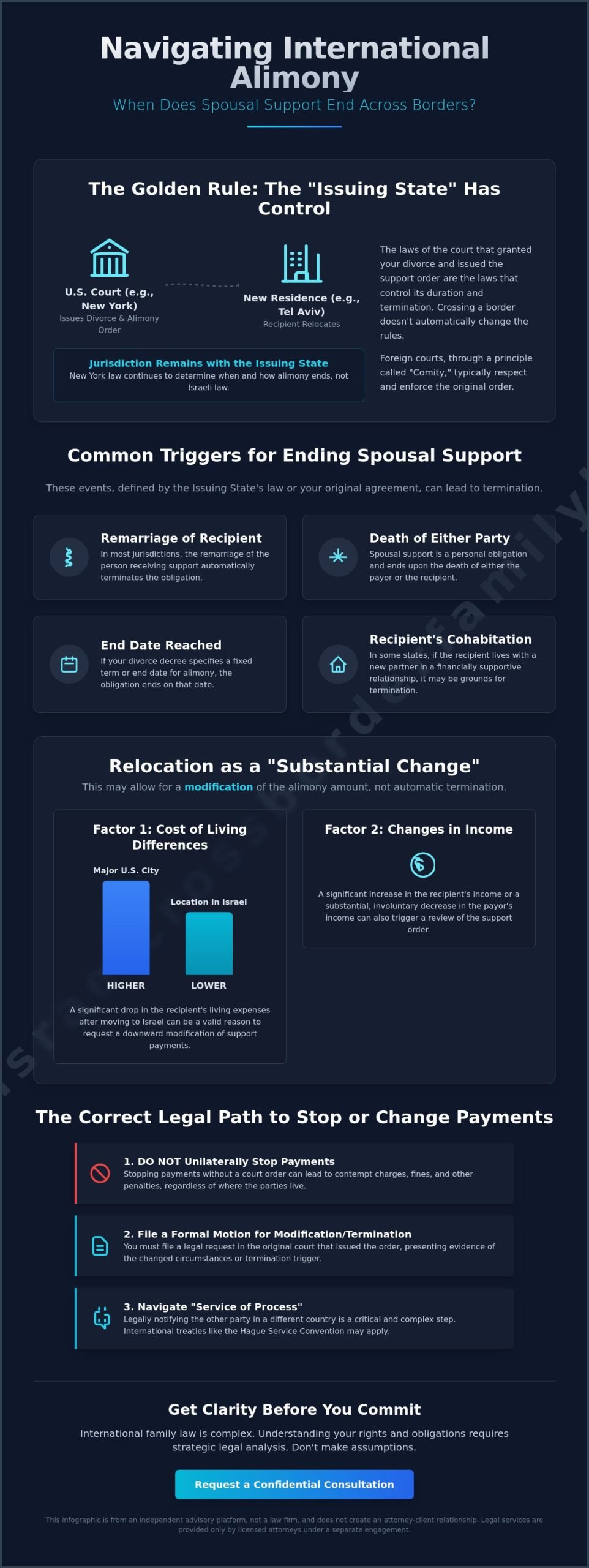
The “Issuing State” rule is the most critical principle to grasp. This legal standard dictates that the law of the specific court that originally granted the divorce and support order continues to control the duration and termination of that support. If a New York court issued your support order, New York law typically determines the end date, regardless of whether the recipient now lives in Tel Aviv or Haifa. Foreign courts generally apply the principle of “Comity,” which is a mutual respect for the judicial decisions of other nations. This means that judges in IL will typically recognize and uphold a valid U.S. support order rather than attempting to rewrite it under local rules just because a party relocated.
To better understand how these support rules function in a practical context, watch this helpful video regarding support termination:
Which Country Has Jurisdiction Over Your Support?
Primary jurisdiction almost always remains with the original divorce forum. This court retains the power to modify or terminate the order because it has the historical record of the case and the initial authority. While it’s possible for an IL court to take jurisdiction in very specific, rare circumstances, this usually only happens if both parties have completely severed ties with the original state. You should remember that this article is published on an independent advisory platform and does not imply an attorney-client relationship. Decisions regarding jurisdiction require a careful analysis of where you and your ex-spouse are “habitually resident” at the time of the filing.
The Role of International Treaties
The Hague Maintenance Convention plays a significant role in US-Israel cases. This treaty simplifies the process of enforcing support across borders, ensuring that payments reach the recipient efficiently. However, these treaties are administrative tools for enforcement; they don’t change the underlying “end date” of your support. If you’re looking for strategies regarding divorce and separation for international families, you must look to the issuing state’s specific statutes to know when does alimony end internationally. For a deeper dive into these jurisdictional hurdles, visit the Israel Family Law YouTube channel for visual breakdowns. Get clarity before you commit. Request a confidential consultation.
This article is published on an independent advisory platform (not a law firm) and must not imply an attorney-client relationship. Legal services are only provided by licensed attorneys under a separate engagement.
Common Triggers for Ending Spousal Support Internationally
Identifying the specific events that terminate a support obligation is the first step in managing your financial future. While jurisdictional rules determine which law applies, the actual triggers for termination are often clearly defined within that law or your original settlement agreement. Determining when does alimony end internationally requires a close examination of these triggers, as they vary significantly between U.S. state statutes and Israeli religious or civil laws.
Most legal systems recognize a few standard events that bring an end to spousal maintenance. Remarriage is the most frequent trigger. In almost every jurisdiction, the recipient’s marriage to a new partner ends their right to receive support from a former spouse. Similarly, the death of either party serves as a standard termination point. Unlike child support, which may continue against an estate, spousal support is typically tied to the lives of the individuals involved.
Fixed-duration support, often called “term of years” alimony, is also common in many U.S. states. This type of support expires automatically on a pre-set date, regardless of where the parties live. However, cohabitation presents a more complex challenge. If a recipient lives with a new partner in a marriage-like relationship, the payer may have grounds to seek termination. This is particularly relevant for those navigating divorce for international families, as the evidence required to prove cohabitation in IL may differ from the standards used in a U.S. court.
Automatic vs. Petition-Based Termination
It’s vital to distinguish between triggers that are automatic and those that require judicial intervention. While death usually ends an obligation immediately, triggers like cohabitation or a change in financial need almost always require a formal court filing. You should never stop payments unilaterally based on a perceived change in your ex-spouse’s circumstances. Doing so without a formal court order or a signed, notarized agreement can lead to claims of contempt or the accrual of significant arrears. While the U.S.-Israel child support agreement primarily focuses on children, the administrative cooperation it establishes underscores how easily arrears can be tracked across borders.
The “Mezonot” Factor in Israel
For families in IL, the distinction between civil alimony and religious spousal maintenance (mezonot isha) is critical. Under Jewish law, spousal support is generally intended to maintain the wife’s standard of living only until the divorce is finalized with a get. This contrasts sharply with U.S. “rehabilitative alimony,” which might continue for years after the marriage has legally ended. Assuming that a U.S. order will naturally expire according to Israeli religious timelines is a common mistake that leads to legal friction. Get clarity before you commit. Request a confidential consultation.
This article is published on an independent advisory platform (not a law firm) and must not imply an attorney-client relationship. Legal services are only provided by licensed attorneys under a separate engagement.
How International Relocation Acts as a “Changed Circumstance”
Relocating between the United States and IL often serves as the primary catalyst for re-evaluating spousal support obligations. In most jurisdictions, a court will only consider modifying or terminating an existing order if there’s a substantial and material change in circumstances. This legal standard acts as a prerequisite for any alimony modification. A move across the globe isn’t just a change of scenery; it’s a fundamental shift in the economic facts that existed when the original order was signed.
Cost of living (COL) differences represent one of the most significant shifts. For example, moving from an expensive metropolis like New York City to a smaller, more affordable city in IL can drastically alter a recipient’s financial “need.” Conversely, the payer’s “ability to pay” might be impacted by the higher costs of maintaining a household in a new country. Proving these shifts requires a sophisticated understanding of international family support laws and how they interface with local economic data.
Currency fluctuations also introduce a layer of complexity that domestic cases don’t face. The USD/ILS exchange rate can effectively increase or decrease the value of support payments without any change in the court order itself. If the Shekel strengthens, a recipient in IL might find their U.S. dollar payments no longer cover basic expenses. These financial pressures often lead individuals to question when does alimony end internationally and whether the current order remains equitable. Employment shifts further complicate the matter. Navigating a new international labor market often results in income changes that justify a legal review of the support obligation.
Calculating Need Across Borders
Courts generally try to respect the “standard of living” established during the marriage. However, proving actual expenses in a foreign currency and within a different legal system is difficult. You must be prepared to provide translated and notarized documentation of housing, utilities, and healthcare costs from IL. Without clear, verifiable evidence, a U.S. court may be reluctant to acknowledge that a “changed circumstance” has truly occurred. Precision in record-keeping is your strongest tool in these situations.
The Tax Implication of International Support
Support payments often carry different tax treatments in the U.S. compared to IL. Changes in tax residency can shift the net financial impact of an alimony payment for both parties. These shifts are frequently used as a strategic lever for modifying or ending support. For those seeking broader information for expats, understanding these tax intersections is essential for informed decision-making. Get clarity before you commit. Request a confidential consultation.
This article is published on an independent advisory platform (not a law firm) and must not imply an attorney-client relationship. Legal services are only provided by licensed attorneys under a separate engagement.
The Legal Process of Modifying or Terminating an Order
Understanding the legal triggers for termination is only half the battle. To actually stop payments, you must navigate a formal judicial process in the court that issued the original decree. Many people mistakenly believe that an administrative agency can terminate their support, but agencies like the Israeli Enforcement and Collection Authority only facilitate collection; they don’t have the power to change the underlying order. Determining when does alimony end internationally requires a proactive legal filing in the original jurisdiction, typically a U.S. state court.
The first significant hurdle is the “Service of Process” on an ex-spouse living in IL. Because the recipient is in a different country, you must comply with international treaties like the Hague Service Convention to ensure the court has jurisdiction to hear your motion. This process can be time-consuming and requires precise documentation. If service isn’t handled correctly, your case might be dismissed before a judge even considers the merits of your request. A negotiated consent order is often the path of least resistance, as it avoids the delays and costs associated with international litigation.
Proving your case also requires international discovery. If you’re alleging that your ex-spouse has remarried or that their income has significantly increased while living in IL, you’ll need verifiable evidence. Obtaining financial records or marriage certificates from a foreign country involves specific legal procedures to ensure they’re admissible in a U.S. court. Without this groundwork, it’s difficult to convince a judge that the circumstances have shifted enough to warrant termination or to answer definitively when does alimony end internationally for your specific case.
Can an Israeli Court Terminate a US Order?
There’s a very high bar for an IL court to interfere with a foreign alimony judgment. Under the concepts of the Uniform Interstate Family Support Act (UIFSA), U.S. courts generally retain “exclusive continuing jurisdiction” over their orders. An Israeli judge will typically decline to modify a U.S. order unless both parties have left the issuing state and consented to a new jurisdiction. Seeking clarity before making a move is far more effective than trying to fight an established judgment after the fact.
Enforcement Defense
Early strategy is the best defense against improper enforcement. If an ex-spouse attempts to use cross-border enforcement mechanisms in IL to collect on an order that should’ve ended, you must act quickly. You’ll need to demonstrate to the Israeli enforcement officers that the original order has expired or been modified by the issuing court. If you’re facing a complex jurisdictional dispute, it’s essential to understand your options. Get professional guidance for your specific situation.
This article is published on an independent advisory platform (not a law firm) and must not imply an attorney-client relationship. Legal services are only provided by licensed attorneys under a separate engagement.
Strategic Planning: Seeking Clarity Before You Commit
Resolving spousal support disputes across international borders requires early preparation and a clear assessment of your legal standing. Many individuals wait until a financial crisis occurs before investigating when does alimony end internationally, but a reactive approach often leads to higher costs and missed opportunities for modification. A strategy-based approach allows you to identify risks before they become liabilities, ensuring your financial planning remains grounded in the realities of both legal systems. This proactive mindset is essential for managing the multi-jurisdictional complexity inherent in US-Israel family law matters.
One of the most significant risks a payer can take is “self-help.” Stopping payments unilaterally because you believe a terminating event has occurred often leads to a finding of contempt of court. Even if your ex-spouse has remarried in IL, the original U.S. order remains enforceable until a judge formally vacates it. Arrears can accumulate quickly, and international enforcement mechanisms are increasingly efficient at tracking down unpaid support. Documenting life changes, such as a new job or remarriage, requires meeting the specific evidentiary standards of the issuing court. This typically involves providing translated and notarized records from the foreign jurisdiction to prove your case effectively.
Audit Your Existing Agreement
Your first step should be a thorough audit of your original divorce decree or settlement agreement. You must check for specific “choice of law” or “choice of forum” clauses that dictate which country’s rules apply to future disputes. Identifying the precise “terminating events” written into your contract is essential for determining when does alimony end internationally for your specific family. While some advisors focus on corporate matters, our family law advisory prioritizes these personal financial protections. Understanding the interplay between your contract and divorce and separation for international families is the foundation of a successful termination strategy.
Next Steps for International Families
Gathering comprehensive financial records from both the U.S. and IL is a prerequisite for any formal filing. You must also weigh the risks of litigation in a foreign court, including the potential for significant legal fees and the uncertainty of judicial outcomes. Managing these transnational operations requires a steady guide who understands the cultural and legal nuances of both regions. Get clarity before you commit. Request a confidential consultation via the case review page.
This article is published on an independent advisory platform (not a law firm) and must not imply an attorney-client relationship. Legal services are only provided by licensed attorneys under a separate engagement.
Securing Your Financial Future Across Borders
Managing a cross-border support obligation requires more than just an awareness of your bank balance. It demands a sophisticated understanding of how the “Issuing State” rule and international treaties impact your specific decree. You’ve seen that relocation to IL serves as a primary catalyst for a “changed circumstances” review, yet these transitions don’t stop payments automatically. Success in these matters depends on a strategy-based risk assessment and a deep understanding of the multi-jurisdictional complexity involved in US-Israel family law.
Our expertise in cross-border matters provides the necessary guidance for expats and international families to navigate these challenging transitions with confidence. Don’t leave your financial security to chance by making assumptions about how foreign courts will interpret your original agreement. Instead, take proactive steps to document your situation and determine exactly when does alimony end internationally for your case. By seeking clarity early, you can avoid the risks of contempt and ensure your financial planning remains grounded in legal reality. Get clarity before you commit. Request a confidential consultation.
This article is published on an independent advisory platform (not a law firm) and must not imply an attorney-client relationship. Legal services are only provided by licensed attorneys under a separate engagement.
Frequently Asked Questions
Does alimony end automatically if my ex-spouse remarries in Israel?
Remarriage usually does not end the obligation automatically without a formal court filing in the original jurisdiction. While most U.S. states list remarriage as a terminating event, the payer must still file a motion to vacate the order to ensure the court clerk stops tracking payments. Relying on an automatic stop often leads to improper arrears being reported to international enforcement agencies, creating unnecessary legal friction in IL.
Can I stop paying alimony if I move to Israel and my income decreases?
You cannot stop payments unilaterally just because your income has decreased after moving abroad. A significant drop in earnings after moving to IL is considered a “changed circumstance,” but it only grants you the right to request a formal modification. You must continue paying the full amount until the issuing court in the United States grants a formal reduction or termination of the support order.
How does the US-Israel tax treaty affect my alimony payments?
The treaty focuses on preventing double taxation rather than setting support end dates. However, tax residency shifts can change the net value of your payments. For instance, California Senate Bill 711, effective January 1, 2026, aligns state tax law with federal law; this means spousal support is no longer deductible for the payer or taxable for the recipient on state returns for agreements made after that date.
What happens if the country I live in doesn’t recognize alimony?
The lack of local alimony laws in a foreign country does not invalidate a U.S. court order. The issuing state maintains jurisdiction, and the debt continues to accrue regardless of where you live. While local enforcement might be more difficult in countries without reciprocal agreements, the U.S. court can still seize domestic assets, intercept tax refunds, or even revoke your passport for non-payment of support.
Can an Israeli court change the end date of a US alimony order?
Israeli courts generally do not have the authority to change the end date of a valid U.S. alimony order. Understanding when does alimony end internationally requires looking back at the laws of the state that issued the original decree. IL courts typically respect foreign judgments under the principle of comity, provided the original court had proper jurisdiction and the order doesn’t violate local public policy or religious laws.
How do I prove my ex-spouse is cohabiting with someone in another country?
Proving cohabitation in a foreign country requires evidence that meets the specific standards of the original issuing court. This often involves hiring a private investigator in IL to document shared living arrangements or gathering utility bills and lease agreements. All foreign evidence must be translated and authenticated with an apostille to be considered admissible in a U.S. modification hearing or termination trial.
Will my alimony obligation end if I retire and move abroad?
Moving abroad for retirement may justify a modification, but it is rarely an automatic ground for termination. You must prove to the issuing court that your retirement was in good faith and not done specifically to avoid support. The court will then re-evaluate your ability to pay based on your new retirement income and the relative cost of living in your new IL residence.
Is there an age limit for spousal support in international law?
International law does not set a specific age limit for spousal support. Instead, the duration is governed by the issuing court’s statutes or your private settlement agreement. Determining when does alimony end internationally depends on the specific terms of your decree rather than a universal age cap. While child support in IL often has specific age triggers, spousal maintenance is typically tied to the length of the marriage.

Article by
Gabriel Lior
A Personal Journey That Became a Mission
The advisory was founded by an American father Gabriel Lior, LLB, MBA , global entrepreneur, and cross-border advisor who spent more than a decade navigating the Israeli family court system firsthand and now lives in Singapore with his son.
As a divorced parent in a cross-border family, Gabriel faced nearly every legal challenge a foreign parent can encounter in Israel — including child custody disputes, child support proceedings, property matters in Israel and abroad, false accusations, and complex immigration and relocation proceedings.
Over the years, he learned the hard way how difficult it is for non-Israeli parents to understand the system, identify the right legal strategy, and choose the right legal representation — especially when language, culture, and jurisdictional differences are involved. He also witnessed how foreign parents and new immigrants are often disadvantaged or taken advantage of by service providers and institutions simply because they lack local knowledge or fluency.
From Client to Advisor
To truly understand — and survive — the system, Gabriel pursued formal legal education in Israel, completing two Israeli law degrees, alongside a BA and MBA earned in the United States. This was never about becoming a practicing attorney, but about gaining a deep, structural understanding of how the system works — and where it breaks down for foreign parents.
This rare combination of:
Firsthand client experience
Israeli legal and US business education
International business and negotiation training
Decades of commercial execution
created a unique perspective – one that understands both sides of the table.
After years of litigation, persistence, and at times self-representation, he ultimately succeeded in securing custody of his son and relocating abroad through a rare legal victory in the Israeli Supreme Court — becoming one of the first fathers in Israel to do so under these circumstances.
Disclaimer
Important Disclaimer:
The information provided on this website and in its content is for general informational and educational purposes only and does not constitute legal advice, legal opinion, or legal representation.
Gabriel Lior is not licensed to practice law in Israel (nor is he interested in doing so) and does not provide legal services, despite having completed 2 Law Degrees. The services offered are advisory in nature and are intended to provide general guidance, strategic insight, and information regarding cross-border family law considerations.
No attorney-client relationship is formed by accessing this website, reading its content, or communicating with us.
Any decisions made based on this information are at your own discretion and risk. For legal advice specific to your situation, you should consult a licensed attorney in the relevant jurisdiction.
Where appropriate, we may refer clients to independent, licensed attorneys or professionals. Such referrals do not constitute legal representation and no liability is assumed for services provided by third parties.