This article is published on an independent advisory platform (not a law firm). This content is for informational and advisory purposes only; it does not constitute legal representation or legal advice. Focus is placed on strategy, risks, and decision-making guidance. For personalized assistance, please reach out via our soft CTA for an advisory call or WhatsApp.
What if a simple administrative oversight in your U.S. divorce decree could legally prevent your child from getting married in Israel thirty years from now? For many international families, the term bastard child carries a social stigma, but in the Israeli legal system, the religious status of “Mamzer” carries concrete, lifelong consequences that differ significantly from secular definitions of illegitimacy. You likely already feel the weight of this uncertainty, as the intersection of civil and religious law is notoriously complex for those living abroad.
It’s understandable to feel overwhelmed by the prospect of religious “blacklisting,” especially when you consider that as of 2022, thousands of individuals were reportedly on the Rabbinate’s marriage-restricted lists. This guide clarifies the legal and religious implications of personal status in IL, helping you navigate these complexities with confidence. We’ll examine the specific risks of DNA testing, how foreign divorce decrees are viewed by Israeli authorities, and the strategic steps you can take to protect your child’s future status. For more visual insights into these complex matters, visit our YouTube channel at https://www.youtube.com/@IsraelFamilyLaw.
Get clarity before you commit. Request a confidential consultation.
Key Takeaways
- Distinguish between children born to unmarried parents and the severe legal implications of being classified as a bastard child (Mamzer) under Israeli religious law.
- Understand the lifelong consequences of a Mamzerut designation, including significant restrictions on the right to marry within the State of Israel.
- Identify the risks associated with foreign divorce decrees and why the timing of a Jewish “Get” is the primary factor in determining a child’s legal status.
- Discover strategic actions and cross-border legal coordination techniques to prevent the Rabbinical Court from issuing a detrimental status designation.
This article is published on an independent advisory platform (not a law firm). Do NOT use language that implies attorney-client relationship, legal representation, or giving legal advice. Focus on strategy, risks, and decision-making guidance. Soft CTA to advisory call / WhatsApp.
Defining the Bastard Child Status in the Israeli Legal System
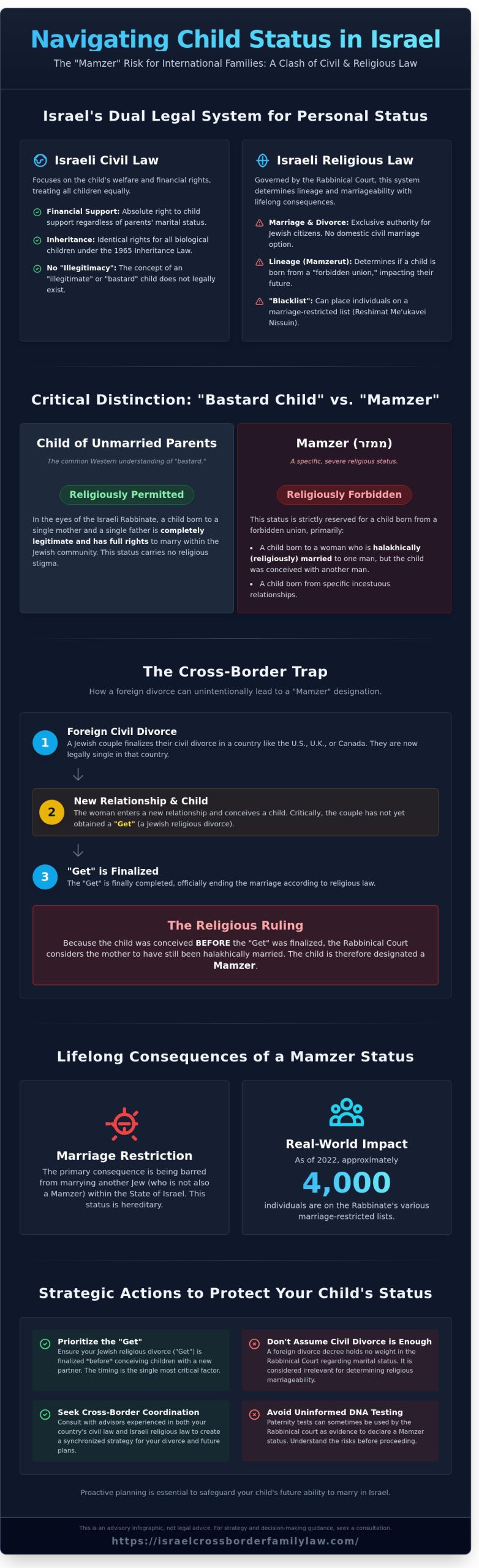
In many English-speaking countries, the term bastard child is a social relic of the past with almost no legal consequence. In Israel, however, the distinction between a child born to unmarried parents and one born from a “forbidden” union remains a critical pillar of personal status law. While IL civil courts prioritize the child’s welfare and financial rights, the religious authorities maintain a parallel system that can impact a person’s ability to marry for generations. Understanding this dual system is essential for expats and international families who may not realize how religious law intersects with their civil rights.
To better understand the historical and religious weight of these terms, watch this helpful video:
Secular vs. Religious Definitions
Under the Family Law Amendment (Maintenance) of 1959, the IL civil system ensures that every child has an absolute right to financial support. This mandate applies regardless of whether the parents are married, cohabiting as common-law partners, or had a brief encounter. From a secular perspective, the concept of an “illegitimate” child does not exist. Inheritance rights under the 1965 Inheritance Law are also identical for all biological children; the law does not discriminate based on the parents’ marital status at the time of birth.
The complexity arises from the religious definition of a “Mamzer.” It’s vital to understand What is a Mamzer because it differs significantly from the Western concept of a bastard child. In IL, a child born to a single mother and a single father is completely “legitimate” in the eyes of the Rabbinate. The label of Mamzer is strictly reserved for children born from specific forbidden relationships. This primarily includes adultery involving a woman who is halakhically married to another man or certain types of incestuous unions.
The Role of the Rabbinical Court
The Rabbinical Courts Jurisdiction Law of 1953 grants religious courts exclusive authority over marriage and divorce for Jews in IL. While civil courts handle the financial aspects of a child’s life, the Rabbinical Court determines their lineage and marriageability. If the court suspects a child was born from a forbidden union, they may be entered into the “Blacklist,” officially known as the Reshimat Me’ukavei Nissuin. This status can prevent the individual from marrying other Jews within the state of Israel in the future.
For the 180,000 Anglos and expats currently residing in IL, these distinctions are often unexpected. The religious ruling is not merely a private community matter; it dictates legal marriage rights because IL does not offer a domestic civil marriage option. Recent data suggests that approximately 4,000 individuals are currently on various restricted marriage lists held by the Chief Rabbinate. This highlights the tangible impact that ancient religious laws continue to have on modern citizens. Families must recognize that while their bastard child may have full civil rights to child support and inheritance, their religious status requires separate, strategic management to avoid long-term social and legal hurdles.
Get clarity before you commit. Request a confidential consultation.
The Reality of Mamzerut: A Specific Legal Challenge in IL
While many Westerners use the term bastard child to describe any child born to unmarried parents, Jewish law in Israel applies a far stricter and more consequential definition. Under Halakhic (Jewish) law, which governs personal status in Israel, a “Mamzer” is specifically a child born from a relationship that is biblically prohibited. This primarily includes children born of adultery, where a married woman conceives a child with a man other than her husband, or children born of certain incestuous unions.
The legal consequences of this status are permanent and severe. A person designated as a Mamzer is prohibited from marrying another Jew in Israel, with the exception of marrying another Mamzer or a convert. This restriction is not limited to the individual; it’s a hereditary status passed down to all future generations. Because the Chief Rabbinate maintains exclusive control over Jewish marriage, there is no civil marriage alternative within the country to bypass these rules.
The Rabbinical Court generally follows a policy of not proactively searching for Mamzerim. They prefer to avoid uncovering evidence that would ruin a person’s lineage. However, they are legally compelled to act when a person’s status is formally questioned. This often occurs during marriage registration or when a paternity suit is filed in the Family Court. These situations frequently lead to modern legal problems for mamzerim that can derail family planning decades after a child is born.
The Adultery Trap for International Families
For Jewish families moving between the US and Israel, the most common trap involves the religious divorce document known as a “Get.” If a woman obtains a civil divorce in a US court but fails to receive a Get from her husband, she remains legally married under Israeli law. Any child she has with a new partner after the civil decree is considered a product of adultery. This creates a bastard child in the eyes of the Rabbinate. A Get is required even if a US court has issued a final decree. Many families overlook this technicality, assuming their US legal status carries over to Israel automatically.
The Prohibited to Marry List
The Israel Chief Rabbinate manages a centralized database often called the “Blacklist” or the “List of Those Prohibited to Marry.” In 2017, reports from advocacy groups like the Center for Women’s Justice indicated that approximately 7,000 individuals were included on various restrictive lists managed by the Rabbinate. Individuals often discover they are on this list only when they attempt to register for marriage in Israel. For children living in the US who eventually wish to marry in Israel, this database presents a significant cross-border hurdle. Removing a name from this list is an exceptionally complex process; it often requires a sophisticated legal strategy and genealogical research to prove the validity of a parent’s prior marriage or divorce.
Understanding these risks early is vital for protecting your family’s future rights. You can find more detailed explanations of these procedures on our YouTube channel. If you are navigating a separation across borders, it’s wise to evaluate your status before legal complications arise.
Get clarity before you commit. Request a confidential consultation.
This article is published on an independent advisory platform (not a law firm). This content is for informational and advisory purposes only and does not constitute an attorney-client relationship, legal representation, or legal advice. We focus on strategy, risks, and decision-making guidance. For specific assistance, reach out for an advisory call or via WhatsApp.
Cross-Border Risks: When Foreign Divorces and Laws Clash
Families moving between the United States and Israel often fall into a dangerous legal trap. They believe a New York or California divorce decree provides a universal shield for their family’s status. It doesn’t. In Israel, personal status matters like marriage and divorce for Jewish citizens fall under the jurisdiction of the Rabbinical Courts. If you’re Jewish, these courts don’t necessarily recognize a US civil judge’s signature as the final word on your marital status.
The timing of a birth relative to a religious divorce, known as a “Get,” is the most common trigger for legal investigations. While the term bastard child carries a social stigma in the US, it represents a specific legal category in Israel with lifelong consequences. If a child is born to a woman who is civilly divorced but has not yet received a Get, the state may investigate the child’s status. This conflict between secular US law and religious Israeli law creates a “limping marriage” where a person is single in Los Angeles but still married in Jerusalem.
The Recognition of Foreign Divorces
The Rabbinical Court frequently looks behind a US divorce decree to ensure religious requirements were met. It’s a common myth that a civil divorce automatically ends a Jewish marriage. Without a Get, the woman is still considered a “married woman” under Israeli law. Any child she has with another man during this period faces the risk of being labeled a mamzer. You can learn more about the complexities of Divorce for International Families to understand how these systems overlap. It’s vital to obtain a religious divorce simultaneously with a civil one to prevent future status issues for children born later.
The DNA Testing Dilemma
Israel’s approach to DNA testing is fundamentally different from the US system. In the US, a paternity test is a standard tool to ensure biological truth. In Israel, the courts often refuse DNA tests if the result might prove a child was born from an adulterous relationship. The court’s primary goal is to protect the child from the legal consequences of being a What is a mamzer?. This category limits who the child can marry in Israel for generations.
To prevent this, the legal system relies on the “Presumption of Legitimacy.” This rule assumes the mother’s husband is the father, even if there’s biological doubt. This protection is a double-edged sword for international families. If you seek a paternity test in a US court for a child with Israeli ties, you might inadvertently create a paper trail that alerts Israeli authorities. This could lead to the child being blacklisted from marriage in Israel. A strategic approach is essential before filing any paternity actions in the US. Early decisions can prevent a child from being classified as a bastard child in the eyes of the Israeli state.
Get clarity before you commit. Request a confidential consultation.
Actionable Guidance: Protecting Your Child’s Future Status
Protecting your child’s legal and religious status in Israel requires a proactive strategy that begins long before a birth certificate is issued. In the IL legal landscape, the timing of a divorce is not just a personal milestone; it’s a critical legal shield. If a woman is religiously married to one man but conceives a child with another, that child faces the irreversible designation of a “mamzer,” often referred to as a bastard child. This status carries heavy consequences, including a lifetime ban on marrying within the Jewish tradition in Israel. You can’t resolve this issue retroactively. You must achieve total clarity regarding your marital status before committing to a new pregnancy.
Preventative Measures for Expats
Expats often fall into the trap of assuming a civil divorce from their home country is sufficient. It isn’t. The Israeli Ministry of Interior and the Rabbinical Courts require a religious “Get” to update your status to “single.” For couples with dual residency, the “Double-Gett” strategy is the safest route. This involves securing a religious divorce in both jurisdictions to ensure no legal gaps exist. You should also consider drafting postnuptial agreements that explicitly address religious status and the timeline for a “Get.” These documents, while complex, provide a roadmap that bypasses the ₪296 filing fees and years of litigation associated with contested divorces. For more details on how this affects those living abroad, see our guide For Expats and Foreign Nationals.
Navigating the IL System as an Anglo
Anglos often find the Rabbinical Court environment jarring and culturally foreign. The proceedings are conducted in Hebrew, and the logic follows Halacha rather than the common law principles found in the US or UK. Don’t rely on “plain English” translations provided by court clerks; they often miss the nuance of “status” risks. A bicultural advisor is vital to bridge this gap. They ensure you don’t inadvertently admit to facts that could lead the court to label a future newborn as a bastard child. Understanding the difference between a civil “separation” and a religious “divorce” is the first step in avoiding a life-altering mistake for your offspring.
Cross-border separations introduce another layer of risk known as the “300-day rule.” In IL, if a child is born within 300 days of a divorce being finalized, the law may automatically presume the ex-husband is the father. While this presumption is designed to protect the child’s status, it creates a massive legal hurdle for the biological father to claim paternity. Correcting a birth record in these cases requires a genetic test authorized by the Family Court, a process that can take over six months and cost upwards of ₪4,000 in legal and laboratory fees. You need to map out these timelines before the third trimester to ensure the correct father is registered without a fight.
Informed choice is your best defense against the complexities of the dual legal system. By choosing the right venue and timing your filings correctly, you maintain control over your family’s future. Get strategic guidance to understand which court best serves your specific needs.
Get clarity before you commit. Request a confidential consultation.
This article is published on an independent advisory platform (not a law firm). Do NOT use language that implies attorney-client relationship, legal representation, or giving legal advice. Focus on strategy, risks, and decision-making guidance. Soft CTA to advisory call / WhatsApp.
Strategic Decision-Making for International Families
Managing a family’s legal status across borders requires more than just filling out forms. It demands a synchronized strategy that accounts for both Israeli secular law and religious mandates. Many expats assume that their home country’s laws will protect them indefinitely. However, once a child is born in IL or to Israeli parents abroad, the jurisdiction of the Rabbinical Court can trigger automatically. This creates a complex web where a child’s personal status in Israel might differ significantly from their status in the US or Europe.
A “wait and see” approach is often a recipe for a crisis. If a dispute arises and one party rushes to the Rabbinical Court, the child might be labeled a bastard child (mamzer) based on strict halakhic interpretations. This status is generally irreversible and carries lifelong consequences for marriage eligibility in Israel. Taking action before a conflict starts ensures you choose the forum, rather than having the system choose it for you. Proactive planning provides a “professional home” for your family’s legal needs, bridging the gap between the “start-up nation” and global legal standards.
An independent advisory platform serves as a neutral guide in these high-stakes scenarios. Unlike a litigator who may be incentivized by court battles, an advisor focuses on risk mitigation and long-term stability. This guidance helps you understand the “team on the ground” reality of Israeli law. It allows you to make informed choices about where to file documents and how to frame your family’s status to avoid religious complications. Peace of mind comes from knowing the risks before they become legal realities.
The Value of Early Advisory
Early intervention is the most effective way to prevent a child from entering the Rabbinical “system” entirely. By establishing facts in the civil Family Court first, parents can often secure a child’s legal standing under secular law. In a 2022 case involving a US-IL family, proactive filing in the civil court prevented a mother’s former husband from claiming the child was a bastard child in religious court. This strategic move saved the family approximately ₪85,000 in future litigation costs and protected the child’s social identity. For visual walkthroughs on these jurisdictional nuances, visit the Israel Family Law YouTube channel.
Next Steps for Your Family
Determining your risk level is the first priority. You need to know if a previous marriage wasn’t properly dissolved or if a religious divorce (Gett) is missing. If these gaps exist, your child’s status is potentially at risk. To prepare for a strategy session, you should organize the following:
- Foreign and Israeli birth certificates for all children.
- Original marriage certificates and any previous divorce decrees.
- Specific dates of entry and exit from Israel for both parents.
- Records of any previous proceedings in religious courts.
Knowing these dates is vital for calculating jurisdictional timelines. You can start this process by requesting a Confidential Case Review to map out your specific risks. Get clarity before you commit. Request a confidential consultation.
Secure Your Family’s Legal Future in Israel
Navigating the intersection of US civil decrees and the Israeli Rabbinical courts requires a proactive, strategic approach. You shouldn’t assume a foreign divorce decree automatically protects your children from local religious restrictions under the 1953 Rabbinical Courts Jurisdiction Law. The legal designation of a bastard child in IL carries lifelong implications that fundamentally alter marriage eligibility and social standing. Our team on the ground offers a sophisticated understanding of these multi-jurisdictional challenges; we’ve spent decades helping international families bridge the gap between US civil frameworks and the IL religious system. By making informed choices today, you prevent complex legal hurdles that could impact your children for decades. This information is for advisory purposes and doesn’t constitute legal advice or an attorney-client relationship. Legal services are provided separately by licensed attorneys. You’ll find more strategic guidance on our YouTube channel at https://www.youtube.com/@IsraelFamilyLaw. Taking the right steps now ensures your family’s status remains protected across every border you cross.
Get clarity before you commit. Request a confidential consultation.
This article is published on an independent advisory platform (not a law firm). Do NOT use language that implies attorney-client relationship, legal representation, or giving legal advice. Focus on strategy, risks, and decision-making guidance. Soft CTA to advisory call / WhatsApp.
Frequently Asked Questions
Is a child born out of wedlock considered a bastard in Israel?
No, a child born to an unmarried woman is not legally classified as a Mamzer or a bastard child under Israeli law. In Jewish Halacha, the term specifically refers to a child born from an adulterous relationship where the mother is married to another man at the time of conception. If the mother is single, divorced, or widowed, the child’s status remains clear and they enjoy full rights to marry within the Jewish community.
Can a US divorce prevent a child from being declared a Mamzer in Israel?
A US divorce decree doesn’t automatically protect a child’s status unless the Israeli Rabbinical Court recognizes it. Under the Rabbinical Courts Jurisdiction Law of 1953, these courts hold exclusive authority over Jewish marriage and divorce for citizens and residents. If your US divorce isn’t registered and validated in IL, the authorities might still view you as married, which creates significant risks if you have a child with a new partner.
What happens if a child is on the Rabbinical Blacklist?
Being on the “List of Delayed Marriage” means the child cannot legally marry another Jew through the Israeli Rabbinate. As of recent 2023 reports, approximately 6,800 individuals are on this list for various reasons, including status doubts. While this doesn’t affect their daily civil life or citizenship, it creates a complex barrier for those wishing to have a traditional state-sanctioned wedding later in life.
Does the Israeli government require DNA tests to prove a child is not a Mamzer?
The Israeli legal system actually restricts DNA testing if the results might label a child as a bastard child. Under the Genetic Information Law of 2000, courts prioritize the child’s social welfare and “purity” of status over biological accuracy. Judges often refuse paternity test requests in cases of suspected adultery to prevent the child from being permanently stigmatized by the religious authorities.
Can a Mamzer status be fixed or removed later in life?
Removing this status is exceptionally difficult and requires navigating complex Rabbinical legal arguments. There’s no simple administrative form to change this designation once it’s established. Specialized advocates sometimes find technical flaws in the mother’s original marriage ceremony to “nullify” it, but this is a high-stakes strategy that requires deep expertise in both civil and religious law.
How does Mamzerut affect child support or inheritance in Israel?
A child’s religious status doesn’t impact their financial rights to support or inheritance. The Succession Law of 1965 ensures that all children inherit equally from their parents regardless of the circumstances of their birth. Furthermore, biological fathers are still obligated to pay child support, which typically starts around ₪1,650 per month plus 30% to 50% of housing and education costs.
What should I do if I am pregnant and my Israeli divorce is not yet final?
You must seek advisory guidance immediately to manage the timing of your legal proceedings. If a child is born within 300 days of the final Get (divorce document), the Rabbinical Court may investigate the child’s status. We help clients navigate these cross-border complexities to ensure that the birth is registered in a way that protects the child’s future legal and religious standing in IL.
Can a non-Jewish child be considered a Mamzer in Israel?
The concept of Mamzerut only applies to the Jewish population under the jurisdiction of the Rabbinate. For Christians, Muslims, or Druze, the legal status of a child born out of wedlock is governed by their own religious courts and traditions. Each community has its own rules, but the specific Jewish definition of a “bastard” doesn’t carry over to other faiths or secular civil registrations.
For more information on navigating family law in Israel, visit our YouTube channel: https://www.youtube.com/@IsraelFamilyLaw
Get clarity before you commit. Request a confidential consultation.

Article by
Gabriel Lior
A Personal Journey That Became a Mission
The advisory was founded by an American father Gabriel Lior, LLB, MBA , global entrepreneur, and cross-border advisor who spent more than a decade navigating the Israeli family court system firsthand and now lives in Singapore with his son.
As a divorced parent in a cross-border family, Gabriel faced nearly every legal challenge a foreign parent can encounter in Israel — including child custody disputes, child support proceedings, property matters in Israel and abroad, false accusations, and complex immigration and relocation proceedings.
Over the years, he learned the hard way how difficult it is for non-Israeli parents to understand the system, identify the right legal strategy, and choose the right legal representation — especially when language, culture, and jurisdictional differences are involved. He also witnessed how foreign parents and new immigrants are often disadvantaged or taken advantage of by service providers and institutions simply because they lack local knowledge or fluency.
From Client to Advisor
To truly understand — and survive — the system, Gabriel pursued formal legal education in Israel, completing two Israeli law degrees, alongside a BA and MBA earned in the United States. This was never about becoming a practicing attorney, but about gaining a deep, structural understanding of how the system works — and where it breaks down for foreign parents.
This rare combination of:
Firsthand client experience
Israeli legal and US business education
International business and negotiation training
Decades of commercial execution
created a unique perspective – one that understands both sides of the table.
After years of litigation, persistence, and at times self-representation, he ultimately succeeded in securing custody of his son and relocating abroad through a rare legal victory in the Israeli Supreme Court — becoming one of the first fathers in Israel to do so under these circumstances.
Disclaimer
Important Disclaimer:
The information provided on this website and in its content is for general informational and educational purposes only and does not constitute legal advice, legal opinion, or legal representation.
Gabriel Lior is not licensed to practice law in Israel (nor is he interested in doing so) and does not provide legal services, despite having completed 2 Law Degrees. The services offered are advisory in nature and are intended to provide general guidance, strategic insight, and information regarding cross-border family law considerations.
No attorney-client relationship is formed by accessing this website, reading its content, or communicating with us.
Any decisions made based on this information are at your own discretion and risk. For legal advice specific to your situation, you should consult a licensed attorney in the relevant jurisdiction.
Where appropriate, we may refer clients to independent, licensed attorneys or professionals. Such referrals do not constitute legal representation and no liability is assumed for services provided by third parties.