This article is published on an independent advisory platform and does not constitute legal representation or an attorney-client relationship.
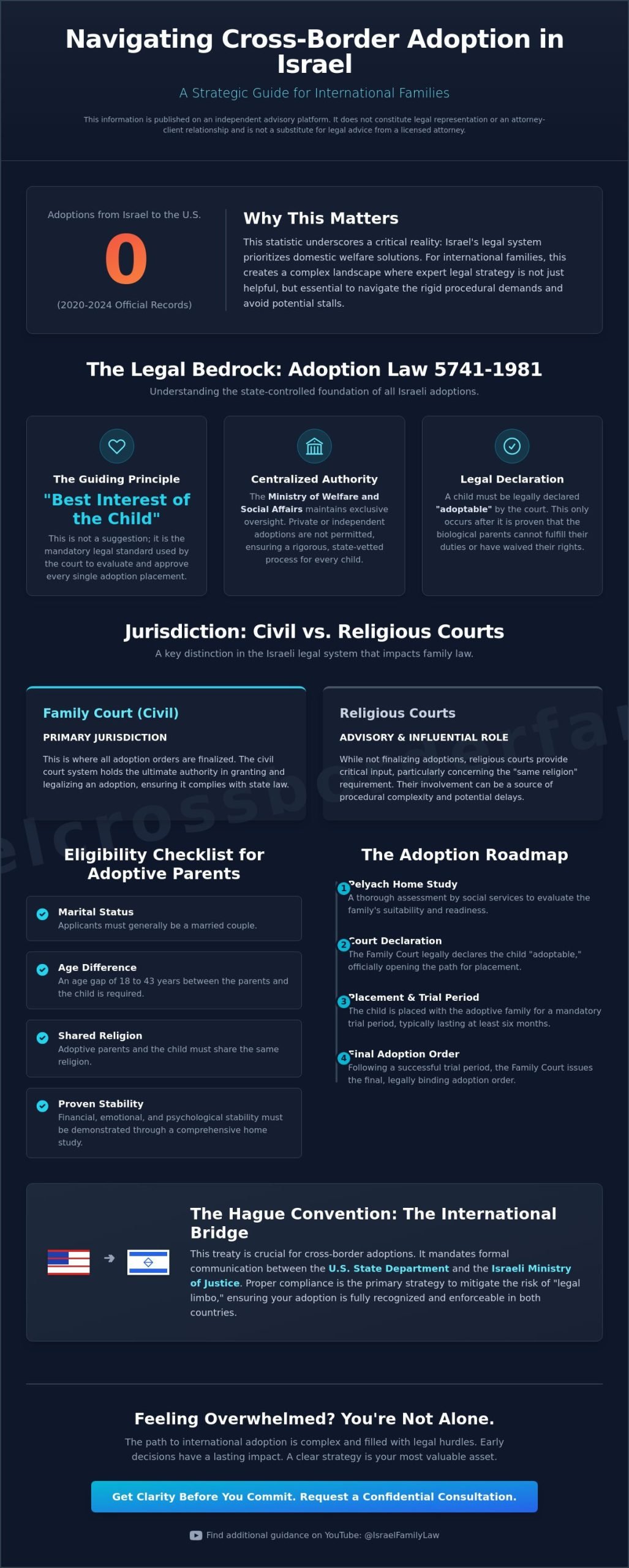
Between 2020 and 2024, official records show there were zero adoptions from Israel to the United States. This reality underscores why consulting an international adoption lawyer israel is essential for families navigating a legal landscape that increasingly prioritizes domestic welfare solutions. You’re likely feeling the weight of this complexity, perhaps struggling to distinguish between the roles of religious and civil courts or worrying about the rigid demands of the Hague Convention. It’s natural to fear that a single procedural mistake could stall your progress or leave your family in legal limbo.
We’ll provide you with a transparent look at the current legal requirements and the procedural steps necessary for success in 2026. This guide explores the Adoption of Children Law 5741-1981, the impact of recent visa restrictions like Presidential Proclamation 10998, and how to ensure your cross-border adoption is fully recognized in IL. You can find additional guidance on these complex family matters at https://www.youtube.com/@IsraelFamilyLaw. Get clarity before you commit. Request a confidential consultation.
Key Takeaways
- Understand how the Adoption of Children Law 5741-1981 centralizes all proceedings under state control to uphold the best interest of the child.
- Distinguish between domestic and inter-country adoption paths to identify which residency and eligibility requirements apply to your family’s specific status in IL.
- Learn how an international adoption lawyer israel facilitates the mandatory communication between the US State Department and the Israeli Ministry of Justice under the Hague Convention.
- Follow a clear roadmap of the Israeli process, from the initial Pelyach home study assessment through the required trial period for placement.
- Identify strategies to mitigate the risk of legal limbo, ensuring your adoption is fully recognized and enforceable across both jurisdictions.
This article is published on an independent advisory platform and does not constitute legal representation or an attorney-client relationship. Legal services are only provided by licensed attorneys under a separate engagement.
The Legal Framework: Understanding Adoption Law 5741-1981 in Israel
When seeking the guidance of an international adoption lawyer israel, the first step is recognizing that adoption in IL is a strictly state-governed process. Unlike some jurisdictions where private placements or independent agencies operate with more autonomy, the Ministry of Welfare and Social Affairs maintains exclusive oversight over every case. This centralized system ensures that no child is placed without rigorous vetting and state approval. The Adoption of Children Law in Israel outlines these requirements to prevent the commercialization of child placement and to protect the rights of all parties involved. Adoption Law 5741-1981 serves as the foundational pillar of all Israeli adoption proceedings.
The primary legal standard in every decision is the “Best Interest of the Child.” This isn’t just a guiding principle; it’s a mandatory legal requirement that the court uses to evaluate every potential placement. Before a child can be placed with a family, they must be legally declared “adoptable” by the court. This status is only granted when it is proven that the biological parents cannot fulfill their role or have legally waived their rights. For international families, understanding how this status is declared is vital to ensuring the process starts on a solid legal footing.
To better understand the complexities involved in cross-border cases, watch this helpful video:
The Role of the Family Court vs. Religious Courts
In IL, the Family Court holds primary jurisdiction over adoption matters. While religious courts handle many family law issues, the civil Family Court is where adoption orders are finalized. However, religious authorities still play a role, particularly regarding the “same religion” principle. If a child’s religious status is a factor, the relevant religious court may need to provide input. Jurisdictional conflicts between these two systems can occasionally cause delays. An international adoption lawyer israel helps manage these interactions to keep the process moving forward without unnecessary procedural friction.
Who Can Adopt Under Israeli Law?
The law sets specific criteria for prospective adoptive parents to ensure stability. Generally, applicants must be a married couple with an age difference of 18 to 43 years between them and the child. They must also demonstrate financial and emotional stability through a comprehensive home study. For expats and foreign nationals living in IL, these rules still apply, but they’re often layered with the laws of their home country. One unique aspect of the Israeli system is the requirement that the adoptive parents and the child must share the same religion. This can create additional layers of complexity for international families who may not fit into traditional religious categories within the Israeli framework. Get clarity before you commit. Request a confidential consultation.
This article is published on an independent advisory platform and does not constitute legal representation or an attorney-client relationship. Legal services are only provided by licensed attorneys under a separate engagement.
International vs. Domestic Adoption: Strategic Differences for Expats
Families living in IL must choose between two distinct legal paths, each carrying unique risks and timelines. Domestic adoption involves adopting a child who is already a resident of IL and under the care of the Ministry of Welfare. Inter-country adoption occurs when families residing in IL adopt a child from a foreign nation. While domestic adoption in IL is relatively rare, with an average of only 120 adoptions completed annually, inter-country options involve navigating the laws of two different countries simultaneously. An international adoption lawyer israel helps families evaluate which path aligns with their residency status and long-term goals.
Domestic Adoption as a Foreign Resident
Adopting locally as an expat or foreign national presents significant hurdles. The Israeli system often prioritizes permanent residents or citizens who share the child’s religious background. If you’re in IL on a temporary work or study visa, you’ll likely find it difficult to enter the domestic queue. Even for those who qualify, the waiting list is extensive. The focus of the Ministry of Welfare is frequently on foster care or rehabilitating biological families rather than permanent adoption. This makes the domestic path a test of patience and legal standing that requires a clear understanding of your rights as a foreign resident.
Inter-country Adoption: Bringing a Child to Israel
For many international families, adopting from abroad is the more viable, though more expensive, option. This process requires working through a recognized non-profit organization, known in IL as an “Amuta.” These organizations are authorized by the Central Authority to facilitate cross-border placements. It’s critical to follow the U.S. State Department guidelines on adoption from Israel to ensure the adoption is recognized by both the source country and the Israeli Ministry of Justice. Without this mutual recognition, you risk facing “legal limbo,” where your child’s citizenship or legal status remains unresolved in one of the jurisdictions. It’s a complex journey that demands a strategic approach to avoid procedural errors.
Before making any financial or emotional commitments, it’s wise to discuss your specific circumstances with a professional who understands these multi-jurisdictional nuances. Get clarity before you commit. Request a confidential consultation.
This article is published on an independent advisory platform and does not constitute legal representation or an attorney-client relationship. Legal services are only provided by licensed attorneys under a separate engagement.
The Hague Convention: US-Israel Cross-Border Nuances
The Hague Convention on Protection of Children and Co-operation in Respect of Intercountry Adoption is the primary treaty governing these complex cases. It creates a framework of safeguards to ensure that adoptions are transparent and prioritize the child’s welfare. In the context of US-Israel relations, every procedural step must align with the requirements of both nations’ central authorities. An international adoption lawyer israel provides the necessary oversight to ensure that no “private” or “independent” arrangements are made. These independent paths are illegal in IL and can lead to severe criminal penalties or the permanent rejection of an adoption petition by the Ministry of Welfare.
A critical document in this process is the “Article 23” certificate of conformity. This certificate proves that the adoption was carried out according to the Convention’s rules. Without it, the US government may refuse to recognize the adoption, leaving the child without a clear legal status or a path to citizenship. Following the U.S. State Department Guidelines on Israeli Adoption is the only way to ensure this documentation is handled correctly from the start. Any deviation from these protocols can result in the adoption being declared void in one or both jurisdictions.
US Citizenship and Immigration Implications
Adopting families must understand the difference between IR-3 and IR-4 visa categories. An IR-3 visa is typically issued when both adoptive parents meet the child before the adoption is finalized in IL. This usually results in automatic US citizenship upon the child’s entry into the United States. If only one parent meets the child, or if the adoption isn’t considered “final” by US standards, an IR-4 visa is used. This requires the family to complete a “re-adoption” in a US court to secure the child’s citizenship. These distinctions are subtle but have lasting legal consequences for the child’s future rights.
The Role of the Central Authority
The Israeli Ministry of Welfare acts as the designated Central Authority under the Hague Convention. They don’t just approve families; they actively vet the foreign agencies involved in the process. They maintain a strict communication chain with US-accredited adoption service providers to verify that all international standards are met. Delays often happen when paperwork doesn’t match the specific formatting or translation requirements of the Israeli system. It’s a rigid hierarchy designed to protect the child, and any attempt to bypass this chain usually results in administrative deadlock. Get clarity before you commit. Request a confidential consultation.
This article is published on an independent advisory platform and does not constitute legal representation or an attorney-client relationship. Legal services are only provided by licensed attorneys under a separate engagement.
The Adoption Process in Israel: A Step-by-Step Roadmap
The journey through the Israeli adoption system is highly structured and begins long before any court appearance. While many families focus on the final legal hearing, the administrative phase determines whether you’ll ever reach that stage. An international adoption lawyer israel helps manage the intersection of these welfare requirements and the eventual legal petition. Every step is designed to ensure the child’s safety, but for international families, the process often feels like a test of endurance and cultural adaptation.
The Home Study and Welfare Assessment
The Home Study is the most critical gatekeeper in the Israeli adoption journey. Known locally as the Pelyach, this assessment involves multiple visits from social workers and psychological evaluations. For Anglos and expats, this phase presents a unique challenge. Cultural and linguistic barriers can sometimes lead to misunderstandings between international families and local social workers. Your parenting philosophy or background might be interpreted differently through a local lens, making it essential to present a clear, consistent picture of your family’s stability.
Preparing documentation for an international background adds another layer of effort. You’ll need to provide certified US criminal records, such as FBI background checks, alongside comprehensive medical and financial reports. This documentation must be translated and authenticated to meet Israeli standards. For more detailed support on these requirements, see our Guidance for Expats and Foreign Nationals.
Once the assessment is complete, the matching process begins. If a child is placed with your family, a mandatory trial period follows. During this time, the Ministry of Welfare continues to monitor the placement to ensure the child’s best interests are being served within the home environment.
The Final Adoption Order
After the trial period concludes successfully, your international adoption lawyer israel files a formal Adoption Petition in the Family Court. This is the legal mechanism that officially severs biological ties and creates a new, permanent legal relationship between you and the child. The resulting Adoption Order is final and binding. It is the definitive document required to secure the child’s future legal rights.
Once the order is issued, you must update the Israeli Population Registry, known as Misrad HaPanim. This step ensures the child’s identity and status are correctly reflected in the state’s central records. For families who may eventually move abroad, it’s vital to understand the implications of International Custody and Relocation. If you’re beginning this process, it’s helpful to review your procedural strategy with an advisor. Get clarity before you commit. Request a confidential consultation.
This article is published on an independent advisory platform and does not constitute legal representation or an attorney-client relationship. Legal services are only provided by licensed attorneys under a separate engagement.
Strategic Considerations: Managing Risks in International Adoption
Entering a cross-border adoption without a comprehensive strategy often leads to a state of legal limbo. This occurs when a foreign jurisdiction grants an adoption decree that the State of Israel refuses to recognize. In such cases, a child might be considered legally yours in the United States but remains a legal stranger to you under Israeli law. This discrepancy affects everything from residency rights to inheritance and healthcare access. An international adoption lawyer israel helps you identify these jurisdictional gaps before they become insurmountable obstacles. Since there were zero adoptions from Israel to the US between 2020 and 2024, the path is narrow and requires precise legal alignment.
Religious identity and marital status are not just personal details in this process; they’re strict legal requirements. Israeli authorities apply the “same religion” principle rigorously. If your family’s religious standing is unclear or if your marital status changes during the lengthy waiting period, the entire process can stall. It’s also important to consider how a potential divorce or separation for international families might impact an ongoing adoption. Managing the emotional toll of these proceedings requires a realistic understanding of these risks rather than relying on optimistic assumptions.
Recognition of Foreign Decrees in Israel
Many families assume that a “simple” foreign adoption decree is enough to finalize their status. However, for a foreign order to have legal effect in IL, it must often undergo a process called “Exequatur.” This is a formal procedure where an Israeli court reviews and enforces the foreign family law order to ensure it doesn’t conflict with local public policy. Without this step, you may find it impossible to register the child with the Ministry of Interior or secure their Israeli citizenship. This is particularly relevant given the 2026 entry restrictions under Presidential Proclamation 10998, which add another layer of visa complexity for children entering from certain jurisdictions.
Seeking Clarity Before Commitment
One of the most common mistakes is signing contracts with foreign adoption agencies before vetting them against Israeli law. These contracts often contain clauses that conflict with the requirements of the Israeli Central Authority. A cross-border advisor acts as a bridge between these two legal cultures, ensuring that your international commitments don’t violate local statutes. Taking the time to build a risk-based strategy early on protects your family from the financial and emotional costs of a failed placement. Cultural differences in how “finality” is defined can lead to unexpected delays if not addressed at the start. Get clarity before you commit. Request a confidential consultation.
This article is published on an independent advisory platform and does not constitute legal representation or an attorney-client relationship.
Securing Your Family’s Legal Future in 2026
Success in cross-border adoption requires moving beyond administrative checklists to embrace a comprehensive risk-management strategy. You’ve seen how the Israeli system prioritizes state control and the “best interest of the child,” making strict adherence to the Hague Convention non-negotiable. Whether you’re navigating the Home Study gatekeeper or ensuring a foreign decree is recognized through the Exequatur process, the impact of your early decisions cannot be overstated. Consulting an international adoption lawyer israel ensures that these multi-jurisdictional complexities don’t jeopardize your family’s legal stability.
With decades of experience in US-Israel cross-border family law, our advisory focuses on bridging the gap between divergent legal cultures. We provide a deep understanding of international treaties and strategic guidance designed to mitigate the risks unique to the expat community. Clarity is your most valuable asset when dealing with state welfare authorities and international immigration rules. Get clarity before you commit. Request a confidential consultation. Building your family across borders is a significant journey; taking the right legal steps today ensures a secure foundation for your child’s future.
This article is published on an independent advisory platform and does not constitute legal representation or an attorney-client relationship.
Frequently Asked Questions
Is it possible for a US citizen living in Israel to adopt a child from a third country?
Yes, US citizens residing in IL can adopt from a third country, but they must coordinate the process through the Israeli Central Authority. You’re required to work with an authorized Israeli non-profit organization, known as an Amuta, to ensure the adoption complies with the Hague Convention. This coordination is vital to ensure the child can legally enter IL and eventually secure US citizenship.
How long does the domestic adoption process typically take in Israel?
The domestic adoption process is extensive and frequently takes several years to complete. Because there are only about 120 domestic adoptions annually, the waiting list for healthy infants is particularly long. Families who are open to adopting older children or children with special needs may find the timeline is somewhat shorter, though the vetting remains rigorous.
Can same-sex international couples adopt in Israel in 2026?
Same-sex couples have the legal right to adopt within the Israeli domestic system. For international adoptions, the primary challenge isn’t Israeli law but the regulations of the source country. Many nations that coordinate with IL don’t permit same-sex adoption, which can significantly limit the options available to these families during the matching phase.
What is the difference between guardianship and full adoption in Israeli law?
Guardianship gives you the legal authority to make daily decisions for a child but doesn’t make you the legal parent. Full adoption is a permanent status that completely severs the legal link to biological parents. This change is recorded in the Israeli Population Registry, granting the child the same inheritance and status rights as a biological child.
Do I need a separate lawyer in both the US and Israel for my adoption?
Most families find it necessary to have professional guidance in both jurisdictions to manage divergent legal requirements. A US professional typically handles the complex immigration and visa steps, such as IR-3 or IR-4 applications. An international adoption lawyer israel focuses on the Ministry of Welfare assessments and the Family Court petition to ensure the adoption is valid under local law.
What happens if the biological parents change their mind during the process?
Biological parents can generally withdraw their consent until the court issues a final declaration that the child is adoptable. Once the trial period begins and the court signs the final adoption order, the decision is usually irrevocable. The legal system prioritizes the child’s need for a stable and permanent home over a biological parent’s late change of heart.
Are there specific religious requirements for adopting a child in Israel?
Yes, religion is a fundamental factor in the Israeli adoption process. The law requires that adoptive parents share the same religion as the child they’re adopting. This requirement is strictly monitored by the Ministry of Welfare and can influence which children a family is eligible to be matched with during the process.
How does the Israeli court define the “Best Interest of the Child”?
The “Best Interest of the Child” is a holistic standard used to evaluate the child’s long-term physical and emotional well-being. The court examines the stability of the adoptive home, the parents’ ability to provide for the child’s specific needs, and the child’s right to a consistent identity. An international adoption lawyer israel helps families demonstrate how their specific circumstances meet this essential legal threshold.

Article by
Gabriel Lior
A Personal Journey That Became a Mission
The advisory was founded by an American father Gabriel Lior, LLB, MBA , global entrepreneur, and cross-border advisor who spent more than a decade navigating the Israeli family court system firsthand and now lives in Singapore with his son.
As a divorced parent in a cross-border family, Gabriel faced nearly every legal challenge a foreign parent can encounter in Israel — including child custody disputes, child support proceedings, property matters in Israel and abroad, false accusations, and complex immigration and relocation proceedings.
Over the years, he learned the hard way how difficult it is for non-Israeli parents to understand the system, identify the right legal strategy, and choose the right legal representation — especially when language, culture, and jurisdictional differences are involved. He also witnessed how foreign parents and new immigrants are often disadvantaged or taken advantage of by service providers and institutions simply because they lack local knowledge or fluency.
From Client to Advisor
To truly understand — and survive — the system, Gabriel pursued formal legal education in Israel, completing two Israeli law degrees, alongside a BA and MBA earned in the United States. This was never about becoming a practicing attorney, but about gaining a deep, structural understanding of how the system works — and where it breaks down for foreign parents.
This rare combination of:
Firsthand client experience
Israeli legal and US business education
International business and negotiation training
Decades of commercial execution
created a unique perspective – one that understands both sides of the table.
After years of litigation, persistence, and at times self-representation, he ultimately succeeded in securing custody of his son and relocating abroad through a rare legal victory in the Israeli Supreme Court — becoming one of the first fathers in Israel to do so under these circumstances.
Disclaimer
Important Disclaimer:
The information provided on this website and in its content is for general informational and educational purposes only and does not constitute legal advice, legal opinion, or legal representation.
Gabriel Lior is not licensed to practice law in Israel (nor is he interested in doing so) and does not provide legal services, despite having completed 2 Law Degrees. The services offered are advisory in nature and are intended to provide general guidance, strategic insight, and information regarding cross-border family law considerations.
No attorney-client relationship is formed by accessing this website, reading its content, or communicating with us.
Any decisions made based on this information are at your own discretion and risk. For legal advice specific to your situation, you should consult a licensed attorney in the relevant jurisdiction.
Where appropriate, we may refer clients to independent, licensed attorneys or professionals. Such referrals do not constitute legal representation and no liability is assumed for services provided by third parties.