This article is published on an independent advisory platform (not a law firm) and does not imply an attorney-client relationship.
You might be surprised to learn that while Israel does not perform same-sex marriages, it fully recognizes those performed in the United States, including those conducted through online services. For many expats and international families, the recognition of us same-sex marriage in israel is a vital bridge to legal security, yet the distinction between performing and recognizing a union often creates unnecessary stress. It’s common to worry about how these rules affect your parental rights or your standing in the eyes of the tax authorities.
You can navigate this system successfully by understanding the administrative requirements and the strategic decisions that protect your family’s assets. This guide provides a clear roadmap for registering with the Population Registry and securing the social benefits you’re entitled to. We’ll explore how to manage cross-border legal complexities and ensure your status is robust under Israeli law. Get clarity before you commit. Request a confidential consultation.
This article is published on an independent advisory platform (not a law firm) and does not imply an attorney-client relationship.
Key Takeaways
- Understand the legal framework governing the recognition of us same-sex marriage in israel and how it differs from domestic marriage performance.
- Navigate the registration process efficiently by preparing the correct US documentation and mandatory Apostille authentication for the Ministry of the Interior.
- Unlock access to essential family benefits, including joint health insurance, National Insurance pensions, and updated 2026 income tax credit points.
- Protect your global estate through strategic planning, such as coordinating your US and Israeli wills to address the complexities of cross-border inheritance.
- Learn how recent legal rulings ensure that same-sex couples can access civil Family Courts for divorce proceedings, providing a clear path for legal dissolution.
This article is published on an independent advisory platform (not a law firm) and does not imply an attorney-client relationship.
The Legal Framework: Performance vs. Recognition in Israel
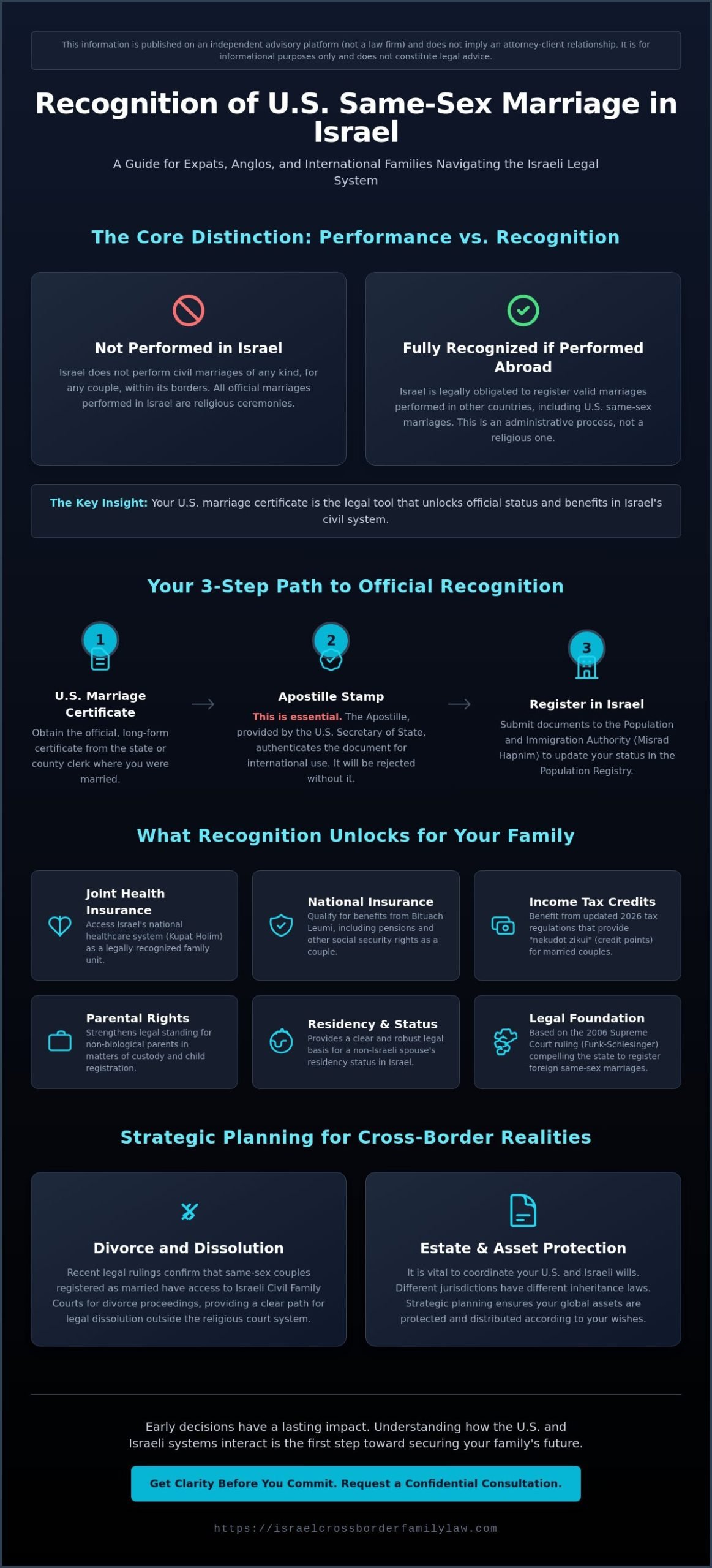
Israel’s legal landscape for couples is distinct and often confusing for those arriving from the United States. While the state does not perform civil marriages of any kind within its borders, it maintains a long-standing obligation to register valid marriages performed abroad. This creates a specific pathway for the recognition of us same-sex marriage in israel. The process isn’t a declaration of religious validity; instead, it is an administrative registration that updates your status in the national Population Registry. For many international families, a US marriage certificate serves as the primary legal tool to unlock residency rights and social benefits.
To better understand this concept, watch this helpful video:
The Role of the Supreme Court and Recent Precedents
The legal basis for this recognition stems from decades of litigation in the High Court of Justice (Bagatz). In 2006, the landmark The Legal Framework: Performance vs. Recognition in Israel established that the Ministry of Interior cannot refuse to register same-sex marriages performed legally in other jurisdictions. The ‘Funk-Schlesinger’ precedent remains fundamentally relevant in 2026 as it continues to prevent administrative barriers for families seeking to formalize their status after moving from the US. This ruling effectively forced a shift from treating couples as ‘unregistered cohabitants’ to recognizing them as ‘married’ in the official civil registry.
Why the Distinction Matters for International Families
You must understand that being registered as married in the Population Registry does not mean you are married under religious law. This distinction is critical because religious courts in IL still hold exclusive jurisdiction over certain aspects of family life for specific communities. However, for expats and foreign nationals, the registry status is what determines your eligibility for tax credits, health care, and National Insurance benefits. Relying on administrative recognition allows families to bypass religious restrictions while securing their civil rights.
Early planning is essential when managing these cross-border complexities. Different jurisdictions handle assets and custody differently, making it vital to align your US legal documents with Israeli requirements. Get clarity before you commit. Request a confidential consultation.
This article is published on an independent advisory platform (not a law firm) and does not imply an attorney-client relationship.
Registering Your US Marriage with the Population Registry
Moving from the legal theory of recognition to practical registration requires a meticulous approach to documentation. The recognition of us same-sex marriage in israel is an administrative procedure conducted through the Population and Immigration Authority, often referred to as Misrad Hapnim. This process does not involve a government fee for the registration itself, but it does require a specific set of authenticated documents that meet international standards. Your US marriage certificate is the foundation of this application, and it must be the official version issued by the relevant state or county clerk.
The most critical step in this chain is obtaining an Apostille. This is a specialized stamp provided by the Secretary of State in the jurisdiction where you were married. It serves as global proof that your document is legitimate. Without it, the Israeli authorities will not accept the certificate, regardless of how official it looks. While many offices in Israel now accept documents in English, you should be prepared for the possibility that a notarized Hebrew translation may be requested to finalize the file. Once your documents are ready, you must schedule an appointment through the central government system to present your case in person.
Essential Documentation Checklist
- Authenticated Certificate: The original US marriage certificate accompanied by a state-level Apostille stamp.
- Identification: Valid US and IL passports for both spouses; ensure they have at least six months of validity remaining.
- Center of Life: For those who are not new Olim, the Ministry may request proof that your primary residence is in Israel, such as rental agreements or utility bills.
Common Bureaucratic Hurdles and How to Avoid Them
Bureaucratic friction often arises when there is a significant gap between the wedding date and the registration date. This “delayed registration” can sometimes trigger additional scrutiny from clerks who are trained to look for inconsistencies. In some instances, the Ministry of Interior might request “proof of sincerity,” asking for photos or correspondence to demonstrate that the relationship is genuine. This is why the recognition of us same-sex marriage in israel is best handled shortly after arrival or marriage. Understanding the Rights and Benefits of Recognized Same-Sex Couples can help you prepare for these interviews with confidence.
Small errors in paperwork can lead to months of delays in securing your status. It’s always prudent to review your file for consistency before your appointment. If you find the requirements confusing, it may be helpful to seek professional clarity regarding your specific situation. Get clarity before you commit. Request a confidential consultation.
This article is published on an independent advisory platform (not a law firm) and does not imply an attorney-client relationship.
Rights and Benefits of Recognized Same-Sex Couples
Once you have completed the administrative process of Registering Your US Marriage with the Population Registry, your status as a married couple is formally established for most civil authorities. This change is not merely symbolic. It triggers a suite of economic and social protections that are essential for long-term stability. The recognition of us same-sex marriage in israel ensures that international families can access the same tax benefits and health insurance coverage as any other married couple in the country. For example, in 2026, the value of a single income tax credit point (Nikudot Zikuy) is 2,904 NIS per year, or 242 NIS per month. Registered spouses often find that these credits significantly reduce their monthly tax burden.
Social security benefits through Bituach Leumi also become accessible. Under 2026 regulations, an individual receiving a basic old-age pension of 1,838 NIS may receive an additional increment of 924 NIS for a spouse who does not receive their own benefit, bringing the couple’s total to 2,762 NIS. These financial safeguards extend to pension survivor benefits and inheritance rights. Under the Israeli Succession Law, a recognized spouse is entitled to inherit their partner’s estate even in the absence of a will. This recognition also facilitates joint mortgage applications, allowing couples to pool their resources and access government housing subsidies that are often restricted to individuals.
Economic and Social Advantages in 2026
Beyond federal benefits, registration impacts your daily cost of living in IL. Many municipalities offer Arnona (municipal tax) discounts based on household income and family status, which are easier to claim when your marriage is registered. In the workplace, recognized couples enjoy equal access to parental leave and bereavement leave. It is vital to remember that under IL law, there is a legal presumption that assets acquired during the marriage are owned jointly by both partners regardless of whose name is on the title. This presumption provides a layer of security, but it also underscores the need for clear financial agreements for expats and foreign nationals who hold assets in multiple countries.
The Boundaries of Recognition
While civil recognition is comprehensive, it does not bridge the gap into the religious sphere. Israel still does not permit the performance of same-sex marriages within its borders. This means that while your US union is recognized, you cannot hold a civil or religious wedding in IL that carries legal weight. This tension also appears in personal status matters, such as religious burial or certain proceedings that remain under the shadow of religious law. Understanding these boundaries is part of a sound risk-based strategy for any family. Get clarity before you commit. Request a confidential consultation.
This article is published on an independent advisory platform (not a law firm) and does not imply an attorney-client relationship.
Cross-Border Divorce and Parental Rights: The New Reality
The legal landscape for same-sex couples in Israel has evolved beyond simple registration. While the administrative recognition of us same-sex marriage in israel provides immediate status, families must also consider the long-term implications of divorce and parentage. A 2024 landmark ruling fundamentally changed how the legal system approaches these unions. It moved the process away from a cumbersome “marriage dissolution” toward formal divorce proceedings in civil Family Courts. This change ensures that couples have access to a secular jurisdiction, providing much-needed clarity on matters of international custody and relocation.
Navigating Divorce for US-IL Couples
For international families, the shift to secular jurisdiction is a significant relief. Historically, the lack of a clear divorce path created legal limbo for couples who no longer lived together. Today, the Family Court handles these cases using a civil framework rather than religious law. This is particularly important for cross-border cases where one spouse may wish to return to the US. The court typically adopts a “no-fault” approach, focusing on the equitable distribution of assets and the best interests of any children involved. If you are facing these challenges, understanding divorce and separation for international families is the first step toward a stable transition.
Securing Parental Rights Across Borders
Parental recognition remains one of the most complex areas for families moving between the US and IL. Even if a child is born in the US and has both parents listed on a US birth certificate, the Israeli Population Authority does not always grant automatic recognition to the non-biological parent. This creates a “legal parentage gap” that can affect everything from medical decisions to inheritance. Families generally have two paths to bridge this gap: a second-parent adoption or a judicial “Parental Order.”
- Parental Orders: These are often faster than adoption and establish a legal bond based on the shared intent to parent from the moment of birth.
- US Birth Certificates: While essential, these documents are treated as evidence of parentage rather than an absolute legal determination in IL.
- Risk Management: Early legal strategy is vital to ensure that both parents have equal rights in both jurisdictions.
To see how these orders work in practice, you can find detailed explanations on the “IsraelFamilyLaw” YouTube channel. Addressing these issues before a crisis occurs is the best way to protect your children’s future. If you are navigating these shifts, you may want to discuss your family’s specific needs to ensure your parental status is secure. Get clarity before you commit. Request a confidential consultation.
This article is published on an independent advisory platform (not a law firm) and does not imply an attorney-client relationship.
Strategic Legal Planning for International Families
Strategic legal planning is the final, essential step for couples navigating the recognition of us same-sex marriage in israel. While administrative registration provides immediate social and tax benefits, it doesn’t automatically protect your global assets or ensure your estate plan functions across borders. International families often face a complex web of conflicting laws that can lead to unintended consequences during a divorce or the passing of a spouse. Adopting a risk-based approach allows you to identify these gaps early and build a legal bridge that spans both jurisdictions. This proactive strategy is vital for those who hold property or accounts in multiple countries.
Financial Agreements and Asset Protection
Many couples believe a standard US prenuptial agreement is sufficient to protect their interests. However, in Israel, financial agreements often require a specific judicial validation known as an ‘Ishur’ to be fully enforceable in a Family Court. This is particularly relevant when you own real estate in IL while maintaining retirement accounts or equity in the US. Without this local validation, the legal presumption of joint assets could apply to property you intended to keep separate. Managing these differences requires a nuanced understanding of how each system views marital property. You can request a Confidential Case Review to discuss a strategy for your specific assets.
Building a Cross-Border Legal Bridge
Coordinating your US and IL wills is equally important for long-term security. The Israeli Succession Law has strict formal requirements that a US estate plan might not meet, potentially complicating the inheritance process for your survivors. Working with multi-qualified practitioners ensures that your documents ‘speak’ to both legal systems, preventing a situation where your US assets are distributed according to one set of rules while your IL assets follow another. This coordination mitigates the risk of conflicting jurisdictional rulings that can drain an estate through prolonged litigation.
The recognition of us same-sex marriage in israel makes you a legal heir under IL law, but a clear, cross-border plan is what provides true peace of mind. It’s important to seek clarity on how your early decisions will impact your family’s future before you finalize a move or a major purchase. Legal services are only provided by licensed attorneys under a separate engagement. Get clarity before you commit. Request a confidential consultation.
This article is published on an independent advisory platform (not a law firm) and does not imply an attorney-client relationship.
Securing Your Family’s Legal Future in Israel
The recognition of us same-sex marriage in israel provides a vital foundation for your civil rights, yet administrative registration is only the beginning of a secure legal journey. Successful relocation and long-term stability depend on understanding the nuances of the Israeli legal system, from securing parental orders to validating financial agreements for global assets. By adopting a strategic, risk-based approach, you can bridge the gap between US and IL jurisdictions and protect your family’s most important interests.
Our expertise in US-Israel cross-border family law is specifically tailored to the unique needs of international families and expats. We focus on providing the clarity you need to make informed decisions about your assets, your children, and your legacy. Early planning remains the most effective way to manage the inherent complexity of a life lived across borders. Legal services are only provided by licensed attorneys under a separate engagement.
Get clarity before you commit. Request a confidential consultation. We look forward to helping you build a secure and predictable legal path in your home in Israel.
This article is published on an independent advisory platform (not a law firm) and does not imply an attorney-client relationship.
Frequently Asked Questions
Is a US same-sex marriage certificate automatically valid in Israel?
A US same-sex marriage certificate is not automatically valid; you must first register it with the Population and Immigration Authority. The recognition of us same-sex marriage in israel is an administrative act that requires an original certificate authenticated by a state-level Apostille stamp. Once you complete this registration, your status is updated in the civil registry. This step is necessary for accessing government services, residency rights, and official documentation.
Can we get divorced in Israel if we were married in the US?
Yes, same-sex couples married in the US can now divorce through the Israeli Family Court system. Following a 2024 landmark ruling, these proceedings are handled by secular civil courts rather than religious ones. This change provides a clear path for the dissolution of the union. It ensures that matters like asset division and custody are managed under a modern legal framework that respects the needs of international families.
How do we register our children’s birth if we used a surrogate in the US?
Registering children born via surrogacy in the US requires a specific legal process in Israel, such as a Parental Order or a second-parent adoption. While your US birth certificate is a critical piece of evidence, Israeli authorities often require a judicial determination to establish the legal bond for the non-biological parent. It’s vital to address this early to avoid gaps in parental rights when moving between different legal jurisdictions.
Do same-sex couples receive the same tax breaks as opposite-sex couples in Israel?
Once your union is formally registered, you are entitled to the same income tax credit points as any other married couple. In 2026, each credit point is worth 2,904 NIS annually, which can significantly reduce your household tax burden. These benefits are part of the broader recognition of us same-sex marriage in israel and help provide economic parity for expats and international families living in IL.
What happens to our Israeli assets if one spouse is not an Israeli citizen?
Israeli assets are generally subject to the Succession Law, which recognizes registered spouses regardless of their citizenship status. However, if one spouse is not a citizen, the probate process can become more complex due to cross-border tax implications. Strategic planning is essential in these cases. Using financial agreements can help protect these assets and ensure a smoother transition for the surviving partner during the inheritance process.
Can a religious court interfere with our secular marriage registration?
Religious courts do not have the authority to interfere with or cancel your administrative registration at the Population Registry. The recognition of your marriage is a civil matter governed by Supreme Court precedents. While religious bodies may not recognize the union for their own ritual purposes, they cannot remove your “married” status from the state’s official civil records or block your access to civil benefits.
Do we need a separate Israeli will if we already have a US will?
You should strongly consider an Israeli will even if you already possess a comprehensive US estate plan. The Israeli Succession Law has specific formal requirements that may differ from those in your home state. Having a local will ensures that your assets in IL, such as real estate or local bank accounts, are distributed according to your wishes without the need for a lengthy foreign probate verification process.
Is there a difference between ‘Common Law’ (Yadua B’Tzibur) and registered marriage?
Registered marriage provides a more immediate and formal legal status than being “Common Law” (Yadua B’Tzibur). While common-law partners do enjoy many rights in Israel, they often have to provide extensive proof of their shared life to various government agencies. Registration through a US marriage certificate bypasses these bureaucratic hurdles. It offers a clearer and more predictable path to securing social and economic benefits for your family.

Article by
Gabriel Lior
A Personal Journey That Became a Mission
The advisory was founded by an American father Gabriel Lior, LLB, MBA , global entrepreneur, and cross-border advisor who spent more than a decade navigating the Israeli family court system firsthand and now lives in Singapore with his son.
As a divorced parent in a cross-border family, Gabriel faced nearly every legal challenge a foreign parent can encounter in Israel — including child custody disputes, child support proceedings, property matters in Israel and abroad, false accusations, and complex immigration and relocation proceedings.
Over the years, he learned the hard way how difficult it is for non-Israeli parents to understand the system, identify the right legal strategy, and choose the right legal representation — especially when language, culture, and jurisdictional differences are involved. He also witnessed how foreign parents and new immigrants are often disadvantaged or taken advantage of by service providers and institutions simply because they lack local knowledge or fluency.
From Client to Advisor
To truly understand — and survive — the system, Gabriel pursued formal legal education in Israel, completing two Israeli law degrees, alongside a BA and MBA earned in the United States. This was never about becoming a practicing attorney, but about gaining a deep, structural understanding of how the system works — and where it breaks down for foreign parents.
This rare combination of:
Firsthand client experience
Israeli legal and US business education
International business and negotiation training
Decades of commercial execution
created a unique perspective – one that understands both sides of the table.
After years of litigation, persistence, and at times self-representation, he ultimately succeeded in securing custody of his son and relocating abroad through a rare legal victory in the Israeli Supreme Court — becoming one of the first fathers in Israel to do so under these circumstances.
Disclaimer
Important Disclaimer:
The information provided on this website and in its content is for general informational and educational purposes only and does not constitute legal advice, legal opinion, or legal representation.
Gabriel Lior is not licensed to practice law in Israel (nor is he interested in doing so) and does not provide legal services, despite having completed 2 Law Degrees. The services offered are advisory in nature and are intended to provide general guidance, strategic insight, and information regarding cross-border family law considerations.
No attorney-client relationship is formed by accessing this website, reading its content, or communicating with us.
Any decisions made based on this information are at your own discretion and risk. For legal advice specific to your situation, you should consult a licensed attorney in the relevant jurisdiction.
Where appropriate, we may refer clients to independent, licensed attorneys or professionals. Such referrals do not constitute legal representation and no liability is assumed for services provided by third parties.