This article is published on an independent advisory platform, not a law firm. The information provided is for educational purposes only and does not constitute legal representation or an attorney-client relationship. Legal services are only provided by licensed attorneys under a separate engagement.
Many parents mistakenly believe that having primary custody grants them the unilateral right to relocate their children to another country. However, the answer to the question “Can a Parent Move a Child Abroad From Israel?” is determined by a court-governed process that requires a comprehensive life-plan for the child. Moving a child without written consent or a court order is a breach of law that can lead to immediate legal action under the Hague Convention. It is natural to feel anxious about the Israeli legal system or the fear of being accused of abduction during such a transition.
This guide provides the clarity you need to understand the legal requirements and the “Best Interests” standard used by Israeli courts. You’ll learn how to approach negotiations with the other parent and how to build a strategic case if consensus isn’t possible. We will preview the roadmap for navigating these multi-jurisdictional complexities safely. Get clarity before you commit. Request a confidential consultation. You can also find helpful information on the Israel Family Law YouTube channel.
Key Takeaways
- Note that this article is published on an independent advisory platform (not a law firm) and explains how the Legal Capacity and Guardianship Law governs child relocation from IL.
- Learn why “Tovat HaYeled” (the Best Interests of the Child) is the paramount standard that prioritizes the child’s welfare over a parent’s career or personal desires.
- Discover the roadmap for seeking legal approval, including the process of negotiating a Relocation Agreement and filing a formal claim in the Family Court.
- Gain clarity on the Hague Convention and the legal risks of “wrongful removal” when asking: Can a Parent Move a Child Abroad From Israel?
- Identify how early decisions and informal communications can impact your legal case and why strategic clarity is essential before making international commitments.
This article is published on an independent advisory platform (not a law firm) and must not imply an attorney-client relationship.
Understanding Israeli Relocation Law and Parental Guardianship
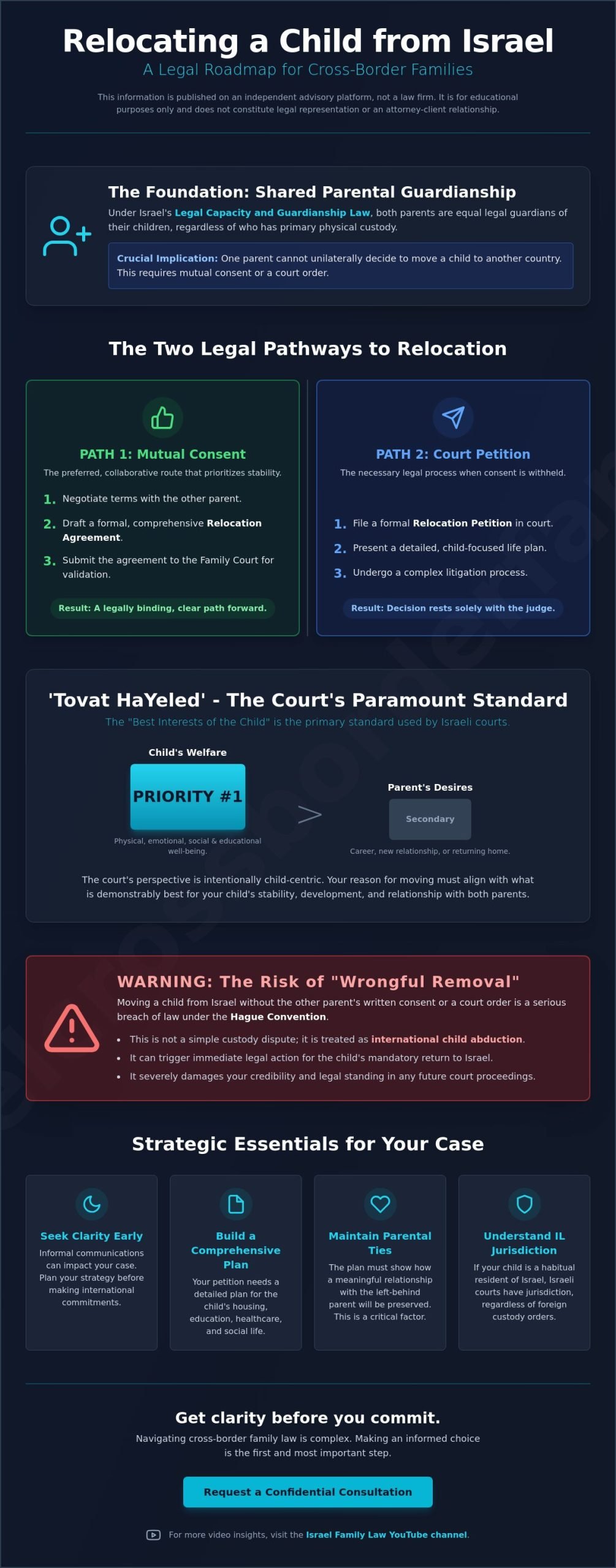
The legal framework governing child relocation in IL is the Legal Capacity and Guardianship Law. This statute establishes that both parents are the natural guardians of their children. This status remains intact regardless of which parent has primary physical custody or how the daily care is divided. Guardianship includes the right and duty to determine a child’s place of residence. Because this is a shared legal responsibility, one parent cannot unilaterally decide to move a child to another country. When asking, “Can a Parent Move a Child Abroad From Israel?”, the answer is rooted in the requirement for mutual cooperation between guardians. For many international families, this shared authority can feel restrictive, but it’s designed to protect the child’s stability.
To better understand this concept, watch this helpful video:
The Requirement for Mutual Consent
Courts in IL prioritize the “Status Quo” principle. This means they generally prefer to maintain the child’s current living environment unless a compelling reason for change exists. Relocation is viewed as a significant disruption to this stability. Under the Hague Convention on the Civil Aspects of International Child Abduction, moving a child without the express written consent of the other guardian is often classified as a wrongful removal. Joint guardianship functions as a safeguard, ensuring that cross-border moves are handled with transparency and legal oversight. Even if you have a foreign custody order, the IL court system will apply its own standards if the child is a habitual resident of IL.
When Consent is Withheld
If a parent refuses to sign a relocation agreement, the parent wishing to move must seek judicial intervention. You’ll need to file a formal Relocation Petition in the Israeli Family Court. This is a complex litigation process where the court evaluates the proposed move in detail. For families navigating international custody and relocation, success depends on presenting a structured plan that addresses the child’s educational, social, and emotional needs in the new country. The court won’t grant permission lightly. It will scrutinize the motives for the move and the feasibility of maintaining a relationship with the left-behind parent. Strategy and early preparation are vital to demonstrate that the move is a necessity rather than a personal preference.
This article is published on an independent advisory platform (not a law firm) and must not imply an attorney-client relationship.
How Israeli Courts Define the ‘Best Interests of the Child’
In the Israeli legal system, the central doctrine for any decision regarding a minor is ‘Tovat HaYeled’, or the Best Interests of the Child. This standard isn’t just a guideline; it’s the paramount consideration that overrides all other factors. When a judge considers the question, “Can a Parent Move a Child Abroad From Israel?”, they look specifically at how the move impacts the child’s physical, emotional, and developmental welfare. The court’s perspective is intentionally child-centric. This means that a parent’s career advancement, financial gain, or personal desire to return to their home country is secondary to the child’s needs. Historically, the ‘Presumption of the Tender Years’ suggested that children under six should remain with their mother, but this doctrine is evolving as IL courts increasingly recognize the vital role of both parents in a child’s life.
The complexity of these cases often involves international standards and multi-jurisdictional oversight. For families coming from the United States, reviewing U.S. State Department guidance on child abduction in Israel can provide helpful context on how different governments view these cross-border jurisdictional overlaps and the legal expectations placed on relocating parents.
Factors Evaluated by the Family Court
The Family Court doesn’t make decisions in a vacuum. Judges rely on professional evaluations, often from court-appointed social workers or psychologists. They examine several key factors to determine if a move is appropriate:
- The Bond Quality: The depth and quality of the child’s relationship with the parent who is staying in IL.
- The Relocation Plan: The specificity of the plan, including confirmed schooling, housing, and a support network of family or friends in the destination country.
- Child Maturity: The child’s age and maturity level. In many cases, children over the age of ten may have their own wishes heard by the court in a sensitive, private setting.
The Contact Plan: Maintaining the Bond
A successful relocation petition must include a robust contact plan. The court is naturally skeptical of any move that effectively severs the bond between the child and the non-relocating parent. You must demonstrate exactly how the child will maintain a meaningful relationship across borders. This plan should include scheduled digital communication, a clear schedule for long-distance visitation during summer breaks and holidays, and logistical arrangements for travel. Building a strategy that prioritizes this connection is essential for judicial approval. If you are unsure how to structure these arrangements, you may want to request a confidential case review to explore your strategic options.
This article is published on an independent advisory platform (not a law firm) and must not imply an attorney-client relationship.
The Legal Process for Seeking Relocation Approval
The journey toward legal relocation is a structured and often lengthy sequence. It begins with Step 1: attempting mediation or negotiation. Parents are strongly encouraged to reach a “Relocation Agreement” that settles every detail of the move, from travel costs to holiday schedules. If a consensus cannot be reached, Step 2 involves filing a formal Relocation Claim in the appropriate Israeli Family Court. This action transitions the decision-making power from the parents to the judiciary. Step 3 is the appointment of a court expert, typically a psychologist or social worker, who conducts an intensive evaluation of the family dynamics. Step 4 is the submission of the “Teskir,” or Social Services Report. This document carries significant weight and frequently dictates the direction of the judge’s final decision. Finally, Step 5 concludes with the final hearing and the issuance of a court order that either allows or denies the move.
Understanding these steps is vital for anyone asking, “Can a Parent Move a Child Abroad From Israel?” Success in these cases is rarely about a single emotional argument. It’s about a sustained legal strategy that respects the court’s procedural requirements and demonstrates a commitment to the child’s long-term stability.
The Role of Court-Appointed Experts
Judges in IL are legal experts, but they aren’t child development specialists. They rely on court-appointed psychologists to determine the child’s emotional needs and the potential impact of a cross-border move. During the evaluation, the expert will interview both parents and the children. They look for signs of parental alienation or whether the move is motivated by a desire to distance the child from the other parent. Transparency is essential during these interviews. Cooperating with the expert and providing honest, child-focused answers is the best way to ensure a fair report. Any attempt to manipulate the expert usually backfires when the behavior is identified in the final written report.
Timelines and Procedural Expectations
Relocation litigation is not a fast process. It often takes 12 to 24 months to reach a final decision. This duration is due to the time required for expert evaluations and the court’s crowded docket. Many parents ask for “Temporary Orders” to move before the case concludes. However, courts rarely grant these for permanent moves. They don’t want to create a new “status quo” before the full facts are examined. You should prepare for a marathon rather than a sprint. For a clearer understanding of the advisory process and how to prepare for these timelines, you can see how it works. Strategy and patience are your most valuable assets during this period of uncertainty.
This article is published on an independent advisory platform (not a law firm) and must not imply an attorney-client relationship.
International Child Abduction and the Hague Convention
The 1980 Hague Convention on the Civil Aspects of International Child Abduction is the primary international treaty governing the “wrongful removal” of children across borders. In the context of Israeli law, wrongful removal occurs when a parent takes a child out of the country without the consent of the other guardian or a court order. Many parents assume that because they are the primary caregiver, they can decide where the child lives. However, the answer to the question “Can a Parent Move a Child Abroad From Israel?” is strictly regulated by this treaty. Taking a child abroad without legal authorization is considered abduction, even if the parent believes they are acting in the child’s interest. IL is a committed signatory to this convention and maintains a sophisticated legal infrastructure to enforce its protocols.
The core mechanism of the Hague Convention is the “Prompt Return” mandate. This means that if a child is wrongfully removed, the court in the destination country is generally required to order the child’s immediate return to their place of habitual residence. There are very limited defenses against a return order. The most common is the “Grave Risk” defense, which requires clear evidence that returning the child would expose them to physical or psychological harm. These defenses are interpreted narrowly by courts to ensure the treaty’s primary goal of deterrence remains effective. IL courts work closely with the Ministry of Justice to process these cases with the urgency they require.
The Risks of ‘Self-Help’ Relocation
Attempting a “self-help” relocation by leaving IL without permission carries severe legal and criminal risks. Beyond the immediate threat of a Hague Convention return application, such actions can lead to criminal charges for kidnapping. From a strategic perspective, an abduction claim can permanently damage a parent’s standing in future custody hearings. Judges view unauthorized removal as a fundamental breach of trust and a failure to respect the child’s right to a relationship with both parents. To understand the specific risks and legal consequences associated with these actions, you can review more on Hague Convention & Child Abduction.
Preventative Measures for the ‘Left-Behind’ Parent
If a parent fears that the other parent might remove a child without consent, there are preventative legal tools available. The most common is the “Stay of Exit” (Delay Itzi’a) order. This court order prevents the child from leaving IL through any border crossing or airport until the order is lifted. It is also possible to monitor a child’s passport status and notify the Central Authority at the Ministry of Justice if an unauthorized move is suspected. Acting immediately is critical. If you are concerned about the possibility of unauthorized removal, you should seek professional guidance immediately to secure your child’s residence and protect your parental rights.
This article is published on an independent advisory platform (not a law firm) and must not imply an attorney-client relationship.
Strategic Considerations for Cross-Border Families
Before you make any life-changing commitments, seek total clarity on your legal standing. Many parents move forward based on emotion or a sense of fairness. However, a risk-based decision-making approach is much safer. Every action you take in the early stages matters. Your initial emails, text messages, and even casual conversations can be presented to a judge as evidence of your true intentions. These early records often reveal whether a parent is genuinely acting in the child’s interest or simply trying to win a dispute. When considering “Can a Parent Move a Child Abroad From Israel?”, you must treat the process as a strategic operation rather than a personal right. For visual insights on these complexities, visit the Israel Family Law YouTube channel.
Developing a Comprehensive Relocation Plan
A court will expect a comprehensive relocation plan that leaves no room for ambiguity. You must document the specific benefits the move offers the child. This includes identifying specific schools, housing arrangements, and the presence of a social support network like grandparents or cousins. Proving financial stability is equally essential. You should be prepared to show job offers or a clear path to employment in the destination country. Finally, draft a communication schedule that is both realistic and generous. Demonstrating a sincere desire to facilitate the other parent’s relationship with the child is often the deciding factor in relocation approval. A plan that appears to isolate the child will likely face significant judicial skepticism.
Navigating Cultural and Legal Differences
Differences between legal cultures are often a major hurdle for international families. US and IL custody norms sometimes conflict, particularly regarding how guardianship is exercised on a daily basis. Bridging this gap requires a nuanced understanding of both systems. This is where cross-cultural practitioners provide immense value. They understand the “Best Interests” standard in the Israeli context while respecting the cultural background of the family. Approaching the question “Can a Parent Move a Child Abroad From Israel?” with this dual perspective helps you avoid common pitfalls that arise from simple misunderstandings of local law. Get clarity before you commit. Request a confidential consultation.
This article is published on an independent advisory platform (not a law firm) and must not imply an attorney-client relationship.
Securing a Strategic Path for Your International Family
Navigating the intersection of two distinct legal systems requires more than just hope; it demands a calculated strategy. As discussed, the question “Can a Parent Move a Child Abroad From Israel?” is answered by a judge’s evaluation of stability and the child’s long-term welfare. Success depends on moving beyond emotional arguments toward a risk-based decision-making framework that respects the “Best Interests” standard. Early choices regarding communication and documentation will define the trajectory of your case in the Israeli Family Court. Missteps in these early stages can have lasting consequences on your parental standing.
Our advisory focuses on the specific complexities of US-Israel jurisdiction. We work with practitioners who are licensed in multiple legal systems to bridge cultural and procedural gaps. This expertise ensures that your relocation plan is robust enough to withstand judicial scrutiny. By prioritizing a strategic approach, you protect your rights and your child’s future. Get clarity before you commit. Request a confidential consultation. You can move forward with confidence when you have a clear roadmap for your family’s transition.
This article is published on an independent advisory platform (not a law firm) and must not imply an attorney-client relationship.
Frequently Asked Questions
Can I move my child abroad if I have ‘sole custody’ in Israel?
Having ‘sole custody’ does not grant you the right to relocate without consent. Under the Legal Capacity and Guardianship Law, both parents remain natural guardians regardless of the daily care arrangements. This means decisions about residence require mutual cooperation. If you are asking, “Can a Parent Move a Child Abroad From Israel?” without the other guardian’s approval, the answer is no. You must obtain either a signed agreement or a specific court order.
What happens if I take my child out of Israel without the other parent’s consent?
Removing a child without legal authorization is classified as international child abduction under IL law. This triggers the Hague Convention, which requires the prompt return of the child to their place of habitual residence. Beyond the civil return process, you may face criminal charges and a permanent loss of credibility in future custody hearings. Acting without consent creates a significant legal risk that often results in the court forcing the child’s return.
Does the child’s age affect the court’s decision to allow relocation?
Yes, the child’s age is a critical factor in the court’s evaluation. While younger children are viewed through the lens of developmental stability, older children, typically aged 10 or above, may have their wishes heard by the judge. The court balances the child’s expressed desires with their maturity level. A teenager’s preference to move or stay often carries more weight than that of a younger child, though the “Best Interests” standard remains the final guide.
How long does a relocation court case typically take in Israel?
A relocation case in IL typically takes between 12 and 24 months to conclude. This timeline accounts for the mandatory expert evaluations, social services reports, and the scheduling of multiple hearings. Because the court prioritizes a thorough investigation over speed, parents should not expect a quick resolution. Temporary orders for relocation are rarely granted, as the court prefers to maintain the status quo until a final decision is reached through the full litigation process.
What is a ‘Stay of Exit’ order and how does it work?
A ‘Stay of Exit’ order, known as Delay Itzi’a, is a preventative measure that stops a child from leaving the country. It is registered with border control and the airport authorities to prevent unauthorized removal from IL. These orders are common in high-conflict cases where there is a credible fear of abduction. To lift the order for a vacation or move, the parent must usually provide a financial guarantee or obtain the other parent’s formal consent.
Can the court prevent me from moving if I am the primary caregiver?
The court can prevent a primary caregiver from moving if the move is not deemed to be in the child’s best interests. Being the main provider of daily care does not override the child’s right to maintain a meaningful relationship with the other parent. If the court determines that relocation would effectively sever the bond with the parent staying in IL, the petition is likely to be denied regardless of the caregiver’s personal or professional needs.
What are the chances of winning a relocation case in the Israeli Family Court?
Success in a relocation case depends entirely on the strength of your strategic plan and the quality of the proposed contact arrangement. When exploring “Can a Parent Move a Child Abroad From Israel?”, remember that there is no fixed percentage for success. Cases with a detailed educational and housing plan tend to fare better. The court looks favorably on parents who demonstrate a genuine willingness to facilitate long-distance visitation through a balanced contact schedule.
Do I need a lawyer if the other parent agrees to the move in writing?
While a lawyer is not strictly required if you both agree, it is essential to have a professional draft a formal Relocation Agreement. This document must be ratified by the Family Court to be legally binding and enforceable. A simple handwritten note is often insufficient to protect your rights in a cross-border context. Ensuring the agreement meets IL legal standards prevents future jurisdictional conflicts and provides the clarity needed for a smooth transition.

Article by
Gabriel Lior
A Personal Journey That Became a Mission
The advisory was founded by an American father Gabriel Lior, LLB, MBA , global entrepreneur, and cross-border advisor who spent more than a decade navigating the Israeli family court system firsthand and now lives in Singapore with his son.
As a divorced parent in a cross-border family, Gabriel faced nearly every legal challenge a foreign parent can encounter in Israel — including child custody disputes, child support proceedings, property matters in Israel and abroad, false accusations, and complex immigration and relocation proceedings.
Over the years, he learned the hard way how difficult it is for non-Israeli parents to understand the system, identify the right legal strategy, and choose the right legal representation — especially when language, culture, and jurisdictional differences are involved. He also witnessed how foreign parents and new immigrants are often disadvantaged or taken advantage of by service providers and institutions simply because they lack local knowledge or fluency.
From Client to Advisor
To truly understand — and survive — the system, Gabriel pursued formal legal education in Israel, completing two Israeli law degrees, alongside a BA and MBA earned in the United States. This was never about becoming a practicing attorney, but about gaining a deep, structural understanding of how the system works — and where it breaks down for foreign parents.
This rare combination of:
Firsthand client experience
Israeli legal and US business education
International business and negotiation training
Decades of commercial execution
created a unique perspective – one that understands both sides of the table.
After years of litigation, persistence, and at times self-representation, he ultimately succeeded in securing custody of his son and relocating abroad through a rare legal victory in the Israeli Supreme Court — becoming one of the first fathers in Israel to do so under these circumstances.
Disclaimer
Important Disclaimer:
The information provided on this website and in its content is for general informational and educational purposes only and does not constitute legal advice, legal opinion, or legal representation.
Gabriel Lior is not licensed to practice law in Israel (nor is he interested in doing so) and does not provide legal services, despite having completed 2 Law Degrees. The services offered are advisory in nature and are intended to provide general guidance, strategic insight, and information regarding cross-border family law considerations.
No attorney-client relationship is formed by accessing this website, reading its content, or communicating with us.
Any decisions made based on this information are at your own discretion and risk. For legal advice specific to your situation, you should consult a licensed attorney in the relevant jurisdiction.
Where appropriate, we may refer clients to independent, licensed attorneys or professionals. Such referrals do not constitute legal representation and no liability is assumed for services provided by third parties.