What if your civil divorce decree is finalized in London or New York, but your religious community still considers you married? It’s a distressing reality for many international Jewish families who find themselves caught between secular laws and the requirements of the Beth Din. When your life spans multiple countries, the risk of becoming an “Aguna,” or a chained spouse, becomes a very real concern. Engaging an experienced jewish divorce solicitor is the most effective way to align these two distinct legal worlds and ensure your religious status is protected.
We understand the anxiety caused by the “race of authorities” in IL and the confusion over whether a foreign decree will be recognized by religious courts. This guide explains how a specialized legal strategy manages the Get process alongside international civil proceedings to secure your future. You’ll learn how to obtain a valid religious divorce while protecting your assets and parental rights across borders. This content is published on an independent advisory platform, not a law firm, and is intended for informational purposes rather than formal legal advice or the establishment of an attorney-client relationship.
Key Takeaways
- Understand how a legal professional bridges the gap between religious tradition and secular law to ensure your divorce is valid in all relevant jurisdictions.
- Learn to navigate the complexities of the “race for jurisdiction” between Israeli Family Courts and Rabbinical Courts to protect your assets and parental rights.
- Identify the specific qualifications required for a jewish divorce solicitor to manage cross-border cases involving US civil decrees and the requirements of the Beth Din.
- Discover proactive strategies to address the risk of “Get” refusal and prevent the long-term legal limbo of a limping marriage.
- Gain insight into a risk-based advisory approach that prioritizes long-term stability and cultural nuance for international families.
What is a Jewish Divorce Solicitor and Why is Specialization Vital?
A jewish divorce solicitor acts as a specialized bridge between the secular legal system and the ancient requirements of Halakha, or Jewish law. While a standard family lawyer handles the division of assets and custody arrangements in civil court, a specialist manages the unique procedural and emotional complexities of the Beth Din. This role requires more than just filling out forms; it involves a deep understanding of how religious authorities interact with civil decrees. This content is published on an independent advisory platform (not a law firm) and focuses on strategy, risks, and decision-making guidance rather than an attorney-client relationship.
General family practitioners often overlook the religious timeline. They might finalize a civil divorce without securing the necessary religious documents, leaving one spouse in a state of legal limbo. A dedicated jewish divorce solicitor ensures that the religious and civil tracks move in harmony. This specialization is particularly vital for the Anglo community in Israel, where cultural expectations often clash with the rigid formalities of the Israeli Rabbinical system. Relying on a generalist can lead to significant delays or even the refusal of a religious divorce, which complicates future personal and legal standing.
The Difference Between Civil and Religious Decrees
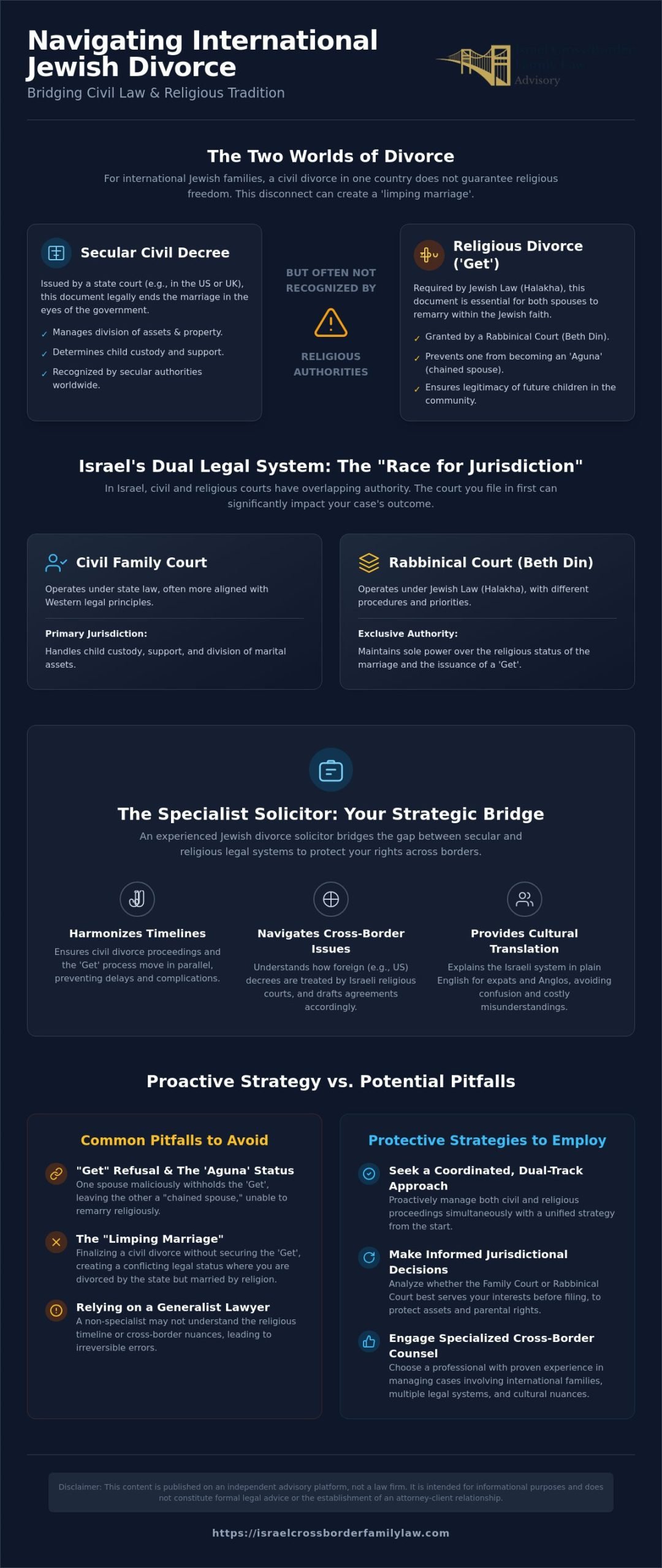
A civil divorce decree is a legal recognition by the state that a marriage has ended. However, for many Jewish couples, this document is insufficient on its own. To be truly free to remarry within the faith, a specific religious document is required. You can learn more about the requirements in this overview of What is a Get? and why it is central to the process. Failing to obtain this document can lead to severe consequences, such as being considered a “chained spouse” or being unable to have future children recognized as legitimate within the community. A solicitor’s job is to bridge this gap, ensuring the civil court’s decisions are respected by the Beth Din. Without this coordination, you risk a “limping marriage,” where you are divorced in the eyes of the state but still married under religious law.
Managing the Anglo-Israeli Legal Experience
Navigating the Israeli legal system is daunting for English speakers. The terminology is different, and the pace can feel erratic. It’s easy to feel overwhelmed by the “race of authorities” between the Family Court and the Rabbinical Court. Clear, plain English explanations are essential here. Practitioners who are licensed or have significant experience in multiple jurisdictions offer a distinct advantage for expats and foreign nationals. They understand the cultural nuances of Western communities and can translate complex religious procedures into actionable strategy. This cross-border expertise helps clients make informed decisions before they commit to a specific legal path in IL, protecting their rights in both jurisdictions simultaneously.
The Dual Process: Navigating the Rabbinical Court and Civil Jurisdictions
Divorce for Jewish couples with ties to both the United States and Israel involves managing two distinct legal tracks simultaneously. In IL, the legal landscape is divided between the civil Family Court and the religious Rabbinical Court. While both systems can handle matters like child custody and asset division, the Rabbinical Court maintains exclusive authority over the religious status of the marriage. A jewish divorce solicitor helps you decide which track serves your specific interests, as the rules of evidence and procedural priorities differ significantly between the two systems. This content is published on an independent advisory platform and focuses on strategy and risk mitigation rather than an attorney-client relationship.
For those holding a US civil divorce decree, it is a common misconception that the Israeli Beth Din will automatically recognize the marriage as dissolved. Even with a final judgment from a court in New York or California, the Rabbinical authorities in IL require a formal religious Get to update your status. A specialized jewish divorce solicitor ensures that the language in your US settlement does not inadvertently complicate your standing before the Dayanim, or Rabbinical judges. They act as your representative, translating your civil status into terms the religious court accepts and ensuring that the timing of your filings protects your future rights.
The “Race of Authorities” Explained
The “Race of Authorities” is a tactical maneuver to determine which court hears specific family matters. In Israel, the court where a valid claim is filed first generally gains the authority to rule on related issues like alimony or property division. If you wait for your spouse to file, you might find yourself litigating in a forum that is less favorable to your specific situation. For expats, delaying this decision can lead to jurisdictional trapdoors where your rights in IL are compromised before you have even begun the civil process in your home country. Understanding these risks is vital before making any formal commitments.
US-Israel Jurisdictional Conflicts
Conflicts often arise when one spouse resides in a US city while the other is in Tel Aviv or Jerusalem. This geographic split creates friction, especially when trying to enforce an Israeli Rabbinical ruling in a US civil court. While US courts generally respect international legal decisions, they may hesitate to enforce religious rulings that conflict with local public policy or due process standards. If you are managing an international relocation or have assets in both countries, the strategy you choose today will dictate your legal freedom for years to come. You may find it helpful to speak with an advisor to clarify your jurisdictional standing before taking action.
Common Pitfalls: Get Refusal and International Legal Limbo
Get refusal remains one of the most significant risks in a cross-border divorce. When one spouse refuses to participate in the religious process, it creates a “limping marriage” where the parties are civilly divorced in the US but remains religiously married in IL. This situation often leads to the status of “Aguna,” or a chained spouse, which carries severe personal and religious consequences. This content is published on an independent advisory platform and focuses on strategy and risk mitigation rather than an attorney-client relationship. Engaging a jewish divorce solicitor early in the process allows you to identify these risks before they become insurmountable barriers to your freedom.
Preventing legal limbo requires a strategy that uses civil leverage to encourage religious cooperation. International law has limited power to enforce purely religious acts, so solicitors must look to secular courts for solutions. For example, a US court may stay the final civil decree until the religious divorce is finalized, or financial settlements may be structured to incentivize the delivery of the Get. A jewish divorce solicitor understands how to weave these religious requirements into civil negotiations to ensure neither party is left without a path forward. Without this dual-track strategy, you may find yourself legally free in one country but religiously bound in another.
The “Get Clause” in Prenuptial and Postnuptial Agreements
A well-drafted agreement is the first line of defense against future refusal. However, many US-drafted “Get clauses” fail to meet the specific Halakhic standards required by the Israeli Rabbinical Court. If the language is not precise, the Dayanim in IL may view the agreement as invalid or coercive. If you are an expat or have assets in both countries, seeking guidance on an international prenuptial agreement us israel is essential. These documents must be carefully calibrated to be enforceable in both the secular courts of your home state and the religious courts in Israel.
Sanctions and Leverage in the Beth Din
The Israeli Rabbinical Court possesses unique tools to compel cooperation, such as freezing bank accounts, revoking driver’s licenses, or issuing stay-of-exit orders that prevent a spouse from leaving the country. These tools are powerful but have limited reach if the refusing spouse is located in the US. In these cases, your strategy must shift toward social and financial pressure within the local community or leveraging civil litigation in US courts. Coordinating these efforts across borders is complex, but it is often the only way to resolve a stalled religious divorce. Get clarity before you commit by requesting a confidential consultation to discuss your specific jurisdictional risks.
Criteria for Choosing the Right Solicitor for International Jewish Divorce
Selecting a jewish divorce solicitor for a cross-border case requires a professional who understands the friction between secular and religious courts. It isn’t enough to hire a local lawyer in one city and hope they can manage a case involving the Israeli Rabbinate. You need a strategist who has proven experience in both US civil statutes and the procedural requirements of the Israeli Beth Din. This content is published on an independent advisory platform and focuses on decision-making guidance rather than an attorney-client relationship. A practitioner who operates as a bridge between these systems can help you avoid the jurisdictional traps mentioned in previous sections.
Key Questions to Ask During a Consultation
- “How will you coordinate with my lawyers in the other jurisdiction to ensure our civil and religious strategies align?”
- “What is your specific experience with the Beth Din handling my Get, and how do they view foreign civil decrees?”
- “How do you handle the international custody and relocation aspects of a Jewish divorce to protect my parental rights?”
Red Flags to Avoid
Be cautious of any professional who promises a “fast” Get. The religious court operates autonomously, and no one can guarantee a specific timeline. Firms that lack a physical presence or strategic ties in both the US and Israel often struggle with the nuances of cross-border enforcement. Additionally, avoid overly aggressive tactics. While you want a strong advocate, alienating the Rabbinical judges can backfire and lead to significant delays in your religious divorce. An aggressive stance might feel satisfying in the short term, but it rarely serves your long-term interests in the Beth Din.
A calm, advisory approach that prioritizes long-term family stability is almost always more effective than a high-conflict stance. If you are unsure about your next steps, it’s wise to consult with an international family law specialist before you file any documents. This early clarity can save you years of legal frustration and ensure your status is protected in both jurisdictions simultaneously.
Strategic Decision-Making with Israel Cross Border Advisory
Israel Cross Border Law Firm acts as a strategic bridge between divergent legal systems and cultures. When you’re managing a life that spans between the US and IL, the path to a resolution isn’t always linear. A jewish divorce solicitor must look beyond the immediate conflict to consider the long-term implications of every filing. Our role is to provide the clarity you need before you make commitments in either the secular or religious courts. This content is published on an independent advisory platform and focuses on strategy, risks, and decision-making guidance rather than an attorney-client relationship.
We focus on risk mitigation rather than just “winning” a specific case. In the world of international family law, a victory in a US civil court can sometimes lead to a stalemate in the Israeli Rabbinical Court. For example, if a financial settlement is reached without securing a Get, you may find yourself legally free but religiously bound. We help expats and international families understand these differences so they can navigate the Israeli system with confidence. Seeking professional guidance from Israel Cross Border Law Firm early ensures that your decisions are based on a comprehensive understanding of both jurisdictions.
Our Approach to Complex International Divorce
Our approach prioritizes your future freedom and the stability of your family. This means coordinating complex matters like child support cross-border enforcement alongside the religious decree. By managing these parallel tracks, we provide a steady hand through one of life’s most challenging transitions. We work to ensure that your civil decree is recognized and that your religious status is fully resolved, protecting your rights across borders. Our strategy is designed to prevent the legal limbo often associated with cross-border separations.
Watch: Navigating Jewish Divorce in Israel
For a deeper understanding of these procedures, we recommend viewing the resources available on the Israel Family Law YouTube channel. These videos provide essential insights into the Rabbinical Court process and the strategic importance of timing your filings correctly. Key takeaways from the video content include the necessity of preparing for the “Race of Authorities” and the specific requirements for obtaining a Get in IL. These resources help you build a foundation of knowledge before you take formal legal action, ensuring you aren’t caught off guard by procedural differences.
Get clarity before you commit. Request a confidential case review.
Securing Your Future Across Borders
Navigating the intersection of Halakha and international civil law is a complex undertaking that requires foresight and a nuanced understanding of both systems. The successful resolution of a Jewish divorce depends on more than just standard legal paperwork; it requires a coordinated strategy that protects your religious status and your civil rights simultaneously. By engaging a specialized jewish divorce solicitor, you ensure that your transition is managed with the cultural and legal expertise necessary for the Anglo and expat communities in IL.
With decades of experience in US-Israel cross-border law and practitioners licensed in multiple jurisdictions, we provide the steady guidance needed to bridge these divergent systems. This advisory focuses on long-term family stability and risk mitigation, helping you move forward without the weight of legal uncertainty. Understanding the differences between legal cultures is the first step toward a valid Get and a secure civil decree. Making informed decisions today protects your personal freedom and your family assets for years to come.
Get clarity before you commit. Request a confidential consultation.
Frequently Asked Questions
What is the difference between a civil divorce and a Jewish divorce?
A civil divorce is a secular legal decree issued by a state court that terminates the legal contract of marriage. In contrast, a Jewish divorce requires a “Get,” which is a religious document delivered from the husband to the wife under the supervision of a Beth Din. Without a Get, the couple remains married in the eyes of religious law, even if they possess a final civil decree from a US court. This content is published on an independent advisory platform and focuses on strategy and risk mitigation rather than an attorney-client relationship.
Can an Israeli Rabbinical Court divorce a couple who married in the US?
The Israeli Rabbinical Court has the authority to divorce Jewish couples even if they were married in the US. If at least one spouse is a resident of IL or has specific ties to the country, the Rabbinical Court can exercise jurisdiction over the religious dissolution of the marriage. This is a common scenario for Anglo expats who married abroad but have since relocated their lives to Israel and need their status updated in both jurisdictions.
What happens if my spouse refuses to give or receive a Get?
If a spouse refuses to give or receive a Get, the other party may become an “Aguna,” or a chained spouse, unable to remarry religiously. In these cases, a jewish divorce solicitor uses specific legal tools, such as stay-of-exit orders or financial sanctions, to encourage cooperation. Strategy focuses on using civil leverage to resolve the religious deadlock and protect the refused spouse’s future freedom within the community.
How long does the Jewish divorce process typically take in a cross-border case?
The timeline for a cross-border Jewish divorce varies significantly based on the level of cooperation between the parties and the complexity of the civil proceedings. A straightforward case might conclude in several months, while contested matters involving international assets can take much longer. Coordinating with a jewish divorce solicitor helps manage expectations and ensures that the religious track doesn’t stall while the civil case progresses in a foreign jurisdiction.
Is a US prenuptial agreement valid in the Israeli Rabbinical Court?
A US prenuptial agreement is not automatically enforceable in the Israeli Rabbinical Court. While civil courts in IL may recognize the document, the Rabbinical Court requires specific language that adheres to Halakhic standards to validate clauses related to the Get. It’s vital to have such agreements reviewed by an advisor who understands the intersection of US state laws and Israeli religious requirements to ensure they hold weight in both systems.
Do I need two separate lawyers for the civil and religious processes?
You don’t necessarily need two separate lawyers, but you do need a practitioner who understands both civil and religious law. Many families choose to work with a specialized advisor who can coordinate with local counsel in the US while managing the Rabbinical process in IL. This integrated approach prevents conflicting strategies that could jeopardize your standing in either court system or leave you religiously bound after a civil divorce.
What is the “race of authorities” and how does it affect me?
The “race of authorities” refers to the tactical competition between the Israeli Family Court and the Rabbinical Court. The first court to receive a valid filing on a specific issue, such as property division, generally gains the authority to decide that matter. This makes the timing of your initial filing critical, as the two courts often apply different priorities and rules of evidence when determining the outcome of your case.
Can child custody be decided by the Rabbinical Court?
Child custody can be decided by the Rabbinical Court if both parents consent to its jurisdiction or if the issue is properly “wrapped” into the initial divorce claim. However, if custody is first filed in the civil Family Court, the Rabbinical Court will generally not have the authority to rule on it. This is a primary reason why seeking strategic clarity before filing any documents is essential for protecting your parental rights in IL.

Article by
Gabriel Lior
A Personal Journey That Became a Mission
The advisory was founded by an American father Gabriel Lior, LLB, MBA , global entrepreneur, and cross-border advisor who spent more than a decade navigating the Israeli family court system firsthand and now lives in Singapore with his son.
As a divorced parent in a cross-border family, Gabriel faced nearly every legal challenge a foreign parent can encounter in Israel — including child custody disputes, child support proceedings, property matters in Israel and abroad, false accusations, and complex immigration and relocation proceedings.
Over the years, he learned the hard way how difficult it is for non-Israeli parents to understand the system, identify the right legal strategy, and choose the right legal representation — especially when language, culture, and jurisdictional differences are involved. He also witnessed how foreign parents and new immigrants are often disadvantaged or taken advantage of by service providers and institutions simply because they lack local knowledge or fluency.
From Client to Advisor
To truly understand — and survive — the system, Gabriel pursued formal legal education in Israel, completing two Israeli law degrees, alongside a BA and MBA earned in the United States. This was never about becoming a practicing attorney, but about gaining a deep, structural understanding of how the system works — and where it breaks down for foreign parents.
This rare combination of:
Firsthand client experience
Israeli legal and US business education
International business and negotiation training
Decades of commercial execution
created a unique perspective – one that understands both sides of the table.
After years of litigation, persistence, and at times self-representation, he ultimately succeeded in securing custody of his son and relocating abroad through a rare legal victory in the Israeli Supreme Court — becoming one of the first fathers in Israel to do so under these circumstances.
Disclaimer
Important Disclaimer:
The information provided on this website and in its content is for general informational and educational purposes only and does not constitute legal advice, legal opinion, or legal representation.
Gabriel Lior is not licensed to practice law in Israel (nor is he interested in doing so) and does not provide legal services, despite having completed 2 Law Degrees. The services offered are advisory in nature and are intended to provide general guidance, strategic insight, and information regarding cross-border family law considerations.
No attorney-client relationship is formed by accessing this website, reading its content, or communicating with us.
Any decisions made based on this information are at your own discretion and risk. For legal advice specific to your situation, you should consult a licensed attorney in the relevant jurisdiction.
Where appropriate, we may refer clients to independent, licensed attorneys or professionals. Such referrals do not constitute legal representation and no liability is assumed for services provided by third parties.