This article is published on an independent advisory platform and is for informational purposes only. It does not constitute legal advice or establish an attorney-client relationship.
A court order from a U.S. judge is not a universal passport for your parental rights. You likely spent months securing your legal status in the United States, believing the paperwork was finished. It is natural to feel a sense of dread when you realize that moving your family to Israel might put that hard-won security at risk. Managing a second-parent adoption across borders requires more than just carrying a folder of documents. It requires a strategic approach to bridge the gap between two very different legal systems.
We understand the anxiety of facing a foreign bureaucracy like the Israeli Ministry of Interior. This guide will help you navigate the complexities of protecting your family’s future. You will learn about the Israeli government’s specific requirements, the impact of the 2023 Supreme Court ruling on adoption equality, and the streamlined Parental Order process. We provide a clear roadmap to help you achieve legal certainty and ensure your child’s security is never in question. For more detailed visual walkthroughs, visit our YouTube channel at https://www.youtube.com/@IsraelFamilyLaw. Get clarity before you commit. Request a confidential consultation.
Key Takeaways
- Learn how second-parent adoption protects non-biological parents without terminating the legal rights of the first parent.
- Understand the strategy for managing second-parent adoption across borders to ensure U.S. court orders are recognized in Israel.
- Identify the risks of “legal limbo” and how it can affect your authority over a child’s medical and educational needs.
- Discover why a “Parental Audit” of birth certificates and decrees is necessary before starting your international move.
- Gain a roadmap for navigating the Israeli Ministry of Interior’s requirements to achieve permanent legal certainty.
Understanding Second-Parent Adoption in an International Context
A second-parent adoption is a legal procedure that allows a second individual to become a child’s legal parent without terminating the rights of the first parent. This path is frequently chosen by same-sex couples, unmarried partners, or families who’ve utilized assisted reproduction. While this process provides security within a single jurisdiction, managing a second-parent adoption across borders introduces significant layers of complexity. Families often assume that a final decree from a U.S. state court carries the same weight internationally as it does at home. However, legal recognition in Israel is not automatic. There’s a distinct difference between domestic finality, where the case is closed in the U.S., and international recognition, where the Israeli government must accept the foreign order.
To better understand this concept, watch this helpful video:
Families moving between the U.S. and IL must realize that a court order is not a portable asset. It’s a legal judgment that requires translation into the Israeli system. Early strategic planning is the only way to avoid the anxiety of a legal limbo where one parent is recognized in New York or California but remains a legal stranger to their child in Tel Aviv or Jerusalem. Without clear recognition, the non-biological parent may face challenges when making medical decisions or enrolling a child in school. Achieving a seamless transition requires a proactive approach to document legalization and court verification.
The Concept of Comity and Parental Rights
When a family presents a foreign adoption decree to an Israeli court, they’re relying on a principle called Comity. This is essentially a legal courtesy where courts in one country respect the judgments made in another. It’s a starting point for recognition, not a guarantee. Israeli authorities will examine the foreign order to ensure it doesn’t violate public policy, known in legal circles as ordre public. If the original process in the U.S. didn’t meet certain Israeli standards, or if the documentation is incomplete, the Ministry of Interior may hesitate to register the non-biological parent. This is why understanding the nuances of second-parent adoption across borders is vital before you relocate.
Second-Parent vs. Joint Adoption
International authorities often view these two categories differently. In a joint adoption, both parents adopt a child simultaneously who isn’t biologically related to either. In a second-parent scenario, one parent usually has a pre-existing legal or biological tie. This distinction matters because the second-parent label can sometimes trigger additional scrutiny from Israeli immigration and family court officials. They may ask for more evidence of the relationship or the circumstances of the child’s birth. U.S. states use varied terminology that might not align perfectly with Israeli family law. For those navigating these differences, our guidance for expats and foreign nationals can help clarify how these terms are interpreted in IL. Get clarity before you commit. Request a confidential consultation.
This article is published on an independent advisory platform (not a law firm) and does not imply an attorney-client relationship. It is for informational and advisory purposes only; legal services are provided only by licensed attorneys under a separate engagement.
The Legal Landscape: US Orders vs. Israeli Recognition
Many families believe that a U.S. birth certificate listing two parents is the final word on legal rights. In IL, this isn’t always the case. The Israeli Population and Immigration Authority often treats a foreign birth certificate as an administrative record rather than a judicial decree. For the non-biological parent, this distinction can create a gap in legal recognition. Successfully managing a second-parent adoption across borders requires understanding that the Israeli Ministry of Interior (Misrad HaPnim) may require a U.S. court order, not just a birth certificate, to register the relationship.
Israeli law has evolved through several landmark rulings. A 2021 High Court decision streamlined the process for non-biological parents through a “Parental Order,” which is often faster than a standard adoption. More recently, in December 2023, the Supreme Court mandated that same-sex couples must be treated equally in the adoption process. These rulings provide a legal foundation for recognition, but the administrative burden remains on the family to prove their status. The US-Israel adoption process follows strict standards to ensure the child’s welfare is protected under both nations’ laws.
Recognition via the Ministry of Interior (Misrad HaPnim)
The administrative process begins by presenting your U.S. adoption decree to Misrad HaPnim. Every document must have an Apostille. This is a specialized certificate that authenticates the U.S. official’s signature for use in IL. Without it, the registry will likely reject your application. Delays are common, especially if the registry officials request “clarification” on the nature of the U.S. state law that granted the adoption. This administrative phase is often where families first encounter the inherent complexity of moving between legal systems.
Family Court Declaratory Judgments
If the administrative route stalls, families may need to seek a declaratory judgment from an Israeli Family Court. This is a court order that confirms the existing U.S. parental rights are valid in IL. The court’s primary focus is the “best interests of the child.” They will evaluate whether the second-parent adoption across borders provides the stability the child needs. This process may involve the Israeli Central Authority, which oversees international adoption matters. It’s a strategic move to secure this recognition early to avoid a “legal limbo” during your relocation. You can find more details on how these strategies apply to your situation in our guide for expats and foreign nationals. Get clarity before you commit. Request a confidential consultation.
This article is published on an independent advisory platform (not a law firm) and does not imply an attorney-client relationship. It is for informational and advisory purposes only; legal services are provided only by licensed attorneys under a separate engagement.
Common Challenges in Cross-Border Parental Recognition
Families moving between the United States and Israel often encounter a “Conflict of Laws.” This happens when U.S. state regulations, which vary significantly by jurisdiction, don’t align with Israeli national standards. For example, while a state like New York might require social worker visits and criminal background checks for a second-parent adoption, the Israeli Family Court follows its own Rules of Procedure established in 2020. These differences can leave families in a “legal limbo” where the non-biological parent’s rights aren’t recognized in IL. During this period, you may find it impossible to consent to emergency medical treatment or enroll your child in the national healthcare system.
The risks extend to long-term financial security. If a second-parent adoption across borders isn’t finalized in the Israeli registry, the child may not be recognized as a legal heir under local law. This status also affects eligibility for survivor benefits from social security in both countries. To understand the specific requirements for your situation, it’s helpful to review the U.S. State Department adoption guidelines for Israel. These guidelines highlight the necessity of following the Hague Convention to ensure parental recognition is portable between the two nations.
The Impact of Marital Status on Recognition
In IL, marital status can influence the speed of the recognition process. While the 2023 Supreme Court ruling mandated equal treatment for same-sex couples, unmarried second parents often face higher evidentiary hurdles. The Israeli Ministry of Interior may require more extensive documentation to prove a shared household and “psychological parenthood.” For many families, getting married in the U.S. before relocating can simplify the administrative path, as Israel generally recognizes valid foreign marriage certificates for registration purposes. You can explore more about these strategies in our resources for expats and foreign nationals.
Apostilles and Document Authentication
Document authentication is the most common point of failure in cross-border cases. Under the Hague Convention, all U.S. court orders and birth certificates must bear an Apostille to be valid in Israel. A common mistake is assuming a standard notarized copy is sufficient; it’s not. As of May 2026, families should expect document processing to take several months due to increased demand at state offices. It’s also worth noting that while verification of an affidavit in Israeli family courts is not subject to a court fee, the costs of securing and authenticating U.S. documents can add up quickly. Get clarity before you commit. Request a confidential consultation.
This article is published on an independent advisory platform (not a law firm) and does not imply an attorney-client relationship. It is for informational and advisory purposes only; legal services are provided only by licensed attorneys under a separate engagement.
Strategic Steps for Families Relocating Between the US and Israel
Relocating your family requires more than just logistical planning. It demands a thorough legal audit to ensure your parental status remains intact. Before you leave your home country, you should conduct what we call a ‘Parental Audit.’ This involves reviewing every document to ensure names, dates, and legal terms match across all records. Securing a certified copy of your adoption decree and the original birth certificate is essential. These documents are the foundation of your case when managing a second-parent adoption across borders. Discrepancies that seem minor in the U.S. can cause significant delays when they reach an Israeli clerk’s desk.
Obtaining a formal legal opinion from practitioners in both the U.S. and Israel provides a necessary bridge between the two systems. This opinion explains how your specific state’s laws interact with Israeli family law. It also prepares you for the mandatory interview at the Ministry of Interior (Misrad HaPnim). During this meeting, officials will verify your identity and the legitimacy of your parental rights. You should expect questions about your family history and the specific circumstances of the adoption process. Having a clear strategy before this interview can reduce the risk of your application being flagged for further investigation.
The Pre-Departure Checklist
Gathering evidence of your ‘de facto’ parental relationship is a critical step. This includes school records, medical histories, and insurance documents that list both parents. You must also ensure that your U.S. court orders are marked as ‘final’ and are no longer subject to appeal. Israeli authorities will not accept a temporary or pending order. For the latest procedural updates and visual guides on these requirements, visit the Israel Family Law YouTube channel. Reviewing these resources early can help you avoid common mistakes made by other international families.
Establishing Residency and Rights in IL
Once you arrive in IL, you should file for recognition as soon as your residency is established. While you wait for a final decision from the registry or the court, interim steps can protect your child. Documents such as a Power of Attorney or healthcare proxies can ensure the non-biological parent has authority in medical emergencies. It is also vital to consider the naturalization and citizenship implications for your child. An adopted child’s status in Israel often depends on the legal recognition of both parents at the time of entry. You can learn more about relocating as an international family on our advisory platform. Get clarity before you commit. Request a confidential consultation.
This article is published on an independent advisory platform (not a law firm) and does not imply an attorney-client relationship. It is for informational and advisory purposes only; legal services are provided only by licensed attorneys under a separate engagement.
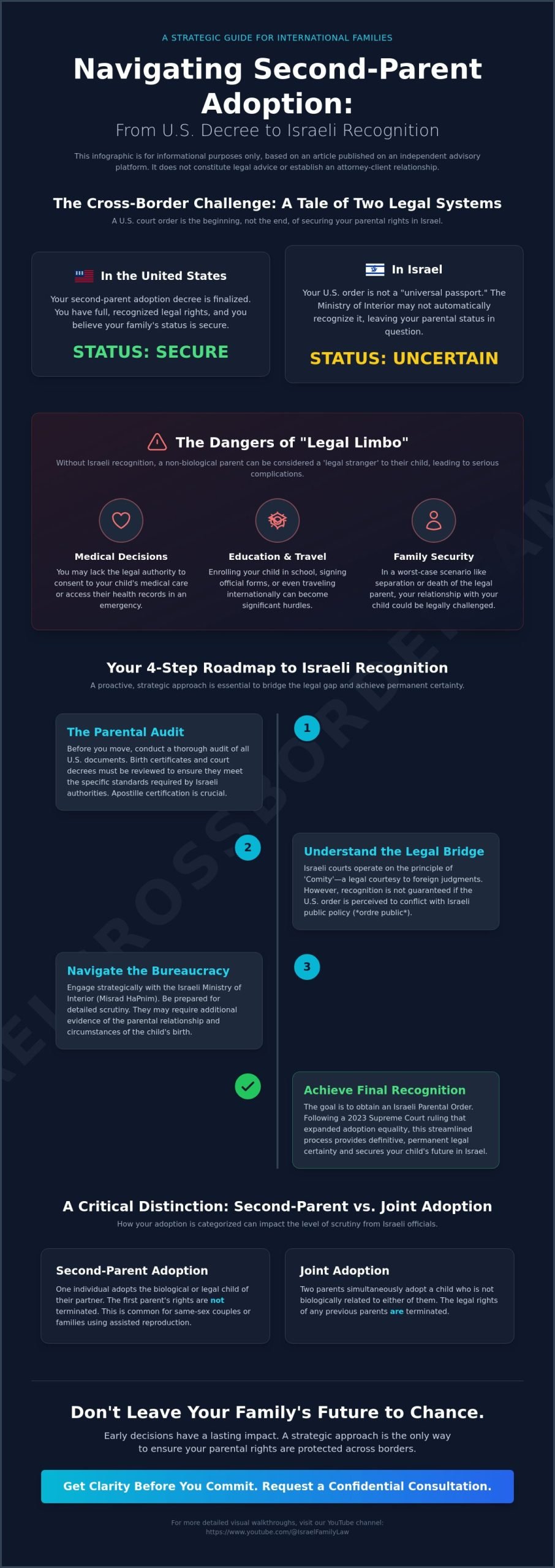
Navigating Complexity: How to Protect Your Parental Rights
Early strategic planning is the most effective tool to prevent a legal crisis. When you handle a second-parent adoption across borders, you’re managing two distinct legal cultures simultaneously. Generic legal advice often fails because it focuses only on the laws of one country. A local lawyer in a U.S. state might understand their own adoption statutes but may not know how the Israeli Ministry of Interior interprets those specific orders. This gap in knowledge can lead to rejected applications and months of unnecessary stress for your family.
Choosing a cross-border advisor is different from hiring a local litigator. While a local attorney handles specific court filings, an advisor looks at the entire transnational landscape. They act as a bridge between systems. This perspective ensures that your U.S. paperwork is prepared with Israeli requirements in mind from the very beginning. Protecting your parental rights isn’t just about winning a court case; it’s about building a legal foundation that travels with you across jurisdictions. Strategy based on risk management is the key to avoiding the ‘legal limbo’ that many families fear during relocation.
Risk Management for International Families
Identifying ‘red flags’ in your family structure early can save your residency status in IL. For instance, being unmarried or having inconsistent names on medical and school records can trigger additional scrutiny from Israeli population registry officials. These early decisions impact your ability to secure long-term residency and national insurance for your child. Understanding these risks before you board a plane is essential for a smooth transition. You can find more specific guidance in our resource For Expats and Foreign Nationals.
The Advisory Approach to Family Law
Strategy-based decision-making differs from traditional litigation because it focuses on risk avoidance rather than conflict. Instead of reacting to a crisis at the border, you build a roadmap that anticipates bureaucratic hurdles. This proactive method allows families to make informed choices that align with their long-term goals. You can learn more about How the Advisory Works to see if this approach fits your needs. Protecting your family through informed choices is the only way to ensure your child’s security. Get clarity before you commit. Request a confidential consultation.
This article is published on an independent advisory platform (not a law firm) and does not imply an attorney-client relationship. It is for informational and advisory purposes only; legal services are provided only by licensed attorneys under a separate engagement.
Securing Your Family’s Legal Future
A successful transition between the United States and Israel depends on more than just physical relocation. It requires a deep understanding of how two distinct legal systems view your parental rights. As we’ve discussed, a U.S. birth certificate is often insufficient for registration in IL without a properly authenticated court order and a proactive strategy. Managing a second-parent adoption across borders means preparing for the specific administrative hurdles of the Israeli Ministry of Interior before you leave your home country.
Our advisory platform provides a specialized focus on US-Israel family law to help you minimize legal risks. We focus on an advisory-led strategy that bridges the gap between jurisdictions, ensuring you avoid the ‘legal limbo’ that can jeopardize medical and educational authority. By making informed choices early, you can protect your child’s security and your own peace of mind. Get clarity before you commit. Request a confidential consultation to discuss your family’s unique roadmap. You don’t have to navigate these complexities alone.
This article is published on an independent advisory platform (not a law firm) and does not imply an attorney-client relationship. It is for informational and advisory purposes only; legal services are provided only by licensed attorneys under a separate engagement.
Frequently Asked Questions
Is a US second-parent adoption decree automatically valid in Israel?
No, a U.S. decree is not automatically valid in Israel. It serves as foundational evidence for either an administrative or judicial recognition process. You must present the authenticated decree to the Ministry of Interior to begin the registration of your parental rights. If the registry officials refuse the application, you may need to seek a declaratory judgment from an Israeli Family Court to confirm your legal status locally.
Can a non-biological parent travel to Israel with a child without the biological parent’s consent?
Traveling without the biological parent’s consent is legally risky and can lead to significant delays at the border. While a legal parent generally has travel rights, carrying a notarized consent letter and an authenticated adoption decree is standard practice for international families. This proactive step helps avoid complications related to international child abduction laws or detailed questioning from border officials regarding your parental authority.
What is an Apostille and why do I need it for my adoption papers?
An Apostille is a specialized certificate that authenticates a public official’s signature for use in another country. Under the Hague Convention, you need this for your adoption papers so the Israeli government can verify the U.S. court order is legitimate. Without an Apostille, Israeli clerks at the Ministry of Interior will not accept your U.S. documents for registration. It’s the essential link that makes your paperwork portable.
Does the Israeli Ministry of Interior recognize same-sex second-parent adoptions?
Yes, the Israeli Ministry of Interior recognizes same-sex second-parent adoptions following a December 2023 Supreme Court ruling. This landmark decision mandated that same-sex couples receive equal treatment throughout the adoption process. However, the administrative steps for a second-parent adoption across borders still require meticulous documentation to ensure the relationship is properly recorded in the population registry without bureaucratic delays or requests for additional evidence.
How long does it take for Israel to recognize a foreign adoption order?
The timeline for recognition varies significantly based on the specific path you take. An administrative registration at the Ministry of Interior typically takes several months as they verify your documents. If you must go through the Family Court for a Parental Order or a declaratory judgment, the process may extend longer. This depends on the court’s schedule and whether the Israeli Central Authority requires additional reports.
What happens if our second-parent adoption is not recognized in Israel?
If your adoption isn’t recognized, the non-biological parent remains a legal stranger to the child in IL. This status means you don’t have the authority to consent to medical procedures or enroll the child in the national healthcare system. It also creates significant risks regarding inheritance rights and the child’s long-term residency status. Families in this situation often face a stressful state of legal limbo.
Do I need to hire a lawyer in both the US and Israel?
It’s highly beneficial to work with practitioners who understand the nuances of both legal systems. A U.S. attorney ensures your adoption decree is finalized correctly under state law, while an Israeli advisor manages the strategy for local recognition. This collaborative approach helps prevent the document errors that frequently cause delays in second-parent adoption across borders cases and ensures your family remains protected in both jurisdictions.
Can we perform a second-parent adoption while living in Israel as expats?
Performing a second-parent adoption while living in Israel as expats is uncommon and complex. Adoption in IL by non-citizens is strictly regulated through the Israeli Central Agency for International Adoption and usually requires permanent residency. Most families find it more efficient to finalize their legal status in the U.S. before relocating. Alternatively, they may seek a Parental Order from an Israeli Family Court if they meet the specific eligibility criteria.
Get clarity before you commit. Request a confidential consultation.

Article by
Gabriel Lior
A Personal Journey That Became a Mission
The advisory was founded by an American father Gabriel Lior, LLB, MBA , global entrepreneur, and cross-border advisor who spent more than a decade navigating the Israeli family court system firsthand and now lives in Singapore with his son.
As a divorced parent in a cross-border family, Gabriel faced nearly every legal challenge a foreign parent can encounter in Israel — including child custody disputes, child support proceedings, property matters in Israel and abroad, false accusations, and complex immigration and relocation proceedings.
Over the years, he learned the hard way how difficult it is for non-Israeli parents to understand the system, identify the right legal strategy, and choose the right legal representation — especially when language, culture, and jurisdictional differences are involved. He also witnessed how foreign parents and new immigrants are often disadvantaged or taken advantage of by service providers and institutions simply because they lack local knowledge or fluency.
From Client to Advisor
To truly understand — and survive — the system, Gabriel pursued formal legal education in Israel, completing two Israeli law degrees, alongside a BA and MBA earned in the United States. This was never about becoming a practicing attorney, but about gaining a deep, structural understanding of how the system works — and where it breaks down for foreign parents.
This rare combination of:
Firsthand client experience
Israeli legal and US business education
International business and negotiation training
Decades of commercial execution
created a unique perspective – one that understands both sides of the table.
After years of litigation, persistence, and at times self-representation, he ultimately succeeded in securing custody of his son and relocating abroad through a rare legal victory in the Israeli Supreme Court — becoming one of the first fathers in Israel to do so under these circumstances.
Disclaimer
Important Disclaimer:
The information provided on this website and in its content is for general informational and educational purposes only and does not constitute legal advice, legal opinion, or legal representation.
Gabriel Lior is not licensed to practice law in Israel (nor is he interested in doing so) and does not provide legal services, despite having completed 2 Law Degrees. The services offered are advisory in nature and are intended to provide general guidance, strategic insight, and information regarding cross-border family law considerations.
No attorney-client relationship is formed by accessing this website, reading its content, or communicating with us.
Any decisions made based on this information are at your own discretion and risk. For legal advice specific to your situation, you should consult a licensed attorney in the relevant jurisdiction.
Where appropriate, we may refer clients to independent, licensed attorneys or professionals. Such referrals do not constitute legal representation and no liability is assumed for services provided by third parties.