This article is published on an independent advisory platform and does not constitute an attorney-client relationship or legal advice.
What if the person you hired to protect your family’s future is bound by two sets of conflicting rules that you don’t even know exist? When you’re managing a family matter between the United States and Israel, it’s natural to feel overwhelmed by the complexity of two different legal systems. You might worry about being exploited because you don’t know the local rules or feel anxious about whether your private information is truly safe across borders. Understanding the ethical duties of an international family lawyer is your most important shield in these situations.
You deserve to know that your representative is held to high standards of loyalty, competence, and transparency. This guide explains the professional standards and ethical protections you should expect when hiring a lawyer for US-Israel family matters. We’ll walk through the specific obligations your counsel must meet and provide a clear checklist to help you vet potential advisors. By the end, you’ll have the clarity needed to ensure your interests are protected by a steady, knowledgeable guide who understands the nuances of both jurisdictions.
Key Takeaways
- Learn why the ethical duties of an international family lawyer are more complex in US-Israel cases and how they protect you from jurisdictional confusion.
- Understand the difference between basic legal knowledge and true cross-border competence to avoid the risks of hiring a lawyer who only understands one side of the ocean.
- Discover how attorney-client privilege and privacy rules vary between the US and IL, ensuring your sensitive information remains protected during the disclosure process.
- Identify common conflicts of interest in family law, such as representing both parties in a “friendly” agreement, to ensure your counsel has undivided loyalty to your interests.
- Gain insight into why an ethical approach prioritizes long-term strategic stability and alternative dispute resolution over aggressive, short-term litigation wins.
What are the Ethical Duties of an International Family Lawyer?
The ethical duties of an international family lawyer represent a strict framework of professional and moral obligations designed to protect you. These rules ensure that when a professional handles cases across different legal systems, they remain focused on your family’s best interests. In US-Israel family matters, these duties become even more vital. You might be dealing with the US secular court system while simultaneously managing a case in the Israeli Rabbinical courts. This complexity requires a lawyer to act as more than just a legal technician; they must be a bridge between different cultures and legal philosophies.
To better understand these professional standards, watch this helpful video:
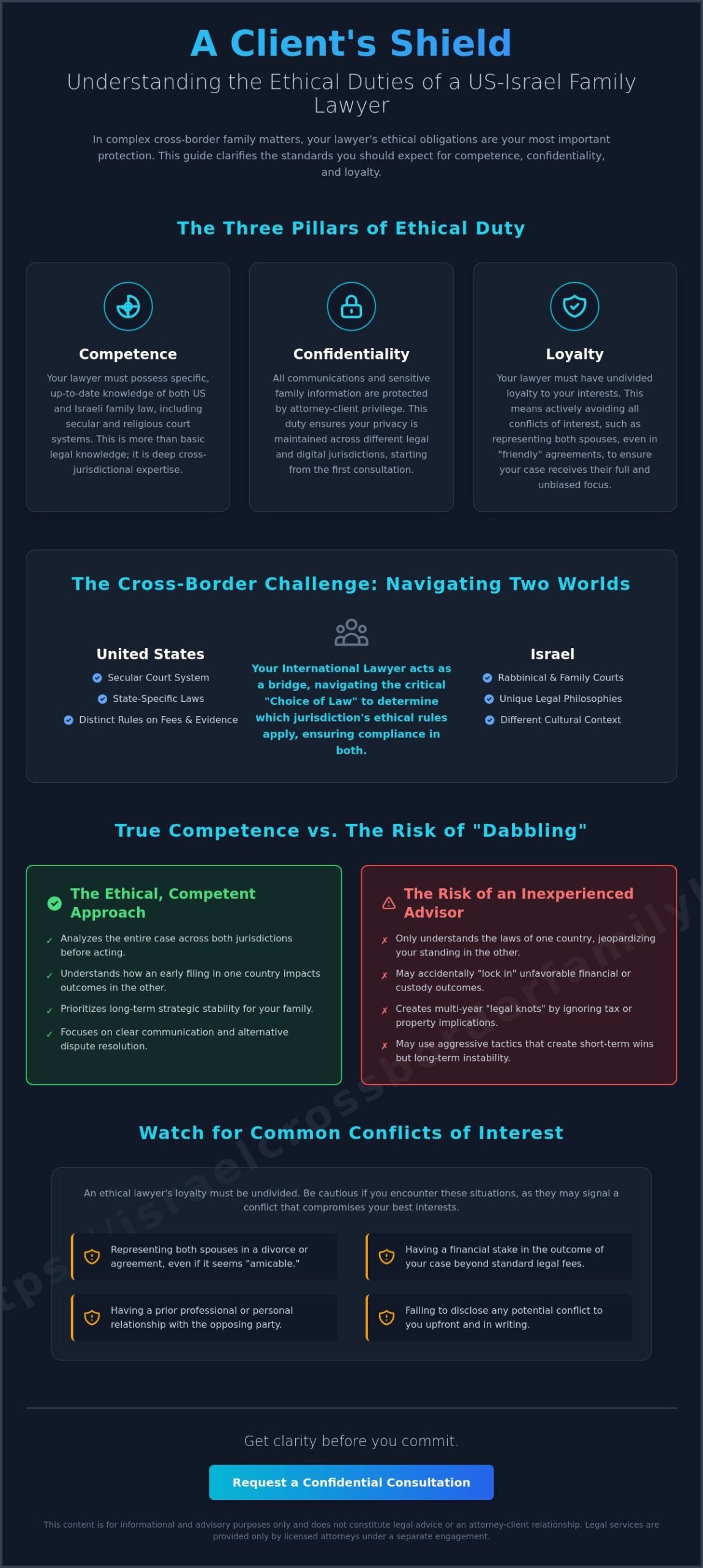
These obligations rest on three main pillars: competence, confidentiality, and loyalty. Competence requires the lawyer to possess the specific knowledge needed for cross-border litigation. Confidentiality ensures your private family details remain protected as they move between different digital and physical jurisdictions. Loyalty means the lawyer must avoid any Conflict of Interest that could divide their focus. It’s a common misconception that these duties only start after you sign a retainer. In reality, the ethical duties of an international family lawyer protect your information from the very first consultation, even before a formal relationship begins.
The Core Purpose of Legal Ethics
Ethics exist to protect the integrity of the legal process in both IL and the US. Without clear rules, the risk of exploitation increases in complex international cases. An ethical approach ensures you receive objective, strategy-driven advice rather than just aggressive tactics. This consistency maintains public trust in international legal institutions and helps families find predictable resolutions in an unpredictable environment. It’s about ensuring that every step taken is legally sound and morally defensible in both jurisdictions.
Which Rules Apply? The Challenge of Multiple Jurisdictions
Navigating two legal systems creates a unique challenge called “Choice of Law” in professional responsibility. If a lawyer is licensed in both New York and IL, they must carefully balance two different sets of ethical codes. For example, rules regarding how fees are handled or how evidence is shared can differ significantly between the US and Israel. You have the right to ask for proof of licensing and to verify their standing with the relevant Bar Association. This verification provides peace of mind that your representative is accountable to professional oversight bodies in both countries.
The Duty of Competence: Navigating Two Legal Systems
In the context of cross-border litigation, the duty of competence goes far beyond knowing the statutes of a single country. For a professional, competence is the intersection of legal knowledge and cross-cultural strategy. If your representative only understands the laws of one jurisdiction, they may inadvertently jeopardize your standing in the other. This “dabbling” in international law is a significant risk for families. A local lawyer might be excellent at domestic cases but lack the specific training required to manage the ethical duties of an international family lawyer across the US-Israel corridor.
Early decisions often carry the heaviest weight. A single filing in a US state court can “lock in” specific financial or custody outcomes that are difficult to reverse once the case moves to Israel. Conversely, starting a process in the Israeli Rabbinical courts without considering US tax or property implications can create a multi-year legal knot. An ethical professional will analyze the entire board before making the first move. They understand that a win in one court is meaningless if it leads to a total loss in another.
Knowledge of Substantive Law in the US and IL
Mastering substantive law requires a deep understanding of international treaties like the Hague Convention on the Civil Aspects of International Child Abduction. Courts in 2026 are using increasingly precise rules to determine a child’s “habitual residence,” making it vital for your lawyer to understand these evolving standards. There is also a constant “Race to the Court” dynamic between IL and US jurisdictions. Filing first in the most favorable venue can dictate which country’s laws will govern your future. You can learn more about these strategic choices in our guide on divorce and separation for international families.
Cultural Competence and Communication
Competence also includes the ethical duty to explain complex Israeli legal concepts in plain English. The Israeli legal landscape often operates with a different rhythm and style than the American system. While the “Anglo” approach might prioritize formal, written procedures, the Israeli system can be more fluid and assertive. If a lawyer fails to bridge this gap, it’s more than a linguistic error; it’s an ethical failure. You should feel confident that your advisor can translate the nuances of the local system into a strategy that makes sense to you. If you are unsure how these differences might affect your case, you can reach out for a strategy discussion to gain a clearer perspective.
Protecting Your Privacy: Confidentiality and Attorney-Client Privilege
Privacy is a primary concern for families managing assets or custody between the US and Israel. You should understand that the ethical duties of an international family lawyer involve two distinct concepts: the broad duty of confidentiality and the narrower rule of attorney-client privilege. Confidentiality is an ethical promise that your lawyer won’t reveal your secrets. Privilege is a legal protection that prevents the court from forcing that disclosure. When your case crosses borders, these rules can clash in unexpected ways.
A major challenge arises from the “discovery” process used in the United States. US courts often require parties to produce a vast amount of documentation, including emails and financial records. In contrast, Israel (IL) generally follows a more restrictive disclosure process. This creates a dangerous gap. Information you share with a professional in Israel might be subject to a discovery request in a US court, potentially leading to a “privilege waiver.” If you share sensitive data without a clear strategy, you might lose the legal right to keep that information private in both jurisdictions. Protecting your data requires a proactive approach to how evidence is gathered and shared.
Maintaining Privilege in Cross-Border Communications
Your legal team has an ethical obligation to guide you on how to communicate safely. Best practices often include using dedicated, secure channels rather than standard personal email. The “Work Product Doctrine” is a critical tool here. It protects documents prepared in anticipation of litigation, but its application can vary between US state courts and Israeli tribunals. If a US court orders the disclosure of files physically held in IL, your lawyer must understand the specific jurisdictional rules to challenge or limit that order effectively. Maintaining this shield is a continuous process throughout your case.
Digital Security and Data Protection
Modern international cases rely heavily on digital platforms for document sharing and case tracking. This digital shift in 2026 brings new risks. An ethical professional must take reasonable steps to protect your data against cyber threats. This includes understanding how the Israel Privacy Protection Authority rules or international standards like GDPR might apply to your sensitive family documents. Managing these technical risks is just as important as the legal strategy itself. You can find out more about how we prioritize these protections by reviewing how our advisory works.
Loyalty and Conflicts of Interest in Multi-Jurisdictional Cases
The duty of loyalty is perhaps the most personal of the ethical duties of an international family lawyer. It requires that your counsel maintains no divided allegiances, ensuring their strategy is focused solely on your objectives. In the multi-jurisdictional context of US-Israel cases, this duty is frequently tested by the interconnected nature of international legal circles. You must be certain that your advisor isn’t balancing your needs against the interests of another party or a past professional relationship. Loyalty is what allows you to share sensitive information with the confidence that it will only be used to advance your position.
A common conflict arises when couples attempt a “friendly” prenuptial agreement or a collaborative divorce settlement using a single lawyer. While this might seem cost-effective, it often violates basic ethical standards. A lawyer cannot effectively advocate for two people whose interests may eventually diverge. In the US, this is often strictly prohibited in family matters. In Israel (IL), it requires very specific disclosures that many families overlook. If you’re asked to share a lawyer with your spouse, it’s a clear signal to pause and seek independent advice to protect your future.
The “Small World” problem is a unique risk when dealing with the Israeli legal landscape. Because IL is a relatively small jurisdiction, lawyers often have ties to major families or businesses. An ethical professional will conduct a thorough conflict check before you share sensitive details. This check should look for any past or current representation of your spouse’s business partners or extended family members. If you’re concerned about potential overlaps in your social or professional circles, you should request a formal conflict-of-interest review before moving forward.
Identifying Potential Red Flags
You should be alert to specific situations that might compromise your lawyer’s independence. These red flags include:
- Undisclosed Referral Fees: If a lawyer refers you to a specialist in another country, they must disclose if they’re receiving a financial kickback for the recommendation.
- Corporate Ties: You should ask if the firm represents your spouse’s business or real estate holdings in unrelated matters.
- Informed Consent: If a minor conflict exists, the lawyer has an ethical requirement to explain the risks and obtain your written consent before proceeding.
The Ethics of Fee Arrangements
Transparency in billing is a fundamental ethical obligation. Hidden cross-border costs, such as unexpected translation surcharges or foreign filing fees, can quickly erode the trust between a family and their counsel. An ethical lawyer has a duty to provide regular, understandable billing statements that track how your resources are being used. This clarity is essential for maintaining a steady, professional relationship during a stressful time. You can learn more about our commitment to transparency and pricing to see how these standards are applied in practice.
This article is published on an independent advisory platform and does not constitute an attorney-client relationship or legal advice.
Strategy First: Choosing an Ethical Approach to Your Case
Choosing the right professional is about more than just legal skill; it’s about finding someone who respects the ethical duties of an international family lawyer. An ethical advisor won’t just chase short-term wins that might feel good today but cause long-term damage in another country. For example, winning an aggressive motion in a US court could unintentionally alienate an Israeli judge who values cooperation. A strategic approach prioritizes durable solutions over temporary victories, ensuring that the results you achieve are enforceable and respected across borders.
A core ethical duty involves advising you on alternative dispute resolution, such as mediation. In 2026, many legal systems are actively encouraging families to resolve disputes outside the courtroom to reduce emotional and financial acrimony. An ethical professional will honestly assess whether your case is better suited for a private settlement or formal litigation. They have a duty to help you avoid unnecessary conflict when a collaborative path can achieve your goals more efficiently. This focus on the “big picture” is what separates a steady guide from a reactive litigator.
Vetting a lawyer’s reputation is a critical step in your journey. You should verify that they are in good standing with both their US state bar and the Israel Bar Association. Ethical representation is the foundation of a successful cross-border outcome. Without it, even the most sophisticated legal plan can crumble under the weight of jurisdictional conflicts or procedural errors. Taking the time to ensure your counsel is committed to these professional standards provides the peace of mind you need to move forward.
Questions to Ask During Your Initial Consultation
Before you commit to a full representation agreement, you should ask several targeted questions to gauge a professional’s ethical preparedness. These include:
- In which jurisdictions are you currently licensed and in good standing?
- How do you handle the specific clash between US discovery rules and IL confidentiality standards?
- What is your internal process for identifying and disclosing potential conflicts of interest in the US-Israel legal community?
Seeking Clarity Before Commitment
The engagement letter is your most important tool for defining the scope of representation. It should clearly outline what the lawyer will and will not do, as well as how they will manage the complexities of your international case. Many families find value in seeking an independent advisory perspective before they hire a full litigation team. This allows you to build a strategy based on neutral, objective guidance. You can learn more about our international advisory and how we help families find clarity before they make major legal commitments.
Get clarity before you commit. Request a confidential consultation.
Protecting Your Interests in a Complex Legal Landscape
Managing a family matter between the United States and Israel requires more than just legal paperwork; it demands a strategy rooted in professional integrity. By understanding the ethical duties of an international family lawyer, you can better evaluate whether your counsel has the cross-cultural competence and undivided loyalty your case requires. You’ve learned how to identify potential conflicts and why protecting your privacy across borders is a technical as much as a legal challenge. These standards are your primary shield against the risks of multi-jurisdictional complexity.
Our independent advisory platform focuses on these specific strategy and friction points to provide authoritative guidance for international families. We help you navigate the systemic differences between the US and IL so you can make informed choices with confidence. Prioritizing an ethical approach today prevents costly procedural or strategic errors tomorrow, ensuring your family’s interests remain the top priority.
Get clarity before you commit. Request a confidential consultation or message us on WhatsApp. You don’t have to face these complexities alone; professional guidance is available to help you secure a stable path forward.
This article is published on an independent advisory platform and does not constitute an attorney-client relationship or legal advice.
Frequently Asked Questions
What should I do if I suspect my international lawyer has a conflict of interest?
You should address your concerns directly with your lawyer and ask for a formal, written clarification of their professional ties. If the explanation is unsatisfactory or if you still feel their loyalty is divided, you can seek an independent second opinion or contact the relevant Bar association in the US or Israel. Identifying a potential conflict early is vital to ensure your sensitive family information is not compromised by a professional with competing allegiances.
Can a lawyer licensed only in the US represent me in an Israeli court?
No, a lawyer licensed only in the US cannot represent you or appear before a judge in an Israeli court. To practice law in IL, a professional must be a member of the Israel Bar Association. While a US lawyer can act as a consultant or co-counsel to provide guidance on American legal issues, you must have a locally licensed attorney to handle the actual filings and hearings within the Israeli legal system.
Is my communication with an international lawyer always protected by privilege?
Privilege is not a guarantee and can be lost when information moves between different legal systems. For example, documents that are protected under Israeli law might be subject to mandatory disclosure during the broad “discovery” phase of a US court case. Understanding the ethical duties of an international family lawyer helps you recognize the risks of “privilege waiver” and the importance of using secure, professional communication channels at all times.
What is the difference between legal advice and the advisory services provided by your platform?
Legal advice consists of specific instructions and formal representation provided by a licensed attorney under a signed engagement agreement. Our advisory platform provides strategic education, risk analysis, and guidance to help you understand the Israeli legal landscape. We focus on helping you find clarity and vet the right legal team before you make major commitments, ensuring you approach your case with a well-defined strategy.
How do ethical duties change if my case involves the Hague Convention?
In cases involving the Hague Convention, the ethical duties of an international family lawyer include a strong focus on the best interests and welfare of the child. This principle is a cornerstone of modern international law and may require your lawyer to honestly explain the risks of certain litigation tactics. In 2026, courts are applying increasingly precise rules regarding “habitual residence,” making it essential for your counsel to prioritize compliance with these international standards over aggressive, short-term goals.
Are there different ethical standards for lawyers in Israel compared to the United States?
Yes, ethical standards and professional rules differ significantly between the two countries. US rules often emphasize a very broad discovery process where almost all relevant information must be shared, while Israeli rules typically involve more limited disclosure. Additionally, the rules governing fee structures and how conflicts are disclosed can vary, reflecting the unique cultural and systemic differences between the American and Israeli legal environments.
What happens if a lawyer violates their ethical duties in a cross-border case?
A lawyer who violates their ethical duties may face serious disciplinary actions from their respective Bar association, including fines, suspension, or permanent disbarment. Such violations can also have a direct impact on your case, potentially leading to the dismissal of your claims or the overturning of previous court orders. Ensuring your representative adheres to high professional standards is the best way to protect the long-term stability of your family’s legal outcomes.
Get clarity before you commit. Request a confidential consultation.

Article by
Gabriel Lior
A Personal Journey That Became a Mission
The advisory was founded by an American father Gabriel Lior, LLB, MBA , global entrepreneur, and cross-border advisor who spent more than a decade navigating the Israeli family court system firsthand and now lives in Singapore with his son.
As a divorced parent in a cross-border family, Gabriel faced nearly every legal challenge a foreign parent can encounter in Israel — including child custody disputes, child support proceedings, property matters in Israel and abroad, false accusations, and complex immigration and relocation proceedings.
Over the years, he learned the hard way how difficult it is for non-Israeli parents to understand the system, identify the right legal strategy, and choose the right legal representation — especially when language, culture, and jurisdictional differences are involved. He also witnessed how foreign parents and new immigrants are often disadvantaged or taken advantage of by service providers and institutions simply because they lack local knowledge or fluency.
From Client to Advisor
To truly understand — and survive — the system, Gabriel pursued formal legal education in Israel, completing two Israeli law degrees, alongside a BA and MBA earned in the United States. This was never about becoming a practicing attorney, but about gaining a deep, structural understanding of how the system works — and where it breaks down for foreign parents.
This rare combination of:
Firsthand client experience
Israeli legal and US business education
International business and negotiation training
Decades of commercial execution
created a unique perspective – one that understands both sides of the table.
After years of litigation, persistence, and at times self-representation, he ultimately succeeded in securing custody of his son and relocating abroad through a rare legal victory in the Israeli Supreme Court — becoming one of the first fathers in Israel to do so under these circumstances.
Disclaimer
Important Disclaimer:
The information provided on this website and in its content is for general informational and educational purposes only and does not constitute legal advice, legal opinion, or legal representation.
Gabriel Lior is not licensed to practice law in Israel (nor is he interested in doing so) and does not provide legal services, despite having completed 2 Law Degrees. The services offered are advisory in nature and are intended to provide general guidance, strategic insight, and information regarding cross-border family law considerations.
No attorney-client relationship is formed by accessing this website, reading its content, or communicating with us.
Any decisions made based on this information are at your own discretion and risk. For legal advice specific to your situation, you should consult a licensed attorney in the relevant jurisdiction.
Where appropriate, we may refer clients to independent, licensed attorneys or professionals. Such referrals do not constitute legal representation and no liability is assumed for services provided by third parties.