This article is published on an independent advisory platform and is not a law firm. The information provided is for educational purposes and does not create an attorney-client relationship.
Establishing legal parentage for children born via ART abroad is not simply a matter of filing paperwork; it’s a strategic alignment of two distinct and often conflicting legal systems. You likely feel the weight of ensuring your child is recognized as yours in both the United States and Israel, especially with the fear of them being left without legal status in one jurisdiction. The intersection of US federal law and Israeli regulations creates a complex environment where early decisions have long-term consequences for your family’s security.
This guide provides a clear roadmap to navigate the complexities of international surrogacy and assisted reproduction. You’ll learn how to secure a Consular Report of Birth Abroad (CRBA) and ensure your parental rights are protected across borders. We’ll examine the 2021 USCIS policy updates and the July 2025 Israeli entry regulations that require infants to be naturalized before travel. For more insights on these topics, you can view our resources at https://www.youtube.com/@IsraelFamilyLaw. Get clarity before you commit. Request a confidential consultation.
Key Takeaways
- Establishing legal parentage for children born via ART abroad requires a strategic approach to align the laws of the United States, Israel, and the birth country.
- A 2021 US policy update now recognizes married parents as legal parents for citizenship purposes, even without a genetic or gestational connection.
- You’ll need to coordinate between the Israeli Ministry of Interior and local courts to secure a Legal Parentage Order, known as a Tzav Horut.
- Strategic pre-conception planning is the most effective way to manage cross-border risks and ensure your child receives both a US passport and Israeli recognition.
This article is published on an independent advisory platform and is not a law firm. The information provided is for educational purposes and does not create an attorney-client relationship.
What is Legal Parentage for Children Born via ART Abroad?
Legal parentage is the formal recognition of a relationship between a child and their parents. While it seems straightforward, the use of Assisted Reproductive Technology (ART) across international borders introduces layers of complexity that standard birth registration systems aren’t built to handle. Traditional legal frameworks often rely on biological or gestational ties. When a child is born via surrogacy or egg/sperm donation, these traditional ties are intentionally separated. This creates a situation where the people intending to be the parents might not be automatically recognized as such by every government involved.
The core issue is that legal parentage for children born via ART abroad is not a universal concept. Different countries apply different standards. Some prioritize the genetic connection; others focus on the “intent” of the parents who initiated the medical process. This divergence can leave families in a legal grey area where they are parents in the country of birth but strangers to their child in their home country. Understanding these distinctions is the first step in ensuring your child’s future is secure.
Common ART Scenarios in Cross-Border Families
Families often encounter these hurdles through several common paths. International surrogacy is perhaps the most complex; it involves the laws of the country where the birth occurs, the citizenship laws of the parents, and the residency requirements of IL. Because international surrogacy laws vary so widely, a process that is legal in one jurisdiction might be unrecognized in another. Other families use IVF with donated gametes, which can challenge US citizenship transmission if the US citizen parent lacks a genetic link. Same-sex couples face additional hurdles, as IL and the US have historically different thresholds for recognizing non-biological parents.
Why a Birth Certificate is Often Insufficient
Many parents assume a birth certificate from the country of birth is final proof of parentage. This is a risky assumption. US consulates and the Israeli Ministry of Interior often look past the birth certificate to the underlying biological or legal facts. A foreign birth certificate might list both parents, but if that listing contradicts the laws of the US or IL, it may be rejected for citizenship or residency purposes. This leads to “limping parentage,” where a child is legally tied to a parent in one country but has no legal relationship to them in another. This status can affect everything from inheritance to medical decision-making. You can learn more about how we support expats and foreign nationals on our platform. Get clarity before you commit. Request a confidential consultation.
This article is published on an independent advisory platform and is not a law firm. The information provided is for educational purposes and does not create an attorney-client relationship.
US Citizenship Transmission: The 2021 Policy Shift
The 2021 USCIS policy update significantly changed how the US government evaluates legal parentage for children born via ART abroad. Previously, the Department of State focused heavily on a direct genetic link between the US citizen parent and the child to transmit citizenship at birth. Under the current rules, children born abroad through ART are considered born “in wedlock” for citizenship purposes if the parents are married to each other at the time of birth. This applies even if the US citizen parent doesn’t share a genetic connection with the child, provided at least one parent has a biological or gestational link.
This policy shift provides a more inclusive framework for international families. However, the US Department of State still maintains rigorous standards for verifying these relationships. They don’t simply accept a foreign birth certificate as proof of citizenship. Instead, they examine the legal and medical context of the ART arrangement. While Israeli surrogacy laws emphasize a specific regulatory path within IL, the US focuses on the requirements of the Immigration and Nationality Act. These differing legal priorities make early strategy essential for families living between both systems.
The Consular Report of Birth Abroad (CRBA) Process
The primary method for securing a child’s US citizenship is the Consular Report of Birth Abroad. The application fee for this document is $100. Families must submit extensive evidence, including medical records from the ART clinic and the original surrogacy or donation contracts. Most applications are now processed through the eCRBA online portal before an in-person interview is scheduled at the US Embassy in Jerusalem or the Branch Office in Tel Aviv. During this interview, consular officers verify the physical presence of the US parent and may request DNA testing if the evidence of a biological link is insufficient.
Transmission Requirements for Married vs. Unmarried Parents
Citizenship transmission is subject to specific residency rules. For married couples, the US citizen parent must usually show they were physically present in the US for at least five years before the child’s birth. Two of these years must have occurred after the age of 14. If the parents are not married, the legal requirements for transmitting citizenship are often more stringent. This includes specific requirements for the US parent to acknowledge the child and provide financial support. Understanding these nuances early helps avoid delays in securing your child’s passport. You should review these requirements with an advisor to ensure your documentation is complete. Get clarity before you commit. Request a confidential consultation.
This article is published on an independent advisory platform and is not a law firm. The information provided is for educational purposes and does not create an attorney-client relationship.
The Conflict of Laws: Navigating US and Israeli Requirements
Navigating the legal landscape becomes particularly difficult when US and Israeli requirements clash. The core of the issue is that Israel doesn’t always recognize foreign birth certificates or court orders as final proof of parentage. While the US has moved toward an intent-based model, IL remains deeply rooted in a biological and judicial model. Securing legal parentage for children born via ART abroad requires understanding that a document issued in New York or London may carry little weight with the Israeli Ministry of Interior (Misrad Hapnim) without additional steps.
In Israel, the primary mechanism for establishing parentage in ART cases is the Legal Parentage Order, known as a Tzav Horut. This is a judicial decree issued by an Israeli family court. It’s essential for the child’s registration and for granting them full legal rights in Israel. Even if you hold a US court order declaring you the legal parent, it won’t be automatically recognized. This is often due to the principle of “Takant HaTzibur,” or public policy. This legal exception allows Israeli authorities to reject foreign rulings that they believe conflict with local legal standards or ethical regulations. This creates a significant gap for families who assume their US paperwork is sufficient for their life in IL.
Surrogacy Abroad: The Israeli Perspective
For Israeli parents using surrogacy in a foreign country, the genetic link is a non-negotiable requirement. At least one intended parent must have a genetic connection to the child to initiate the recognition process in IL. A significant regulation reported in July 2025 requires that these infants be naturalized in their country of birth and obtain an Israeli passport before they can even enter Israel. This means you cannot simply bring the child home on a foreign passport and settle the legalities later. The process involves coordinating DNA testing, court petitions, and consular appointments before the child ever steps foot in the country.
Recognition of Same-Sex Parentage Across Borders
While a 2022 High Court of Justice ruling expanded access to surrogacy within Israel for same-sex couples and single fathers, cross-border ART still presents unique hurdles. The US and IL treat non-biological parents differently. In the US, your marriage might be enough to secure parentage, but in IL, the non-biological parent often needs a Tzav Horut or a second-parent adoption to be recognized. This discrepancy can lead to situations where a parent has full rights in the US but no legal standing to make medical or educational decisions for their child in Israel. You can learn more about how these dynamics work on our how it works page. Get clarity before you commit. Request a confidential consultation.
This article is published on an independent advisory platform and is not a law firm. The information provided is for educational purposes and does not create an attorney-client relationship.
Practical Steps for Securing Your Child’s Legal Status
Success in establishing legal parentage for children born via ART abroad depends on identifying your child’s legal “home” before the birth occurs. This decision dictates which court orders you need and which consulate you must prioritize. Coordinating between a clinic in a third country and the authorities in the US and IL is a multi-step process that leaves little room for error. You must ensure that every party is working from the same legal strategy to avoid conflicting documents that could stall your child’s recognition.
Timing is often the most critical factor. Many applications, especially those involving DNA verification or court petitions, should be initiated immediately after birth. Delays can lead to a “travel gap,” where the child is medically ready to leave the birth country but lacks the necessary travel documents. As previously discussed, the July 2025 Israeli regulations require naturalization before entry, making the window for paperwork even tighter. Managing this gap requires a clear timeline of when to file for the US citizenship documents and when to petition the Israeli Family Court.
Documentation and Evidence Checklist
Gathering the right evidence is a logistical task that starts months before the due date. You will need authenticated medical records from the ART clinic detailing the procedures performed. Surrogacy or gamete donation contracts must be drafted to meet the specific standards of both the US and IL. Most foreign documents will require an Apostille, a specialized certificate that allows a document from one country to be recognized in another. Without this, your birth certificates or clinic letters may be rejected by the US Embassy or the Israeli Ministry of Interior (Misrad Hapnim).
Working with Local and International Authorities
You will likely need to engage with several different government bodies simultaneously. In IL, this often means involving the Family Court to obtain a parentage order, which is a necessary step for local registration. Simultaneously, you must communicate with the US Department of State to process the citizenship claim. Understanding how these agencies interact is vital for families who plan to live between two cultures. To better understand how these decisions impact your family’s mobility, learn more about international custody and relocation. If you are beginning this journey, you should reach out for a strategy session to map out your specific timeline. Get clarity before you commit. Request a confidential consultation.
This article is published on an independent advisory platform and is not a law firm. The information provided is for educational purposes and does not create an attorney-client relationship.
Strategic Planning for International ART Families
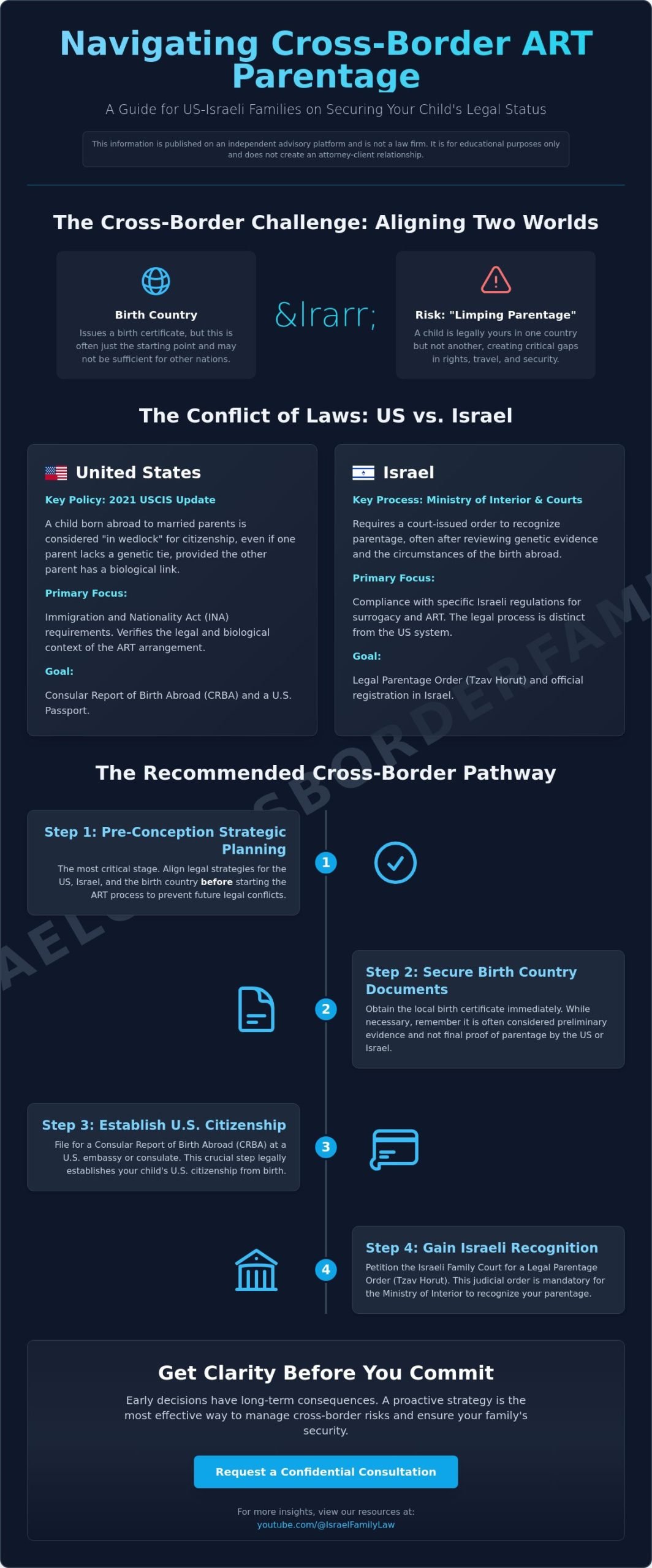
Strategic planning is the foundation of a successful cross-border family journey. For many, the medical process begins long before the legal implications are fully considered. However, pre-conception legal consultation is a risk-management necessity. Once a pregnancy begins, your legal options narrow significantly. Decisions made in the early stages of choosing a clinic or a surrogate impact the eventual recognition of legal parentage for children born via ART abroad. These choices also dictate the ease with which your child will acquire US citizenship and Israeli residency.
Evaluating the legal friendliness of different ART destinations is a vital part of this strategy. While the United States offers a robust and intent-based legal framework, other popular hubs like Georgia or Greece operate under very different statutory requirements. A destination that seems affordable or medically advanced might present significant hurdles when you attempt to register the birth with the Israeli Ministry of Interior (Misrad Hapnim). Early decisions also have a lasting impact on long-term rights, including inheritance and financial support. If the parental link is not established correctly at the outset, it can lead to complications in estate planning or the enforcement of parental obligations under Israeli law. Understanding how our advisory works for international families can help you align these moving parts before you make a financial or emotional commitment.
Assessing Risks and Avoiding Litigation
The goal of strategic planning is to identify potential parentage voids before they occur. A parentage void happens when neither the birth country nor the home countries of the parents immediately recognize the intended parents as the legal guardians. This often leads to expensive and stressful litigation in the Israeli Family Court. Families must also budget for legal costs across multiple jurisdictions. This includes the costs of local counsel in the birth country, US consular fees, and the judicial process in IL. Understanding pricing for cross-border advisory allows families to factor these essential protections into their overall ART budget.
The Role of Specialized Cross-Border Advisory
Relying solely on local counsel in the birth country is a common mistake. A lawyer in Greece or Georgia may understand their local statutes but will likely be unfamiliar with the specific requirements of the US Department of State or the Israeli “Tzav Horut” process. Specialized advisory serves as a bridge. It integrates family law strategy with your broader citizenship and immigration goals. This holistic view ensures that your medical path does not conflict with your legal reality. Seek clarity before you commit to an ART path abroad. Get clarity before you commit. Request a confidential consultation.
This article is published on an independent advisory platform and is not a law firm. The information provided is for educational purposes and does not create an attorney-client relationship.
Securing Your Family’s Legal Future
Successfully establishing legal parentage for children born via ART abroad requires more than just following a checklist. It demands a sophisticated understanding of how US citizenship transmission and Israeli judicial orders interact. By aligning your medical path with a clear legal strategy, you can avoid the risks of unrecognized parental rights. We’ve explored the importance of the 2021 US policy shift and the necessity of obtaining an Israeli Legal Parentage Order to ensure your child’s status is secure in both nations.
Our advisory provides international expats with authoritative expertise in US-Israel family law. We focus on strategic risk management to help you navigate these multi-jurisdictional challenges. It’s vital to address these legal requirements early to prevent future complications with residency or inheritance. Get clarity before you commit. Request a confidential consultation to discuss your family’s specific needs. Taking the right steps today ensures a stable and legally recognized future for your child.
This article is published on an independent advisory platform and is not a law firm. The information provided is for educational purposes and does not create an attorney-client relationship.
Frequently Asked Questions
Is my child a US citizen if born via ART abroad to at least one US parent?
A child born abroad via ART is a US citizen if at least one parent has a genetic or gestational tie and the parents were married at the time of birth. Since the 2021 policy update, this includes children who don’t share DNA with the US citizen parent, provided they’re born in wedlock. The US parent must also meet specific physical presence requirements in the United States to transmit citizenship successfully.
Will Israel recognize both parents on a US birth certificate for a surrogacy birth?
No, Israel does not automatically recognize both parents listed on a foreign birth certificate for surrogacy births. The Ministry of Interior (Misrad Hapnim) requires a judicial process in an Israeli family court. You’ll likely need a Legal Parentage Order to establish legal parentage for children born via ART abroad within the Israeli system. This is a separate requirement from US citizenship registration.
Do we need a DNA test to get a US passport for our ART-born child?
You might need a DNA test if the documentary evidence doesn’t clearly establish a biological link between the child and a US citizen parent. Consular officers at the US Embassy in Jerusalem or Tel Aviv have the discretion to request DNA testing during the CRBA interview. It’s often requested in surrogacy cases to confirm the genetic connection required under the Immigration and Nationality Act.
What happens if only one parent is a US citizen and the child is born via ART?
If only one parent is a US citizen, that parent must demonstrate they were physically present in the US for at least five years before the birth. Two of those years must have been after the age of 14. This requirement ensures the parent has a sufficient connection to the US to pass citizenship to a child born in a foreign jurisdiction.
Can a non-biological parent be registered as a parent in Israel for a child born abroad?
Yes, a non-biological parent can be registered in Israel, but it requires a specific judicial decree. This process usually involves obtaining a Legal Parentage Order (Tzav Horut) from an Israeli court. The court evaluates the intent of the parents and the legality of the ART process. It’s a critical step for families where only one parent shares a genetic link with the child.
What is the difference between a Legal Parentage Order and a second-parent adoption?
A Legal Parentage Order recognizes a parent’s rights as existing from the moment of birth, whereas an adoption creates a new legal relationship after the fact. For families navigating legal parentage for children born via ART abroad, a Parentage Order is often preferred because it’s more streamlined and avoids the waiting periods associated with traditional adoption. It’s the standard path for recognizing non-biological parents in IL.
How long does it take to get a CRBA for a child born via surrogacy abroad?
The timeline for a Consular Report of Birth Abroad (CRBA) typically ranges from a few weeks to several months. This depends on the specific US consulate’s workload and the complexity of your documentation. Using the eCRBA online system can help speed up the process, but you should still account for potential delays if the consulate requests additional medical records or DNA verification.
What are the risks of using an ART clinic in a country that doesn’t regulate parentage?
The primary risk is a parentage void, where neither the birth country nor your home country recognizes you as the legal parents. This can leave a child stateless or without legal guardians in certain jurisdictions. It also complicates the child’s ability to travel or access healthcare. Choosing a country with a clear legal framework for ART is a vital part of risk management.

Article by
Gabriel Lior
A Personal Journey That Became a Mission
The advisory was founded by an American father Gabriel Lior, LLB, MBA , global entrepreneur, and cross-border advisor who spent more than a decade navigating the Israeli family court system firsthand and now lives in Singapore with his son.
As a divorced parent in a cross-border family, Gabriel faced nearly every legal challenge a foreign parent can encounter in Israel — including child custody disputes, child support proceedings, property matters in Israel and abroad, false accusations, and complex immigration and relocation proceedings.
Over the years, he learned the hard way how difficult it is for non-Israeli parents to understand the system, identify the right legal strategy, and choose the right legal representation — especially when language, culture, and jurisdictional differences are involved. He also witnessed how foreign parents and new immigrants are often disadvantaged or taken advantage of by service providers and institutions simply because they lack local knowledge or fluency.
From Client to Advisor
To truly understand — and survive — the system, Gabriel pursued formal legal education in Israel, completing two Israeli law degrees, alongside a BA and MBA earned in the United States. This was never about becoming a practicing attorney, but about gaining a deep, structural understanding of how the system works — and where it breaks down for foreign parents.
This rare combination of:
Firsthand client experience
Israeli legal and US business education
International business and negotiation training
Decades of commercial execution
created a unique perspective – one that understands both sides of the table.
After years of litigation, persistence, and at times self-representation, he ultimately succeeded in securing custody of his son and relocating abroad through a rare legal victory in the Israeli Supreme Court — becoming one of the first fathers in Israel to do so under these circumstances.
Disclaimer
Important Disclaimer:
The information provided on this website and in its content is for general informational and educational purposes only and does not constitute legal advice, legal opinion, or legal representation.
Gabriel Lior is not licensed to practice law in Israel (nor is he interested in doing so) and does not provide legal services, despite having completed 2 Law Degrees. The services offered are advisory in nature and are intended to provide general guidance, strategic insight, and information regarding cross-border family law considerations.
No attorney-client relationship is formed by accessing this website, reading its content, or communicating with us.
Any decisions made based on this information are at your own discretion and risk. For legal advice specific to your situation, you should consult a licensed attorney in the relevant jurisdiction.
Where appropriate, we may refer clients to independent, licensed attorneys or professionals. Such referrals do not constitute legal representation and no liability is assumed for services provided by third parties.